
Why Your Current Agency Is Burning $10K/Month on “Plane Spotters” — and How to Fix It
Your private aviation ads may be reaching exactly the audience the platform thinks you want.
Unfortunately, that audience may be completely wrong for your business.
Private jets generate enormous attention. Aviation enthusiasts watch aircraft videos, follow manufacturers, research tail numbers, photograph arrivals, compare cabins, track celebrity jets, read airport news, and interact with aviation content every day. Consequently, advertising platforms can find an almost endless supply of people who appear deeply interested in private aviation.
However, interest is not the same thing as purchase intent.
A person who watches every Gulfstream G700 video may never charter an aircraft. Meanwhile, a principal who spends six figures annually on private travel may rarely interact with obvious “private jet” content at all.
Therefore, private aviation marketers face an unusual targeting problem: the industry attracts a massive enthusiast audience surrounding an extremely small commercial buyer audience.
If your advertising system cannot distinguish those groups, more optimization can actually make the problem worse.
Why Do Private Aviation Ads Attract So Many Unqualified Prospects?
Direct Answer: Private aviation advertising can attract large numbers of aviation enthusiasts because common interest and engagement signals identify people who consume aviation content, not necessarily people with the financial capacity, authority, timing, or intent to purchase private aviation services. Therefore, charter marketers should combine platform targeting with exclusions, qualification signals, first-party data, CRM outcomes, and revenue attribution instead of treating aviation interest as proof of buyer quality.
In other words, the problem is not necessarily that your agency cannot generate clicks.
The problem may be that it is generating the wrong clicks very efficiently.
What Private Aviation Operators Need to Know
- Private aviation interest is not the same as private aviation buying power.
- Therefore, low-cost engagement can be a misleading performance signal.
- Plane spotters, aviation students, pilots, job seekers, enthusiasts, and aspirational followers can all interact heavily with private jet advertising.
- Meanwhile, genuine charter buyers may reveal intent through routes, airports, trip requirements, timing, privacy concerns, and other commercially meaningful behaviors.
- Exclusion audiences can help reduce known sources of poor-quality traffic; however, exclusions alone cannot prove wealth or buyer status.
- Consequently, qualification should continue after the click through forms, landing pages, CRM scoring, call handling, and sales outcomes.
- Ultimately, cost per lead should be evaluated alongside cost per qualified opportunity, booking rate, customer acquisition cost, and revenue.
What Is the “Plane Spotter” Problem in Private Aviation Marketing?
The key point: Private aviation has an unusually large audience of people who love the product but may have little or no commercial intent to purchase it.
That is not an insult to aviation enthusiasts. In fact, enthusiasts are an important part of aviation culture. They create communities, photograph aircraft, follow manufacturers, discuss airports, track fleets, and generate tremendous engagement around the industry.
However, an audience can be valuable to aviation culture while simultaneously being the wrong audience for a charter acquisition campaign.
Consider two people.
The first follows Gulfstream, Bombardier, Dassault, Boeing Business Jets, dozens of aviation photographers, aircraft-tracking accounts, and several private jet pages. Moreover, this person watches cabin tours, identifies aircraft by tail number, comments on aviation videos, and clicks private jet advertisements.
From an advertising-data perspective, that person looks extraordinarily interested in private aviation.
Nevertheless, the individual may have absolutely no intention or financial ability to charter an aircraft.
Now consider a second person.
This individual owns several businesses, travels between operating locations, occasionally uses private aviation, has an executive assistant coordinate transportation, and values time compression more than luxury imagery. However, this person does not spend evenings liking pictures of Gulfstreams.
Which person looks more like a private aviation enthusiast?
The first.
Which person could be worth more to a charter operator?
Potentially the second.
Therefore, the central targeting challenge becomes obvious: digital enthusiasm and economic intent are different variables.
Why Does Standard Interest Targeting Break Down in Private Aviation?
The key point: Interest-based targeting can help define an audience, but aviation interests alone are weak evidence that someone is a qualified charter buyer.
Many generalist advertising strategies begin with an intuitive assumption. If a company sells private aviation, then target people interested in private jets, luxury travel, aircraft manufacturers, business aviation, luxury goods, or adjacent interests.
At first glance, that sounds logical.
However, the logic contains a major gap.
Advertising interests generally describe some form of inferred affinity or behavior. They do not automatically tell a charter company who controls a meaningful travel budget, who needs a flight, who is authorized to make the purchase, or who can economically justify private aviation.
Moreover, “luxury” interests can create the same problem.
Millions of consumers enjoy exotic cars, luxury watches, yachts, mansions, resorts, and private aircraft without owning or purchasing any of them.
Therefore, adding more luxury interests does not necessarily solve the qualification problem.
Instead, private aviation marketers need to separate three concepts:
- Affinity: Does this person like aviation or luxury content?
- Intent: Is there evidence this person may be solving a private travel problem?
- Qualification: Does this person have the authority, economics, timing, and trip requirements necessary to become a viable customer?
Those concepts can overlap. Nevertheless, they are not interchangeable.
Is the Algorithm Actually Finding the Wrong People?
The key point: Advertising systems optimize toward the objectives and conversion signals marketers provide; therefore, a weak conversion definition can reward the wrong behavior.
This distinction is critical.
The algorithm is not sitting inside your advertising account asking, “Which person has enough liquidity to charter a Gulfstream?”
Instead, the system is trying to achieve the optimization objective configured by the advertiser using the signals available to it.
If the primary success event is a click, then clicks matter heavily.
If the primary success event is a basic lead form, then form completions become valuable signals.
However, if an unqualified prospect and a serious charter buyer trigger the same conversion event, the advertising system may initially receive little information about the enormous economic difference between those outcomes.
Therefore, the marketer has to improve the signal.
The algorithm does not inherently know which lead is valuable to your charter operation. It learns from the objectives, events, data, and outcomes available to it.
Consequently, private aviation marketers should think beyond lead generation and toward signal engineering.
How Can Cheap Leads Train a Campaign in the Wrong Direction?
The key point: When low-quality prospects repeatedly generate the conversion event being optimized, campaign performance can look efficient even though business performance remains poor.
Imagine an agency launches a campaign and produces 100 leads.
Seventy-five are curiosity inquiries, job seekers, unrealistic price shoppers, enthusiasts, or prospects whose trips are commercially unsuitable. Meanwhile, 20 require additional qualification, four become legitimate opportunities, and one eventually books.
The dashboard may still celebrate the 100 leads.
However, the charter company’s sales team experiences a completely different reality.
Sales representatives spend time calling people who cannot buy. Additionally, response times for legitimate opportunities may suffer because weak inquiries consume attention. Eventually, the sales team begins distrusting marketing leads altogether.
Meanwhile, the advertising report may show an attractive cost per lead.
This creates a dangerous feedback loop:
- The campaign generates inexpensive form submissions.
- Those submissions are counted as successful conversions.
- The agency reports a falling cost per lead.
- More budget is allocated toward the apparent winner.
- The campaign continues attracting similar conversion behavior.
- The sales team receives increasing volumes of weak inquiries.
- Marketing celebrates while sales becomes frustrated.
Therefore, a falling cost per lead can sometimes hide a deteriorating lead mix.
The solution is not simply to demand more leads.
Instead, the company needs to distinguish a lead from a qualified private aviation opportunity.
Can Facebook or Meta Simply Target Wealthy Private Jet Buyers?
The key point: Marketers should not assume an advertising platform provides a perfect “high-net-worth charter buyer” switch; instead, qualification should be built from compliant platform tools, first-party data, intent, funnel design, and actual business outcomes.
Wealth is complicated. Furthermore, having substantial wealth does not automatically make someone a private aviation buyer.
A high-net-worth individual who rarely travels may be less valuable to a charter operator than a business owner with frequent time-sensitive regional trips. Likewise, an executive assistant may influence substantial aviation spending despite not being the principal whose wealth ultimately funds the travel.
Therefore, the objective should not simply be “find rich people.”
Instead, the objective should be:
Find qualified people connected to private aviation purchasing decisions at the right point in their travel journey.
That group can include principals. However, depending on the charter model, it may also include executive assistants, chiefs of staff, family-office personnel, travel coordinators, corporate aviation decision-makers, and other authorized buyers.
Consequently, a sophisticated strategy focuses on commercial relevance rather than a simplistic wealth label.
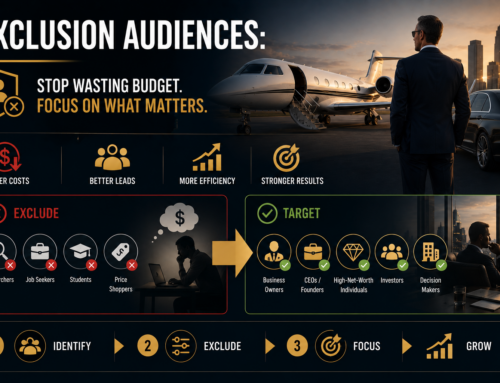
How Should Exclusion Audiences Be Used in Private Aviation?
The key point: Exclusion audiences should remove known sources of irrelevant or already-resolved traffic where platform capabilities and privacy rules permit, while qualification systems determine who deserves sales attention.
Exclusions are powerful because most targeting discussions focus only on who should be included.
However, in private aviation, determining who should not consume acquisition budget can be equally valuable.
Suppose CRM analysis reveals that a particular lead source repeatedly generates noncommercial inquiries. In that case, the company can investigate whether campaign structure, placements, creative, geography, landing-page messaging, or available audience exclusions can reduce that traffic.
Likewise, existing customers may need different campaigns than new prospects. Employees should not consume prospecting budgets. Moreover, people who already completed a particular funnel action may belong in a different sequence.
Therefore, exclusions should become part of a larger audience architecture rather than a single magic filter.
Which Audiences Should Private Aviation Marketers Evaluate for Exclusion?
The key point: Exclusions should be based on actual campaign data and available platform controls rather than stereotypes about individual users.
Depending on the campaign, available tools, privacy requirements, and historical data, marketers may evaluate ways to reduce exposure to audiences associated with:
- existing employees
- known vendors
- already-converted customers when acquisition is the objective
- duplicate leads
- known spam submissions
- irrelevant geographic markets
- commercially unsuitable trip requests
- job-seeking traffic
- educational or career intent when unrelated to the offer
- repeated low-quality lead sources identified through CRM analysis
However, marketers should be careful with the phrase “exclude plane spotters.”
There is rarely a perfect universal audience labeled “people who like airplanes but will never charter.” Therefore, the real system requires several layers working together.
Creative can discourage curiosity clicks. Landing pages can establish expectations. Forms can collect commercially relevant information. CRM systems can classify outcomes. Meanwhile, campaign data can reveal where poor-quality traffic originates.
Consequently, the best exclusion strategy is evidence-driven rather than assumption-driven.
Which Signals Can Be More Valuable Than Generic Private Jet Interest?
The key point: Commercially relevant travel context can reveal more about a potential charter opportunity than broad enthusiasm for private aircraft.
Consider what a real charter buyer needs to solve.
They need to travel between places. They have a date or window. They have passengers. They may have baggage, pets, privacy requirements, ground transportation, schedule constraints, or aircraft preferences.
Therefore, strong private aviation marketing should surround the actual mission.
High-Intent Content and Funnel Context Can Include
- specific departure and arrival airports
- private aviation options near a destination
- route-pair research
- aircraft range and mission fit
- passenger capacity
- baggage requirements
- pet travel requirements
- FBO information
- international flight considerations
- privacy and security questions
- charter versus membership decisions
- charter versus aircraft ownership
- one-way and empty-leg availability
- same-day or time-sensitive travel
Importantly, not every one of these behaviors is available as a direct advertising-platform targeting option.
Instead, companies can build owned search content and landing experiences around these needs. Then, where consent and platform rules permit, first-party interactions can inform segmentation, retargeting, and measurement.
Therefore, SEO, GEO, paid media, and CRM strategy should work together rather than operate as separate departments.
How Should Private Aviation Leads Be Qualified?
The key point: Qualification should collect enough information to determine whether an inquiry represents a viable mission without creating unnecessary friction for legitimate buyers.
A form that asks only for a name, email, and phone number maximizes simplicity. However, it tells the charter company almost nothing about the opportunity.
On the other hand, a 25-field application may discourage legitimate buyers.
Therefore, qualification needs balance.
Useful Charter Qualification Fields Can Include
- departure location or airport
- destination
- travel date
- return date when applicable
- number of passengers
- one-way or round-trip requirement
- preferred contact method
- flexibility around schedule
- special baggage or pet requirements
- aircraft preference when relevant
Additionally, the landing page itself can prequalify prospects.
For example, messaging can clearly explain the service model, geographic coverage, aircraft category, membership structure, or trip requirements. Consequently, unsuitable prospects can self-select out before consuming sales time.
That is valuable.
After all, the goal is not to make the form submission number as large as possible.
The goal is to create more commercially viable conversations.
What Does a Principal-Focused Private Aviation Funnel Look Like?
The key point: A high-value private aviation funnel should move from relevant demand to mission qualification, CRM classification, rapid sales response, and revenue attribution.
| Stage | Purpose | Example Signal |
|---|---|---|
| Demand | Reach relevant prospective buyers | Search, content engagement, paid acquisition |
| Intent | Identify the travel problem | Route, airport, aircraft, trip or membership research |
| Qualification | Determine commercial viability | Dates, passengers, route and requirements |
| CRM Classification | Separate inquiry quality | Qualified, unqualified, duplicate, spam, future opportunity |
| Sales Routing | Respond appropriately | Priority assignment and rapid contact |
| Opportunity | Track real pipeline | Quote or active charter conversation |
| Booking | Measure customer acquisition | Completed transaction |
| Feedback | Improve future acquisition | Revenue and qualification data returned to marketing analysis |
This architecture changes the definition of marketing success.
Instead of asking, “How many leads did Facebook generate?” the company can ask, “How many qualified charter opportunities originated from this campaign, what did they cost, and how much revenue did they produce?”
That is a much more useful business question.
Why Must the CRM Be Connected to Private Aviation Advertising?
The key point: Without downstream CRM outcomes, marketers can optimize toward front-end conversions while remaining blind to which campaigns actually create qualified pipeline and bookings.
Imagine Campaign A generates 80 leads for $100 each.
Meanwhile, Campaign B generates 20 leads for $250 each.
At first glance, Campaign A appears dramatically better.
However, suppose only two Campaign A leads become qualified opportunities, while eight Campaign B leads become qualified opportunities.
Suddenly, the economics change.
Campaign A spent $8,000 to generate two qualified opportunities, or $4,000 per qualified opportunity.
Campaign B spent $5,000 to generate eight qualified opportunities, or $625 per qualified opportunity.
Therefore, the “expensive” campaign was actually far more efficient at generating the outcome the company cared about.
Furthermore, suppose Campaign B produces three booked trips while Campaign A produces none.
Cost per lead becomes almost irrelevant.
This is why IMR emphasizes connecting marketing data with CRM outcomes whenever the client’s technology and privacy requirements allow it.
Which Metrics Should Private Aviation Companies Measure Instead of Cheap Leads?
The key point: Cost per lead remains useful, but it should sit underneath metrics that reflect qualification, pipeline, bookings, and revenue.
A Better Private Aviation Measurement Stack
- cost per landing-page visit
- lead conversion rate
- cost per lead
- qualified-lead rate
- cost per qualified opportunity
- quote rate
- sales response time
- opportunity-to-booking rate
- customer acquisition cost
- revenue by campaign
- revenue by audience
- revenue by landing page
- revenue by route or market
- repeat booking rate
- customer lifetime value where measurable
Consequently, marketing teams become less likely to celebrate cheap activity that produces little commercial value.
Instead, the conversation moves toward economics.
Why Should Private Aviation Paid Media Connect With SEO and GEO?
The key point: Charter buyers can research a trip across multiple channels and over extended periods; therefore, paid media becomes stronger when it operates inside a larger private aviation authority system.
A principal may not click an advertisement and immediately book a $40,000 flight.
Instead, the journey can begin with research.
The buyer may search an airport. Next, the buyer may compare aircraft. Later, an executive assistant may research FBOs. Meanwhile, another stakeholder may investigate safety, memberships, pets, luggage, international requirements, or alternative airports.
Therefore, a charter company’s website should answer those questions before the sales conversation begins.
This is why IMR builds private aviation authority around interconnected assets such as private aviation airport guides and private jet aircraft guides.
Additionally, comprehensive organic coverage creates first-party touchpoints. Where appropriate and consented, those interactions can support audience development and measurement.
Meanwhile, GEO-oriented content can make clear answers, entities, relationships, and expertise easier for AI-assisted discovery systems to interpret.
As a result, the charter company stops treating Meta as the entire acquisition system.
Instead, paid media becomes one acceleration layer inside a larger digital infrastructure.
How Could a Private Aviation Company Burn $10,000 a Month Without Realizing It?
The key point: Waste occurs when campaign dashboards reward inexpensive activity while the company lacks enough downstream data to distinguish attention from qualified demand.
The entire $10,000 does not need to go to fake leads for the account to underperform.
Instead, waste can accumulate gradually.
Perhaps broad creative attracts curiosity clicks. Then, a frictionless form generates weak inquiries. Meanwhile, the CRM does not return qualification outcomes to the marketing team. Consequently, the agency continues optimizing around front-end conversion cost.
Month after month, the dashboard looks busy.
There are impressions. There are clicks. There are forms. There are charts.
However, nobody can answer the question that matters:
How much qualified charter pipeline did the $10,000 actually create?
If that question cannot be answered, the first problem is not necessarily targeting.
The first problem is measurement.
Once measurement improves, the company can identify which audiences, creatives, placements, markets, landing pages, and messages deserve more budget.
Therefore, the fix begins with visibility into the complete funnel.
How Do You Audit a Private Aviation Ad Account for Low-Quality Traffic?
The key point: Start at booked revenue and work backward through opportunities, qualification outcomes, leads, landing pages, campaigns, audiences, creative, and traffic sources.
Step 1: Classify Historical Leads
First, label past inquiries as booked, qualified, unqualified, duplicate, spam, future opportunity, or another meaningful sales status.
Step 2: Map Outcomes Back to Acquisition Sources
Next, determine which campaigns and landing pages produced each category whenever attribution data is available.
Step 3: Find the False Winners
Then, identify campaigns with attractive front-end metrics but weak qualification or booking performance.
Step 4: Review Geography
Additionally, determine whether spend is leaking into locations that the operator cannot serve efficiently.
Step 5: Review Creative
Ask whether the advertising attracts buyers or simply attracts aviation attention. For example, dramatic aircraft imagery can generate engagement without communicating the problem the service solves.
Step 6: Review Landing-Page Qualification
Next, determine whether the page establishes the service model and collects enough trip information to identify commercial viability.
Step 7: Review Available Exclusions
Then, remove irrelevant known audiences where appropriate and supported by the platform.
Step 8: Improve Conversion Signals
Finally, where technically appropriate, improve the data available to marketing analysis so qualified opportunities and bookings matter more than generic form fills.
Consequently, optimization begins moving toward business value rather than raw volume.
How Does IMR Approach Private Aviation Audience Targeting Differently?
The key point: Infinite Media Resources treats paid acquisition as one component of a broader private aviation demand, qualification, authority, and attribution system.
First, we look at the actual buyer journey.
Who purchases the service? Who influences the purchase? Which missions are economically attractive? Which airports matter? Which routes matter? Which aircraft categories matter? Additionally, what questions appear before a prospect contacts sales?
Next, we examine where marketing is losing efficiency.
Perhaps the problem is audience quality. However, the real bottleneck could also be weak creative, poor geographic coverage, an unqualified landing page, slow sales response, inadequate CRM tracking, or an offer that attracts the wrong type of inquiry.
Therefore, the objective is not merely to create a narrower Facebook audience.
Instead, the objective is to create a better customer acquisition system.
That System Can Connect
- private aviation SEO
- airport authority pages
- aircraft authority pages
- route and destination content
- GEO and AI-search optimization
- paid social acquisition
- paid search
- retargeting
- qualification funnels
- first-party audiences
- CRM classification
- revenue attribution
- continuous campaign feedback
As a result, a campaign can be judged by more than its ability to attract someone who likes airplanes.
Instead, the system can increasingly focus on attracting people with commercially meaningful private aviation needs.
Frequently Asked Questions About Private Aviation Ad Targeting
Why do private jet Facebook ads attract plane spotters?
Direct Answer: Private jets generate significant enthusiast engagement, so aviation-related interests and creative can attract people who enjoy aircraft content even when they have no charter purchase intent. Therefore, aviation interest alone should not be treated as a qualification signal.
Are aviation enthusiasts bad traffic?
Direct Answer: Not inherently. Aviation enthusiasts can create valuable awareness and engagement. However, they may be inefficient traffic when a campaign’s specific objective is generating qualified charter opportunities.
Can Meta directly identify every high-net-worth charter buyer?
Direct Answer: No targeting method should be treated as a perfect indicator of wealth or charter intent. Private aviation marketers should combine compliant platform tools with first-party data, commercially relevant intent, qualification, CRM outcomes, and revenue attribution.
What are exclusion audiences?
Direct Answer: Exclusion audiences prevent selected audience groups from receiving a particular campaign when supported by the advertising platform. They can help reduce overlap, existing-customer acquisition spend, known irrelevant traffic, and other forms of avoidable waste.
Should private aviation companies optimize for leads?
Direct Answer: Lead volume can be useful, but it should not be the final measurement. Companies should also track qualified opportunities, quote rates, bookings, customer acquisition cost, revenue, and other downstream business outcomes.
What is a qualified private aviation lead?
Direct Answer: A qualified private aviation lead is an inquiry that meets the operator’s meaningful commercial criteria, which can include a viable route, timing, passenger requirements, service fit, purchasing authority, and realistic ability to proceed.
Why is cost per lead misleading for charter marketing?
Direct Answer: Cost per lead treats every form submission as economically similar. However, a $50 unqualified inquiry can be more expensive to the business than a $500 lead that becomes a profitable repeat charter customer.
What should private aviation companies measure instead?
Direct Answer: Companies should measure cost per qualified opportunity, qualification rate, quote rate, booking rate, customer acquisition cost, revenue by source, repeat bookings, and customer lifetime value where reliable data is available.
How does CRM data improve advertising?
Direct Answer: CRM data shows which inquiries become qualified opportunities, bookings, and revenue. Consequently, marketers can evaluate campaigns according to business outcomes rather than front-end conversions alone.
Should private aviation advertising use luxury interests?
Direct Answer: Luxury interests may be useful in some campaign strategies, but they should not be treated as proof of financial qualification or private aviation intent. Testing should ultimately be judged by downstream commercial results.
How do SEO and paid social work together for charter companies?
Direct Answer: SEO captures research demand around airports, routes, aircraft, destinations, and buyer questions, while paid social can create or recapture demand. Together with first-party data and CRM measurement, the channels can support a broader acquisition system.
How do I know if my private aviation agency is wasting ad spend?
Direct Answer: Compare campaign leads with CRM qualification, opportunities, bookings, and revenue. If the agency reports inexpensive leads but cannot show which campaigns create qualified pipeline, the account needs deeper attribution analysis.
External Resources for Audience, Conversion, and Search Strategy
Stop Paying for Aviation Attention. Start Measuring Aviation Buyers.
Direct Answer: Private aviation companies should stop treating clicks, engagement, and inexpensive leads as sufficient evidence of advertising success. Instead, campaigns should be evaluated by their ability to create qualified opportunities, bookings, revenue, and long-term customer value.
Plane spotters are not the enemy.
The problem is paying acquisition prices for people who were never acquisition prospects in the first place.
Likewise, Meta is not necessarily the problem.
The problem is asking an advertising system to optimize toward a weak business signal and then being surprised when it becomes extremely efficient at generating that signal.
Therefore, private aviation companies need a deeper system.
Start with commercially relevant demand. Next, reduce obvious waste. Then, qualify the mission. Afterward, classify the opportunity inside the CRM. Finally, connect actual sales outcomes back to marketing decisions wherever technically and legally appropriate.
Meanwhile, build organic authority around the airports, aircraft, routes, destinations, and questions that real charter buyers research.
Once those layers work together, the question changes.
Instead of asking, “How cheaply can we generate private jet leads?”
Ask:
“How efficiently can we acquire profitable private aviation customers?”
That is the metric that matters.
Find Out Where Your Private Aviation Ad Budget Is Actually Going
If your agency is reporting clicks and leads but cannot connect those numbers to qualified charter opportunities and booked revenue, your marketing system may be optimizing too early in the funnel.
Infinite Media Resources builds private aviation acquisition infrastructure around SEO, GEO, paid media, buyer-intent architecture, qualification, CRM attribution, and long-term digital authority.
Talk to Infinite Media Resources about your private aviation growth strategy.
About the author : Anthony Paulino