How Private Jet Companies Can Reduce Cost Per Charter Booking
Every charter operator watches the same number.
Not flight hours. Not occupied legs. Not website traffic.
Cost per booked charter.
Because every new client carries an acquisition cost, profitability isn’t determined solely by what happens in the air. It begins long before the aircraft ever leaves the runway. Every advertising campaign, every sales conversation, every piece of content, and every client interaction either lowers that acquisition cost over time or quietly pushes it higher.
Here’s what’s interesting.
Two charter companies can operate nearly identical fleets, serve the same airports, employ equally talented sales teams, and spend almost identical amounts on marketing. Yet one consistently acquires new clients for significantly less while producing higher lifetime value from every relationship.
Most people assume the difference comes down to advertising budgets.
Others point toward better salespeople or a larger fleet.
Neither explanation tells the whole story.
The real difference usually begins months before anyone requests a quote.
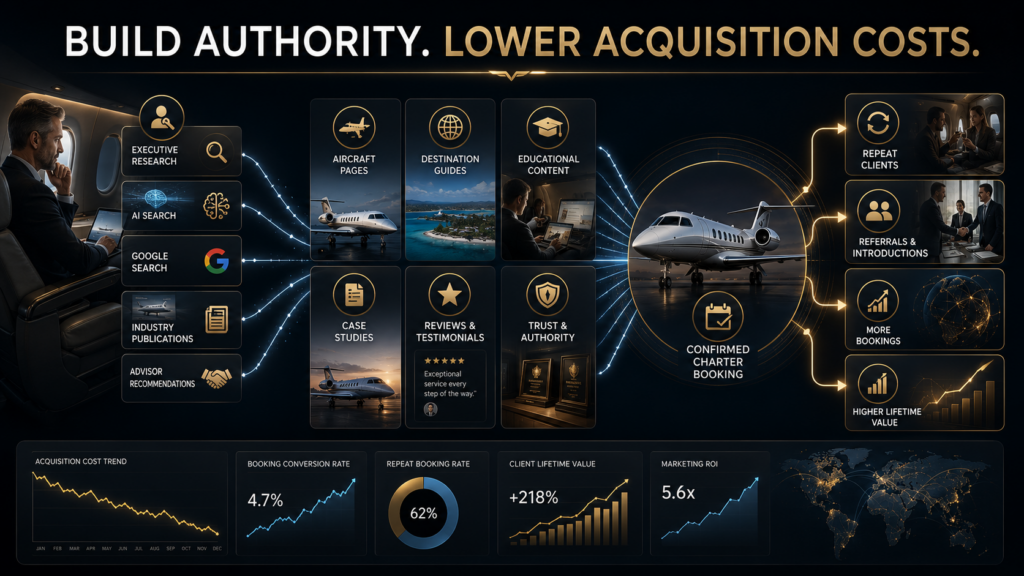
Successful charter operators don’t simply advertise aircraft. They build a client acquisition system that influences buying decisions throughout the entire research process. By the time a prospect reaches out for pricing, much of the selling has already taken place.
That’s why the most profitable operators rarely think in terms of campaigns.
They think in terms of systems.
Direct Answer
Private jet companies reduce cost per charter booking by attracting higher-intent prospects earlier in the buying journey, building digital authority that compounds over time, improving conversion rates through trust, and creating marketing systems that generate repeat business instead of relying solely on paid advertising. The goal isn’t simply generating more leads—it’s lowering acquisition costs while increasing client lifetime value.
The Most Expensive Charter Booking Is the One You Have to Buy Twice
Imagine a charter operator spends thousands of dollars generating a new client. That client books one flight, enjoys the experience, and then disappears because there was no follow-up strategy, no relationship nurturing, and no long-term engagement beyond the completed trip.
Six months later, the company spends another marketing budget acquiring another first-time customer.
Then another.
And another.
Although bookings continue arriving, the business never escapes the cycle of constantly paying for new clients. Every month begins with the same challenge because yesterday’s marketing does very little to reduce tomorrow’s acquisition costs.
Now compare that with an operator who approaches marketing differently.
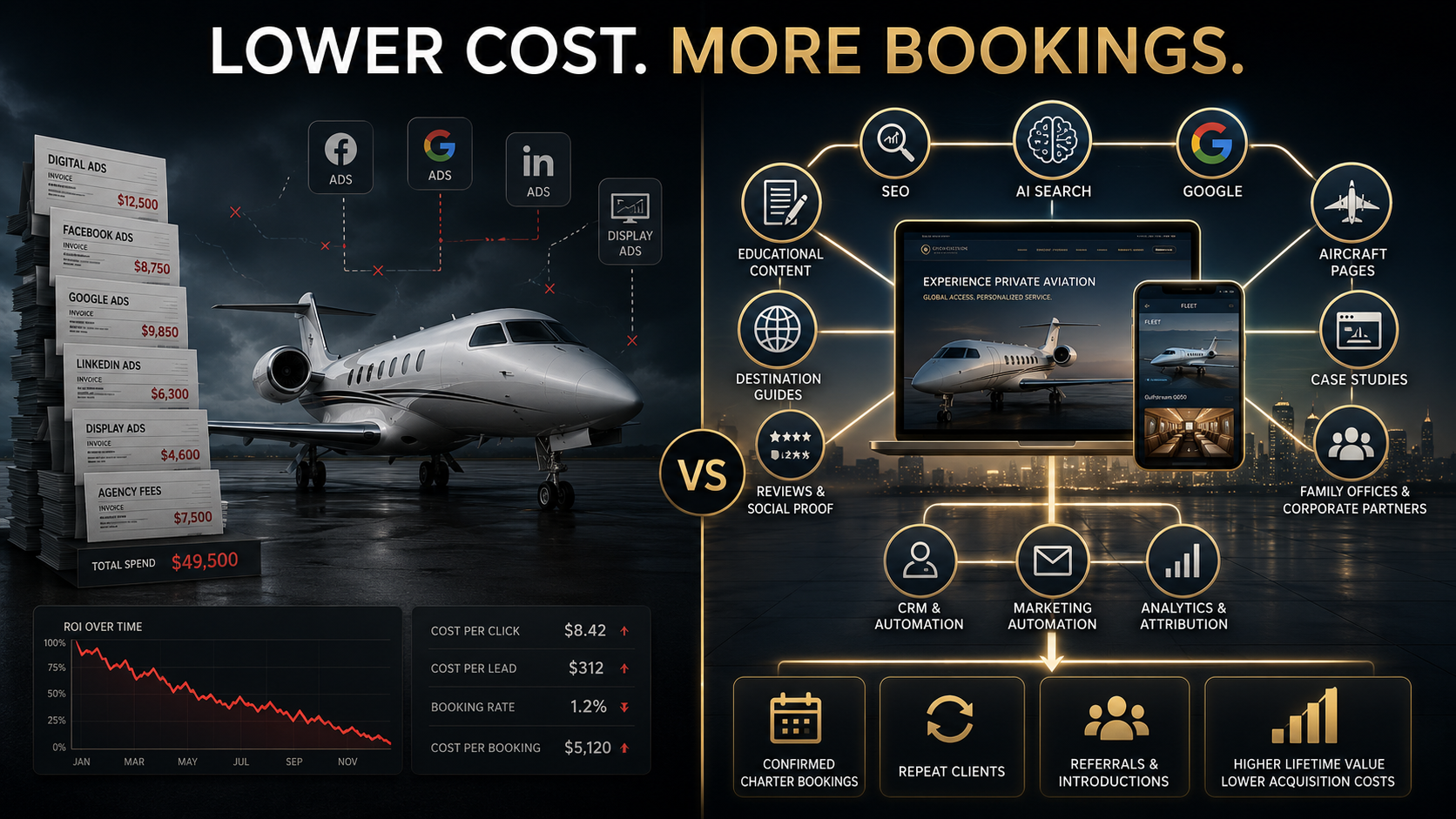
Rather than focusing exclusively on generating today’s booking, they build an ecosystem designed to attract prospects, educate them throughout the buying process, convert them efficiently, and remain connected after the flight has been completed. Educational content answers common charter questions. Aircraft comparison pages help executives evaluate options. Destination guides introduce new travel opportunities, while CRM automation maintains relationships long after the aircraft returns home.
Over time, the business stops depending entirely on acquiring strangers because existing relationships begin generating repeat bookings and referrals. Every client becomes more valuable, which means the original acquisition cost is spread across multiple flights instead of one.
The cheapest charter booking isn’t the one with the lowest advertising cost. It’s the one that becomes the beginning of a long-term client relationship.
The Search Begins Long Before Someone Requests a Quote
One of the biggest misconceptions in private aviation marketing is believing that prospective clients suddenly decide to charter an aircraft and immediately request pricing.
That’s rarely how high-net-worth travelers make significant purchasing decisions.
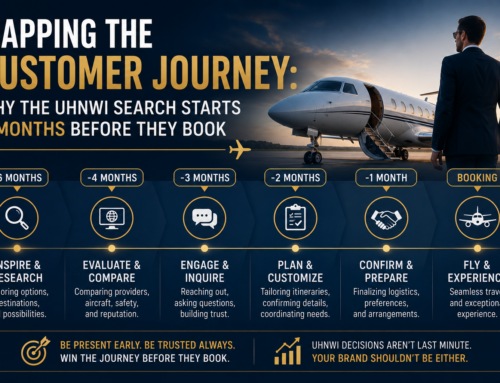
Imagine a CEO planning a multi-city European business trip six months from now. Before contacting a charter operator, they may spend weeks researching aircraft range, cabin layouts, international customs procedures, membership programs, airport options, onboard connectivity, and whether chartering makes more financial sense than fractional ownership.
Today’s research doesn’t happen in one place either. Prospects move between Google, AI search engines, YouTube, industry publications, destination guides, and recommendations from trusted advisors. Every search builds another piece of the buying journey.
The operator who consistently appears throughout that research process earns something far more valuable than another website visitor.
They earn familiarity.
And familiarity is one of the strongest foundations of trust.
By the time that executive finally requests a charter quote, they no longer view every operator as interchangeable. They’ve already developed confidence in the company that educated them throughout the journey.
That’s why client acquisition often begins months before a quote request ever enters the CRM.
Most Charter Operators Measure the Wrong Marketing Metrics
It’s easy to become distracted by marketing dashboards filled with impressions, clicks, website traffic, and cost-per-click reports. Those metrics are useful because they reveal activity, but activity alone doesn’t create profitable charter operations.
A charter company could double its website traffic without generating a single additional booking if that traffic comes from people with little intention of flying privately. Likewise, an advertising campaign may produce hundreds of quote requests that never translate into occupied flight hours because the prospects weren’t qualified from the beginning.
The operators achieving the lowest acquisition costs focus on a different set of numbers. Instead of asking how many visitors reached the website, they ask how efficiently marketing produces profitable client relationships. They evaluate booking quality, conversion rates, repeat charter frequency, customer lifetime value, referral generation, and overall return on marketing investment.
Those measurements reveal something far more important than campaign performance.
They reveal whether marketing is creating a stronger business.
| Common Marketing Metric | Executive Business Metric |
|---|---|
| Website Visitors | Qualified Charter Requests |
| Clicks | Confirmed Charter Bookings |
| Cost Per Click | Cost Per Charter Booking |
| Quote Requests | Revenue Per Client |
| Traffic Growth | Client Lifetime Value |
| Campaign ROI | Fleet Utilization & Profitability |
That shift in perspective changes every marketing decision moving forward because the objective is no longer generating more activity.
The objective is generating better business.
The Difference Between Running Advertising and Building a Client Acquisition System
Many charter operators think about marketing in terms of individual tactics. One quarter the focus shifts to Google Ads. The next quarter it’s LinkedIn campaigns, a redesigned website, or another round of paid media designed to generate quote requests.
Although each tactic can produce results, none of them creates a lasting competitive advantage by itself. The moment spending slows, visibility begins to disappear, quote requests decline, and the sales team finds itself searching for the next campaign to refill the pipeline.
That’s the difference between advertising and a client acquisition system.
Advertising is designed to generate attention today. A client acquisition system is designed to make every future marketing effort more efficient than the last. Instead of treating each campaign as an isolated event, every piece of the system supports every other piece until marketing begins compounding rather than restarting.
Think about how the world’s most respected luxury brands operate. They don’t rely on one advertisement to build trust. Instead, every touchpoint reinforces the next. Their website reflects the same quality as their product, their educational content answers questions before customers ask them, their client experience creates referrals, and their reputation continues attracting new business long after an individual campaign has ended.
Private aviation should work the same way.
The goal isn’t to create more campaigns. The goal is to build a system where every campaign becomes more effective because of everything that came before it.
Every Search Is an Opportunity to Earn Trust Before the Sales Conversation Begins
Consider how an executive plans an important trip.
Very few people begin by searching “private jet charter quote.” Instead, the process starts with questions. Which aircraft can fly nonstop between two cities? Is chartering more economical than fractional ownership for a specific travel schedule? Which airports reduce total travel time? What onboard amenities matter for an overnight international flight?
Each question represents an opportunity to introduce your company before competitors even know the prospect exists. When your business consistently provides thoughtful answers, educational resources, aircraft comparisons, and destination expertise, prospects begin associating your brand with competence rather than simply transportation.
That distinction becomes incredibly valuable because private aviation is built on confidence. Clients are trusting you with executive schedules, family travel, confidential business discussions, and experiences where mistakes carry significant consequences. Trust is rarely established through a pricing page alone.
Instead, trust is built gradually as prospects encounter your expertise throughout their research journey. By the time they request a quote, they no longer feel like they’re contacting a stranger. They feel like they’re reaching out to the company that has already been helping them make informed decisions.
That’s a completely different sales conversation.
Lower Acquisition Costs Begin Months Before the Flight
One of the biggest misconceptions in private aviation marketing is believing acquisition costs are determined when advertising budgets are approved. In reality, they begin much earlier because every interaction leading up to the booking influences how difficult—or how easy—it becomes to convert a prospect into a client.
A prospect who discovers your company for the very first time through a paid advertisement typically requires much more education than someone who has already spent weeks reading your aircraft guides, comparing destinations, exploring case studies, and following your market insights. One prospect enters the sales process with questions. The other enters with confidence.
That confidence has measurable business value.
Sales conversations become shorter because many objections have already been answered. Conversion rates improve because the prospect already understands your expertise. Repeat bookings become more likely because the relationship begins with trust instead of uncertainty.
Over time, those improvements compound into lower acquisition costs—not because advertising became cheaper, but because every booking became easier to earn.
The Operators Winning Tomorrow Are Building Authority Today
It’s easy to assume that the largest charter operators dominate because they simply spend more on marketing. While larger budgets certainly help, budget alone rarely explains long-term market leadership.
The strongest operators build authority years before competitors recognize what they’re doing.
They create detailed aircraft pages that answer executive buying questions. They publish destination guides that become trusted travel resources. They explain international flight procedures, customs requirements, empty leg opportunities, onboard productivity, and every other topic affluent travelers research before making a booking decision.
None of those individual resources transforms the business overnight. However, together they create an expanding knowledge ecosystem that continues attracting prospects month after month. Every article strengthens the website, every new page broadens search visibility, and every interaction reinforces the perception that this company understands private aviation at a deeper level than its competitors.
That’s difficult to replicate with advertising alone.
Authority compounds.
Campaigns expire.
Digital Authority Is the Competitive Advantage Money Can’t Buy Overnight
Imagine two charter companies decide to double their marketing budgets tomorrow.
Both can purchase more advertising. Both can increase impressions. Both can appear in front of more potential clients almost immediately.
What neither company can purchase overnight is years of accumulated authority.
They can’t instantly create hundreds of educational pages that answer executive travel questions. They can’t manufacture years of thought leadership, trusted destination content, aircraft expertise, client success stories, and organic search visibility with a single campaign.
That’s why digital authority behaves differently than paid media.
Advertising is available to anyone with enough budget.
Authority has to be earned.
| Advertising Assets | Authority Assets |
|---|---|
| Paid Search Campaigns | Aircraft Knowledge Library |
| Display Advertising | Destination Intelligence Guides |
| Social Media Campaigns | Executive Travel Resources |
| Lead Generation Ads | SEO & AI Search Authority |
| Temporary Visibility | Long-Term Digital Equity |
Every authority asset continues working after it’s published. It attracts future prospects, strengthens future campaigns, and reinforces every future sales conversation. That’s why the operators with the lowest cost per charter booking often aren’t spending less on marketing—they’re simply benefiting from years of investments that continue paying dividends.
Repeat Clients Are the Fastest Way to Reduce Cost Per Charter Booking
Many charter operators devote the majority of their marketing budget to acquiring new clients. While new business is essential, it is often the most expensive revenue a company will ever generate. Every first-time client requires awareness, education, trust, multiple conversations, and a significant investment of time before they ever step onto the aircraft.
The economics change dramatically after that first successful trip.
A client who enjoyed a seamless experience already knows your team, understands your process, and has confidence that you’ll deliver again. The next booking typically requires less education, fewer objections, and a much shorter sales cycle because the relationship has already been established.
Viewed through that lens, reducing cost per charter booking isn’t simply about lowering marketing expenses. It’s about increasing the number of flights generated from every client you acquire.
The operators with the healthiest acquisition costs don’t just generate bookings—they generate relationships that continue producing bookings for years.
Your most profitable charter booking is often the second, third, and fourth flight—not the first.
Luxury Clients Don’t Buy Flights. They Buy Confidence.
One of the biggest mistakes in private aviation marketing is assuming clients purchase aircraft based primarily on price or availability. While those factors certainly influence decisions, they rarely determine long-term loyalty in the luxury market.
Ultra-high-net-worth individuals, executives, family offices, entertainers, and professional athletes are buying something much larger than transportation. They’re buying reliability when an important meeting can’t be missed. They’re buying privacy for sensitive business discussions. They’re buying flexibility when commercial schedules no longer fit their lives. Most importantly, they’re buying confidence that every detail will be handled without unnecessary friction.
That confidence is built long before someone requests a quote.
It begins with how your company presents itself online, continues through every educational resource you publish, and grows stronger with every interaction a prospect has with your brand. A polished website, insightful destination guides, detailed aircraft information, client testimonials, and consistent thought leadership all communicate the same message: this company understands luxury travel at the highest level.
When confidence already exists, price becomes only one part of the decision rather than the entire decision.
Why the Lowest Cost Per Booking Usually Comes From the Strongest Brand
Imagine two charter operators receive identical quote requests.
The first company has little online presence beyond a brochure website and a few paid advertisements. The prospect has never heard of the operator before today, so the sales team must establish credibility, explain the fleet, justify pricing, answer operational questions, and overcome uncertainty during a single conversation.
The second company has spent years building authority. The prospect has already read destination guides, compared aircraft on the website, watched educational videos, explored safety information, and followed market insights on multiple platforms. By the time they request pricing, they’re already convinced the operator belongs on the shortlist.
Both companies generated a lead.
Only one generated trust before the sales process even began.
That’s why branding should never be viewed as something separate from performance marketing. In private aviation, brand strength directly influences acquisition costs because trusted companies convert prospects more efficiently than companies prospects have never encountered before.
What a Modern Charter Marketing System Actually Looks Like
The lowest acquisition costs rarely come from one exceptional marketing tactic. Instead, they come from a system where every component supports the next. Each interaction moves a prospect closer to booking while making future marketing efforts more effective.
| Marketing Asset | Business Impact |
|---|---|
| Aircraft Pages | Capture high-intent aircraft research. |
| Destination Guides | Build authority before travel planning begins. |
| Executive Travel Resources | Educate prospects during the research phase. |
| SEO & AI Search Optimization | Increase visibility across Google and AI platforms. |
| Google Business Profile | Strengthen local trust and branded searches. |
| Case Studies | Demonstrate real-world client success. |
| Email & CRM Automation | Encourage repeat bookings and referrals. |
| Remarketing Campaigns | Reconnect with prospects still evaluating options. |
| Analytics & Attribution | Continuously improve marketing efficiency. |
Viewed individually, none of these assets guarantees lower acquisition costs. Together, however, they create a marketing ecosystem that becomes increasingly efficient as it grows. Every completed booking strengthens the next marketing campaign, every new content asset attracts future prospects, and every satisfied client creates opportunities for referrals and repeat business.
The Future of Private Jet Marketing Belongs to Companies That Build Authority
The private aviation industry is changing rapidly. Today’s buyers don’t rely on a single source of information before making a booking decision. They research across search engines, AI platforms, industry publications, social media, YouTube, and trusted recommendations while comparing operators, aircraft, destinations, and travel options.
As a result, the companies that consistently reduce cost per charter booking won’t necessarily be the ones spending the most on advertising. They’ll be the companies that become the most trusted source of information throughout the entire buying journey.
Authority is no longer a branding exercise.
It’s a competitive advantage.
Every educational article, aircraft guide, destination resource, comparison page, and client success story becomes another opportunity to meet a prospect before competitors even know they’re planning a trip. Over time, those interactions compound into stronger trust, higher conversion rates, greater client loyalty, and lower acquisition costs.
That’s why the most successful charter operators don’t simply invest in marketing.
They invest in becoming the obvious choice.
Frequently Asked Questions
How can private jet companies reduce cost per charter booking?
The most effective strategy combines SEO, AI search optimization, educational content, remarketing, CRM automation, and client retention. Rather than relying entirely on paid advertising, successful operators build long-term digital assets that continue generating qualified prospects while increasing repeat bookings.
What is the difference between cost per lead and cost per charter booking?
Cost per lead measures how much it costs to generate an inquiry. Cost per charter booking measures how much it costs to acquire an actual paying client. The latter provides a much more accurate picture of marketing efficiency because it reflects real business outcomes.
Why are repeat charter clients so valuable?
Repeat clients dramatically lower acquisition costs because the initial marketing investment has already been made. Additional bookings often require less sales effort while increasing customer lifetime value and overall profitability.
Does SEO reduce customer acquisition costs for charter operators?
Yes. A strong SEO strategy helps operators appear during the research phase of the buying journey, creating trust before prospects request quotes. Over time, organic visibility can reduce dependence on expensive paid advertising.
How does AI search affect private jet marketing?
AI search platforms increasingly influence how executives and affluent travelers research aircraft, destinations, and charter options. Companies that publish authoritative, well-structured content are more likely to appear in AI-generated answers and recommendations.
Final Thoughts: The Goal Isn’t Cheaper Marketing. It’s More Efficient Growth.
Every charter operator wants to reduce marketing costs. That’s a reasonable objective, especially in an industry where acquiring a single qualified client can require significant investment. However, the companies consistently lowering their cost per charter booking aren’t simply finding cheaper advertising platforms or negotiating lower media rates.
They’re building businesses that become easier to market every year.
Think about the difference between pushing a heavy aircraft across the ramp and taxiing under its own power. Both eventually reach the runway, but one requires dramatically less effort because momentum is already working in its favor.
Marketing follows the same principle.
When your company depends entirely on paid campaigns, every month begins with the same challenge. Budgets must be approved, campaigns must launch, and every new booking starts by purchasing another opportunity. Nothing from last month automatically improves next month’s performance.
Companies that invest in digital authority experience something very different. Every aircraft guide continues educating prospects. Every destination page attracts executives planning future travel. Every article strengthens search visibility, every review reinforces credibility, and every successful charter creates another story capable of influencing future buying decisions.
Instead of rebuilding momentum every month, they continue adding to it.
Eventually, the question changes from “How do we generate more charter requests?” to “How do we manage the increasing number of qualified opportunities already entering our pipeline?”
That’s one of the clearest signs a marketing system has matured. The business is no longer chasing demand. Demand is beginning to find the business.
The Competitive Advantage Most Charter Operators Underestimate
Aircraft can be purchased.
Pilots can be hired.
Advertising budgets can be increased almost overnight.
Digital authority cannot.
Authority is earned through years of consistently publishing valuable insights, answering executive travel questions, documenting client success, building search visibility, and becoming a trusted resource for affluent travelers. Unlike advertising, it can’t simply be purchased because it exists in the minds of prospects long before they become clients.
That makes authority one of the few competitive advantages that grows stronger with time instead of weaker.
A competitor may copy your pricing model or launch similar advertising campaigns next month. They cannot instantly recreate hundreds of educational resources, years of search authority, an established reputation across AI search platforms, or the trust your company has built with executives, family offices, and ultra-high-net-worth travelers.
That’s why the strongest operators view marketing as an investment in enterprise value rather than a monthly expense. Every digital asset becomes part of the business itself, increasing both marketing efficiency and the long-term value of the company.
If You Want Lower Acquisition Costs Tomorrow, Build Better Marketing Today
Reducing cost per charter booking isn’t about finding shortcuts. It’s about creating a business that earns trust earlier, converts prospects more efficiently, and generates repeat relationships that continue producing value long after the first flight has landed.
When your marketing strategy combines search visibility, AI optimization, educational content, executive-focused resources, aircraft expertise, destination intelligence, CRM automation, and ongoing relationship management, each booking becomes easier to acquire than the one before it.
That’s the compounding effect most operators never experience because they’re too busy replacing yesterday’s advertising instead of building tomorrow’s authority.
The companies leading the next generation of private aviation won’t simply have larger marketing budgets.
They’ll have stronger marketing systems.
And those systems will consistently produce what every charter operator ultimately wants:
- Lower customer acquisition costs.
- Higher booking conversion rates.
- More repeat charter clients.
- Greater client lifetime value.
- Higher fleet utilization.
- A business that becomes more valuable every year.
That’s how the best charter operators reduce cost per booking—not by spending less, but by making every marketing dollar work harder.
Ready to Build a Private Aviation Marketing System That Compounds?
At Infinite Media Resources, we don’t build disconnected marketing campaigns. We build integrated client acquisition systems designed specifically for private aviation companies, charter operators, aircraft management firms, FBOs, and luxury aviation brands.
Our strategies combine SEO, Generative Engine Optimization (GEO), AI search optimization, conversion-focused website architecture, destination content, aircraft-specific authority pages, digital PR, CRM strategy, paid advertising, and advanced analytics into one system designed to lower acquisition costs while increasing long-term enterprise value.
Instead of asking how to generate more quote requests next month, we’ll help you build a marketing ecosystem that continues attracting qualified clients for years.
The goal isn’t just more charter bookings.
The goal is becoming the company affluent travelers trust before they ever request a quote.
Schedule a strategy consultation to learn how Infinite Media Resources helps private aviation companies reduce cost per charter booking through long-term digital authority and integrated marketing systems.
About the author : Anthony Paulino