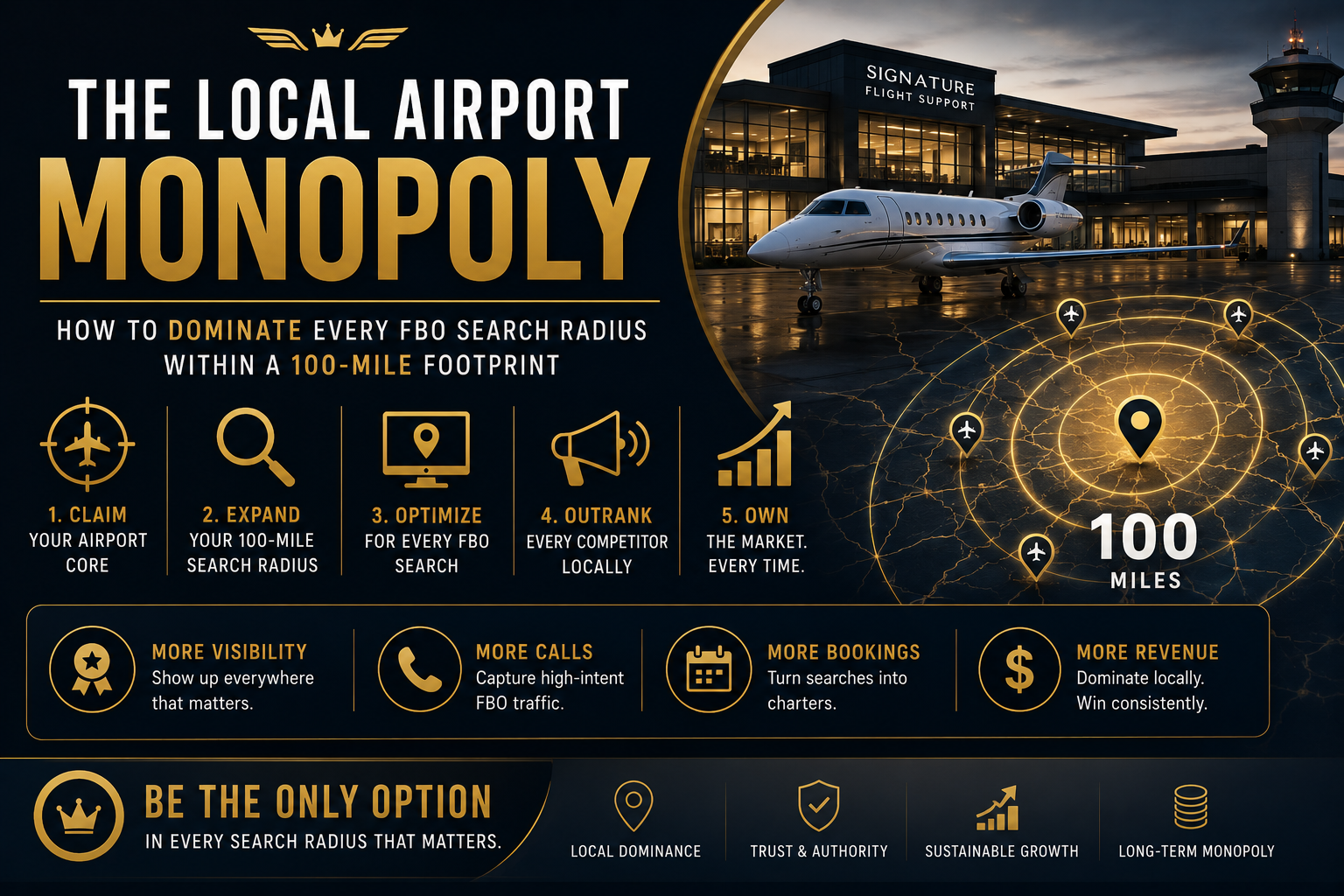
The Local Airport Monopoly: How to Dominate Every FBO Search Radius Within a 100-Mile Footprint
A regional charter operator does not need to rank for every private aviation search in the country. Instead, it needs to become almost impossible to miss inside the market its aircraft, crews, partners, and buyers actually use.
That market rarely follows a city boundary. A principal may live in one suburb, work in another city, depart from a reliever airport 55 miles away, use a preferred FBO, and fly to a destination that never appears on the operator’s main service page.
Therefore, a single “private jet charter near me” page cannot represent the full opportunity. The operator needs a connected search ecosystem built around airports, FBOs, cities, affluent suburbs, aircraft, routes, events, and buyer questions.
What Is a Local Airport Monopoly?
Direct Answer: A local airport monopoly is dominant organic and AI-search visibility across the commercially relevant airports, FBOs, cities, suburbs, aircraft needs, and route searches within an operator’s practical service footprint. It does not mean controlling an airport. Instead, it means becoming the most visible and useful private aviation resource whenever a qualified traveler researches how to depart from, arrive through, or charter around that region.
When built correctly, this system captures more than direct charter searches. It also reaches executive assistants comparing airports, family offices reviewing access, corporate teams planning multi-leg travel, aircraft owners researching management, and principals deciding whether private aviation solves a specific time or logistics problem.
As a result, the operator enters the buyer journey earlier and appears more often before the quote request.
Key Takeaways
- A profitable private aviation market extends beyond the city where the operator maintains an office.
- Therefore, airport, FBO, suburb, route, aircraft, and event searches should support one connected regional strategy.
- However, thin location pages and copied airport descriptions will not create durable authority.
- Each page should answer a distinct traveler question and provide unique local, operational, and mission context.
- Additionally, operators must avoid implying an FBO partnership, airport affiliation, or operational capability that does not exist.
- Ultimately, the goal is not page count alone. The goal is qualified market coverage that produces consultations, quotes, flights, and repeat revenue.
Why a 100-Mile Airport Search Radius Matters
The key point: Qualified private aviation demand often travels across city and county lines because buyers choose departure points by total convenience, not by municipal boundaries.
A principal may drive past the closest airport because another field offers better aircraft availability, easier ground access, longer runways, a preferred FBO, stronger privacy, or a more efficient departure path. Likewise, an executive assistant may compare three airports before choosing the one that best protects the principal’s schedule.
Therefore, the operator’s true market should be based on practical travel behavior rather than a map pin.
The 100-Mile Radius Can Include
- primary commercial and general aviation airports
- regional and reliever airports
- FBO locations serving business aviation traffic
- affluent suburbs and second-home communities
- corporate headquarters and industrial centers
- universities, hospitals, resorts, and event venues
- high-value outbound route demand
- aircraft owners who need management or operational support
However, 100 miles should function as a planning framework, not a rigid promise. Some markets justify a smaller footprint because drive times become impractical. Meanwhile, sparse or high-value regions may justify a wider radius.
Consequently, the best radius is the area where a qualified buyer could realistically use the operator, airport, aircraft, or service.
How Do You Map the Real Airport Market?
The key point: Begin with buyer behavior, operational relevance, and revenue potential before creating pages.
Many aviation websites begin by listing every nearby airport. However, that approach can create a large amount of low-value content. Instead, the operator should score each airport and market by its commercial importance.
Score Each Airport by These Factors
- historical charter inquiries
- completed trips and revenue
- drive time from affluent communities
- corporate and family-office presence
- runway and aircraft suitability
- FBO infrastructure
- event and seasonal demand
- common outbound routes
- operator or aircraft positioning patterns
- competition in search and paid media
Next, organize the region into airport clusters. A cluster may include one main airport, two nearby alternatives, several FBOs, surrounding cities, high-value suburbs, common aircraft categories, and priority routes.
As a result, the site architecture mirrors how buyers actually make travel decisions.
The Four Layers of Airport Search Demand
The key point: Airport authority grows when the operator covers four distinct layers: airport, FBO, local-market, and route intent.
1. Airport Searches
These searches focus on a named airport or airport code. For example, a traveler may research private jet charter from a regional airport, aircraft availability near that airport, or the best private aviation option for reaching a nearby city.
2. FBO Searches
These searches focus on terminal access, amenities, ground transportation, arrival logistics, or a known FBO location. Although the traveler may not be ready to book, the search often shows practical trip-planning intent.
3. City and Suburb Searches
These searches begin with where the traveler lives, works, owns property, or plans to visit. Therefore, the page must connect the city to realistic airport options instead of pretending every city has its own private airport.
4. Route-Pair Searches
These searches connect a local airport or city with a destination. They often reveal stronger buying intent because the traveler has moved from general research into mission planning.
When all four layers connect, the operator can appear throughout the journey instead of competing for one broad term at the end.
How to Build High-Value Airport Pages
The key point: An airport page should help a qualified traveler understand access, aircraft suitability, local logistics, route options, and the next step toward chartering.
A weak airport page simply repeats the airport name and adds a generic sales paragraph. However, a strong page answers the practical questions that assistants, principals, and travel teams need before a booking.
Every Airport Page Should Address
- where the airport sits relative to major cities and business districts
- which types of missions commonly use the airport
- general aircraft and runway considerations
- nearby FBO options, without implying affiliation
- ground transportation and arrival planning
- common outbound and inbound routes
- weather, seasonal, or event considerations when relevant
- alternative nearby airports
- operator, broker, or advisory role clarity
- a route review or availability CTA
Additionally, the page should explain when another airport may be more appropriate. That honesty builds trust because the content helps the buyer make a decision instead of forcing every search toward one location.
A Better Airport CTA
Instead of using only “Request a Quote,” consider mission-focused calls to action such as:
- Compare Departure Airport Options
- Review Aircraft Availability Near This Airport
- Plan a Route From This Airport
- Compare This Airport With Nearby Alternatives
As a result, the page can convert buyers who are still evaluating logistics, not only those ready for a final price.
How to Build FBO Guides Without Implying Affiliation
The key point: FBO content should educate travelers about private terminal logistics while clearly avoiding false partnership, endorsement, or operational claims.
An FBO guide can help travelers understand where a terminal is located, which airport it serves, what general trip-planning questions to ask, and how ground transportation may connect to nearby destinations. However, the operator should not imply that it owns, manages, represents, or partners with an FBO unless that relationship is real and authorized.
Useful FBO Guide Topics
- airport and terminal location context
- distance to business districts, resorts, or event venues
- general arrival and departure planning
- ground transportation considerations
- nearby airport alternatives
- questions travelers should confirm before arrival
- how aircraft availability may differ by date and operator
Language to Avoid Without Authorization
- our FBO
- our terminal
- our partner FBO
- exclusive access
- guaranteed amenities
- guaranteed aircraft availability
Instead, use neutral language such as “travelers using this airport may consider,” “confirm current services directly,” or “availability depends on the operating carrier and trip date.”
Therefore, the page remains useful without creating misleading brand relationships.
How Nearby Cities and Affluent Suburbs Expand Demand
The key point: City and suburb pages capture demand where buyers begin their search, then guide them toward the most practical airport options.
A principal may search for private jet charter from the city where they live, even though the departure airport sits in another municipality. Likewise, an executive assistant may search from the destination name rather than the airport code.
Therefore, local pages should connect the traveler’s starting point to realistic airport choices.
A Strong City Page Should Include
- the main airports serving the city
- general drive-time and access considerations
- which airport may suit different mission types
- common business and leisure routes
- nearby affluent communities or corporate centers
- aircraft categories commonly considered for those routes
- local event or seasonal demand
- links to airport and route pages
However, city pages should not simply replace one location name with another. Each market needs distinct airport logic, buyer context, routes, and travel considerations.
Consequently, the best pages feel like local aviation guidance rather than search-engine inventory.
How Route-Pair Pages Turn Local Authority Into Revenue
The key point: Route-pair pages capture buyers who have moved beyond general airport research and are evaluating a specific trip.
Once a traveler connects a regional airport with Palm Beach, Aspen, Teterboro, London, Cabo, Naples, or the Caribbean, the search becomes more commercially meaningful. Therefore, route pages should sit close to the center of the airport authority strategy.
A High-Value Route Page Should Explain
- departure and arrival airport options
- general mission distance and flight considerations
- aircraft categories that may fit the trip
- passenger, luggage, pet, or equipment considerations
- seasonal winds or airport constraints when relevant
- ground access at both ends
- one-way, round-trip, and multi-leg considerations
- how to request current aircraft availability
Additionally, route pages should link back to both airport clusters. That creates a useful web of local and destination authority.
This strategy connects directly to IMR’s Route-Pair Strategy.
How Aircraft-by-Airport Content Qualifies Buyers
The key point: Aircraft-by-airport content helps buyers understand mission fit while filtering out people who are only browsing private jet imagery.
A buyer may know the airport but not the right aircraft. Therefore, pages can explain which aircraft categories travelers commonly consider for regional, transcontinental, international, ski, island, or short-runway missions.
Useful Aircraft-by-Airport Topics
- best aircraft categories for a specific airport
- light jet options for regional routes
- super-midsize aircraft for transcontinental trips
- large-cabin jets for international missions
- baggage considerations for ski or golf travel
- runway and weather factors that may affect selection
- why exact performance requires operator review
However, avoid guaranteeing that a model can operate a mission under every condition. Actual performance depends on the aircraft, payload, weather, runway, reserves, operator, and trip details.
Therefore, the content should educate and invite a mission review rather than present a universal operating promise.
How Events and Seasonal Travel Create Airport Demand Spikes
The key point: Major events and seasonal travel can transform secondary airports and FBO searches into high-value charter opportunities.
Demand may surge around sporting events, business conferences, art fairs, college events, holiday travel, ski seasons, equestrian events, yacht shows, and resort calendars. Consequently, a regional operator should map which airports and cities receive temporary increases in private aviation interest.
Event Content Can Cover
- best airport options for the event
- arrival and departure planning
- ground transportation considerations
- possible slot, parking, or congestion concerns
- alternative airports
- aircraft availability and early planning
- common routes into the event market
Additionally, event pages should be updated rather than copied annually without review. Dates, venues, airport conditions, and operational details can change.
As a result, event content becomes a recurring authority asset instead of a temporary promotional post.
How to Avoid Thin and Repetitive Airport Pages
The key point: Scale only works when every page earns its place through unique buyer value.
Airport SEO becomes risky when a company publishes hundreds of pages with the same paragraphs, swaps the airport name, and adds a generic quote form. That strategy may create page count, yet it does not create a trusted regional resource.
Every Page Needs a Distinct Reason to Exist
- a different airport decision
- a different city-to-airport relationship
- a different route or aircraft need
- a different traveler profile
- a different event or seasonal context
- a different operational question
- a different conversion path
Unique Evidence Can Include
- verified airport and access details
- original local photography
- completed mission examples
- approved client testimonials
- airport comparison tables
- route-specific planning guidance
- local business and resort context
- current FBO and airport links
Google’s people-first guidance emphasizes useful content created for visitors rather than pages designed primarily to manipulate rankings. Therefore, the operator should prioritize usefulness, accuracy, and real market expertise throughout the build.
How the Airport Content Ecosystem Should Connect
The key point: Internal links should guide buyers from broad regional research toward a specific airport, route, aircraft, safety resource, and consultation.
A large content library without a clear structure can confuse users and search systems. Therefore, every page should support the next logical question.
Regional Private Aviation Hub ├── Airport Cluster Pages │ ├── Primary Airport │ ├── Regional Alternative │ └── Reliever Airport ├── FBO Guides ├── Nearby City Pages ├── Affluent Suburb Pages ├── Aircraft-by-Airport Pages ├── Route-Pair Pages ├── Event Travel Pages ├── Safety and Operator Resources └── Route Review / Availability CTA
Useful Internal Link Paths
- city page to airport comparison
- airport page to FBO guide
- airport page to route pair
- route page to aircraft comparison
- aircraft page to baggage or cabin guide
- event page to airport alternatives
- every commercial page to safety and booking resources
As a result, the website helps the buyer complete a decision rather than forcing them to return to search.
How GEO and AI Search Expand the Local Airport Monopoly
The key point: AI search creates additional opportunities for operators whose content clearly explains airport choices, routes, aircraft, FBO context, and traveler decisions.
A principal or assistant may ask an AI system which private airport best serves a city, which airport is closest to a corporate center, which aircraft category fits a route, or what to consider when choosing an FBO.
Therefore, pages should provide direct answers, clear headings, tables, comparison logic, entity relationships, and supporting links.
AI-Search Questions to Answer
- Which private airport is best for this city?
- What airports serve this affluent suburb?
- Which FBO options are located at this airport?
- What aircraft categories suit this route?
- Which nearby airport offers a practical alternative?
- How early should travelers book for a major event?
- What should a buyer ask before chartering?
Google’s current AI-search guidance still emphasizes the same core practices as strong SEO: helpful content, technical accessibility, clear page experiences, and accurate information. Therefore, GEO should strengthen the airport ecosystem rather than become a separate collection of artificial pages.
How to Retarget the Airport Research Journey
The key point: Retargeting should adapt to the airport, route, aircraft, and buyer behavior shown during the visit.
A visitor who reads one general airport page should not receive the same message as someone who compares aircraft, views a route page, starts an availability form, and returns several times.
Build Retargeting Audiences Around
- specific airport clusters
- high-value route pages
- aircraft category interest
- international travel content
- ski, island, or event travel
- safety and privacy research
- aircraft management interest
- form starts without submission
Match the Message to the Intent
- Airport visitors: Compare departure options for your region.
- Route visitors: Review aircraft availability for your mission.
- Aircraft visitors: Compare cabins, range, and passenger fit.
- Event visitors: Plan early around airport congestion and availability.
- Safety visitors: Understand who operates your flight before booking.
Consequently, retargeting becomes a continuation of the research experience rather than repetitive brand advertising.
How to Track Revenue by Airport Cluster
The key point: Airport authority should be measured by qualified consultations, quotes, flights, and revenue—not page count or traffic alone.
Without CRM attribution, an operator may know which pages receive visitors but not which airport clusters create valuable clients. Therefore, every form and call should carry source, airport, route, and service context into the CRM.
Track These Fields
- first landing page
- airport or FBO content viewed
- departure and destination interest
- aircraft category
- traveler or decision-maker role
- consultation status
- quote value
- flight booked
- revenue and gross margin
- repeat-booking potential
- disqualification reason
Airport Cluster KPIs
- qualified inquiries by airport
- cost per qualified consultation
- quotes by route
- booked flights by cluster
- revenue per airport page group
- assisted conversions
- repeat charter revenue
- aircraft management opportunities
As a result, the operator can expand around markets that produce real business rather than markets that only produce impressions.
A Six-Month Roadmap for Building Regional Airport Authority
The key point: Build the system in commercial priority order instead of publishing every location at once.
Month 1: Map the Market
Identify airport clusters, FBOs, cities, suburbs, routes, events, aircraft needs, and historical revenue. Additionally, define which pages already exist and where content gaps remain.
Month 2: Build Primary Airport Pages
Create or improve the pages for the airports that generate the most realistic demand. Meanwhile, establish the direct-answer format, airport comparison logic, CTAs, and internal linking structure.
Month 3: Add City and Suburb Connections
Build unique pages connecting affluent communities and corporate centers to practical airport options. Therefore, the site begins capturing demand where the buyer starts the search.
Month 4: Publish Route and Aircraft Content
Add high-value outbound routes, aircraft categories, airport alternatives, and mission-specific comparisons. As a result, the content moves closer to booking intent.
Month 5: Add FBO, Event, and Seasonal Guides
Publish neutral, accurate FBO resources and event planning content. Additionally, build seasonal updates for ski, island, holiday, and major-event travel.
Month 6: Optimize With CRM Data
Review qualified leads, quotes, revenue, assisted conversions, and low-value traffic. Then, strengthen the clusters producing the best commercial outcomes.
Ultimately, this phased approach creates useful regional depth without sacrificing quality.
Common Airport and FBO Marketing Mistakes
The key point: Most airport SEO strategies fail because they chase page count, broad rankings, or affiliation signals instead of helping travelers make real decisions.
- building one generic page for an entire region
- publishing copied airport pages
- targeting airports outside the practical service area
- using FBO brand names without useful context
- implying partnerships that do not exist
- ignoring cities and suburbs around the airport
- failing to connect airports with routes
- guaranteeing aircraft performance without trip review
- ignoring safety and operator clarity
- tracking traffic without CRM revenue
- creating pages without internal links
- publishing outdated event and airport details
Instead, build a market resource that helps principals, assistants, family offices, and travel teams understand the regional private aviation landscape.
Frequently Asked Questions
What is FBO marketing?
Direct answer: FBO marketing is content and advertising designed around private terminal, airport-access, ground-logistics, and traveler-intent searches. Operators should use it to educate buyers without falsely implying ownership or affiliation.
Why use a 100-mile airport radius?
Direct answer: A 100-mile radius helps map the broader market because private aviation travelers may drive past the nearest airport for better access, aircraft availability, privacy, runway suitability, or convenience.
Should a charter company create a page for every nearby airport?
Direct answer: No. Create pages only when the airport has real buyer relevance, operational context, unique search intent, or commercial potential.
Can a company create pages about FBOs it does not own?
Direct answer: Yes, it can publish accurate educational guides. However, it should not imply ownership, partnership, endorsement, guaranteed services, or exclusive access without authorization.
What should an airport charter page include?
Direct answer: Include airport access, nearby cities, general aircraft considerations, FBO context, common routes, alternative airports, local logistics, safety guidance, and a mission-focused CTA.
How are airport pages different from city pages?
Direct answer: Airport pages focus on aviation access and mission planning. City pages begin with the traveler’s location and compare the airports that realistically serve it.
Why are route-pair pages important?
Direct answer: Route-pair pages capture stronger intent because the traveler has identified both the regional departure market and a destination.
Can airport pages help AI-search visibility?
Direct answer: Yes. Clear airport comparisons, direct answers, route guidance, entity relationships, and structured data can help AI systems understand and surface useful information.
How do you avoid doorway-style location pages?
Direct answer: Give every page unique buyer value through verified local details, distinct airport logic, route context, original proof, relevant questions, and useful comparisons.
What is the most important airport marketing KPI?
Direct answer: Revenue from qualified airport-cluster demand matters most. Supporting KPIs include consultations, quotes, bookings, gross margin, assisted conversions, and repeat revenue.
Should airport marketing replace paid advertising?
Direct answer: No. Airport authority creates owned demand, while paid search and retargeting can accelerate visibility around high-value clusters and routes.
How long does regional airport authority take to build?
Direct answer: Initial pages and campaigns can generate signals quickly, yet durable organic and AI-search authority usually compounds over several months of consistent, accurate publishing and optimization.
External Authority Resources
Conclusion: Own the Regional Decision, Not Just One Keyword
Direct Answer: A regional charter operator creates a local airport monopoly by becoming the most useful source across every commercially relevant airport, FBO, city, suburb, route, aircraft, event, and buyer question in its practical footprint.
The operator does not need national visibility for every private aviation term. However, it does need enough local depth that a qualified traveler repeatedly encounters the brand while comparing departure airports, terminals, routes, aircraft, and booking options.
Therefore, the winning strategy is not one airport page or one city page. It is a connected regional authority system built around real travel behavior.
Once that system connects to retargeting and CRM attribution, the operator can see which airport clusters create qualified consultations, quotes, booked flights, and repeat clients. As a result, marketing stops guessing and begins expanding around proven demand.
Final Insight: National rankings create visibility. Regional airport ownership creates a market.
Build a Private Aviation Search Footprint That Compounds
IMR builds private aviation digital real estate across airports, FBO research, routes, aircraft, safety, buyer questions, local markets, and AI search. Therefore, charter operators can attract qualified demand earlier and reduce their dependence on broad, expensive lead channels.
Explore IMR’s complete private aviation digital marketing strategy to see how regional search authority, GEO, paid media, retargeting, and CRM attribution can work together.
About the author : Anthony Paulino