How To Build An AI Calling Agent That Actually Books Appointments (Full System + Fixes)
An AI calling agent booking system uses voice AI, scheduling logic, CRM integration, and production-ready node flows to qualify leads, present real availability, and complete bookings automatically. However, most systems fail in production, so the winning setup must handle ambiguity, variable persistence, availability logic, and clean booking execution.
Most AI calling agents sound impressive in demos. However, real production calls expose the failures fast. The system may understand the lead, yet lose the date variable. It may retrieve available times, yet never present them naturally. It may even complete the booking logic, yet fail to end the call cleanly. As a result, the business does not get a reliable appointment booking system. Instead, it gets a fragile conversation bot.
This page explains how to build an AI calling agent booking system that actually works in production. More importantly, it explains how to fix the real problems that break appointment booking. Therefore, this is not just a “how to build an AI agent” page. Instead, it is a production-focused system guide built around the failures, fixes, and logic layers that turn a broken AI caller into a booking engine.
This hub also serves as the root page for the full spoke cluster below. Accordingly, each spoke now lives under this hub so the entire topic sits inside one clear authority structure.
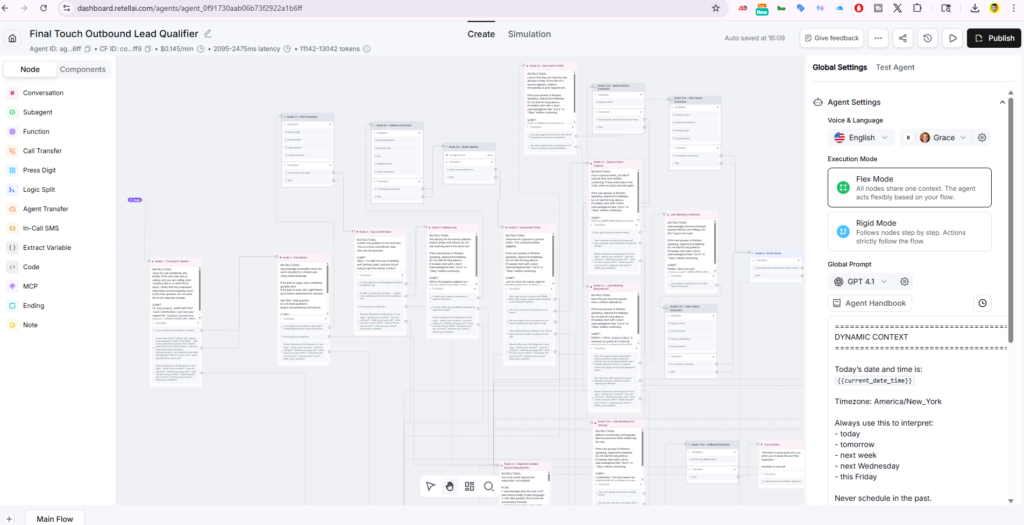
Table Of Contents
- Direct Answer
- What An AI Calling Agent Actually Is
- What Makes An AI Calling Agent Actually Work
- System Overview
- The Core Booking Engine
- Real Problems We Hit In Production
- How We Fixed Each Problem
- Final Node Flow Architecture
- Conversion Optimization Layer
- Business Integration Layer
- Production-Ready System
- Spoke Pages
- FAQ
- External Authority Links
Direct Answer
Direct Answer: An AI calling agent that actually books appointments needs more than voice AI. It needs production-ready date handling, slot retrieval, slot presentation, booking execution, CRM integration, reschedule logic, clean call control, and conversation structure that moves the lead from interest to commitment without breaking the flow.
That is the real dividing line. Many systems can talk. Far fewer can book. Therefore, this hub focuses on the exact system layers that make booking happen consistently.
What An AI Calling Agent Actually Is
Direct Answer: An AI calling agent is a voice-driven system that answers or places phone calls, understands user intent, gathers information, handles objections or ambiguity, and moves the caller toward a business outcome such as an appointment, transfer, qualification, or follow-up action.
For appointment booking, the AI calling agent acts like a scheduling rep. However, it must do more than repeat a script. It has to interpret natural language, preserve state, retrieve live availability, present time options clearly, capture the final selection, create the booking, and close the call cleanly. Consequently, the agent needs strong logic under the surface, not just strong wording on the surface.
What Makes An AI Calling Agent Actually Work
Direct Answer: An AI calling agent works when conversation, logic, scheduling, and execution all stay connected without losing state, skipping steps, or confusing the caller.
The Non-Negotiable Layers
- accurate extraction of user intent
- date and time normalization
- availability retrieval from the booking system
- clear presentation of open slots
- booking payload generation
- conflict handling and reschedule logic
- CRM synchronization
- clean call termination and confirmation
If any one of these layers breaks, the system may still sound intelligent. However, it will not book reliably. Therefore, the build must be judged by booked appointments, not by how natural the opening greeting sounds.
System Overview
Direct Answer: The production system combines conversational AI, scheduling infrastructure, CRM automation, and flow logic so every stage of the booking process is controlled from first answer to final confirmation.
Core Stack
- Retell AI: Voice conversation layer
- Cal.com: Availability and booking execution layer
- HubSpot: CRM and automation layer
- Node Flow Architecture: Control layer that manages variables, decisions, and fail states
- Dynamic Variables: State layer that carries user data across the call
Each layer must pass clean data to the next layer. Otherwise, the agent may understand the lead but still fail to complete the appointment. As a result, the architecture matters just as much as the prompt.
The Core Booking Engine
Direct Answer: The booking engine turns human language into structured scheduling actions by extracting the user’s request, normalizing it, checking availability, presenting real options, collecting a selection, and executing the booking.
Core Booking Stages
- Capture the caller’s booking intent
- Extract date, time, and availability preferences
- Normalize vague phrases into usable values
- Retrieve open slots from the scheduler
- Present those slots naturally in conversation
- Confirm the chosen time
- Build the booking payload
- Create the booking
- Confirm success and end the call
This is where most systems break. Usually, they do fine through steps one through four. However, they collapse during slot presentation, variable persistence, or booking confirmation. Therefore, the rest of this hub focuses heavily on those failure points.
Real Problems We Hit In Production
Direct Answer: Real production failures showed up in scheduling logic, variable persistence, slot presentation, duplicate booking conflicts, business information handling, and clean call closure.
Main Failures
- slot_start_iso and slot_end_iso logic failing during availability checks
- relative dates like “next Wednesday” not converting properly
- phrases like “any day” and “anytime” causing the flow to stall
- selected_day or similar variables being overwritten or cleared
- slots being found but not spoken back naturally to the caller
- booking payload issues in Cal.com due to address and booking fields formatting
- duplicate booking and reschedule conflicts
- the AI being asked business questions and drifting off the booking path
- end-call logic failing after the booking completed
- voice pacing issues that affected clarity for some callers
These were not theoretical edge cases. Instead, they were the exact points where real conversations broke. Consequently, each one required a dedicated fix layer.
How We Fixed Each Problem
Direct Answer: We fixed production failures by separating logic responsibilities, tightening variable persistence, adding fallback handling, and creating clearer bridges between conversation stages.
Fix Categories
- date normalization rules for relative phrases
- anyday and anytime conversion rules
- persistent variable rules to prevent overwrite loss
- slot expansion and fallback logic when no immediate times are found
- dedicated slot presentation step after retrieval
- booking payload cleanup for Cal.com compatibility
- reschedule logic for conflict handling
- trust-layer answers for business info questions
- forced end-call logic after successful confirmation
- conversation structure optimization using one-question sequencing
Each fix improved reliability. However, more importantly, the fixes worked together. Therefore, the system became more stable because it stopped depending on one perfect path.
Final Node Flow Architecture
Direct Answer: The final node flow architecture separates conversation, logic, retrieval, execution, and closure into clear stages so the system can maintain control and recover gracefully when input is messy.
Recommended Flow Layers
- Intake Layer: greet, qualify, and capture booking intent
- Extraction Layer: identify date, time, and preference signals
- Normalization Layer: convert vague phrases into booking-ready values
- Availability Layer: retrieve valid slots
- Presentation Layer: speak back options clearly
- Selection Layer: confirm the chosen slot
- Execution Layer: send booking payload and create appointment
- Confirmation Layer: confirm success and restate next step
- Closure Layer: end the call cleanly
Because the stages are separated, the system can diagnose failures more easily. As a result, troubleshooting becomes cleaner and scaling becomes much safer.
Conversion Optimization Layer
Direct Answer: The conversion layer helps the AI move the caller toward booking by keeping the conversation controlled, natural, and low-friction.
Key Principles
- One-question rule: ask only one booking-relevant question at a time
- Mirroring: reflect the caller’s language where helpful
- Control: keep the call moving without sounding robotic
- Pacing: slow down enough for clarity without losing momentum
- Bridge logic: move naturally from answer to next action
Without this layer, the system may still book sometimes. However, the call quality will feel rough and the close rate will drop. Therefore, conversation design is not separate from system performance. It is part of system performance.
Business Integration Layer
Direct Answer: The business integration layer connects the AI caller to CRM workflows, lead records, follow-up automation, and operational data so the booking becomes a usable business event instead of an isolated phone result.
Key Business Functions
- HubSpot lead creation and updates
- automatic AI outbound triggers from new leads
- appointment data sync
- follow-up workflow triggers
- business info handling without derailing booking flow
This matters because a booked appointment is only valuable if the rest of the business can use it. Consequently, CRM and automation are not optional layers for a serious booking system.
Production-Ready System
Direct Answer: A production-ready AI calling agent booking system handles real language, preserves state, presents options clearly, executes bookings reliably, and closes the conversation cleanly without needing ideal input from the caller.
What The Final System Does Well
- understands normal human scheduling language
- handles ambiguity without stalling
- does not lose critical variables
- always bridges from availability to user selection
- manages reschedules and booking conflicts
- answers simple business trust questions without losing control
- syncs data to the business stack
- ends calls predictably after confirmation
This is the real benchmark. The system must work when the caller is imperfect, not only when the caller follows a script. Therefore, production readiness means resilience.
Spoke Pages
Direct Answer: Each spoke page below lives under this hub root so the entire AI calling agent topic stays inside one clean authority structure.
Technical And Scheduling Fixes
- Why AI Scheduling Fails And How To Fix It
- How To Normalize Dates In An AI Calling Agent
- How To Handle “Any Day” And “Anytime” In AI Scheduling
- Why AI Booking Variables Get Overwritten And How To Fix It
- What To Do When No Booking Slots Are Available
- Why AI Agents Fail After Finding Available Times
- How To Fix Booking Payload Problems In Cal.com
- How To Handle Duplicate Bookings And Reschedules In AI Agents
- Why AI Calls Do Not End Properly And How To Fix It
- AI Calling Agent Node Flow Architecture
Conversation And Business Layers
FAQ
What is an AI calling agent booking system?
Direct Answer: It is a connected system that uses voice AI, scheduler integrations, logic flows, and CRM automation to turn phone conversations into booked appointments.
Why do most AI calling agents fail in production?
Direct Answer: Most fail because they break between understanding the caller and completing the booking, especially when dates are vague, variables are lost, or slot presentation is weak.
What is the most important part of the system?
Direct Answer: The booking engine is the most important part because it converts conversation into a real confirmed appointment.
Can AI handle phrases like “any day” or “next Wednesday”?
Direct Answer: Yes, but only when the system includes a strong date normalization layer and fallback logic for ambiguous scheduling language.
Why is slot presentation such a common failure point?
Direct Answer: Many systems retrieve availability correctly but do not bridge that data back into natural conversation, so the caller never gets usable options clearly presented.
Can an AI caller answer business questions without losing the booking flow?
Direct Answer: Yes, when the system has a trust-layer response strategy that answers simple business questions and then redirects the caller back into the scheduling path.
Does the CRM layer really matter for booking?
Direct Answer: Yes, because a booking is only useful if the business can capture, track, and automate around that event inside the CRM and follow-up stack.
What makes a system production-ready?
Direct Answer: A production-ready system handles ambiguity, preserves state, executes bookings reliably, resolves common conflicts, and closes calls cleanly without depending on perfect user behavior.