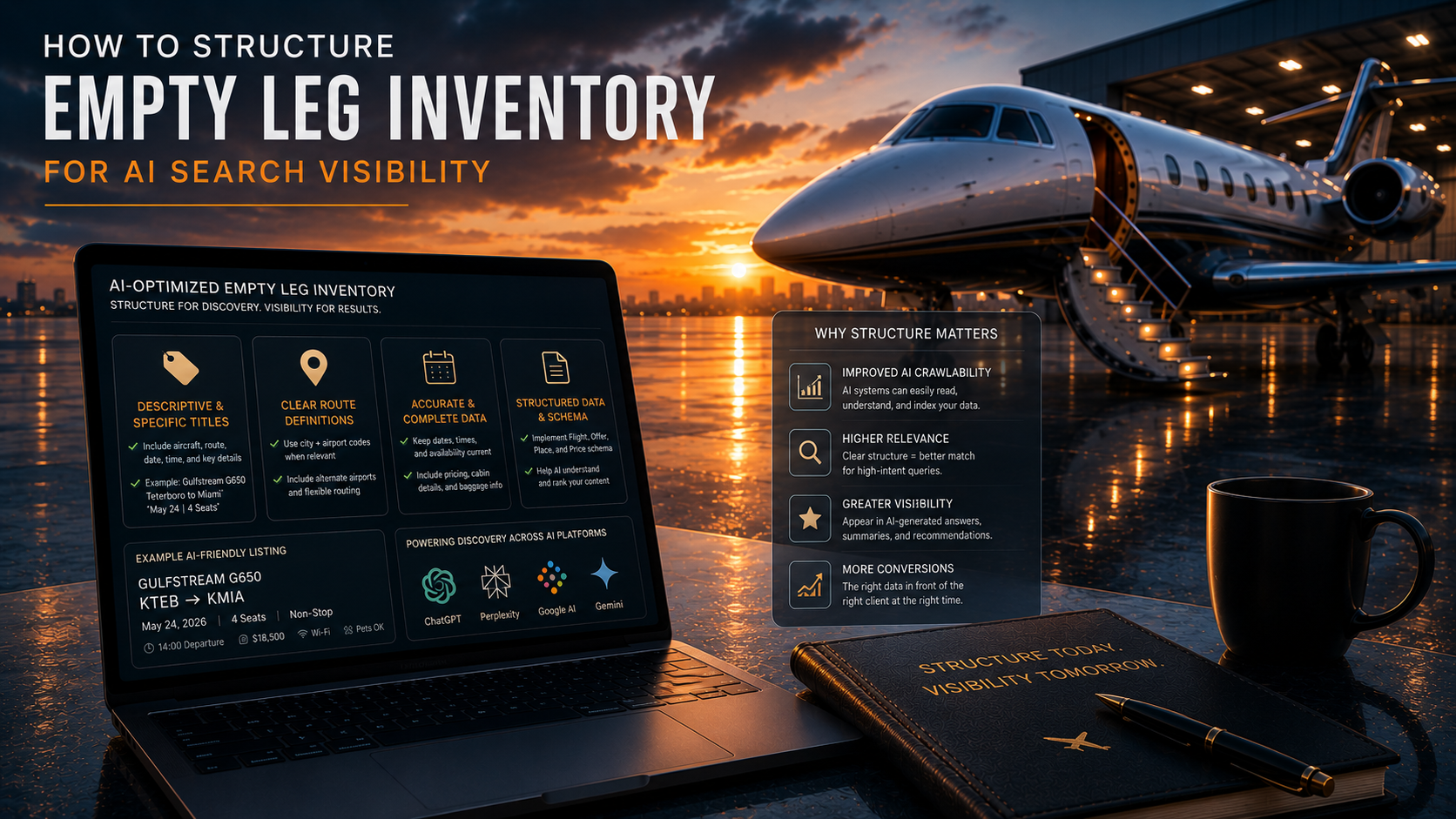
How to Structure Empty Leg Inventory for AI Search Visibility
Direct Answer: Empty leg inventory becomes more visible in AI search when operators structure each flight as a clear, crawlable, route-specific, aircraft-specific, and frequently updated content asset. Therefore, instead of hiding empty legs inside a generic list, charter companies should build inventory hubs, route-pair pages, aircraft pages, airport pages, FAQs, structured data, and conversion paths that help Google, ChatGPT, Gemini, Perplexity, and other answer engines understand which flights are available, where they operate, and who they fit.
Most empty leg marketing is too reactive. A flight appears. Someone adds it to a list. Sales sends a quick email. Then, if nobody books, the aircraft still flies empty. However, AI search creates a new opportunity. Instead of treating empty legs as last-minute discounts, operators can structure inventory as searchable, understandable, and conversion-ready digital assets.
Therefore, the goal is not to “hack” AI search. Instead, the goal is to make inventory easier for search engines, answer engines, assistants, travel coordinators, family offices, and buyers to understand.
Google recommends creating helpful, reliable, people-first content. Additionally, structured data helps Google understand page content and entities. Therefore, empty leg inventory should not live only in a JavaScript table, PDF, or unindexed feed. Instead, it should connect to clear pages, route context, aircraft context, airport context, and schema-supported content. Google Search Central explains helpful content, while Google explains structured data.
Key Takeaways
- Empty leg inventory should be crawlable, structured, and connected to route intent.
- However, most operators hide inventory inside weak lists or temporary posts.
- Therefore, each empty leg should connect to airport, route, aircraft, and conversion context.
- Additionally, recurring empty leg routes should have evergreen route-pair pages.
- Ultimately, AI search visibility comes from clarity, authority, freshness, and entity structure.
Why Empty Leg Inventory Is Invisible to AI Search
Direct Answer: Empty leg inventory is often invisible to AI search because it is temporary, poorly structured, not crawlable, missing context, and disconnected from evergreen authority pages.
Many operators publish empty legs in a table with limited text. However, AI systems need context. A table that says “KTEB → KPBI, Challenger 350, Friday” may help a human who already understands private aviation. However, it does not fully explain route value, aircraft fit, timing flexibility, airport relevance, or buyer suitability.
Common Visibility Problems
- inventory hidden behind forms
- inventory loaded only through JavaScript
- no indexable route pages
- no aircraft context
- no airport context
- no FAQs
- no structured data
- no internal links
- no expired-flight handling
- no conversion-specific CTA
Therefore, the first step is making inventory understandable.
What Is Empty Leg AI Search Visibility?
Direct Answer: Empty leg AI search visibility means structuring inventory so answer engines can understand and potentially surface relevant route, aircraft, airport, and availability information.
This does not mean AI systems will instantly recommend every available flight. However, it does mean your inventory ecosystem becomes easier to understand. Consequently, your brand has a better chance of appearing for route-specific, airport-specific, and empty-leg-related questions.
AI Search Questions to Target
- Are there empty leg flights from Teterboro to Palm Beach?
- How do I find private jet empty legs to Miami?
- What aircraft are commonly available for empty legs to Aspen?
- Can I book a one-way private jet from New York to Florida?
- Which charter companies publish empty leg inventory?
Additionally, these questions often come from flexible, high-intent travelers.
Build an Empty Leg Inventory Hub
Direct Answer: An empty leg inventory hub should act as the central, crawlable, frequently updated page for current and upcoming repositioning opportunities.
This hub should not be a thin list. Instead, it should explain how empty legs work, how inventory changes, which routes appear often, and how travelers should evaluate availability.
Inventory Hub Sections
- current empty leg availability
- how empty legs work
- route flexibility explanation
- aircraft category overview
- popular empty leg routes
- airport-specific inventory links
- FAQ section
- urgent inquiry CTA
- expired inventory explanation
Additionally, the hub should link to evergreen content like The Empty Leg Algorithm and The Empty Leg Retargeting Playbook. As a result, the inventory page becomes part of a larger authority system.
Create Route-Pair Pages for Recurring Empty Legs
Direct Answer: Recurring empty leg routes should have evergreen route-pair pages because the route has lasting search value even when a specific flight expires.
For example, “Teterboro to Palm Beach empty leg” may repeat many times across a season. Therefore, the route deserves a permanent page that explains normal charter options, one-way opportunities, aircraft fit, seasonality, and how to request alerts.
High-Value Empty Leg Route Pages
- Teterboro to Palm Beach empty legs
- Palm Beach to Teterboro empty legs
- Van Nuys to Aspen empty legs
- Miami to Nassau empty legs
- Dallas to Cabo empty legs
- Chicago to Naples empty legs
- London to Nice empty legs
Furthermore, these pages should connect to broader route strategy content like The Route-Pair Strategy. Therefore, empty leg inventory becomes a search asset rather than a temporary post.
When to Create Individual Empty Leg Pages
Direct Answer: Individual empty leg pages make sense when the flight is high-value, has enough booking window, matches a recurring route, or supports a major airport/aircraft content cluster.
Not every empty leg deserves a standalone page. However, certain opportunities are valuable enough to create a temporary inventory page.
Create Individual Pages When
- the route is high demand
- the aircraft is high value
- the booking window is long enough
- the route repeats often
- the flight supports a major airport page
- the page can redirect after expiration
Additionally, expired pages should not become dead ends. Instead, redirect or update them into evergreen route pages, similar-route pages, or empty leg alert pages.
Connect Inventory to Airport Authority Pages
Direct Answer: Empty leg inventory should connect to airport authority pages because buyers often search by departure or arrival airport.
Airport entities matter. Therefore, empty leg pages should link to relevant airport content, and airport pages should link back to current or recurring empty leg opportunities.
Airport Inventory Examples
- Teterboro empty leg flights
- Palm Beach empty leg flights
- Van Nuys empty leg flights
- Aspen empty leg flights
- Miami empty leg flights
- Farnborough empty leg flights
Additionally, airport pages should explain why empty legs appear on that route. This connects directly to Beyond KTEB, because weak airport pages often fail when they do not connect to real route and inventory intent.
Connect Inventory to Aircraft Model Pages
Direct Answer: Empty leg inventory should include aircraft model context because buyers often care about cabin size, range, luggage, route fit, and comfort.
A listing that says “super-midsize jet available” is less useful than a listing that explains the actual aircraft category and mission fit. Therefore, inventory pages should link to aircraft model pages whenever possible.
Aircraft Context Should Include
- aircraft category
- passenger capacity
- luggage suitability
- typical mission fit
- route range suitability
- cabin comfort notes
- airport performance considerations
Additionally, model pages should link back to availability pages when relevant. This supports The Tail Number SEO Strategy, because aircraft-specific search intent can turn inventory into stronger lead generation.
Use Structured Data Carefully
Direct Answer: Structured data should clarify the page, service, FAQs, breadcrumbs, article context, and inventory-related content, but operators should avoid misleading markup for unavailable or expired flights.
Schema helps search systems understand your content. However, it must match the visible page content. Therefore, do not mark up inventory that no longer exists or use inaccurate availability language.
Recommended Schema Types
- Organization
- WebSite
- ProfessionalService
- WebPage
- Article
- FAQPage
- HowTo
- BreadcrumbList
- SpeakableSpecification
Additionally, if you display specific availability, keep dates, routes, and availability language accurate. Therefore, your GEO strategy remains trust-based rather than manipulative.
Freshness, Updates, and Expiration Rules
Direct Answer: Empty leg inventory needs clear freshness rules because availability changes quickly.
AI search visibility depends on trust. Therefore, stale inventory can damage credibility. If an empty leg has expired, the page should say so clearly or redirect to a relevant evergreen option.
Inventory Freshness Rules
- show last updated date
- show availability window
- remove or archive expired flights
- redirect expired flight pages when appropriate
- offer similar route alerts
- do not imply guaranteed availability
- keep aircraft and route details current
As a result, buyers trust the inventory experience more.
Add AI-Friendly Direct Answers
Direct Answer: Empty leg pages should include short answer-ready paragraphs that explain route availability, flexibility, aircraft fit, and next steps.
AI systems often summarize concise explanations. Therefore, pages should include direct answers near the top and throughout the content.
Example Direct Answer
Direct Answer: Empty legs from Teterboro to Palm Beach are most common during high-demand Northeast-to-Florida travel periods. However, availability changes quickly because repositioning flights depend on confirmed one-way charter activity. Therefore, flexible travelers should request alerts and confirm timing with an advisor.
Additionally, direct answers help human readers quickly understand whether the page fits their need.
Conversion Strategy for Empty Leg Pages
Direct Answer: Empty leg pages should convert with urgency, flexibility, and route-specific CTAs instead of generic contact forms.
Empty leg buyers need fast clarity. Therefore, the CTA should ask about route flexibility, timing, passenger count, and aircraft fit.
Strong Empty Leg CTAs
- Check This Empty Leg
- Request Similar Route Alerts
- Review One-Way Availability
- Speak With an Empty Leg Advisor
- Compare Empty Leg and Full Charter Options
Recommended Form Fields
- departure airport
- arrival airport
- preferred date
- flexible travel window
- passenger count
- luggage needs
- phone number
Consequently, sales receives useful qualification data immediately.
Use Retargeting After Inventory Views
Direct Answer: Empty leg inventory visitors should enter retargeting audiences because many flexible travelers will not book the first route they view.
A visitor who checks a Teterboro-to-Palm-Beach empty leg may still be valuable even if that specific flight expires. Therefore, retargeting should show related routes, aircraft options, and alert signups.
Retargeting Audiences
- all empty leg visitors
- specific route visitors
- specific airport visitors
- specific aircraft category visitors
- form starters who did not submit
- expired inventory viewers
- repeat empty leg viewers
Additionally, this supports the broader paid strategy explained in Integrating Your Charter CRM with Your Ad Pixels.
Connect Inventory to CRM Attribution
Direct Answer: Empty leg inventory should connect to the CRM so operators can track which routes, aircraft, airports, and campaigns create qualified opportunities.
Without CRM attribution, empty leg marketing becomes guesswork. Therefore, each inquiry should pass route, aircraft, date, source, campaign, and page information into the CRM.
CRM Fields to Capture
- source page
- route requested
- aircraft category
- departure airport
- arrival airport
- travel flexibility
- lead source
- campaign source
- qualified status
- closed revenue
As a result, leadership can identify which inventory pages create real revenue, not just traffic.
Empty Leg Inventory Content Map
Direct Answer: Empty leg visibility requires a connected system of inventory hubs, route pages, airport pages, aircraft pages, and alert pages.
| Content Asset | Purpose | Example |
|---|---|---|
| Inventory Hub | Central availability page | Current Empty Leg Flights |
| Route Page | Evergreen route authority | Teterboro to Palm Beach Empty Legs |
| Airport Page | Airport demand capture | KTEB Empty Leg Flights |
| Aircraft Page | Aircraft fit explanation | Challenger 3500 Empty Leg Availability |
| Alert Page | Lead capture after expiration | Get Empty Leg Alerts |
| Comparison Page | Decision support | Empty Leg vs On-Demand Charter |
Metrics That Matter
Direct Answer: Empty leg AI search visibility should be measured by inventory engagement, qualified inquiries, route alerts, and revenue recovered.
Track These Metrics
- empty leg page impressions
- inventory page clicks
- route-specific visits
- aircraft-specific visits
- alert signups
- form starts
- qualified inquiries
- response time
- filled empty legs
- revenue recovered
- gross contribution
- repeat traveler conversions
- AI-search visibility
Additionally, track expired inventory behavior. Often, expired pages still create future lead opportunities when they redirect to alerts or similar routes.
Common Empty Leg GEO Mistakes
Direct Answer: Empty leg GEO fails when inventory is hidden, stale, generic, or disconnected from route and aircraft authority.
- hiding inventory behind forms
- using uncrawlable JavaScript lists only
- not creating route-pair pages
- not linking to aircraft pages
- not using airport authority pages
- not adding direct answers
- not handling expired inventory
- using fake urgency
- not tracking CRM outcomes
- not adding schema
- not building retargeting audiences
- not explaining empty leg flexibility clearly
Instead, treat inventory like a structured authority asset.
Frequently Asked Questions
Can empty leg inventory show up in AI search?
Yes, but visibility depends on how clearly the inventory is structured, updated, linked, and supported by route, airport, aircraft, and FAQ content.
Should every empty leg get its own page?
No. Individual pages make sense for high-value, recurring, or longer-window opportunities. Otherwise, use route pages, airport pages, and inventory hubs.
How should expired empty legs be handled?
Expired empty legs should be clearly marked, redirected, or converted into similar-route alert pages so users do not reach dead inventory.
What schema should empty leg pages use?
Most empty leg content can use Organization, WebSite, ProfessionalService, WebPage, Article, FAQPage, HowTo, BreadcrumbList, and SpeakableSpecification schema.
What is the best CTA for empty leg pages?
The best CTAs are route-specific, such as “Check This Empty Leg,” “Request Similar Route Alerts,” or “Review One-Way Availability.”
External Sources
Conclusion
Direct Answer: Empty leg inventory becomes more visible in AI search when operators structure it as a connected, crawlable, route-specific, aircraft-aware, and frequently updated authority system.
Most operators still treat empty legs like temporary discounts. However, the stronger strategy treats inventory as Digital Real Estate. Therefore, every route, airport, aircraft, alert signup, and inventory hub becomes another signal that helps buyers and AI systems understand what your company can provide.
Ultimately, the operator that structures inventory clearly will have an advantage over competitors that hide flights in generic lists, stale pages, or sales-only workflows.
Final Insight: AI search cannot prioritize inventory it cannot understand. Structure the inventory clearly, connect it to authority pages, update it honestly, and make the next step obvious.
About the author : Anthony Paulino