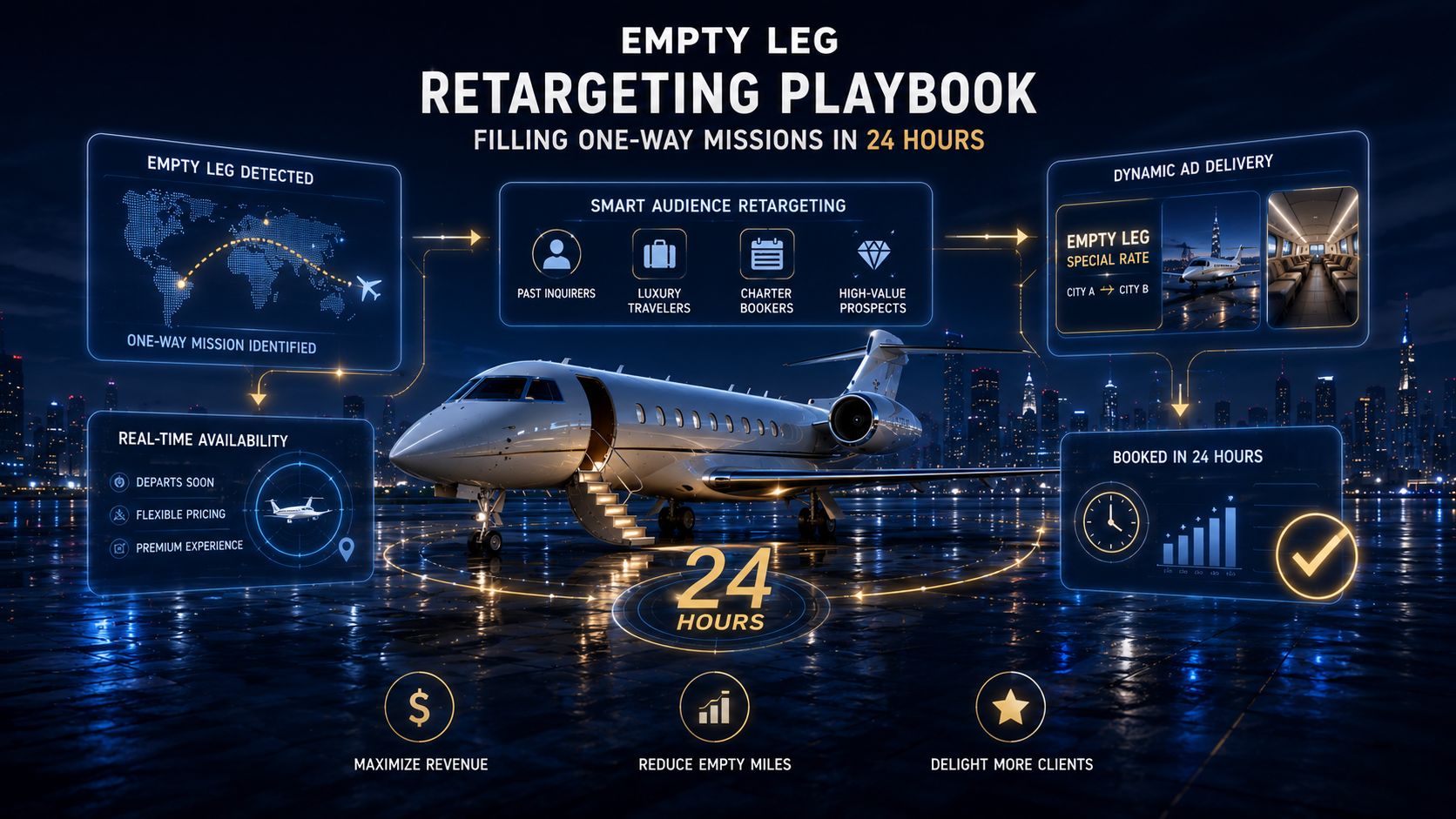
The “Empty Leg” Retargeting Playbook: Filling One-Way Missions in 24 Hours
Direct Answer: The Empty Leg Retargeting Playbook is a 24-hour private aviation marketing system that uses route intent, website behavior, CRM data, Meta retargeting, email, SMS, and fast sales follow-up to place one-way charter opportunities in front of the right buyers before the aircraft repositioning window closes. Therefore, instead of treating empty legs like last-minute leftovers, you turn them into targeted urgency campaigns.
Empty legs create a unique marketing problem. The opportunity has real value, but the window is short. Meanwhile, broad ads usually waste time because most people are not ready to fly that specific route. Therefore, the winning strategy is not “show this flight to everyone.” Instead, the winning strategy is “show this mission to people who already showed interest in the aircraft, airport, destination, route type, or travel pattern.”
Additionally, empty leg campaigns require trust and discretion. UHNWI buyers do not want spammy “deal” messaging that feels cheap. However, they may respond well to a private, relevant availability alert if the route, timing, aircraft class, and next step make sense. As a result, the offer should feel selective, useful, and time-sensitive without feeling desperate.
Meta explains that website custom audiences can help advertisers reach people who have already shown interest in a business, while custom audiences can also use advertiser data sources and engagement data. Therefore, empty leg retargeting works best when your website, CRM, and Meta audiences are already organized by route, aircraft, airport, and buyer intent. Meta explains website custom audiences and Meta explains custom audiences.
Key Takeaways
- Empty leg retargeting works because urgency meets known travel intent.
- However, broad discount ads usually attract low-quality attention.
- Therefore, campaigns should segment by route, airport, aircraft, and past engagement.
- Additionally, CRM and sales follow-up must move faster than normal campaigns.
- Ultimately, the goal is not cheap clicks. Instead, it is fast, qualified mission matching.
What Is Empty Leg Retargeting?
Direct Answer: Empty leg retargeting is a time-sensitive ad and follow-up system that promotes one-way private jet availability to people who already showed relevant travel intent.
An empty leg usually exists because an aircraft needs to reposition after a booked mission or move into position for the next one. Therefore, the operator may have a one-way opportunity that can be sold at a more attractive rate than a normal on-demand charter. However, the route and timing are fixed or limited.
Because of that, the marketing must move quickly. Additionally, it must target people who are more likely to care about that exact route. A random luxury audience is usually too broad. Instead, a better audience may include people who visited a related route page, viewed a nearby airport page, watched destination-specific content, or submitted a similar inquiry before.
Action Step: Treat every empty leg as a temporary route-pair campaign, not a generic deal blast.
Why Empty Legs Are Hard to Fill
Direct Answer: Empty legs are hard to fill because they have fixed timing, fixed routing, limited flexibility, and a short sales window.
Even if the price is attractive, the buyer must match the mission. Therefore, the ideal prospect needs the right departure area, destination area, travel timing, aircraft fit, and decision speed. That is a narrow market.
Additionally, many aviation marketers make the mistake of leading with discount language. However, UHNWI buyers often respond better to relevance than discounting. Therefore, the message should emphasize private availability, route fit, aircraft class, and limited timing.
Proof Breadcrumb: empty leg value + wrong audience = wasted urgency. Empty leg value + route-intent audience = real opportunity.
The 24-Hour Empty Leg Formula
Direct Answer: The 24-hour formula combines prebuilt audiences, route-specific creative, a fast landing page, qualifying forms, and immediate follow-up.
Use this formula:
Empty Leg Fill Rate = Route Match × Audience Warmth × Offer Clarity × Response Speed × Sales Follow-Up
First, the route must match a real buyer pattern. Next, the audience must already show relevant intent. Additionally, the offer must explain the aircraft, route, timing, and limitations clearly. Meanwhile, response speed must be immediate because the mission window is short. Finally, sales follow-up must qualify and close quickly.
Therefore, the campaign should be built before the empty leg appears. Otherwise, the opportunity may expire before the marketing system learns.
Step 1: Build Route and Airport Audiences Before You Need Them
Direct Answer: The best empty leg campaigns start weeks or months before the aircraft needs to move.
Retargeting only works when audiences already exist. Therefore, your website should build intent pools every day through aircraft pages, airport pages, route-pair pages, empty leg guides, and destination content.
Audience Pools to Build
- Visitors to empty leg pages
- Visitors to specific route-pair pages
- Visitors to departure airport pages
- Visitors to destination airport pages
- Visitors to aircraft model pages
- Visitors to pricing guide pages
- Video viewers from destination or route content
- Past leads with route or region interest
- CRM contacts who requested similar missions
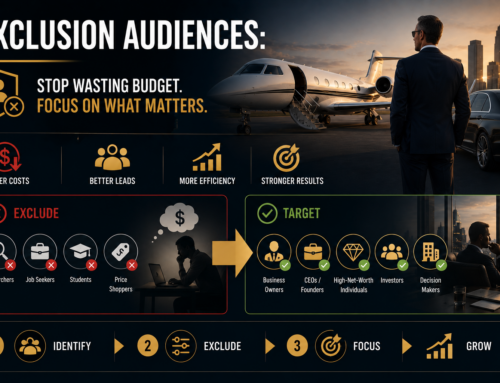
Additionally, create exclusion lists for unqualified leads, job applicants, vendors, and irrelevant engagement audiences. As a result, the campaign spends more efficiently when time matters.
Action Step: Build one custom audience for every major airport and route cluster. Then keep those audiences active year-round.
Step 2: Trigger the Campaign When the Empty Leg Appears
Direct Answer: Once an empty leg appears, launch the campaign immediately with route, aircraft, and timing details.
The campaign brief should answer five questions before any ad goes live:
- What is the departure airport or region?
- What is the arrival airport or region?
- What aircraft class or aircraft model is available?
- What date and time window matters?
- What flexibility exists, if any?
Then, create the fastest compliant campaign possible. However, do not rush into vague messaging. Instead, keep the offer precise because specificity improves qualification.
Action Step: Create an “Empty Leg Launch Sheet” template inside your operations or marketing workflow. Then fill it out every time an aircraft becomes available.
Step 3: Match the Empty Leg to the Right Buyer Segments
Direct Answer: Match each empty leg to audiences based on departure area, destination area, aircraft class, and past behavior.
For example, a Palm Beach to Aspen empty leg should not only target general private aviation audiences. Instead, it should target:
- KPBI page visitors
- Aspen route page visitors
- ski travel content viewers
- super midsize or heavy jet page visitors
- past Palm Beach leads
- past Colorado or ski-destination inquiries
Additionally, create a secondary audience for broader high-intent aviation engagers. However, keep budget priority on the strongest route matches first. Therefore, the campaign starts with relevance before expanding.
Action Step: Rank audience segments from “closest route match” to “broad aviation interest.” Then allocate budget in that same order.
Step 4: Write Ads That Create Urgency Without Looking Cheap
Direct Answer: Empty leg ads should feel timely, private, and relevant rather than discounted, desperate, or mass-market.
Private aviation buyers value discretion. Therefore, avoid language like “cheap private jet deal” or “huge discount.” Instead, use language that positions the opportunity professionally.
Better Empty Leg Messaging
- Private one-way availability from Palm Beach to Aspen
- Limited heavy jet availability for a South Florida departure
- One-way charter opportunity to the Bahamas this week
- Available repositioning flight for qualified travelers
- Route-specific availability for flexible departure timing
Additionally, include clear limitations. For example, if timing is fixed, say so. If departure can shift within a small window, say so. As a result, the lead quality improves.
Action Step: Write three ad angles: route-first, aircraft-first, and timing-first. Then test which angle creates better qualified conversations.
Step 5: Build a Fast Landing Page for the Specific Mission
Direct Answer: Every empty leg campaign should send traffic to a route-specific page, not a generic charter page.
The landing page should answer the exact mission quickly. Therefore, it should include only the details needed to create confidence and action.
Empty Leg Landing Page Sections
- Direct answer summary
- Departure and arrival route
- Available date or timing window
- Aircraft class or model
- Passenger fit
- Luggage considerations
- Flexibility notes
- Pricing variable explanation
- Urgent CTA
- Short FAQ
However, do not publish fake details. If exact pricing requires confirmation, explain that pricing depends on mission fit, fees, timing, and aircraft availability. Therefore, the page stays accurate while still moving the buyer forward.
Action Step: Build a reusable empty leg landing page template so the team can launch a route page quickly.
Step 6: Use Lead Forms That Qualify Immediately
Direct Answer: Empty leg lead forms should qualify route fit, timing fit, and decision readiness in seconds.
Because empty legs expire quickly, the form should not only collect contact information. Instead, it should tell the sales team whether the lead can actually use the mission.
Empty Leg Form Questions
- Can this departure city or airport work for you?
- Can this destination city or airport work for you?
- Can you travel within this timing window?
- How many passengers?
- Do you have luggage, pets, or special requirements?
- Are you ready to confirm if the aircraft fits?
- What is the fastest way to reach you?
Additionally, include phone and SMS options. As a result, the team can respond quickly while the buyer is still engaged.
Step 7: Add Email, SMS, and CRM Follow-Up
Direct Answer: Empty leg retargeting needs immediate follow-up because a slow response can kill the opportunity.
After a lead submits, the CRM should route the opportunity instantly. Then, the system should trigger a call, SMS, and email sequence. However, keep the message professional and concise.
Fast Follow-Up Sequence
- Minute 0: CRM creates lead and tags route source.
- Minute 1: Sales receives alert with route, aircraft, and timing.
- Minute 2: Lead receives SMS confirming availability review.
- Minute 5: Sales calls the lead.
- Minute 10: Email sends route details and next steps.
- Hour 2: Retargeting reminder continues if no response.
Therefore, the empty leg system should function more like a live booking desk than a normal lead funnel.
Action Step: Create a dedicated empty leg pipeline inside your CRM with route, timing, passenger count, and qualification fields.
Step 8: Retarget by Click, Form Open, and Route Interest
Direct Answer: After launch, retarget users based on how close they came to action.
Someone who watched a video needs education. However, someone who opened the form may only need urgency and reassurance. Therefore, retargeting should change by behavior.
Behavior-Based Retargeting
- Page viewer: Show route reminder.
- Long page engagement: Show aircraft or timing clarification.
- Form opener: Show urgency and advisor support.
- Past lead: Send CRM-driven email or SMS follow-up.
- Similar route visitor: Show alternate route availability.
Additionally, cap frequency so the campaign does not feel intrusive. Therefore, the buyer sees useful reminders without feeling chased.
The 24-Hour Campaign Timeline
Direct Answer: The 24-hour timeline should move from launch to lead capture to direct sales follow-up as quickly as possible.
| Time Window | Action | Goal |
|---|---|---|
| Hour 0 | Confirm route, aircraft, timing, and flexibility | Build accurate campaign brief |
| Hour 1 | Launch landing page and audience match | Create route-specific destination |
| Hours 1–2 | Launch Meta ads and CRM alerting | Start immediate demand capture |
| Hours 2–6 | Run first retargeting wave | Reach warm route and airport audiences |
| Hours 6–12 | Review lead quality and adjust budget | Shift spend toward strongest audience |
| Hours 12–18 | Push urgency follow-up to engaged users | Convert form openers and page engagers |
| Hours 18–24 | Final availability push | Fill mission before window closes |
Empty Leg Creative Examples
Direct Answer: Empty leg creative should lead with route, timing, and aircraft fit.
Route-First Ad
Headline: One-Way Private Jet Availability: Palm Beach to Aspen
Body: A limited one-way charter opportunity is available for flexible travelers heading from South Florida to Aspen. Request route details and timing options.
Aircraft-First Ad
Headline: Heavy Jet Availability for a South Florida Departure
Body: A one-way heavy jet mission may fit qualified travelers planning a premium departure from South Florida. Check availability before the window closes.
Timing-First Ad
Headline: Private One-Way Mission Available This Week
Body: If your schedule is flexible, a private one-way opportunity may align with your route. Request details now.
Additionally, create creative variants for each audience segment. Therefore, a route visitor sees route language, while an aircraft visitor sees aircraft language.
Metrics That Matter
Direct Answer: Empty leg campaigns should measure qualified route fit, not only clicks or lead volume.
Track These Metrics
- Cost per qualified route lead
- Lead-to-call speed
- Route match rate
- Timing match rate
- Aircraft fit rate
- Form open rate
- Form completion rate
- Booked conversation rate
- Filled mission rate
- Revenue recovered from empty leg
Additionally, track which audience produced the actual buyer. As a result, future empty leg campaigns launch with better data.
Common Empty Leg Retargeting Mistakes
Direct Answer: Empty leg campaigns fail when marketers treat them like generic discount ads instead of mission-specific urgency plays.
- Launching broad ads with no route targeting
- Using cheap or desperate language
- Sending traffic to a generic charter page
- Waiting too long to launch
- Not prebuilding route audiences
- Not qualifying travel timing
- Failing to alert sales immediately
- Ignoring CRM route history
- Retargeting everyone with the same message
- Measuring CPL instead of mission fit
Instead, build the audience system before the empty leg appears. Then, when the mission opens, you can move fast.
Frequently Asked Questions
What is empty leg retargeting?
Empty leg retargeting is a private aviation marketing strategy that promotes one-way aircraft availability to people who already showed relevant route, airport, aircraft, or travel intent.
Can Meta Ads help fill empty legs?
Yes. However, Meta Ads work best when the campaign uses warm audiences, route-specific creative, qualifying forms, and immediate sales follow-up.
Should empty leg ads lead with discounts?
No. Empty leg ads should lead with route relevance, aircraft availability, timing, and private mission fit rather than cheap discount language.
How fast should sales follow up with empty leg leads?
Sales should follow up within minutes because empty leg opportunities have short timing windows and buyers may contact multiple providers.
What audiences work best for empty leg campaigns?
The best audiences include route-page visitors, airport-page visitors, aircraft-page visitors, pricing-page visitors, past similar-route leads, and CRM contacts with matching travel patterns.
External Sources
Conclusion
Direct Answer: The Empty Leg Retargeting Playbook fills one-way missions faster by matching route-specific availability with people who already showed relevant intent.
Empty legs expire quickly. Therefore, the marketing system must already exist before the opportunity appears. Build route audiences, airport audiences, aircraft audiences, CRM segments, landing page templates, qualifying forms, and sales alerts in advance. Then, when a one-way mission opens, you can launch within hours instead of starting from zero.
Final Insight: Empty legs are not random discounts. Instead, they are time-sensitive mission matches. The faster you connect the right aircraft to the right buyer, the more revenue you recover.
About the author : Anthony Paulino