Exclusion Audiences: How to Stop Showing Ads to $200-Per-Hour “Dreamers” and Focus on $20,000-Per-Hour “Principals”
Direct Answer: Private aviation companies should use exclusion audiences to reduce wasted ad spend on low-intent luxury browsers, aviation hobbyists, price shoppers, and unqualified form fillers. Therefore, the goal is not more impressions, clicks, or generic leads. Instead, the goal is more principal-level conversations with UHNWIs, family offices, executive assistants, corporate travel managers, aircraft owners, and decision makers who can actually book, manage, or influence private aviation spend.
Private aviation marketing has a volume problem. Not because there are not enough people interested in jets. In fact, the opposite is true. Too many people are interested in jets, luxury travel, cockpit videos, celebrity flights, and aspirational lifestyle content.
However, interest does not equal buying power.
A campaign can generate thousands of clicks from people who love private jets and still produce no meaningful charter revenue. Meanwhile, a smaller campaign can generate only a handful of inquiries and still produce six or seven figures in lifetime value if those inquiries come from the right principals, family offices, or executive teams.
Therefore, the best private aviation marketing systems do not only target better people. They also exclude the wrong people.
That is the real power of exclusion audiences.
Google recommends helpful, reliable, people-first content, and structured data helps search systems understand page content. Therefore, private aviation companies should combine paid targeting with useful route content, aircraft content, safety content, privacy resources, and CRM attribution so campaigns optimize around real business outcomes instead of vanity metrics. Google explains helpful content, and Google explains structured data.
Key Takeaways
- Private aviation campaigns should optimize for qualified principal conversations, not broad luxury engagement.
- However, many campaigns waste budget on dreamers, hobbyists, students, career seekers, and price shoppers.
- Therefore, exclusion audiences help protect spend, sales time, CRM quality, and brand positioning.
- Additionally, family offices, executive assistants, chiefs of staff, and corporate travel managers may research before the principal appears.
- Ultimately, the strongest campaigns attract the right buyers while quietly filtering out everyone else.
Why Charter Operators Optimize for the Wrong Metrics
Direct Answer: Many charter operators optimize for clicks, impressions, and lead volume when they should optimize for qualified consultations, principal conversations, booked flights, and revenue per audience segment.
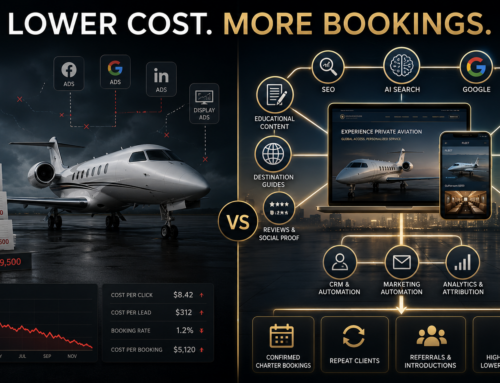
Most ad platforms reward activity. They show impressions, clicks, view rates, form fills, engagement, and cost per lead. Those numbers matter because they help diagnose campaign performance. However, they do not prove that the campaign reached anyone with the ability or intent to book private aviation.
In private aviation, a low-cost lead can be extremely expensive if it wastes the sales team’s time. Meanwhile, a high-cost lead can be profitable if it turns into a qualified charter client, membership inquiry, aircraft management opportunity, or repeat corporate account.
The Vanity Metrics Trap
- high impressions from unqualified users
- cheap clicks from aviation enthusiasts
- form fills from price shoppers
- video views from luxury content consumers
- engagement from people who cannot book
- website traffic that never reaches route or quote intent
Therefore, private aviation marketers need a different scoreboard. The campaign should not be judged by how many people noticed the ad. Instead, it should be judged by whether the right people moved closer to a qualified conversation.
The $200-Per-Hour vs. $20,000-Per-Hour Framework
Direct Answer: The $200-per-hour vs. $20,000-per-hour framework separates people who are interested in private aviation from people whose time, role, or financial position makes private aviation economically rational.
Private aviation is not only a luxury purchase. For the right buyer, it is a time-compression tool. A principal who values an hour at $20,000, $50,000, or more may justify private aviation because commercial travel creates opportunity cost, privacy risk, schedule friction, and lost productivity.
However, a person who enjoys jet content but does not control that level of time value may behave like a prospect online without ever becoming one in reality.
The Dreamer Audience
- aviation hobbyists
- luxury lifestyle followers
- aspirational travel fans
- celebrity jet watchers
- students researching aviation careers
- people looking for “cheap private jet” content
- users who engage with every jet video but never request serious availability
The Principal Audience
- founders
- CEOs
- private equity partners
- family office principals
- UHNW families
- aircraft owners
- board members
- high-value corporate travel decision makers
As a result, the campaign should not simply ask, “Who likes private jets?” Instead, it should ask, “Whose time, schedule, privacy needs, or decision power makes private aviation a rational solution?”
Who Are the Dreamers?
Direct Answer: Dreamers are people who engage with private aviation content but do not have the intent, authority, timing, or buying power to become profitable clients.
Dreamers are not bad people. In many cases, they may love aviation. However, they are not the audience a charter operator should pay heavily to reach if the goal is booked revenue.
Dreamer Behavior Often Looks Like
- clicking lifestyle ads but never viewing route pages
- watching jet videos repeatedly without taking action
- asking broad pricing questions with no route or timeline
- submitting forms without a real travel date
- requesting unrealistic discounts
- researching aircraft for entertainment
- engaging with celebrity or luxury content but not operator content
Additionally, dreamers can distort campaign data. If an algorithm sees that low-intent users click often, it may find more users like them. Consequently, the campaign can drift toward cheap engagement instead of profitable demand.
Who Are the Principals?
Direct Answer: Principals are the people who either control private aviation spending directly or influence the decision on behalf of someone who does.
A principal may be the traveler. However, in private aviation, the person completing the research or form may also be a trusted operator of the principal’s life or business.
Principal-Level Buyers and Influencers
- business owners booking multi-city travel
- founders managing investor meetings
- private equity partners traveling between portfolio companies
- family offices arranging seasonal travel
- executive assistants managing complex calendars
- chiefs of staff coordinating secure movement
- corporate travel leaders supporting leadership teams
- aircraft owners comparing management options
Therefore, the right marketing system should not only target wealth. It should target authority, logistics responsibility, mission complexity, and timing.
Why Wealth Rarely Looks Wealthy Online
Direct Answer: Wealth often does not look wealthy online because many UHNWIs do not publicly engage with luxury content, influencer pages, or obvious status signals.
This is one of the biggest private aviation targeting mistakes. Marketers assume wealthy buyers behave like luxury followers. Sometimes they do. However, many principals keep a low profile. They may follow industry news, investment content, business strategy, philanthropy, policy, real estate, healthcare, or family office topics instead.
Therefore, targeting generic luxury interests can overreach into an audience full of people who admire private aviation but cannot buy it.
Hidden Wealth Signals May Include
- business ownership behavior
- family office research
- investment content consumption
- private equity and M&A interest
- high-value route research
- airport and FBO searches
- membership and jet card comparisons
- aircraft management content
- privacy and security content
This connects closely to How to Use Hidden Wealth Keywords to Target Non-Showy UHNWIs, because the strongest signals are often practical, not flashy.
What Exclusion Audiences Actually Do
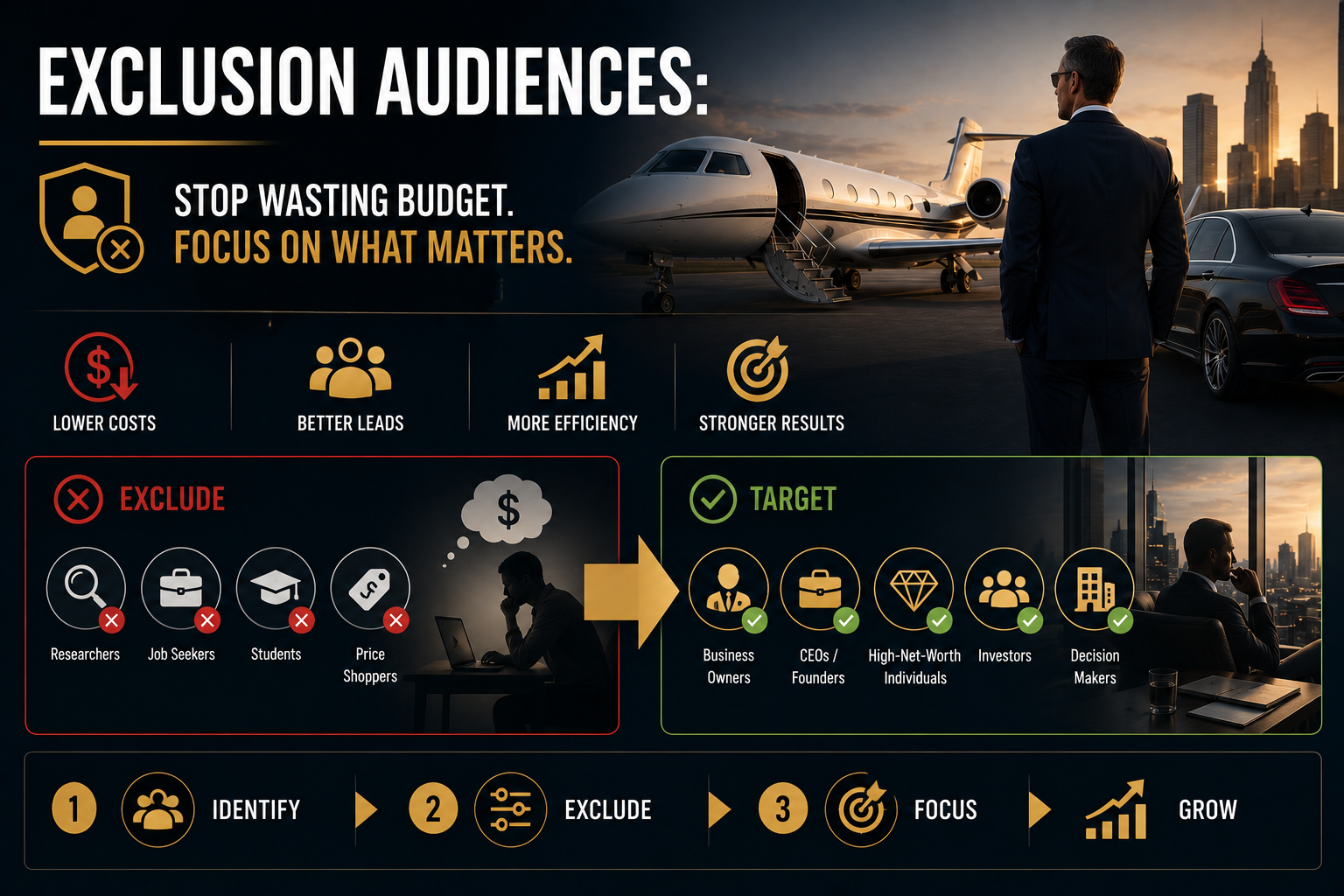
Direct Answer: Exclusion audiences remove low-value users from campaigns so budget, reporting, and sales follow-up concentrate on more qualified prospects.
Most marketers think about who to include. However, in private aviation, who you exclude can be just as important. When low-value users repeatedly engage with ads, the platform may optimize toward them. Therefore, exclusion audiences help protect the algorithm from learning the wrong lesson.
Common Exclusion Groups
- previously disqualified leads
- career seekers
- students and aviation training researchers
- aviation hobbyist traffic with no buyer intent
- low-value repeat form fillers
- non-service-area traffic
- job applicants
- vendor solicitations
- users who only consume lifestyle content
Additionally, exclusions improve sales team morale. When the CRM contains fewer unqualified inquiries, the sales team can respond faster and with more confidence.
Behavioral Exclusions That Protect Budget
Direct Answer: Behavioral exclusions help remove users whose actions show curiosity but not real buying intent.
Not every website visitor deserves continued ad spend. For example, someone who views “private jet careers” or “how much do pilots make” may be valuable for recruitment, but not for charter acquisition. Likewise, someone who visits only lifestyle imagery and never route, aircraft, safety, or availability pages may be lower priority.
Exclude or Suppress Users Who
- visit career pages but not charter pages
- engage with lifestyle content only
- submit unqualified forms repeatedly
- search for unrealistic low-cost charter terms
- visit aircraft content only as hobby research
- consume content outside the service region repeatedly
- never reach a route, aircraft, membership, or quote-intent page
However, exclusions should be used carefully. A wealthy principal may browse quietly before taking action. Therefore, behavioral exclusions should focus on repeated low-intent patterns, not a single early-stage visit.
Intent Signals That Matter More Than Luxury Interests
Direct Answer: Route, aircraft, airport, safety, membership, privacy, and aircraft management signals usually indicate stronger buying intent than broad luxury interests.
Private aviation buyers often reveal intent through mission research. They are not always liking jet photos. Instead, they are trying to solve a route, timing, privacy, or operational problem.
High-Intent Content Signals
- route-pair pages
- airport/FBO pages
- aircraft comparison pages
- jet card vs charter pages
- membership pages
- empty leg inventory pages
- aircraft management pages
- ARGUS/Wyvern safety pages
- privacy and anonymity pages
Consequently, the highest-value audiences often come from behavior around practical aviation decisions, not luxury inspiration.
This supports the logic in Mapping the Customer Journey, because principal-level intent often begins months before the booking.
The Principal-Only Funnel
Direct Answer: A principal-only funnel qualifies prospects before sales invests significant time, so the team focuses on high-value conversations instead of generic leads.
Most weak funnels look like this:
Traffic → Form Submission → Sales Call
That structure creates volume but not necessarily quality. A stronger private aviation funnel looks like this:
Traffic → Intent Page → Qualification → CRM Scoring → Retargeting → Consultation → Booking
What Changes
- traffic is filtered by content behavior
- forms ask mission-specific questions
- CRM fields score fit and authority
- retargeting adapts to route or service interest
- sales receives context before the first call
- reporting connects campaigns to booked revenue
Therefore, the funnel stops treating every form fill equally. Instead, it moves high-fit prospects faster while nurturing or filtering everyone else.
Qualification Questions That Improve Lead Quality
Direct Answer: Private aviation forms should qualify mission, timing, route, passenger count, decision role, and service type without creating unnecessary friction.
Luxury campaigns often use overly simple forms because they want more leads. However, in private aviation, more leads can become a problem if most are unqualified. Therefore, the form should protect the sales team while still feeling appropriate for a high-end buyer.
Useful Qualification Fields
- departure city or airport
- destination city or airport
- expected travel window
- passenger count
- one-way, round-trip, or multi-leg
- charter, membership, jet card, or aircraft management interest
- decision role
- best contact method
- urgency level
Additionally, the CTA should match buyer intent. “Request a Quote” is useful for urgent missions. However, “Review My Route,” “Compare Aircraft for This Trip,” or “Discuss Membership Options” may work better for high-value research-stage prospects.
CRM Attribution: The Revenue Filter
Direct Answer: CRM attribution separates audiences that create engagement from audiences that create revenue.
Without CRM attribution, the marketing team may optimize for leads that never become flights. However, once campaigns connect to CRM outcomes, the operator can identify which audiences produce consultations, bookings, repeat trips, and management conversations.
Track These CRM Fields
- lead source
- campaign
- route
- aircraft interest
- service type
- decision role
- urgency
- qualified or disqualified
- consultation completed
- quote issued
- flight booked
- revenue
- repeat booking potential
As a result, future budget decisions become much clearer. The operator can stop funding audience segments that look good in ad dashboards but fail inside the CRM.
Retargeting Without Chasing Dreamers
Direct Answer: Retargeting should prioritize meaningful aviation intent instead of retargeting every website visitor equally.
Generic retargeting can create waste. If every visitor gets the same ad, the operator may keep paying to reach low-value users. Therefore, retargeting should segment visitors by behavior and intent.
High-Value Retargeting Segments
- route page visitors
- aircraft comparison visitors
- membership content visitors
- aircraft management visitors
- safety content visitors
- privacy content visitors
- empty leg inventory visitors
- form starters who did not submit
Retargeting Messages Should Match Intent
- route visitors: “Review aircraft options for your route.”
- membership visitors: “Compare charter, jet cards, and membership models.”
- safety visitors: “Understand operator safety standards before booking.”
- privacy visitors: “Plan discreet private aviation with confidence.”
Consequently, the campaign feels more useful and less generic.
How This Applies to Google, Meta, LinkedIn, and GEO
Direct Answer: Exclusion strategy applies across paid search, paid social, professional targeting, retargeting, and AI-search visibility.
Google Ads
Google Ads should use negative keywords, route-intent segmentation, location filtering, and conversion tracking that prioritizes qualified consultations over raw leads.
Meta Ads
Meta campaigns should suppress low-quality lead groups, retarget high-intent site behavior, and avoid optimizing only for cheap form fills.
LinkedIn can support executive, founder, family office, and corporate travel audience strategies. However, it still needs qualification and CRM feedback to avoid expensive noise.
GEO and AI Search
GEO helps operators appear when buyers ask AI systems practical questions about routes, aircraft, safety, memberships, or privacy. Therefore, strong content can attract principal-level intent before a paid ad ever appears.
The Real KPIs for Private Aviation Advertising
Direct Answer: The most important KPIs are cost per qualified consultation, cost per principal conversation, cost per booked flight, and revenue per audience segment.
Clicks and leads still matter. However, they are diagnostic metrics, not final success metrics.
Track These Metrics
- cost per qualified consultation
- cost per principal conversation
- cost per booked flight
- revenue per lead source
- revenue per audience segment
- route interest by campaign
- repeat booking rate
- CRM disqualification rate
- sales time wasted on unqualified leads
- lifetime value by source
Therefore, the best campaign is not always the cheapest campaign. It is the campaign that creates profitable private aviation conversations with the least waste.
Common Mistakes
Direct Answer: Private aviation campaigns underperform when they attract attention from people who admire jets but cannot buy or influence private aviation services.
- targeting luxury interests instead of mission intent
- optimizing for cheap leads
- not using exclusions
- not separating dreamers from principals
- not tracking CRM revenue
- not building family office content
- not targeting executive assistant behavior
- retargeting every visitor equally
- using generic luxury messaging
- not qualifying forms
- ignoring route and aircraft research behavior
- not building GEO-ready answer content
Instead, operators should build a system that attracts real decision power and filters low-intent attention before it becomes a sales burden.
Frequently Asked Questions
What is an exclusion audience?
An exclusion audience removes specific users from an advertising campaign so the budget can focus on better-fit prospects.
Why are exclusion audiences important in private aviation?
They reduce wasted spend on aviation hobbyists, luxury browsers, career seekers, and unqualified leads while improving focus on principals and decision makers.
Who should private aviation companies target?
They should target principals, business owners, UHNW families, family offices, executive assistants, chiefs of staff, corporate travel managers, and aircraft owners.
What is the best KPI for private aviation ads?
Cost per qualified consultation, cost per principal conversation, cost per booked flight, and revenue per audience segment are usually more useful than cost per click.
Why do luxury audiences sometimes underperform?
Luxury audiences often include many aspirational users. However, actual buyers may show intent through routes, aircraft comparisons, safety research, privacy needs, or business travel behavior.
External Sources
Conclusion
Direct Answer: Exclusion audiences help private aviation companies protect budget, improve lead quality, and focus sales time on people who can actually book, manage, or influence private aviation spend.
The goal is not to reach everyone who likes private jets. That audience is too broad, too noisy, and often too expensive to serve. Instead, the goal is to reach the small group of people whose time, role, privacy needs, route requirements, or financial position make private aviation a rational decision.
Therefore, the strongest private aviation campaigns attract principals and filter dreamers. They combine intent signals, exclusion audiences, CRM attribution, qualification systems, retargeting, and GEO-ready content.
Final Insight: In private aviation, the best marketing does not chase attention. It protects attention for the people who can turn it into booked revenue.
About the author : Anthony Paulino