The 5 Must-Read Books Before Building Your First Sales Funnel
A sales funnel can look impressive and still fail completely. After all, attractive landing pages cannot rescue a weak offer, confusing message, poor lead source, or unconvincing sales process.
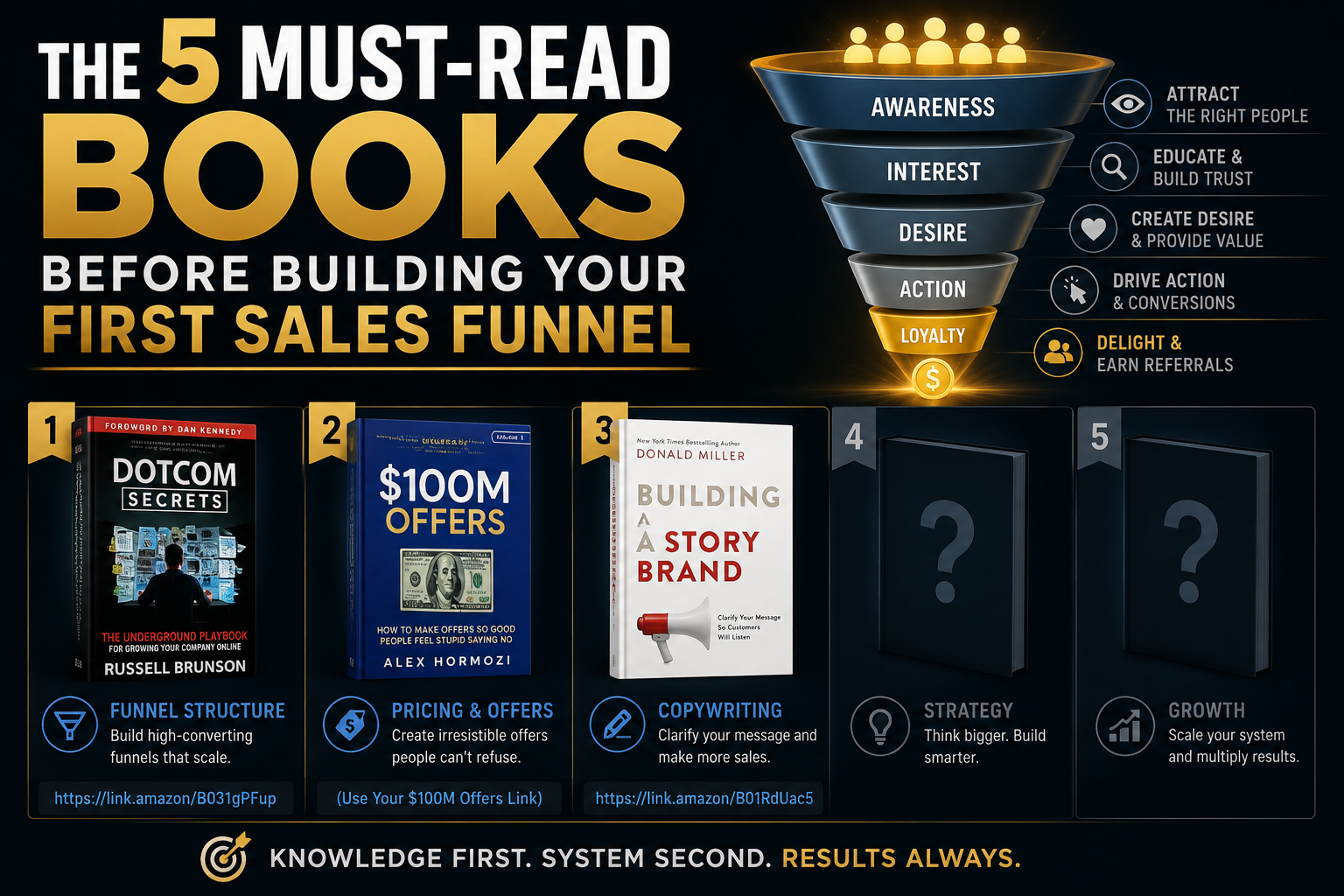
Direct Answer: The five best books to read before building your first sales funnel are DotCom Secrets, $100M Offers, Building a StoryBrand, Influence, and $100M Leads. Together, they explain funnel architecture, offer creation, clear messaging, buyer psychology, and predictable lead generation.
Therefore, the smartest way to build a funnel is not to begin with software. Instead, begin by understanding what must happen inside the buyer’s mind from the first click to the final purchase.
First, the buyer must enter through the correct message. Next, the buyer must understand the problem and believe your solution fits. Then, the offer must feel valuable enough to justify action. Finally, the funnel must reduce uncertainty, answer objections, and make the next step easy.
However, most beginners reverse that order.
They choose a funnel builder, copy a template, write a headline, add a form, and start buying traffic. Consequently, they discover too late that the pages were never connected to a strong strategy.
This reading list prevents that mistake.
Each book solves a different part of the funnel:
- DotCom Secrets explains funnel structure and value ladders.
- $100M Offers explains offer design and pricing.
- Building a StoryBrand explains clear customer-centered messaging.
- Influence explains persuasion and buyer psychology.
- $100M Leads explains how to create demand and fill the funnel.
Ultimately, these five books form a practical sales funnel curriculum. Although none of them replaces execution, together they can prevent many of the expensive mistakes beginners make before launching their first campaign.
Key Takeaways
- A funnel is a guided buying journey, not merely a collection of web pages.
- Therefore, funnel strategy should begin before choosing software.
- DotCom Secrets explains how offers and pages connect across a value ladder.
- Meanwhile, $100M Offers explains how to create an offer buyers perceive as highly valuable.
- Building a StoryBrand helps businesses communicate clearly and keep the customer at the center of the message.
- Additionally, Influence explains the psychological principles that reduce uncertainty and support action.
- Finally, $100M Leads explains how to generate enough qualified attention to test and scale the funnel.
- Consequently, reading all five creates a stronger foundation than copying a funnel template alone.
Why Should You Read These Books Before Building a Funnel?
Sales funnel software makes page creation easier. However, it does not decide which market to target, what promise to make, which objections to answer, or why the buyer should trust you.
Therefore, software solves only the assembly problem.
The strategic problems remain:
- Who is the ideal buyer?
- What painful problem do they want solved?
- What result should the funnel promise?
- How should the offer be structured?
- What message will capture attention?
- Why should the buyer believe the claims?
- Which step should happen next?
- How will qualified traffic enter the funnel?
- What happens when the buyer does not purchase immediately?
Without clear answers, the funnel becomes a decorated guessing machine.
Additionally, paid traffic can make a weak funnel more expensive. When the page underperforms, beginners often blame the ad platform, audience, or bidding strategy. However, the real problem may involve the offer, message, proof, follow-up, or customer journey.
Consequently, these books help you diagnose the entire system rather than one isolated landing page.
The Five Parts Every Sales Funnel Must Get Right
Every successful funnel must perform five fundamental jobs.
Funnel Component |
Core Question |
Best Book |
|---|---|---|
| Architecture | How should pages, offers, and follow-up connect? | DotCom Secrets |
| Offer | Why should the customer buy this specific solution? | $100M Offers |
| Message | How do we explain the offer clearly? | Building a StoryBrand |
| Persuasion | What increases trust and supports action? | Influence |
| Traffic | How do qualified prospects enter the funnel? | $100M Leads |
Although each book can stand alone, the real power comes from combining them.
For example, DotCom Secrets can help you map the journey. However, the funnel may still struggle if the offer feels weak. Likewise, $100M Offers can improve the package, yet buyers may remain confused if the message focuses on the company instead of the customer.
Therefore, the five books function like interconnected parts of one system.
1. DotCom Secrets: Learn How a Sales Funnel Is Structured
DotCom Secrets by Russell Brunson is the best starting point when you need to understand how online funnels connect offers, pages, traffic, and follow-up.
Many beginners think a funnel is simply a landing page followed by a thank-you page. However, Brunson presents a broader model in which the business guides buyers through a sequence of increasingly valuable offers.
Core Lessons From DotCom Secrets
- Value ladders
- Customer avatars
- Traffic temperature
- Lead magnets
- Frontend offers
- Upsells and downsells
- Follow-up funnels
- Email sequences
- Funnel scripts
- Offer sequencing
What Is a Value Ladder?
A value ladder organizes offers from lower commitment to higher commitment. Therefore, customers can begin with a smaller step before purchasing the company’s premium solution.
For example, a digital marketing agency might use this ladder:
- Free SEO checklist
- Paid competitive audit
- Strategy workshop
- Monthly marketing service
- Full Digital Fortress implementation
Similarly, a remodeling company might use:
- Free kitchen planning guide
- Design consultation
- Paid design agreement
- Full remodeling project
- Additional home renovation projects
Consequently, the funnel does not force every visitor to make the largest possible commitment immediately.
Why DotCom Secrets Matters Before You Build
The book helps you understand what each page should accomplish.
For instance:
- The advertisement earns the click.
- The landing page earns attention.
- The lead magnet earns contact information.
- The email sequence earns trust.
- The sales page explains value.
- The application or calendar qualifies intent.
- The sales process converts the opportunity.
Therefore, each step carries one primary responsibility.
Best for:
- Entrepreneurs building their first funnel
- Agencies designing customer journeys
- Coaches and consultants
- Online course creators
- SaaS companies
- Service businesses using lead magnets
Potential Limitation
The book contains many tactical funnel concepts. However, readers can become distracted by complexity and attempt to build every funnel type at once.
Instead, begin with one audience, one problem, one lead source, and one primary offer.
Action Step: Draw your funnel on one sheet of paper before opening any software. Include the traffic source, landing page, lead capture, follow-up, sales step, and core offer.
2. $100M Offers: Build an Offer Worth Sending Traffic To
$100M Offers by Alex Hormozi should be read before you spend heavily on funnel traffic.
After all, traffic does not repair an undesirable offer. Instead, more traffic exposes the weakness faster.
Therefore, Hormozi’s offer framework helps businesses answer the most important funnel question: why should the buyer take action now?
Core Lessons From $100M Offers
- Market selection
- The Value Equation
- Dream outcomes
- Perceived likelihood of achievement
- Time delay
- Effort and sacrifice
- Offer packaging
- Bonuses
- Guarantees
- Scarcity and urgency
- Pricing strategy
Why the Offer Matters More Than the Funnel Design
Suppose two contractors use the same landing-page template.
The first contractor offers a “free estimate.” Meanwhile, the second offers a complete roof condition assessment, photo documentation, repair-versus-replacement guidance, financing options, and a written next-step plan.
Although both offers may lead to an estimate, the second one feels more specific and valuable.
Consequently, the second funnel may convert more effectively without changing the page design.
The Value Equation Inside a Funnel
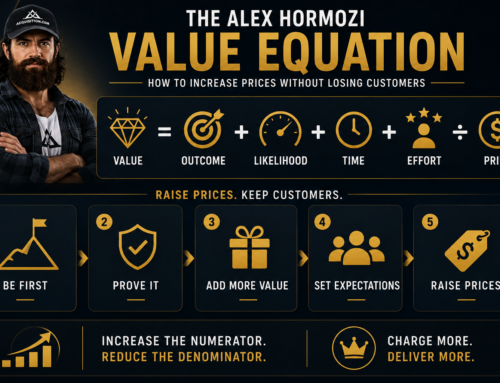
Hormozi’s Value Equation suggests that value rises when you increase:
- Dream Outcome
- Perceived Likelihood of Achievement
Meanwhile, value also rises when you decrease:
- Time Delay
- Effort and Sacrifice
Therefore, every funnel page should reinforce those four factors.
How to Apply the Value Equation to a Landing Page
- Use the headline to clarify the desired outcome.
- Use proof to increase perceived likelihood.
- Use timelines and immediate next steps to reduce delay.
- Use simple forms, clear scheduling, and done-for-you service to reduce effort.
Pricing Lessons for Funnel Builders
Beginners often lower prices when a funnel underperforms. However, lower prices can reduce margins without fixing the underlying problem.
Instead, improve the offer first.
Add stronger proof. Clarify the result. Reduce implementation burden. Create a faster first win. Then, test pricing with qualified buyers.
For a deeper breakdown, review The Alex Hormozi Value Equation Explained.
Action Step: Rewrite your offer so the buyer can understand the outcome, proof, timeline, support, and risk reversal within sixty seconds.
3. Building a StoryBrand: Make the Funnel Message Easy to Understand
Building a StoryBrand by Donald Miller addresses one of the most common funnel problems: confusing copy.
Businesses naturally want to talk about themselves. Therefore, their landing pages often begin with company history, awards, methods, technology, and broad claims.
However, buyers usually care first about their own problem and desired result.
Consequently, StoryBrand encourages businesses to position the customer as the central character while the company acts as a helpful guide.
Core StoryBrand Ideas
- The customer is the hero.
- The company is the guide.
- The customer has a clear problem.
- The guide provides a plan.
- The plan includes a call to action.
- The message shows what success looks like.
- The message also explains what failure costs.
How StoryBrand Improves Funnel Copy
A confused customer delays.
Therefore, the funnel should quickly answer:
- What do you offer?
- How does it help me?
- What should I do next?
For example, compare these two agency headlines.
Confusing Headline
“Revolutionizing Omnichannel Digital Experiences Through Innovative Solutions.”
Clear Headline
“Turn More Contractor Leads Into Booked Estimates and Signed Jobs.”
The second headline sacrifices clever language. However, it gains relevance and clarity.
The Customer as the Hero
Your business does not need to disappear from the page. Nevertheless, the copy should explain your company through the buyer’s needs.
Instead of saying:
“We have twenty years of experience and a proprietary process.”
Say:
“You get an experienced implementation team and a proven process, so your funnel launches with fewer mistakes.”
The same credibility remains. However, the benefit now connects directly to the buyer.
StoryBrand Funnel Structure
- State the customer’s desired outcome.
- Identify the problem.
- Show empathy and authority.
- Present a simple plan.
- Explain the offer.
- Provide proof.
- Show the successful outcome.
- Present a clear call to action.
Best for:
- Landing-page headlines
- Homepages
- Lead magnets
- Email sequences
- Sales presentations
- Video scripts
- Proposal messaging
Action Step: Review every major funnel section and count how often it says “we” compared with “you.” Then, rewrite company-centered copy around the customer’s problem and outcome.
4. Influence: Understand Why Buyers Say Yes
Influence: The Psychology of Persuasion by Robert Cialdini explains several psychological principles that affect trust, decision-making, and action.
However, ethical persuasion does not mean pressuring buyers into unsuitable purchases.
Instead, it means presenting truthful information in ways that help qualified buyers make decisions with greater confidence.
The Seven Principles Commonly Associated With Cialdini
- Reciprocity
- Commitment and consistency
- Social proof
- Authority
- Liking
- Scarcity
- Unity
Reciprocity in a Funnel
When a business provides useful value before asking for a purchase, the buyer may become more willing to continue the relationship.
Therefore, strong lead magnets should solve a real problem rather than merely tease information.
Examples include:
- Calculators
- Checklists
- Audit tools
- Planning guides
- Comparison charts
- Templates
- Personalized assessments
Commitment and Consistency
Small actions can prepare buyers for larger actions.
For example, a prospect may first download a guide. Next, the prospect completes an assessment. Then, the prospect books a strategy call.
Consequently, each step should feel logically connected rather than manipulative.
Social Proof
Buyers gain confidence when similar people achieved relevant results.
Therefore, place testimonials and case studies near the claims they support.
For example, if the page claims the funnel helps roofers book more estimates, show proof from a roofing company rather than an unrelated ecommerce brand.
Authority
Authority can come from expertise, certifications, experience, original research, transparent processes, trusted associations, or recognized standards.
However, authority should support the buyer’s decision rather than dominate the message.
Scarcity
Real scarcity can increase action when availability is genuinely limited.
Examples include:
- Limited implementation capacity
- Fixed event dates
- Seasonal deadlines
- Geographic exclusivity
- Limited inventory
However, false countdown timers and invented limits damage trust.
Unity
Buyers often respond to companies that understand their identity, profession, community, or values.
Therefore, industry-specific funnels can outperform generic messaging because the buyer feels recognized.
For a complete review, read Influence: The Psychology of Persuasion Review.
Action Step: Add one truthful trust-building element to every major decision point in the funnel. However, ensure each element directly supports the nearby claim.
5. $100M Leads: Learn How to Fill the Funnel
$100M Leads by Alex Hormozi completes the list because even the strongest funnel needs qualified attention.
However, lead generation should not begin with “How do we get more traffic?”
Instead, begin with “How do we reach more of the right buyers?”
Core Lessons From $100M Leads
- Creating lead magnets
- Using warm outreach
- Using cold outreach
- Publishing content
- Running paid advertising
- Using referrals
- Increasing activity volume
- Building repeatable acquisition channels
Why Traffic Quality Matters
A funnel built for commercial contractors may perform poorly when the traffic consists mostly of homeowners. Likewise, a premium consulting funnel may fail when the audience primarily wants free information.
Therefore, conversion rate must be interpreted alongside traffic quality.
The Four Broad Lead Channels
Businesses can generate leads through combinations of:
- Warm outreach
- Cold outreach
- Free content
- Paid advertising
Additionally, referrals and partnerships can expand the reach of those channels.
Choose One Primary Channel First
Beginners often try SEO, Facebook Ads, Google Ads, cold email, LinkedIn, YouTube, TikTok, and networking simultaneously.
Consequently, no channel receives enough attention to improve.
Instead, choose one primary acquisition channel. Then, define a consistent activity level and measure its performance.
Lead Generation Metrics to Track
- Impressions
- Click-through rate
- Cost per click
- Landing-page conversion rate
- Cost per lead
- Qualified lead rate
- Appointment rate
- Show rate
- Close rate
- Customer acquisition cost
- Customer lifetime value
Therefore, funnel optimization should continue beyond the form submission.
For a practical agency checklist, review The Alex Hormozi $100M Leads Checklist for B2B Agencies.
Action Step: Select one traffic channel and define the weekly volume required to produce enough qualified conversations for meaningful funnel testing.
What Order Should You Read the Five Funnel Books?
The best reading order depends on your current problem. However, beginners should generally follow this sequence:
Why This Order Works
First, DotCom Secrets helps you understand the structure of the journey.
Next, $100M Offers helps you decide what the funnel should sell.
Then, Building a StoryBrand helps you explain the offer clearly.
After that, Influence helps you build trust and support the decision ethically.
Finally, $100M Leads helps you attract enough qualified prospects to test and scale the complete system.
Therefore, the reading order mirrors the funnel-building process.
How to Combine the Five Books Into One Sales Funnel
The easiest way to combine the books is to assign each framework to a specific funnel decision.
Step 1: Map the Funnel With DotCom Secrets
Define the traffic source, lead magnet, landing page, follow-up sequence, sales mechanism, core offer, and next offer.
Step 2: Design the Offer With $100M Offers
Clarify the buyer’s dream outcome. Then, increase confidence, reduce time delay, remove effort, add relevant bonuses, and create responsible risk reversal.
Step 3: Write the Message With StoryBrand
Position the customer as the hero. Meanwhile, position your company as the guide with a clear plan.
Step 4: Add Ethical Persuasion With Influence
Use relevant proof, authority, reciprocity, commitment, scarcity, and unity where each principle naturally supports the decision.
Step 5: Fill the Funnel With $100M Leads
Choose one primary channel. Then, create enough consistent activity to generate meaningful conversion data.
Step 6: Measure the Complete Journey
Track traffic, leads, qualification, appointments, proposals, sales, revenue, and retention.
Consequently, you can identify whether the real constraint involves traffic, messaging, offer quality, trust, sales follow-up, or delivery.
Example: A Sales Funnel for a Roofing Contractor
A roofing company can use all five books to build a more complete customer journey.
Traffic Source
Google Ads, local SEO, Facebook Ads, referrals, or storm-related content attracts homeowners.
Lead Magnet
The company offers a “Roof Replacement Planning Guide” or a free roof condition assessment.
StoryBrand Message
The page focuses on the homeowner’s fear of hidden damage, expensive mistakes, and unreliable contractors.
Meanwhile, the roofing company acts as the expert guide with a clear inspection and replacement process.
Hormozi-Style Offer
The assessment includes:
- Photo documentation
- Repair-versus-replacement guidance
- Material options
- Warranty explanation
- Financing information
- Written next steps
Cialdini Principles
The page uses local reviews, relevant project examples, manufacturer credentials, and honest scheduling availability.
Lead Follow-Up
The CRM immediately sends confirmation, assigns the salesperson, creates a call task, and begins appointment reminders.
For contractor CRM strategy, review Best CRM for Contractors.
Example: A Sales Funnel for a Digital Marketing Agency
A digital marketing agency can use the same framework for a premium service.
Traffic Source
SEO content, comparison articles, LinkedIn outreach, referrals, or paid advertising attracts qualified businesses.
Lead Magnet
The agency offers a “Digital Authority Gap Assessment.”
StoryBrand Message
The funnel focuses on the client’s problem: competitors own more search territory, capture more buyer questions, and appear more often in AI-generated answers.
Hormozi-Style Offer
The assessment provides:
- Keyword opportunity mapping
- Competitor content analysis
- AI-search visibility gaps
- Technical weaknesses
- Priority page recommendations
- A phased implementation roadmap
Cialdini Principles
The funnel includes relevant examples, transparent process details, original analysis, and limited implementation capacity.
Value Ladder
- Free assessment
- Paid strategy workshop
- SEO or GEO roadmap
- Ongoing content production
- Full Digital Fortress build
Consequently, the funnel educates the buyer before asking for the largest investment.
For a related conversion framework, review The Straight Line Funnel.
Which Sales Funnel Software Should You Use?
The best funnel software depends on the complexity of your sales process.
However, software should be chosen after the funnel is mapped.
HubSpot
HubSpot works well when landing pages, forms, email, CRM records, deals, sales tasks, marketing campaigns, and reporting need to connect.
Therefore, it fits B2B companies, contractors with sales teams, agencies, consultants, and businesses that require deeper attribution.
Explore HubSpot for your sales funnel.
GoHighLevel
GoHighLevel works well for local businesses and agencies that prioritize funnels, SMS follow-up, calendars, review requests, and rapid campaign deployment.
For a complete contractor comparison, review HubSpot vs. GoHighLevel for Contractors.
Dedicated Funnel Builders
Dedicated funnel software may provide fast page creation, checkout flows, upsells, and template-driven implementation.
Nevertheless, confirm how the platform handles:
- CRM records
- Email follow-up
- Payment processing
- Reporting
- Integrations
- Mobile performance
- Data ownership
- Sales-team workflows
Ultimately, choose the simplest platform that can support your current funnel and the next stage of growth.
Common Mistakes When Building Your First Sales Funnel
Mistake 1: Choosing Software Before Strategy
A funnel builder cannot define the market, offer, message, or buying journey.
Therefore, map those elements first.
Mistake 2: Targeting Everyone
Broad messaging creates weak relevance.
Instead, choose one specific buyer with one meaningful problem.
Mistake 3: Offering a Weak Lead Magnet
A vague ebook rarely creates strong intent.
Therefore, offer a tool, assessment, guide, template, or comparison that helps the buyer make immediate progress.
Mistake 4: Making the Company the Hero
Buyers care about your experience because it helps them. However, they do not visit primarily to celebrate your company.
Consequently, connect every credential to a customer benefit.
Mistake 5: Sending Traffic to an Untested Offer
Paid traffic can become expensive when the offer remains unproven.
Therefore, test the offer through direct conversations and small campaigns first.
Mistake 6: Using Fake Scarcity
False urgency may increase short-term clicks. However, it damages trust and brand value.
Mistake 7: Ignoring Follow-Up
Many qualified prospects do not buy during the first visit.
Therefore, build useful email, SMS, retargeting, and sales follow-up.
Mistake 8: Measuring Leads Instead of Revenue
A high-converting form can still create unqualified leads.
Consequently, track the full path from click to customer.
Mistake 9: Building Too Many Funnel Steps
Every additional step creates friction.
Therefore, include only the steps required to educate, qualify, and convert the buyer.
Mistake 10: Never Improving the Funnel
Your first version should create learning rather than perfection.
Therefore, review behavior, objections, calls, recordings, conversion rates, and revenue continuously.
A 30-Day Plan to Build Your First Sales Funnel
Days 1–5: Study the Buyer
- Define the market.
- Interview potential buyers.
- List problems, fears, goals, objections, and prior solutions.
- Identify the most valuable outcome.
Days 6–10: Design the Offer
- Clarify the Dream Outcome.
- Add proof.
- Reduce Time Delay.
- Reduce Effort and Sacrifice.
- Create a responsible guarantee.
- Choose the price.
Days 11–15: Map the Funnel
- Choose the traffic source.
- Create the lead magnet.
- Define the landing page.
- Write the follow-up sequence.
- Choose the sales mechanism.
- Map the primary offer.
Days 16–20: Write the Message
- Write a clear headline.
- Describe the buyer’s problem.
- Present the company as the guide.
- Explain the plan.
- Add proof.
- Show the successful outcome.
- Add the call to action.
Days 21–25: Build and Connect the Funnel
- Create the page.
- Connect the form.
- Connect the CRM.
- Build email and SMS follow-up.
- Configure tracking.
- Test every step.
Days 26–30: Launch a Controlled Test
- Send targeted traffic.
- Review conversion rates.
- Listen to sales calls.
- Record objections.
- Measure qualified leads.
- Track sales and revenue.
- Improve the weakest stage.
Consequently, the first month produces both a funnel and a structured learning process.
The Complete Five-Book Funnel Reading List
- DotCom Secrets by Russell Brunson — Best for funnel architecture, value ladders, and customer journeys.
- $100M Offers by Alex Hormozi — Best for offer design, pricing, guarantees, and value creation.
- Building a StoryBrand by Donald Miller — Best for clear funnel messaging and customer-centered copy.
- Influence by Robert Cialdini — Best for ethical persuasion, trust, and buyer psychology.
- $100M Leads by Alex Hormozi — Best for lead generation, traffic channels, and filling the funnel.
Frequently Asked Questions
What is the best book for learning sales funnels?
DotCom Secrets is one of the best starting books for understanding funnel architecture, value ladders, lead magnets, offer sequencing, and follow-up funnels.
What should I read before DotCom Secrets?
You do not need to read another book first. However, basic knowledge of your buyer, market, and offer will make the concepts easier to apply.
Is $100M Offers about sales funnels?
$100M Offers is primarily about offer creation. However, the offer is the central product or service every funnel must present and sell.
Why is Building a StoryBrand useful for funnels?
Building a StoryBrand helps businesses clarify their message, position the customer as the hero, explain the problem, present a plan, and create a clearer call to action.
How does Influence apply to sales funnels?
Influence explains principles such as reciprocity, social proof, authority, commitment, scarcity, liking, and unity. Therefore, it helps funnel builders understand trust and decision-making.
Why read $100M Leads after building the offer?
Lead generation becomes more efficient after the market, message, and offer become clear. Otherwise, more traffic may simply expose an unconvincing funnel.
What order should I read the five books?
Read DotCom Secrets, $100M Offers, Building a StoryBrand, Influence, and then $100M Leads.
Can I build a funnel before finishing all five books?
Yes. However, outline the funnel while reading and improve each section as you learn. Therefore, the reading process becomes practical rather than passive.
What is the most important part of a sales funnel?
The offer is often the most important part because traffic, copy, and design cannot fully compensate for weak value. Nevertheless, every stage must work together.
Do I need expensive funnel software?
No. You need a clear market, offer, message, and follow-up process first. Therefore, begin with the simplest software that supports the required workflow.
What is a value ladder?
A value ladder organizes offers from lower commitment to higher commitment. Consequently, customers can enter through a smaller step before purchasing premium services.
How long should a sales funnel be?
A funnel should include only the steps necessary to educate, qualify, and convert the buyer. Therefore, complex purchases may require longer funnels than simple purchases.
What should my first funnel sell?
Your first funnel should sell one clear offer to one specific buyer. Additionally, the offer should solve a painful problem with a measurable or meaningful outcome.
Should my funnel use email and SMS?
Use the communication channels your buyers prefer. However, follow applicable consent, privacy, and messaging rules while avoiding excessive automation.
How do I know whether my funnel works?
Track traffic, landing-page conversion, qualified leads, appointments, show rate, proposals, sales, acquisition cost, revenue, and customer value.
Final Verdict
The best sales funnels are not created by software alone.
Instead, they are built from a clear understanding of the customer, a valuable offer, a simple message, ethical persuasion, and consistent lead generation.
Therefore, read DotCom Secrets to map the journey. Then, use $100M Offers to create something worth buying.
Next, use Building a StoryBrand to explain the offer clearly. After that, use Influence to strengthen trust and reduce uncertainty.
Finally, use $100M Leads to place the complete funnel in front of more qualified buyers.
Although reading these books will not guarantee success, applying their frameworks can help you avoid building a funnel that looks polished but lacks strategic depth.
Build the market understanding first.
Then, build the offer.
After that, build the message and funnel.
Finally, scale the traffic.
About the author : Anthony Paulino