
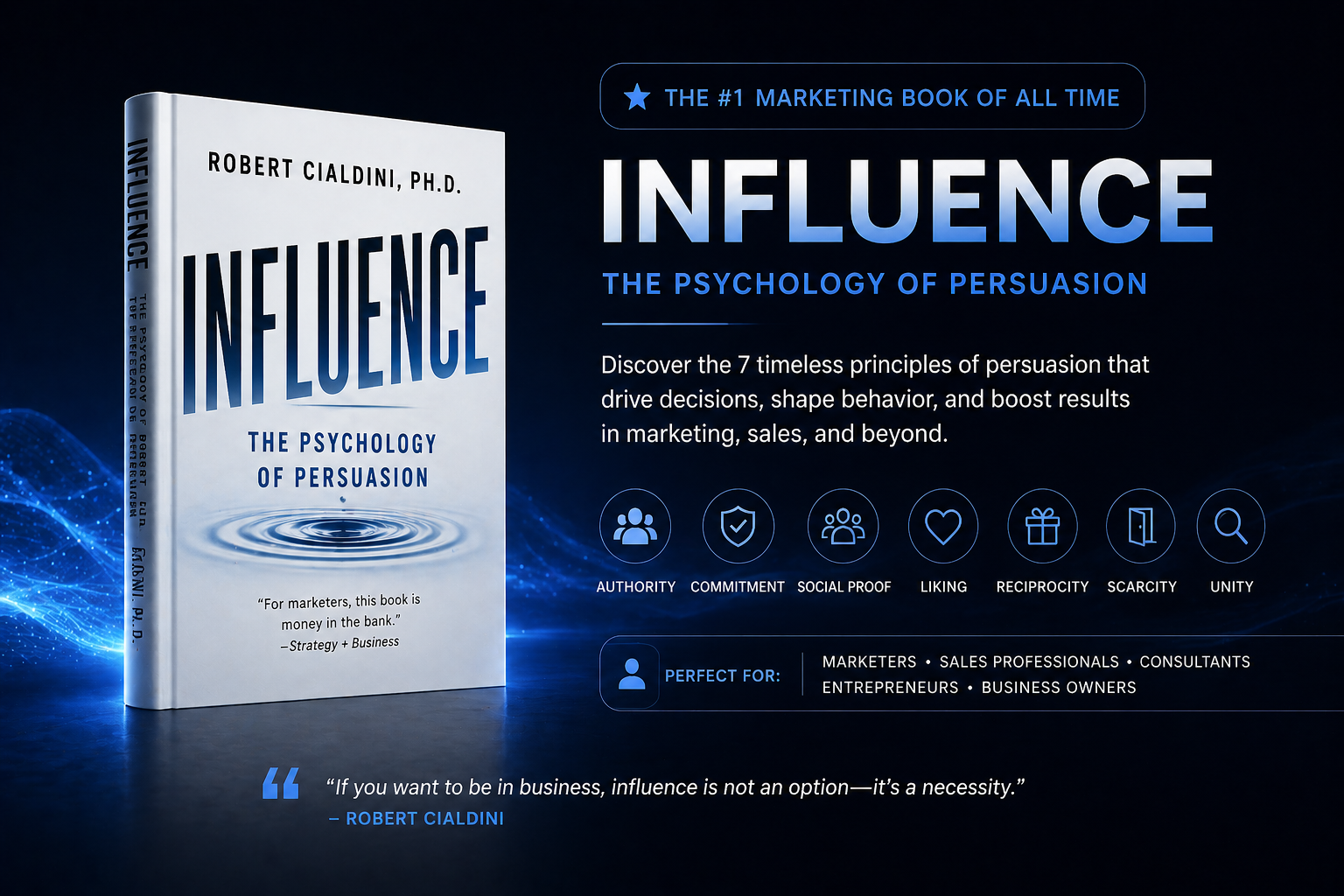
Influence: The Psychology of Persuasion Review | Complete Marketing Breakdown
Definition: Influence: The Psychology of Persuasion by Robert Cialdini explains why people say yes, why they hesitate, and how ethical persuasion works in marketing, sales, consulting, advertising, and negotiation.
Direct Answer: Influence remains one of the most important marketing psychology books because it teaches persuasion principles that still shape buying behavior today. Therefore, SEO specialists, PPC managers, salespeople, agency owners, consultants, and premium brand advisors should understand its lessons deeply.
Many marketing books become outdated because platforms change. However, buyer psychology changes much more slowly. Search engines evolve, ad platforms shift, social platforms rise and fall, and AI search changes discovery. Nevertheless, people still look for trust, proof, certainty, authority, belonging, and value before they act.
Because of that, Influence is not just a book about persuasion. Instead, it is a book about buyer behavior. It helps marketers understand what reduces friction, what increases desire, and what makes a person feel safe enough to move forward.
Moreover, the book matters because it applies across nearly every growth channel. It can improve SEO pages, paid ads, email campaigns, landing pages, sales calls, luxury consultations, personal branding, and high-ticket offers.
Therefore, if you want to understand why buyers say yes, Influence belongs near the top of your reading list.
Key Takeaways
- Persuasion works best when it supports real value instead of forcing pressure.
- Social proof reduces uncertainty because buyers borrow confidence from others.
- Scarcity increases desire when it reflects real limits, not fake urgency.
- Authority helps buyers trust complex decisions faster.
- Reciprocity works because value given first can create goodwill.
- Commitment and consistency explain why small yeses often lead to larger yeses.
- Unity matters because shared identity can build deeper trust.
- SEO, PPC, sales, and luxury marketing all become stronger when persuasion principles guide the strategy.
Why Influence Still Matters
Most marketers chase tactics. However, tactics usually have a short shelf life. What worked on Facebook five years ago may not work today. What worked in SEO before AI Overviews may need a different approach now. Likewise, what converted on landing pages years ago may feel outdated today.
By contrast, persuasion principles stay useful because they connect to human behavior. People still compare risk. They still look for proof. They still trust experts. They still move faster when urgency feels real. Therefore, a business owner who understands persuasion can adapt across platforms more easily.
That matters because traffic alone does not create revenue. Instead, traffic creates opportunity. The page, offer, proof, and message must persuade the visitor to take the next step. Therefore, persuasion sits between attention and revenue.
If you generate traffic through SEO Services for Businesses, the page still has to convert that traffic. If you run paid campaigns through Google Ads Management Company, the landing page still has to justify the click. Moreover, if you want visibility in AI search, Generative Engine Optimization still depends on authority, trust, and clear proof.
Because of that, Influence is not only useful for copywriters. It is useful for every person who touches the customer journey.
After the core value is clear, this is a good book to study directly: Influence: The Psychology of Persuasion by Robert Cialdini.
What Influence Is Really About
Influence explains the mental shortcuts people use when making decisions. These shortcuts matter because most people do not evaluate every choice from scratch. Instead, they use signals.
For example, when buyers see many positive reviews, they assume reduced risk. When they see expert credentials, they assume competence. When they see limited availability, they may feel a stronger need to act. Consequently, persuasive signals can shape decisions before a sales conversation ever begins.
However, the best use of this book is not manipulation. Instead, it is alignment. Ethical marketers use persuasion principles to make real value easier to understand. They reduce doubt. They clarify proof. They show why action matters. Therefore, the buyer makes a better-informed decision.
That distinction matters. Manipulation hides weakness. Ethical persuasion highlights genuine strength.
The Seven Principles of Persuasion
Cialdini’s most famous contribution is the set of persuasion principles that explain why people comply, agree, buy, subscribe, or move forward. Although the original framework became famous for six principles, modern discussions often include unity as the seventh.
1. Reciprocity
When people receive value first, they often become more willing to respond positively later. Therefore, free audits, helpful guides, calculators, samples, checklists, and strategy calls can work well when they provide real value.
2. Commitment and Consistency
When people take a small step, they often want their next step to remain consistent with that first action. Consequently, small commitments such as quizzes, checklists, discovery calls, and self-assessments can lead to larger commitments later.
3. Social Proof
When people feel uncertain, they often look at what others have done. Therefore, reviews, testimonials, case studies, adoption numbers, and peer examples can reduce hesitation.
4. Authority
People trust experts faster when the decision feels complex. As a result, credentials, case studies, research, frameworks, media features, and deep educational content can increase confidence.
5. Liking
People are more receptive to people and brands they like, respect, or relate to. Therefore, tone, personality, story, shared values, and genuine empathy matter.
6. Scarcity
People often value opportunities more when availability is limited. However, scarcity must be real. Otherwise, it damages trust.
7. Unity
People trust those they feel connected to. Therefore, shared identity, shared mission, shared standards, or shared community can make persuasion stronger.
Deep Dive: Scarcity
Scarcity works because people place higher value on opportunities that feel limited. If something feels unlimited, urgency drops. However, if access is limited for a real reason, buyers pay closer attention.
Nevertheless, scarcity is dangerous when used dishonestly. Fake countdown timers, fake “last chance” offers, and repeated false urgency can destroy trust. Therefore, ethical scarcity matters more than aggressive scarcity.
Why Scarcity Works Psychologically
Scarcity triggers loss aversion. People often feel the pain of missing out more strongly than the pleasure of gaining something. Therefore, when a real opportunity may disappear, buyers feel more pressure to decide.
However, high-end buyers dislike cheap pressure. Consequently, scarcity must feel aligned with quality, not desperation.
Ethical Scarcity Examples
- Limited client onboarding capacity.
- Seasonal campaign deadlines.
- Quarterly strategy windows.
- Limited production inventory.
- Private event seats.
- Invite-only consultation slots.
- Founder-led implementation availability.
Agency Example
A weak scarcity claim says, “Act now before it is too late!”
A stronger claim says, “We accept a limited number of implementation clients per quarter so our team can maintain strategy quality and execution speed.”
The second version works better because it explains the reason behind the limit. Therefore, scarcity feels credible.
Luxury Example
Luxury buyers often respond more to access than discounts. Therefore, “private allocation,” “limited availability,” “by invitation,” and “reserved consultation” can feel more premium than “save 20% today.”
For UHNWI consultants, scarcity should usually signal selectivity, not panic. Because of that, capacity-based scarcity works better than discount-based urgency.
Scarcity in Paid Ads
PPC teams can use scarcity carefully when deadlines or capacity limits are real. For example, a campaign might say “Spring installation spots now booking” or “Limited consultation availability this month.” However, the landing page must match the ad honestly.
Otherwise, the visitor feels baited. As a result, conversion trust drops.
Scarcity Mistakes to Avoid
- Using fake timers.
- Repeating “last chance” every week.
- Claiming limited supply when supply is unlimited.
- Using urgency before trust exists.
- Using discount urgency for luxury positioning.
Ultimately, scarcity should help buyers act on a real opportunity. It should not manufacture pressure around a weak offer.
Deep Dive: Reciprocity
Reciprocity works because people often feel more open to responding after receiving genuine value. In marketing, this principle supports lead magnets, free audits, free tools, useful guides, webinars, newsletters, and educational content.
However, reciprocity only works when the value feels real. A weak PDF made only to collect emails does not create trust. Instead, it can create disappointment. Therefore, the free value must actually help.
Strong Reciprocity Examples
- A free SEO audit that identifies real issues.
- A lead cost calculator for paid ads.
- A landing page checklist that improves conversion.
- A short buyer guide that saves time.
- A comparison worksheet that helps decision-making.
- A private consultation that gives actionable next steps.
Agency Application
An agency can use reciprocity by giving prospects useful clarity before pitching. For example, instead of saying “book a call,” the agency can offer a free diagnostic that identifies whether the issue is traffic, offer, conversion, or follow-up.
As a result, the prospect receives value first. Therefore, trust increases before the sales conversation begins.
Reciprocity Mistakes to Avoid
- Giving low-quality freebies.
- Making the “free” offer feel like a bait-and-switch.
- Overwhelming the buyer with too much information.
- Giving strategy away without framing the next step.
- Using value only as a disguise for pressure.
Ultimately, reciprocity works best when the buyer thinks, “If this is what they give away, their paid work must be stronger.”
Deep Dive: Commitment and Consistency
Commitment and consistency explain why small actions can lead to bigger decisions. When someone takes a small step, they often want future actions to align with that first step.
This principle matters because most buyers do not jump from stranger to customer instantly. Instead, they move through smaller commitments.
Examples of Small Commitments
- Taking a quiz.
- Downloading a guide.
- Requesting a free audit.
- Watching a webinar.
- Answering a diagnostic form.
- Booking a discovery call.
- Replying to a follow-up email.
Marketing Application
A strong funnel makes the first step easy. For example, a visitor may not be ready to buy SEO services. However, they may be willing to request a visibility audit. After that, they may be willing to review the findings. Then, they may be willing to discuss implementation.
Consequently, the path feels natural instead of forced.
Sales Application
Salespeople can use this ethically by asking questions that help buyers define their own goals. For example, “Would it be fair to say your biggest issue is not lead volume, but lead quality?” If the buyer agrees, the conversation gains direction.
Therefore, the salesperson does not force the buyer. Instead, the buyer clarifies their own thinking.
Consistency Mistakes to Avoid
- Trying to force a big commitment too early.
- Using manipulative questions.
- Skipping discovery.
- Offering too many next steps at once.
- Making the first step too difficult.
Ultimately, commitment works best when each step helps the buyer make a more confident decision.
How SEO Specialists Should Use Influence
SEO specialists often focus heavily on rankings, keywords, and technical structure. However, ranking is only the first step. Once the visitor lands on the page, persuasion determines whether that traffic becomes revenue.
Therefore, SEO pages should use persuasion principles intentionally.
SEO Page Persuasion Checklist
- Add direct answers near the top for clarity.
- Use case studies to support claims.
- Add review snippets near CTAs.
- Explain process to build authority.
- Use FAQs to reduce objections.
- Use internal links to guide readers deeper.
- Use schema to structure the page clearly.
- Use specific examples instead of generic claims.
For example, a service page for SEO Services for Businesses should not only target keywords. It should also prove why the company can solve the problem. Therefore, social proof, authority, and clarity all matter.
Advanced SEO Angle
Strong SEO content should serve both humans and AI systems. That means the content should answer questions clearly, define concepts, show expertise, and cite related services naturally. Consequently, persuasion and GEO work together.
How PPC Specialists Should Use Influence
PPC specialists pay for attention. Therefore, every click carries financial pressure. If the landing page does not persuade, the campaign wastes budget.
Because of that, Cialdini’s principles matter deeply in Google Ads, Meta Ads, retargeting, and lead form campaigns.
Google Ads Application
- Use authority in headlines when space allows.
- Use social proof in extensions or landing pages.
- Use real urgency when deadlines exist.
- Match ad promise to landing page proof.
- Reduce friction near the form.
For example, a Google Ads Management Company campaign should not only drive clicks. Instead, the landing page should show why the visitor should trust the offer immediately.
Meta Ads Application
Meta Ads often perform well when creative feels human. Therefore, testimonial videos, review screenshots, story-based ads, and problem-solution creatives can outperform polished but empty brand graphics.
If you are building campaigns through a Facebook Ads Management Agency strategy, social proof and liking often matter heavily.
PPC Mistakes to Avoid
- Using urgency in the ad but no urgency on the landing page.
- Sending paid traffic to a generic homepage.
- Using claims without proof.
- Ignoring mobile form friction.
- Testing headlines while ignoring trust signals.
Ultimately, PPC works better when every click lands inside a persuasion system.
How Salespeople and Consultants Should Use Influence
Salespeople often think persuasion means saying the perfect line. However, strong persuasion usually starts earlier. It starts with diagnosis, trust, and clarity.
Therefore, consultants should use Influence to structure conversations, not pressure buyers.
Sales Call Application
- Use authority by diagnosing clearly.
- Use reciprocity by giving a useful insight early.
- Use social proof by sharing a relevant success story.
- Use commitment by confirming the buyer’s stated goals.
- Use scarcity only when capacity or timing is real.
Example Conversation Flow
First, ask what the buyer wants to improve. Then, clarify what they have already tried. Next, identify the real bottleneck. After that, share a relevant example. Finally, explain the next step if there is a fit.
As a result, the conversation feels consultative instead of pushy.
Advanced Consultant Angle
Elite consultants use persuasion through framing. They help the buyer see the problem differently. For example, a buyer may think they need more leads. However, the real issue may be weak follow-up, unclear offer positioning, or no trust after the click.
Consequently, the consultant earns authority by helping the buyer understand the real problem.
How UHNWI and Luxury Consultants Should Use Influence
Ultra-high-net-worth buyers often value privacy, certainty, discretion, speed, and elite outcomes. Therefore, mass-market pressure tactics usually fail.
Luxury persuasion works differently. Instead of shouting urgency, premium brands signal selectivity. Instead of offering discounts, they offer access. Instead of overexplaining, they demonstrate competence.
What Works with Affluent Buyers
- Quiet authority.
- Selective social proof.
- Private access.
- Trusted introductions.
- High-quality visuals.
- Clear process.
- Discreet communication.
- Capacity-based scarcity.
Example
“Save 25% today” feels wrong for most luxury offers.
However, “Private strategy sessions are limited to a small number of qualified clients each quarter” feels more aligned with premium expectations.
Therefore, luxury persuasion should create confidence, not pressure.
UHNWI Mistakes to Avoid
- Using discount-heavy messaging.
- Overusing urgency.
- Sounding too eager.
- Showing generic proof instead of relevant proof.
- Ignoring privacy concerns.
- Using loud visuals that feel cheap.
Ultimately, affluent buyers often buy certainty. Therefore, persuasion should reduce risk while protecting prestige.
A Practical Persuasion Framework for Marketers
If you want to apply Influence today, use this simple framework across pages, ads, emails, and sales calls.
Step 1: Clarify the Buyer’s Risk
First, identify what the buyer fears. They may fear wasting money, choosing the wrong provider, looking bad, losing time, or missing an opportunity.
Step 2: Match Proof to the Risk
Next, use proof that directly reduces that fear. For example, if they fear poor results, show case studies. If they fear complexity, show process. If they fear trust, show reviews.
Step 3: Add Authority
Then, explain why your team understands the problem. Use expertise, frameworks, examples, and educational clarity.
Step 4: Use Ethical Scarcity
After that, add real timing or capacity limits only when they exist. Otherwise, skip scarcity.
Step 5: Make the Next Step Easy
Finally, reduce friction. Use one clear CTA, a simple form, and a direct next step.
As a result, the buyer feels informed instead of pressured.
Persuasion Principle Comparison Table
| Principle | Why It Works | Best Marketing Use | Common Mistake |
|---|---|---|---|
| Social Proof | Reduces uncertainty | Reviews, testimonials, case studies | Using vague or irrelevant proof |
| Scarcity | Increases perceived value | Limited capacity, deadlines, exclusive access | Using fake urgency |
| Authority | Builds trust quickly | Expert content, credentials, process pages | Claiming expertise without proof |
| Reciprocity | Creates goodwill | Free audits, tools, guides | Offering low-value lead magnets |
| Commitment | Encourages consistent action | Quizzes, audits, discovery calls | Asking for too much too soon |
| Liking | Builds relationship trust | Brand voice, founder content, story | Trying to be liked by everyone |
| Unity | Creates shared identity | Community, mission, niche positioning | Faking belonging |
Common Mistakes to Avoid
- Using fake scarcity that damages trust.
- Inventing testimonials or exaggerating results.
- Using authority claims without evidence.
- Leading with persuasion before proving value.
- Putting all proof at the bottom of the page.
- Using the same proof for every audience.
- Ignoring buyer risk.
- Making the next step too complicated.
- Confusing pressure with persuasion.
Ultimately, persuasion works best when the offer is real, the proof is honest, and the next step feels safe.
Frequently Asked Questions
Is Influence still worth reading in 2026?
Yes. Buyer psychology remains relevant even when platforms change. Therefore, the book still applies to SEO, PPC, sales, consulting, and premium service marketing.
Who should read Influence?
Marketers, founders, consultants, salespeople, agencies, PPC specialists, SEO specialists, and premium service providers should read it.
What is the most important principle in Influence?
That depends on the situation. However, social proof and authority are especially powerful when buyers feel uncertain.
Can these persuasion principles be ethical?
Yes. Ethical persuasion helps buyers make better decisions by reducing uncertainty, clarifying value, and showing honest proof.
Is Influence useful for luxury marketing?
Yes. Luxury buyers often respond to authority, selective proof, exclusivity, and trust. Therefore, the book is highly useful for premium positioning.
What should I read after Influence?
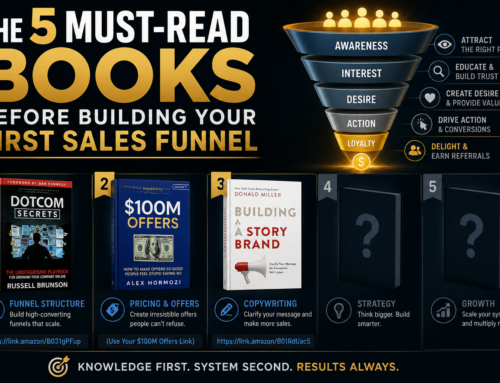
Read related books on marketing strategy, brand authority, and buyer behavior. You can start with Best Modern Marketing Books.
Final Verdict
Influence: The Psychology of Persuasion remains one of the best business books ever written because it explains why people buy at a fundamental level.
If you already have traffic, this book helps you convert more of it. If you sell high-ticket services, it helps you build trust faster. Moreover, if you market luxury offers, it helps you communicate exclusivity without sounding cheap.
Therefore, read it once for tactics. Then, read it again for mastery.
About the author : Anthony Paulino















Deep Dive: Social Proof
Social proof works because uncertainty creates hesitation. When buyers cannot easily judge quality, they borrow confidence from other people’s decisions. Therefore, a brand with strong proof feels safer than a brand with only claims.
This matters especially in SEO, PPC, high-ticket consulting, home services, luxury services, medical services, and B2B marketing. In these categories, buyers often cannot fully evaluate expertise before buying. Therefore, they look for signals that others already trusted the provider.
Why Social Proof Works Psychologically
Social proof reduces perceived risk. If many similar people already chose a product or service, the buyer feels less alone. Moreover, if those people had a good outcome, the buyer can imagine a safer path forward.
For example, a landing page that says “We help companies grow” feels vague. However, a landing page that says “See how we helped a regional contractor generate 415 leads in 30 days” feels more concrete. As a result, the buyer has something specific to evaluate.
How to Apply Social Proof Today
SEO Example
A weak SEO page says, “We provide expert SEO services.”
A stronger SEO page says, “Our SEO and GEO systems help local and national brands build authority through service pages, city pages, schema, and conversion-focused content.” Then, it supports that claim with case studies, proof, testimonials, and process clarity.
Consequently, the page does not rely on a claim alone. Instead, it stacks proof.
PPC Example
A Google Ads landing page should not only repeat the ad headline. Instead, it should immediately show why the visitor should trust the company. Therefore, add social proof near the top, such as “Trusted by service businesses across Ohio,” “See recent campaign results,” or “Read client success stories.”
If you are building this kind of paid traffic system, the same psychology applies to Google Ads campaign landing pages and Meta lead generation funnels.
Advanced Social Proof Strategy
Average marketers place one testimonial at the bottom of the page. However, elite marketers stack proof across the entire customer journey.
As a result, buyers never have to carry trust alone. The funnel keeps reinforcing confidence.
Social Proof Mistakes to Avoid
Ultimately, social proof works best when it is specific, relevant, recent, and tied to the buyer’s problem.