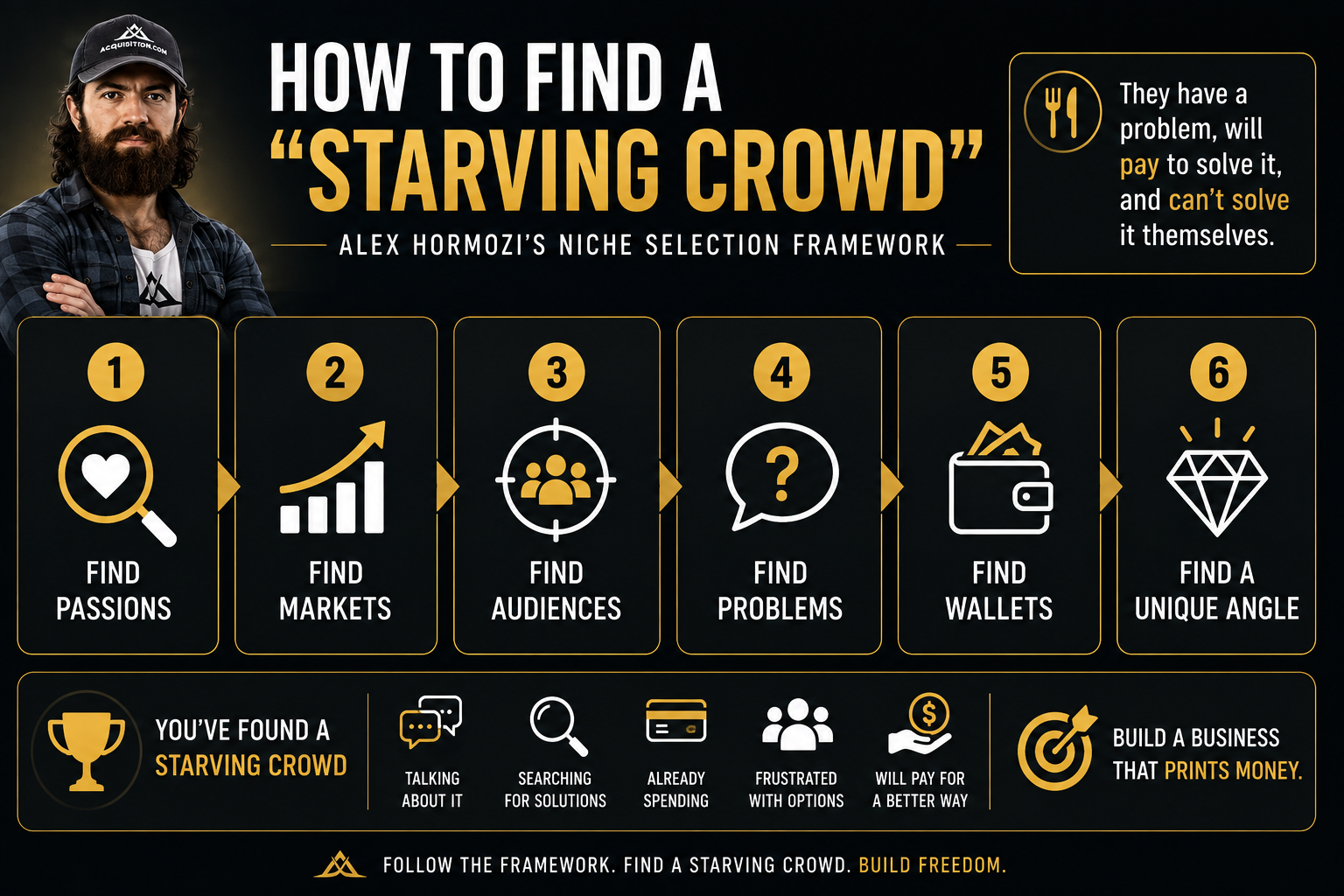
How to Find a “Starving Crowd”: Alex Hormozi’s Niche Selection Framework
A brilliant offer cannot rescue a market that does not care. Likewise, persuasive advertising cannot create durable demand where buyers feel little pain, lack money, or remain difficult to reach.
Therefore, Alex Hormozi’s “starving crowd” framework begins before the offer, funnel, advertisement, or sales script. First, you choose a market with urgent demand. Then, you build the offer around what that market already wants.
Direct Answer: Alex Hormozi’s starving crowd framework evaluates a market using four conditions: significant pain, enough purchasing power, an audience that is easy to identify and reach, and a market that is growing. The strongest niche scores well across all four conditions rather than depending on clever marketing to manufacture demand.
In other words, imagine two restaurant owners selling identical hot dogs. One opens beside a quiet road. Meanwhile, the other opens outside a packed stadium after the game. Although both owners may use the same product, price, and script, the second owner has the better market.
The difference is not talent alone.
Instead, the difference is hunger.
Hormozi’s official offer-creation training begins with a dedicated “Picking Markets” module before moving into pricing, the value equation, offer creation, bonuses, guarantees, scarcity, and urgency. Consequently, the sequence reinforces a critical lesson: market selection comes before offer optimization. :contentReference[oaicite:0]{index=0}
This guide explains how to identify that hungry market, score potential niches objectively, avoid attractive but weak opportunities, and apply the framework to agencies, contractors, professional services, affiliate sites, SEO, and Generative Engine Optimization.
For the complete offer framework behind this concept, read $100M Offers by Alex Hormozi.
Key Takeaways
- A strong market can make an average offer easier to sell.
- However, a weak market can make an excellent offer unnecessarily difficult to sell.
- Hormozi’s framework prioritizes pain, purchasing power, targeting accessibility, and market growth.
- Therefore, niche selection should rely on evidence rather than personal excitement alone.
- Additionally, narrow positioning does not require choosing a tiny market.
- Instead, the goal is to choose a specific, reachable segment inside a large pool of demand.
- Ultimately, the strongest niche has painful problems, capable buyers, clear channels, and expanding demand.
What Does Alex Hormozi Mean by a “Starving Crowd”?
A starving crowd is a market that already wants the result you sell. Therefore, the seller does not need to manufacture desire from nothing.
Instead, the seller must understand the existing desire, package a credible solution, and make the buying decision easier.
For example, someone facing an emergency roof leak does not need to be convinced that dry shelter matters. Likewise, a business owner whose advertising budget produces no qualified leads already understands the cost of the problem.
However, desire alone is not enough.
A market may desperately want a result but lack the financial ability to buy it. Similarly, buyers may have pain and money, yet remain scattered across channels that make them expensive to reach.
Therefore, a true starving crowd combines demand with commercial viability.
The central lesson: Do not ask only whether people want the outcome. Instead, ask whether enough reachable people urgently want it and can afford to act.
This distinction prevents entrepreneurs from confusing interest with demand. After all, people may like, share, discuss, and praise an idea without paying for it.
Consequently, market research must look beyond attention. It must investigate urgency, budgets, buying behavior, competition, search activity, and transaction history.
Why Does the Market Come Before the Offer?
Entrepreneurs often fall in love with products before proving that a desirable market exists. Therefore, they spend months designing websites, logos, packages, courses, applications, and automations before confirming demand.
However, an offer is a bridge between a buyer’s current condition and desired outcome. If the buyer does not care deeply about crossing that bridge, better design rarely solves the problem.
Market selection affects nearly every growth metric:
- Response rate
- Cost per lead
- Appointment rate
- Close rate
- Price sensitivity
- Customer retention
- Referral potential
- Lifetime value
- Content demand
- Sales-cycle length
For instance, compare an agency selling generic social media posting to small businesses with an agency helping private aviation companies capture high-intent charter searches.
The first agency may compete against freelancers, software, internal employees, and low-cost providers. Meanwhile, the second agency connects its offer to bookings worth tens of thousands of dollars.
Consequently, the second agency can support higher prices when it proves that the system influences qualified charter demand.
The offer still matters. Nevertheless, the economics of the market create the ceiling.
Therefore, smart entrepreneurs do not begin by asking, “What can I sell?”
Instead, they ask, “Which expensive, urgent problem can I solve for buyers who already spend money?”
What Are the Four Signs of a Strong Market?
Hormozi’s market-selection framework can be organized around four practical signals:
- The market experiences significant pain.
- The market has enough purchasing power.
- The audience is easy to identify and target.
- The market is growing.
Although one exceptional strength can partially offset a weakness, the best markets generally perform well across all four dimensions.
Market Signal |
Core Question |
Strong Evidence |
Weak Evidence |
|---|---|---|---|
| Massive pain | How costly or urgent is the problem? | Buyers actively search, complain, compare, and pay for solutions. | Buyers say the issue is interesting but delay action. |
| Purchasing power | Can the buyer afford a meaningful solution? | Existing budgets, high transaction values, recurring spend, or financing. | Strong desire but limited discretionary income. |
| Easy targeting | Can you locate buyers predictably? | Clear search terms, trade groups, databases, communities, platforms, or locations. | Audience remains broad, hidden, fragmented, or difficult to identify. |
| Market growth | Is demand expanding or shrinking? | More buyers, rising spending, regulatory shifts, new technology, or changing behavior. | Declining participation, commoditization, collapsing budgets, or obsolete demand. |
Therefore, niche selection should resemble investment underwriting. Instead of relying on instinct alone, you score the market using observable evidence.
1. Does the Market Have Massive Pain?
Pain creates movement. However, mild inconvenience usually creates delay.
Therefore, the first question is not whether a problem exists. Instead, ask how much the problem costs the buyer emotionally, financially, socially, operationally, or physically.
What Makes a Problem Painful?
- It threatens revenue.
- It creates recurring expenses.
- It wastes time.
- It creates embarrassment or status loss.
- It introduces legal or regulatory risk.
- It harms health or safety.
- It prevents an important goal.
- It becomes worse when ignored.
- It creates uncertainty.
- It affects someone the buyer cares about.
For example, a contractor lacking a logo has a branding problem. However, a contractor spending $30,000 monthly on advertising without knowing which leads become revenue has a more urgent financial problem.
Similarly, a private jet operator may want more social media engagement. Nevertheless, losing qualified charter buyers to larger brokers creates far greater pain.
How Can You Measure Pain?
First, examine how buyers describe the issue. Urgent language often includes phrases such as:
- “We need to fix this now.”
- “This is costing us money.”
- “We have already tried everything.”
- “We cannot keep operating like this.”
- “Our competitors are taking the market.”
- “We are losing good leads.”
- “The problem keeps getting worse.”
Next, look for existing spending. If buyers already pay consultants, software companies, agencies, employees, or vendors to address the problem, the market has demonstrated economic pain.
Additionally, study urgency. A roof leak has immediate urgency. However, a homeowner casually considering a decorative upgrade may wait for years.
Therefore, strong niches generally connect to problems that buyers cannot comfortably ignore.
The Pain Test
Ask this question:
If the buyer does nothing for the next twelve months, what becomes worse?
If the answer is “almost nothing,” the niche may lack urgency.
However, if inaction creates lost revenue, higher costs, greater risk, declining health, damaged property, or competitive weakness, the pain may support a strong offer.
2. Does the Market Have Purchasing Power?
Need does not automatically create a business opportunity. Therefore, you must separate people who want a solution from people who can realistically buy one.
Purchasing power can come from several sources:
- Personal income
- Business revenue
- Departmental budgets
- Insurance coverage
- Financing
- Investment capital
- Government reimbursement
- Employer benefits
- Cost savings created by the solution
For example, a commercial contractor may pay substantially for software that improves close rates because one additional project can cover the cost. Meanwhile, an audience of hobbyists may love a product but resist even modest pricing.
Therefore, purchasing power is not simply about wealth. Instead, it is about the relationship between the offer price and the economic value of the outcome.
Questions That Reveal Purchasing Power
- What does the buyer already spend to solve the problem?
- What is one successful outcome worth?
- Can the buyer measure a return?
- Does the buyer control the budget?
- Can financing reduce immediate friction?
- Does the solution save more money than it costs?
- Are competitors already selling premium solutions?
- How large is the buyer’s average transaction value?
Why High Purchasing Power Changes Marketing
When one customer is worth more, you can invest more to acquire that customer. Consequently, the business can support deeper content, stronger sales teams, better creative, more sophisticated technology, and longer nurture cycles.
For instance, an agency selling a $300 product and an agency selling a $300,000 digital authority build face different acquisition economics.
The larger offer does not automatically make selling easier. However, the agency can invest more in research, education, account-based outreach, proof, and sales support because the upside justifies the effort.
Therefore, purchasing power expands your strategic options.
3. Is the Market Easy to Identify and Target?
A profitable audience must be reachable. Otherwise, customer acquisition becomes unpredictable or excessively expensive.
Therefore, ask whether you can build a practical list of prospects, identify what they search, find where they gather, or target them through platforms and partnerships.
Signs of an Easy-to-Target Market
- Buyers use predictable search terms.
- Industry directories list them.
- They belong to professional associations.
- They use identifiable software.
- They attend specific trade shows.
- They follow niche publications.
- They join focused online communities.
- They share clear job titles.
- They cluster geographically.
- They purchase from known vendors.
For example, roofing contractors are relatively easy to identify. You can find them through Google Maps, state registration databases, industry associations, social platforms, trade events, supplier networks, and SEO data.
Likewise, private aviation operators and brokers appear in industry directories, airport records, aircraft databases, LinkedIn, charter marketplaces, trade media, and specific search results.
However, a vague audience such as “people who want to improve their lives” is difficult to target because the category includes almost everyone.
The List Test
Ask whether you could identify 1,000 potential buyers within seven days.
If the answer is yes, the market may be commercially reachable.
However, if finding qualified prospects requires guessing, broad mass advertising, or expensive custom research, acquisition may become difficult.
Search Visibility as Targeting Infrastructure
Search demand makes a market especially attractive because buyers reveal their intent directly.
For example, someone searching “best CRM for roofing contractors” has already identified the category and problem. Likewise, someone searching “Gulfstream G700 charter from New York to London” demonstrates highly specific commercial intent.
Therefore, keyword research can function as market research. It shows what buyers ask, compare, fear, value, and purchase.
For practical competitor and keyword discovery, review How to Find Your Competitor’s Best Keywords With Semrush.
4. Is the Market Growing?
A rising market can hide small mistakes because new demand enters continually. However, a shrinking market punishes every weakness.
Therefore, market direction matters.
What Can Create Market Growth?
- Population changes
- New technology
- Regulatory changes
- New consumer habits
- Rising income
- Industry consolidation
- Aging infrastructure
- Insurance trends
- New distribution channels
- Increased awareness
For example, Generative Engine Optimization emerged because buyers increasingly use AI-assisted answers during research. Consequently, businesses now care about visibility across search engines and answer engines.
Similarly, aging housing stock can support demand for roofing, windows, siding, HVAC replacements, plumbing upgrades, and remodeling.
However, growth should not be confused with hype.
A market may receive enormous attention while producing little durable revenue. Therefore, evaluate actual spending, buyer counts, transaction activity, and long-term need.
How Can You Measure Market Direction?
- Compare search demand over several years.
- Review industry revenue reports.
- Track new company formation.
- Examine hiring activity.
- Study regulatory or demographic changes.
- Review investment and acquisition activity.
- Measure advertising competition.
- Interview existing operators.
Ultimately, you want a market where tomorrow’s opportunity may be larger than today’s.
The Alex Hormozi Starving Crowd Niche Scorecard
A scorecard makes market selection less emotional. Therefore, score each potential niche from one to ten across the four primary dimensions.
Dimension |
1–3 Points |
4–7 Points |
8–10 Points |
|---|---|---|---|
| Massive pain | Minor preference or optional improvement | Meaningful problem with moderate urgency | Expensive, urgent, emotional, or escalating problem |
| Purchasing power | Little budget and high price resistance | Some budget, although ROI may remain unclear | Strong budgets, financing, or measurable economic return |
| Easy targeting | Scattered and difficult to identify | Reachable through several channels with moderate effort | Clear lists, searches, communities, job titles, or locations |
| Market growth | Shrinking, obsolete, or heavily declining | Stable with pockets of growth | Expanding demand, spending, participation, or urgency |
How to Interpret the Total Score
- 32–40: Strong market worth serious validation.
- 24–31: Potentially attractive, although weaknesses require investigation.
- 16–23: Difficult market unless you have a major advantage.
- 4–15: Weak market that may depend too heavily on persuasion.
However, the score should guide investigation rather than replace judgment.
For example, a market may score highly but face legal restrictions, entrenched competitors, low retention, difficult fulfillment, or long payment cycles.
Therefore, add secondary criteria before committing:
- Competitive intensity
- Fulfillment difficulty
- Customer concentration
- Regulatory risk
- Gross margin
- Sales-cycle length
- Retention potential
- Referral potential
- Founder-market fit
- Ability to prove results
How Do You Research a Potential Niche?
Good niche research combines quantitative evidence with direct buyer conversations. Therefore, do not depend on keyword volume alone, and do not depend on interviews alone.
Step 1: Study Search Demand
First, identify the questions, comparisons, products, services, and problems buyers search for.
Look for:
- “Best” searches
- “Cost” searches
- “Near me” searches
- Comparison searches
- Problem-specific searches
- Alternative searches
- Software searches
- Urgent service searches
Additionally, study whether search demand spans the entire buying journey. A strong market usually has informational, commercial, transactional, and local intent.
Step 2: Analyze Existing Competitors
Competition can confirm demand. Therefore, do not automatically avoid markets with strong sellers.
Instead, investigate:
- What competitors charge
- How they package offers
- Which pages generate traffic
- Which advertisements they run
- How they position guarantees
- Which customer complaints remain unresolved
- Where competitors appear interchangeable
Step 3: Interview Ten Buyers
Ask buyers about recent behavior rather than hypothetical preferences.
Useful questions include:
- When did this problem last happen?
- What did it cost?
- What have you already tried?
- Why did those solutions disappoint you?
- How do you currently choose a provider?
- Who approves the purchase?
- What would a successful outcome be worth?
- What would prevent you from buying?
Step 4: Test a Small Offer
Next, create a narrow offer before building a large business infrastructure.
For example, sell:
- A paid audit
- A pilot campaign
- A limited implementation
- A strategy workshop
- A small product bundle
- A niche lead magnet followed by a consultation
Real buying behavior provides stronger validation than compliments.
Step 5: Measure Unit Economics
Finally, estimate acquisition cost, fulfillment cost, gross margin, sales-cycle length, retention, and customer value.
A market can look attractive while producing weak economics. Therefore, validate both demand and profitability.
How Should Digital Marketing Agencies Apply the Framework?
Agencies often niche by industry alone. However, stronger positioning combines an industry, painful problem, valuable outcome, and distinct mechanism.
Weak Positioning
“We are a digital marketing agency for small businesses.”
Better Positioning
“We help roofing companies replace rented lead dependence with an owned SEO, GEO, and paid-media growth system.”
Why the Second Position Is Stronger
- The market is identifiable.
- The pain is expensive.
- The buyers understand lead economics.
- The outcome has measurable value.
- The mechanism feels more specific.
Therefore, agencies should score niches based on commercial pain rather than personal familiarity alone.
Agency Niche Questions
- Does one customer create substantial revenue for the client?
- Does the client already spend money on growth?
- Can the agency prove an economic return?
- Are prospects easy to list and contact?
- Does search demand reveal purchase intent?
- Can the agency create meaningful differentiation?
- Does the market need ongoing support?
- Can one case study unlock similar clients?
For example, contractors and private aviation companies can both represent attractive agency niches. Nevertheless, they require different messages, proof, content systems, sales processes, and pricing.
Therefore, niche specialization should improve relevance rather than merely change the headline.
For a broader implementation framework, review The Alex Hormozi Playbook.
Examples of Starving Crowds in Contractor and Home Service Markets
Contractor markets demonstrate how the same industry can contain both weak and strong niches.
Example 1: Emergency Plumbing
- Pain: High because water damage can worsen quickly.
- Purchasing power: Moderate to high, especially with urgent property risk.
- Targeting: Easy through local search and call-based advertising.
- Growth: Generally stable because plumbing failures continue.
Therefore, emergency plumbing represents strong immediate demand.
Example 2: Premium Kitchen Remodeling
- Pain: Moderate because the project may be desired rather than urgent.
- Purchasing power: High among qualified homeowners.
- Targeting: Moderate through geographic, demographic, search, and referral channels.
- Growth: Depends on housing, financing, and local wealth trends.
Consequently, the market can be attractive. However, qualification and nurture become more important because the sales cycle is longer.
Example 3: Roofing Companies That Depend on Shared Leads
- Pain: High because shared leads create price competition and wasted sales time.
- Purchasing power: High when the contractor closes large projects.
- Targeting: Easy through directories, search, associations, suppliers, and local databases.
- Growth: Stable to growing in many regions because roofs age and weather events create demand.
Therefore, helping roofers build owned lead-generation assets can represent a strong agency niche.
Example 4: Generic Social Posting for Solo Contractors
- Pain: Often low to moderate.
- Purchasing power: Frequently limited.
- Targeting: Easy.
- Growth: Stable, although heavily commoditized.
Although the audience is easy to find, weak urgency and low differentiation can make this offer difficult.
For CRM-driven contractor growth, review Best CRM for Contractors and HubSpot vs. GoHighLevel for Contractors.
How Does the Starving Crowd Framework Apply to Affiliate Content?
Affiliate marketers also need markets with pain, purchasing power, targeting accessibility, and growth.
However, the affiliate does not sell the core product directly. Instead, the affiliate captures comparison intent and helps the buyer choose.
Strong Affiliate Search Intent
- Product A vs. Product B
- Best software for a specific industry
- Is the premium plan worth it?
- Best book for a specific problem
- Alternatives to an expensive tool
- How to use a tool for a valuable outcome
For example, “best CRM for contractors” reflects stronger commercial intent than “what is customer relationship management?”
Likewise, “Semrush vs. Ubersuggest” captures buyers deciding whether a professional tool justifies the investment.
Therefore, affiliate niche research should prioritize problems attached to purchase decisions rather than traffic volume alone.
Affiliate Niche Scorecard
- Does the problem lead naturally to a product?
- Are buyers already comparing solutions?
- Do products offer meaningful commissions?
- Are there recurring subscriptions?
- Can content target long-tail intent?
- Can related articles form a topical cluster?
- Does the product category continue evolving?
Consequently, the strongest affiliate niches connect education directly to a valuable buying decision.
How Does Better Market Selection Improve SEO and GEO?
SEO becomes more valuable when the underlying market has commercial depth. Therefore, keyword volume should never be evaluated without business context.
A niche with strong pain and purchasing power usually produces several layers of search demand:
- Problem awareness
- Solution research
- Provider comparisons
- Product comparisons
- Cost questions
- Implementation questions
- Local searches
- Risk and safety questions
- Brand-specific searches
- Purchase-ready searches
Consequently, a business can build a full content ecosystem rather than depending on one broad keyword.
Why This Matters for a Digital Fortress
A 1,000-page SEO and GEO build needs a market with enough question depth, commercial value, and long-term demand to justify the investment.
Therefore, IMR’s Digital Fortress concept works best when:
- The customer value is high.
- The buying journey contains many research questions.
- The market includes several service lines or use cases.
- Buyers compare providers carefully.
- Search and AI answers influence the decision.
- The company serves several locations or routes.
- Authority compounds over time.
Private aviation, high-ticket home improvement, complex B2B services, healthcare education, and industrial equipment can fit this model because buyers conduct extensive research before acting.
Additionally, AI search increases the value of clear, specific expertise. Answer engines need trusted pages that explain entities, comparisons, standards, processes, costs, and risks.
Therefore, strong market selection creates more than a sales advantage. It also creates a richer information environment for SEO and GEO.
For related strategy, review Generative Engine Optimization and SEO Services for Businesses.
What Are the Warning Signs of a Weak Niche?
Some markets look exciting because they attract attention. However, attention can disguise weak economics.
Red Flag 1: Buyers Love the Idea but Rarely Pay
Compliments are not purchases. Therefore, validate demand through deposits, contracts, paid pilots, or existing transaction data.
Red Flag 2: The Problem Has No Urgency
When buyers can delay indefinitely, sales cycles stretch and follow-up costs rise.
Red Flag 3: The Audience Has Little Purchasing Power
Even severe pain may not support a profitable offer when the market cannot pay.
Red Flag 4: Buyers Are Difficult to Identify
If you cannot create a clear prospect list, keyword set, partnership channel, or targeting method, acquisition may remain expensive.
Red Flag 5: The Market Depends on One Platform
A niche that relies entirely on one algorithm, marketplace, law, or supplier carries concentration risk.
Red Flag 6: Competition Only Happens on Price
Heavy commoditization can destroy margins. However, specialization, proof, proprietary process, speed, or guarantees may restore differentiation.
Red Flag 7: Customers Buy Once and Never Return
One-time purchases can still work. Nevertheless, low retention increases pressure on acquisition.
Red Flag 8: The Market Is Shrinking
A declining market may still create opportunity through consolidation. However, beginners usually benefit from expanding demand.
A 30-Day Plan to Validate Your Starving Crowd
Days 1–3: List Ten Potential Markets
Begin with industries, buyer types, or problems where you have some access, experience, proof, or curiosity.
Days 4–7: Score the Four Market Signals
Score pain, purchasing power, targeting accessibility, and growth from one to ten. Then, remove markets with obvious structural weaknesses.
Days 8–12: Study Search and Competitor Data
Review keywords, advertisements, top-ranking pages, directories, offers, pricing, reviews, and complaints.
Days 13–17: Interview Ten Buyers
Focus on what buyers recently experienced, attempted, purchased, and regretted.
Days 18–21: Design a Narrow Offer
Create one offer for one painful outcome. Additionally, define the buyer, promise, mechanism, proof, risk reversal, and next step.
Days 22–26: Conduct Direct Outreach
Contact qualified prospects through email, phone, LinkedIn, referrals, partnerships, or local networks.
Days 27–30: Measure Real Response
Track:
- Replies
- Qualified conversations
- Appointments
- Objections
- Deposits
- Sales
- Fulfillment concerns
Finally, decide whether to continue, adjust the positioning, change the offer, or leave the market.
Real demand should guide the decision.
Recommended Reading
Alex Hormozi’s official training library places market selection at the beginning of the offer-building process. Additionally, Acquisition.com provides free offer-creation modules covering market selection, pricing, the value equation, offer creation, bonuses, guarantees, scarcity, and urgency. :contentReference[oaicite:1]{index=1}
However, the physical book provides the fuller framework and practical examples. Therefore, the best starting point is $100M Offers.
After choosing the market and building the offer, continue with $100M Leads to develop demand-generation channels.
Acquisition.com describes Hormozi as an entrepreneur and investor who scaled four companies across software, services, ecommerce, and brick-and-mortar industries before building its portfolio. Therefore, the book series draws from several business models rather than one narrow category. :contentReference[oaicite:2]{index=2}
Frequently Asked Questions
What is a starving crowd in marketing?
A starving crowd is a market with strong existing demand for a result. However, a commercially attractive starving crowd must also have purchasing power, remain easy to reach, and offer enough future growth.
What are Alex Hormozi’s four market-selection criteria?
The framework evaluates whether the market has massive pain, purchasing power, easy targeting, and growth. Therefore, the strongest niche performs well across all four conditions.
Why is pain important when choosing a niche?
Pain creates urgency. Consequently, buyers with expensive or worsening problems usually act faster than buyers pursuing optional improvements.
What does purchasing power mean?
Purchasing power means the buyer can afford the solution directly or can justify the cost through revenue, savings, financing, insurance, reimbursement, or another economic mechanism.
How do I know whether a niche is easy to target?
A niche is easy to target when buyers appear in searchable databases, keyword sets, professional groups, job-title lists, industry events, local markets, supplier networks, or focused online communities.
Should I avoid competitive niches?
No. Competition often confirms demand. However, you need a meaningful advantage through positioning, proof, specialization, process, pricing, distribution, speed, or customer experience.
Is a growing market always better?
Usually, growth creates more opportunities. Nevertheless, a growing market can still have weak margins, difficult fulfillment, or unstable demand. Therefore, growth should be evaluated alongside the other criteria.
How narrow should my niche be?
Your positioning should be specific enough to feel relevant. However, the total reachable market must remain large enough to support your goals.
Can I choose more than one niche?
Eventually, yes. However, early specialization makes messaging, proof, outreach, content, and referrals easier. Therefore, prove one market before expanding.
What is the best way to validate a niche?
Combine keyword research, competitor analysis, buyer interviews, direct outreach, and a small paid offer. Ultimately, real purchases provide the strongest validation.
Does the starving crowd framework work for agencies?
Yes. Agencies can use it to prioritize industries with expensive problems, valuable customers, identifiable prospects, existing marketing budgets, and long-term growth.
Does the framework apply to affiliate marketing?
Yes. Affiliate marketers should target painful buying decisions where customers compare products, have budgets, search actively, and purchase through measurable channels.
Can SEO data help identify a starving crowd?
Yes. Keywords reveal questions, comparisons, urgency, local intent, products, costs, and providers. However, keyword volume should be combined with transaction and buyer data.
What if my market has pain but little money?
You may need a lower-cost offer, a different payer, financing, sponsorship, insurance, or a new segment. Otherwise, the market may remain difficult despite strong demand.
Which Alex Hormozi book explains offer and market selection?
$100M Offers is the best starting point because it covers market selection, value, offer structure, bonuses, guarantees, scarcity, and urgency.
Final Verdict
Finding a starving crowd is not about exploiting desperation. Instead, it means locating a market where solving the problem creates meaningful value.
Therefore, choose niches where buyers feel significant pain, possess purchasing power, remain easy to identify, and participate in a growing market.
However, do not stop with a scorecard. Validate the niche through searches, competitor behavior, interviews, outreach, and paid transactions.
Ultimately, the market determines how hard the rest of the business must work. A strong market makes the offer easier to explain, the lead easier to attract, the sale easier to justify, and the customer easier to retain.
First, find the hunger.
Then, build the offer.
After that, scale the distribution.
About the author : Anthony Paulino