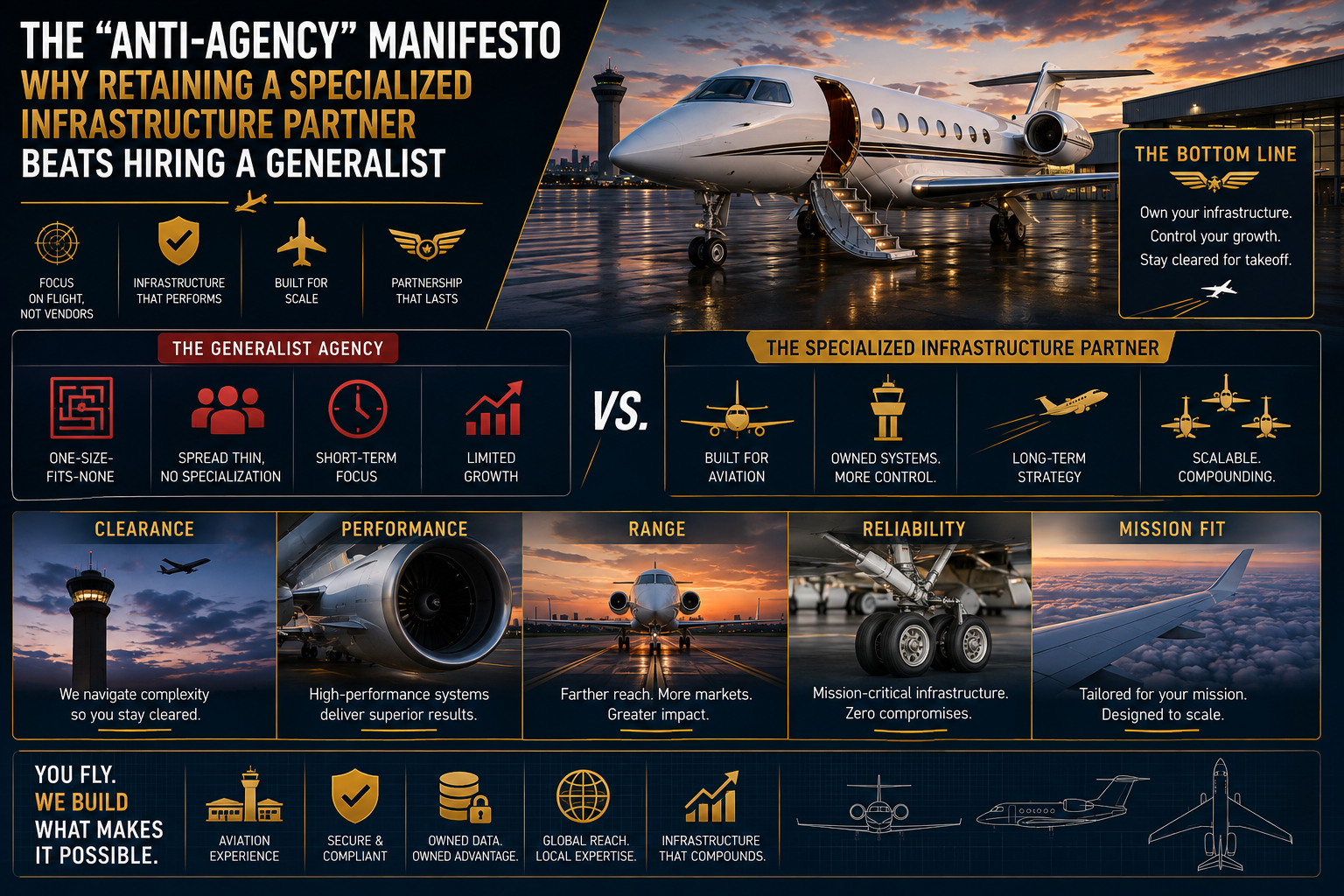
The “Anti-Agency” Manifesto: Why Retaining a Specialized Infrastructure Partner Beats Hiring a Generalist
Most businesses do not need another marketing company completing a checklist every month. Instead, they need a system that becomes more valuable as money, knowledge, data, and content flow into it.
Unfortunately, many companies judge marketing partners by the amount of visible activity they produce. They count blogs, social posts, ad campaigns, reports, meetings, and keyword rankings. Although those activities can matter, activity alone does not create a competitive advantage.
Instead, the more important question is simple: What is your company building that it will still own years from now?
Why Does a Specialized Infrastructure Partner Beat a Generalist Agency?
Direct Answer: A specialized marketing infrastructure partner builds interconnected assets that can compound over time, including search authority, content systems, first-party data, CRM attribution, conversion infrastructure, retargeting audiences, technical SEO, and AI-search visibility. Meanwhile, many generalist agency models focus on recurring execution. Therefore, businesses should compare what they ultimately own, not simply how many monthly tasks an agency completes.
This distinction sits at the center of the Infinite Media Resources philosophy.
However, being “anti-agency” does not mean every agency is bad. Nor does it mean businesses should eliminate outside marketing expertise. In fact, specialized outside expertise can give a company capabilities that would take years to assemble internally.
Rather, the anti-agency philosophy rejects a specific idea: that recurring marketing activity should be the primary product.
Instead, each month of work should strengthen an underlying system that becomes increasingly valuable and increasingly difficult for competitors to reproduce.
Key Takeaways
- Marketing activity can generate results; however, activity alone does not necessarily create a durable business asset.
- Therefore, companies should evaluate what remains after each marketing dollar gets spent.
- A specialized infrastructure partner can connect SEO, GEO, content, paid media, CRM data, conversion systems, and attribution.
- Meanwhile, specialization allows strategy to reflect the economics, terminology, competition, and buyer journey of a particular market.
- Low-cost retainers can restrict how much research, technical work, strategy, and original content a provider can economically deliver.
- However, price alone does not determine quality, and not every generalist agency follows a shallow model.
- Ultimately, the best marketing relationship should make the client’s business progressively stronger rather than permanently dependent on rented attention.
What Does “Anti-Agency” Actually Mean?
The key point: Being anti-agency means rejecting marketing relationships built primarily around recurring activity, not rejecting outside expertise.
A strong outside partner can create enormous value. For example, specialists can give a company access to strategists, developers, search experts, paid-media specialists, analysts, writers, and technical expertise without requiring the business to build every capability internally.
However, the relationship should produce something more substantial than a monthly list of completed tasks.
For example, publishing twelve disconnected articles creates activity. In contrast, building an interconnected authority cluster that answers hundreds of questions throughout the buyer journey creates infrastructure.
Likewise, launching an advertising campaign creates activity. However, connecting advertising behavior with first-party audiences, CRM attribution, conversion data, landing-page intelligence, and organic demand creates infrastructure.
Therefore, the anti-agency philosophy does not ask whether work happened. Instead, it asks whether the work increased the underlying value of the company’s marketing system.
The Agency Test: What Do You Still Own?
The key point: One of the simplest ways to evaluate a marketing relationship is to ask what valuable infrastructure would remain if the engagement ended tomorrow.
Imagine that a company has paid a marketing provider every month for three years. Then, imagine the relationship ends.
What remains?
If most of the value disappears when campaigns stop, the company may have spent primarily on rented distribution. However, if the company retains a stronger website, hundreds of useful search assets, first-party audiences, CRM attribution, conversion data, topical authority, structured information, original research, and a recognized digital brand, then the investment created something more durable.
A Business Should Ideally Retain Assets Such As
- high-quality service and product pages
- industry authority hubs
- location and market authority
- buyer-question libraries
- original research and first-party insights
- CRM attribution history
- conversion data
- first-party audience data
- retargeting audience infrastructure
- case studies and customer proof
- technical SEO improvements
- schema and structured entity relationships
- high-value backlinks and citations earned over time
- AI-search and answer-engine visibility
Consequently, the agency test changes the conversation from “What did we get this month?” to “How much stronger is our acquisition infrastructure than it was before?”
What Is the Difference Between Marketing Activity and a Marketing Asset?
The key point: Activity consumes resources to produce an immediate output, while an asset can continue creating value after the initial work has been completed.
| Traditional Activity | Infrastructure Asset |
|---|---|
| Publishing an isolated blog | Building a connected topical authority cluster |
| Buying traffic | Building organic demand plus reusable first-party audiences |
| Reporting keyword positions | Connecting visibility with pipeline and revenue |
| Creating a landing page | Building a conversion system informed by behavioral data |
| Running retargeting ads | Segmenting audiences by buyer intent and funnel stage |
| Writing for search engines | Creating useful information for buyers, search engines, and AI systems |
| Chasing isolated keywords | Building authority around complete buyer problems |
| Sending monthly reports | Building decision intelligence around customer acquisition |
Importantly, activity is not inherently bad. Every asset requires activity to create it. However, businesses should know whether an activity contributes to something larger.
For instance, one useful article can answer a customer question. Yet 200 strategically connected articles can establish deep coverage of an entire buying journey. Likewise, one location page can attract a local search. However, a properly designed network of city, service, neighborhood, comparison, problem, and decision pages can establish a much larger local footprint.
Therefore, the objective is not to eliminate activity. Instead, the objective is to make activity cumulative.
Why Can Low-Cost Agency Economics Limit Marketing Depth?
The key point: A provider cannot consistently deliver unlimited strategy, research, development, content, analysis, and senior expertise when the economics of the account do not support that work.
This problem does not require bad intentions. Instead, it often comes from simple mathematics.
If an agency sells inexpensive retainers, it generally needs more accounts to generate the same revenue. Consequently, each strategist, account manager, writer, or specialist may need to support more clients.
As the client load increases, the amount of time available for deep market research can decrease. Therefore, standardized templates become attractive because they improve delivery efficiency.
The Economic Pressure Can Encourage
- templated strategies
- generic keyword lists
- short content calendars
- surface-level competitor research
- automated reporting without interpretation
- limited CRM integration
- minimal technical development
- little first-party research
- few custom data systems
- reactive rather than proactive strategy
However, this does not mean every inexpensive provider delivers poor work. Likewise, an expensive provider does not automatically deliver sophisticated work.
Instead, businesses should examine the economics behind the service. If a company expects deep strategic involvement, custom infrastructure, original research, technical implementation, sophisticated measurement, and continuous experimentation, then the engagement must provide enough resources to support those expectations.
Where Does the Generalist Agency Model Break Down?
The key point: Generalist marketing becomes less effective when meaningful growth requires deep knowledge of the buyer, industry, economics, terminology, sales cycle, and competitive landscape.
Consider the difference between a roofing contractor and a private aviation company.
A roofing company may need to capture homeowners within a specific geographic radius who have an immediate replacement, storm-damage, repair, or financing need. Therefore, location authority, review signals, high-intent paid search, visual proof, neighborhood coverage, and lead-speed systems may matter heavily.
Meanwhile, a private aviation company may need to influence UHNW principals, executive assistants, family offices, aircraft owners, corporate flight decision-makers, and charter buyers months before a transaction occurs. Consequently, airport authority, aircraft content, route-pair searches, safety information, privacy questions, FBO research, retargeting, and long-cycle attribution become far more important.
A manufacturer creates another completely different problem. The sales cycle may involve engineers, procurement teams, operations executives, compliance questions, technical specifications, distributors, integrators, and capital expenditure approvals.
Therefore, the same 12-blog, four-ad, one-newsletter marketing package cannot reasonably represent an optimal strategy for every company.
Why Does Specialization Change the Strategy?
The key point: Specialization allows marketing infrastructure to reflect how money actually moves through a particular market.
A specialist should understand more than keywords. Instead, the partner should understand what creates economic value for the client.
A Specialized Strategy Should Consider
- average transaction value
- gross margin
- customer lifetime value
- sales-cycle length
- buyer roles
- geographic limitations
- repeat-purchase behavior
- seasonality
- competitive density
- qualification requirements
- sales-team capacity
- lead-to-close rate
For example, a marketing strategy that generates 1,000 low-value inquiries may perform worse than one that generates 40 highly qualified opportunities. Therefore, raw lead volume cannot serve as the universal objective.
Similarly, ranking nationally may have little value for a regional company that earns nearly all of its revenue within 75 miles. Instead, dominating every commercially important search within that footprint may produce a stronger return.
Consequently, specialization changes both what gets built and how success gets measured.
What Does Marketing Infrastructure Actually Include?
The key point: Marketing infrastructure is the connected system that creates, captures, qualifies, measures, and compounds customer demand.
Although every company needs a different architecture, the system can include several layers.
1. Search Infrastructure
First, the website needs enough useful depth to represent the actual market. Therefore, service pages, product pages, location pages, comparison pages, buyer questions, use cases, educational resources, and supporting authority content should connect logically.
2. GEO and AI-Search Infrastructure
Next, content should make important facts, relationships, expertise, and direct answers easy to understand. Additionally, structured data and clear entity relationships can help machines interpret what the company does and where its expertise applies.
3. Conversion Infrastructure
Traffic alone creates little value when qualified visitors do not take the next step. Consequently, landing pages, calls to action, forms, phone tracking, trust signals, proof, and buyer-specific conversion paths must support the search system.
4. First-Party Data Infrastructure
Meanwhile, the company should learn from its own visitors and customers. CRM records, lead-source data, qualification outcomes, audience behavior, customer questions, and sales outcomes can improve future decisions.
5. Paid Acquisition Infrastructure
Paid media can then accelerate proven opportunities. However, the campaigns should connect with landing pages, audiences, CRM attribution, and revenue data instead of existing as an isolated advertising account.
6. Measurement Infrastructure
Finally, the business needs to know which channels, pages, markets, campaigns, and topics create qualified pipeline. Therefore, measurement should extend beyond clicks and impressions whenever possible.
Why Should Content Become Digital Real Estate?
The key point: Useful content can behave like digital real estate because a page can occupy valuable discovery territory and continue attracting prospective buyers long after publication.
A paid advertisement generally stops producing impressions when the advertiser stops funding it. However, a strong organic page may continue attracting visitors, earning links, supporting other pages, appearing in search results, helping AI systems understand a brand, and assisting conversions.
Furthermore, the value can compound when many pages work together.
One article about a buyer question has limited reach. Yet a comprehensive network covering the buyer’s questions, alternatives, problems, locations, products, use cases, comparisons, and decision criteria can create a much larger discovery surface.
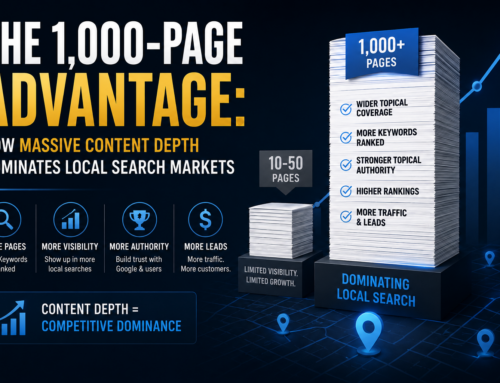
That is the logic behind IMR’s 1,000-Page Digital Real Estate Model.
However, the objective is not to publish 1,000 thin pages. Instead, every page should earn its place through unique intent, useful information, internal relationships, and commercial relevance.
Therefore, scale should amplify usefulness rather than replace it.
Does the Anti-Agency Model Mean You Should Stop Buying Ads?
The key point: No. Paid media remains valuable, but it becomes more powerful when it sits on top of owned marketing infrastructure.
Advertising can generate demand quickly. Therefore, it can help companies test offers, reach new markets, retarget high-intent visitors, and create pipeline while organic assets mature.
However, permanent dependence on paid traffic creates a structural weakness when the company has no owned acquisition system underneath it.
For example, cost per click can rise. Competition can increase. Platforms can change targeting rules. Meanwhile, a competitor with stronger organic authority may attract the same buyer before the paid campaign ever enters the journey.
Therefore, IMR does not treat paid and organic acquisition as opposing strategies.
Instead, paid media can create immediate acceleration while owned digital infrastructure creates long-term leverage.
Why Do SEO and GEO Require More Than a Blog Calendar?
The key point: Search authority depends on how completely and credibly a company represents its expertise, not simply how often it publishes.
A monthly blog calendar can support a larger strategy. However, publishing random topics does not automatically create authority.
Instead, the company should understand the information architecture of its market.
What does a buyer ask before purchasing? Which comparisons matter? Which locations matter? Which objections slow the sale? Which technical questions require expert answers? Which use cases demonstrate expertise? Which entities connect the company to the broader industry?
Once those relationships become clear, the website can address them systematically.
Furthermore, AI-assisted search introduces another discovery layer. Buyers can now ask conversational questions that combine products, geography, requirements, comparisons, budgets, risks, and use cases.
Therefore, companies need content capable of answering complex questions naturally rather than merely repeating target phrases.
Google’s guidance continues to emphasize helpful, reliable, people-first content. Consequently, infrastructure scale should never become an excuse for mass-producing pages without meaningful information.
Why Does CRM Attribution Change Marketing Decisions?
The key point: Marketing becomes substantially more useful when the business can distinguish traffic from leads, leads from qualified opportunities, and qualified opportunities from revenue.
A keyword may generate a large number of leads but almost no sales. Meanwhile, another topic may generate only a handful of inquiries yet repeatedly produce high-value customers.
Without CRM attribution, those two sources can look completely different from reality.
Infrastructure-Level Measurement Can Connect
- first landing page
- campaign source
- keyword or query theme
- content viewed
- form submission
- phone call
- qualification status
- sales opportunity
- quoted value
- closed revenue
- gross margin
- repeat business
As a result, marketing decisions can move away from vanity metrics and toward economics.
For example, the business may discover that a low-traffic technical article influences several large deals. Consequently, that topic deserves additional supporting content even though its raw traffic looks unimpressive.
This feedback loop is one of the major differences between marketing activity and marketing infrastructure.
How Does Marketing Infrastructure Create a Competitive Moat?
The key point: A competitive moat forms when a competitor cannot easily reproduce the accumulated content, data, authority, proof, audience intelligence, and market coverage a company has built over time.
A competitor can copy an advertisement quickly. Likewise, it can redesign a website, bid on the same keyword, or imitate a landing page.
However, copying an entire authority system is much harder.
Imagine a company has built hundreds of high-quality pages covering its market. Additionally, those pages have accumulated internal authority, external references, customer data, conversion history, original proof, local relevance, and brand recognition.
A new competitor cannot instantly recreate those years of accumulated signals.
Furthermore, each new asset can strengthen existing assets. A new case study supports service pages. A new location page connects with local authority. Original research creates citation opportunities. CRM data identifies new questions. Meanwhile, paid campaigns reveal additional buyer language that can inform organic content.
Therefore, the moat does not come from one tactic. It comes from the relationships between the assets.
Should a Marketing Partner Make Your Business Dependent on Them?
The key point: A strong partner may remain valuable for years, but the client should remain because continued collaboration creates new value—not because previous value disappears without the partner.
This distinction matters.
A company may retain architects, attorneys, accountants, engineers, consultants, or technology specialists for decades because their ongoing expertise remains useful. Therefore, a long-term marketing relationship is not inherently a sign of dependency.
However, the reason for retention matters.
If the client remains because leaving would cause the entire acquisition system to disappear, the relationship may be structurally dependent.
In contrast, an infrastructure partner should continually add new layers: more market coverage, better data, stronger conversion systems, deeper authority, improved attribution, new experiments, and stronger competitive positioning.
Consequently, the client stays because the system keeps improving.
How Is the IMR Infrastructure Model Different?
The key point: Infinite Media Resources approaches marketing as the construction of owned digital infrastructure rather than a collection of disconnected monthly services.
The strategy begins with the economics of the business. Therefore, IMR looks at the customer, transaction value, geography, sales cycle, competition, search journey, and long-term market opportunity before deciding what infrastructure deserves investment.
From there, the objective is to connect the layers.
The IMR Model Can Combine
- large-scale SEO architecture
- GEO and AI-search optimization
- industry authority hubs
- service and product ecosystems
- local and regional authority
- comparison and decision content
- first-party expertise
- digital PR and citation development
- paid acquisition
- retargeting
- conversion optimization
- CRM attribution
- revenue-based optimization
Importantly, the system does not require every company to use every tactic. Instead, the architecture should reflect the opportunity.
A regional contractor may need deep local authority. Meanwhile, a private aviation company may need airport, route, aircraft, and UHNWI buyer authority. Likewise, an industrial manufacturer may need technical application, equipment, compliance, troubleshooting, and procurement content.
Therefore, specialization does not mean forcing clients into one industry template. Instead, it means understanding the market deeply enough to build the right infrastructure for it.
How Should You Evaluate a Marketing Partner?
The key point: Evaluate the partner by its strategic model, measurement system, ownership structure, depth of work, and ability to connect marketing with business outcomes.
Ask These Questions Before Hiring
- What will we own? Determine which websites, content, accounts, data, audiences, creative assets, and systems remain with your company.
- How will you learn our market? Ask how the provider researches customers, competitors, economics, sales cycles, and buyer behavior.
- How does the work compound? Determine whether each project strengthens a larger architecture.
- How will you measure qualified demand? Look beyond traffic, impressions, and raw lead volume.
- How does CRM data influence strategy? Ask whether closed revenue can feed future marketing decisions.
- How do paid and organic channels work together? Strong systems should share data and insights across channels.
- How do you prevent thin content? Ask how the provider creates original information and unique value at scale.
- What happens if we stop working together? The answer reveals how much infrastructure you actually own.
Additionally, ask to see how the provider thinks. A polished proposal matters less than whether the strategic logic matches the economics of your business.
When Should a Company Move Away From the Traditional Agency Model?
The key point: A company should reconsider its marketing model when spending continues but the underlying acquisition system does not become measurably stronger.
Warning Signs Can Include
- the same deliverables repeat every month
- reports emphasize activity rather than business outcomes
- content exists without a larger architecture
- paid media operates separately from organic strategy
- marketing data does not reach the CRM
- sales feedback does not change marketing decisions
- the agency cannot explain the buyer journey
- strategy rarely changes despite new information
- most acquisition stops immediately when advertising stops
- years of spending have produced few durable assets
However, businesses do not always need to replace everything at once.
Instead, they can begin by auditing what they already own. Then, they can identify missing infrastructure, preserve productive campaigns, improve measurement, consolidate data, and gradually redirect spending toward assets with longer useful lives.
Therefore, the transition can be strategic rather than disruptive.
Frequently Asked Questions
What is a specialized marketing infrastructure partner?
Direct Answer: A specialized marketing infrastructure partner builds interconnected acquisition assets around a company’s market, buyer journey, economics, search visibility, first-party data, conversion systems, paid media, and revenue attribution.
Is IMR against marketing agencies?
Direct Answer: No. The anti-agency philosophy challenges marketing relationships centered primarily on recurring activity. Outside specialists can create significant value when their work builds durable infrastructure and measurable business advantages.
What is the difference between marketing activity and marketing infrastructure?
Direct Answer: Marketing activity produces an immediate output, while infrastructure connects outputs into systems that can continue creating value. For example, an isolated blog is activity, while an interconnected authority ecosystem can become infrastructure.
Are low-cost marketing agencies always bad?
Direct Answer: No. Price alone does not determine quality. However, businesses should determine whether the economics of a low-cost engagement realistically support the research, strategy, technical work, content depth, and senior expertise they expect.
Why is industry specialization important?
Direct Answer: Specialization helps a marketing partner understand the buyer, terminology, economics, geography, sales cycle, objections, qualification criteria, and competitive structure of a particular market.
Should a business stop running paid ads?
Direct Answer: No. Paid advertising can create immediate demand and accelerate growth. However, companies can reduce structural dependence on rented traffic by building owned search, audience, data, content, and conversion assets alongside paid media.
What is digital real estate?
Direct Answer: Digital real estate describes useful online assets that occupy valuable discovery territory and can continue attracting, educating, and converting prospective customers after the initial creation work.
How does SEO become an asset?
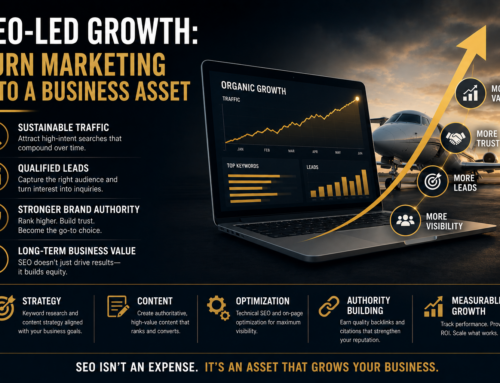
Direct Answer: SEO becomes an asset when useful pages, authority, internal relationships, technical improvements, citations, data, and brand recognition accumulate into a discovery system that can continue producing demand over time.
What is GEO?
Direct Answer: Generative Engine Optimization, or GEO, is the practice of improving how clearly a brand’s information, expertise, entities, and answers can be understood and surfaced within AI-assisted discovery experiences.
Why does CRM attribution matter?
Direct Answer: CRM attribution helps companies determine which marketing sources create qualified opportunities and revenue rather than judging success only by traffic, clicks, or raw leads.
Should a company retain a marketing infrastructure partner long term?
Direct Answer: It can make sense when the partner continues adding valuable infrastructure, expertise, data, experimentation, market coverage, and competitive advantages. The relationship should continue because new value compounds, not because old value disappears.
How can I tell whether my marketing agency is building assets?
Direct Answer: Ask what your company would still own if the relationship ended tomorrow. Strong answers include useful content, search authority, first-party data, CRM history, conversion systems, audiences, technical improvements, research, and measurable market coverage.
External Authority Resources
The Anti-Agency Manifesto: Build Something That Gets Harder to Replace
Direct Answer: The strongest marketing relationship does more than produce campaigns. Instead, it builds an owned system of authority, data, content, conversion infrastructure, audiences, and market intelligence that becomes more valuable over time.
Businesses will always need execution. They will also need specialists, strategists, developers, creative talent, analysts, and media expertise.
However, execution should contribute to something larger.
Every useful article should expand market coverage. Likewise, every campaign should generate information. Every customer interaction should improve first-party knowledge. Every case study should strengthen proof. Every technical improvement should make the platform stronger. Meanwhile, every year of investment should leave the company with more leverage than it had the year before.
That is the difference between renting marketing activity and building marketing infrastructure.
Therefore, the most important question is not whether your company has an agency.
The more important question is: What is your marketing partner actually building for you?
Final Insight: The best marketing partner should not make your business permanently dependent on the partner. Instead, it should make your business progressively more difficult for competitors to displace.
Stop Renting Attention. Start Building Digital Infrastructure.
Infinite Media Resources builds interconnected SEO, GEO, content, paid-media, conversion, and attribution systems designed to create long-term digital assets. Therefore, businesses can pursue immediate growth while simultaneously building an owned acquisition system that compounds.
Explore IMR’s Digital Real Estate model to see how large-scale authority architecture can turn marketing spend into a growing portfolio of digital assets.
About the author : Anthony Paulino