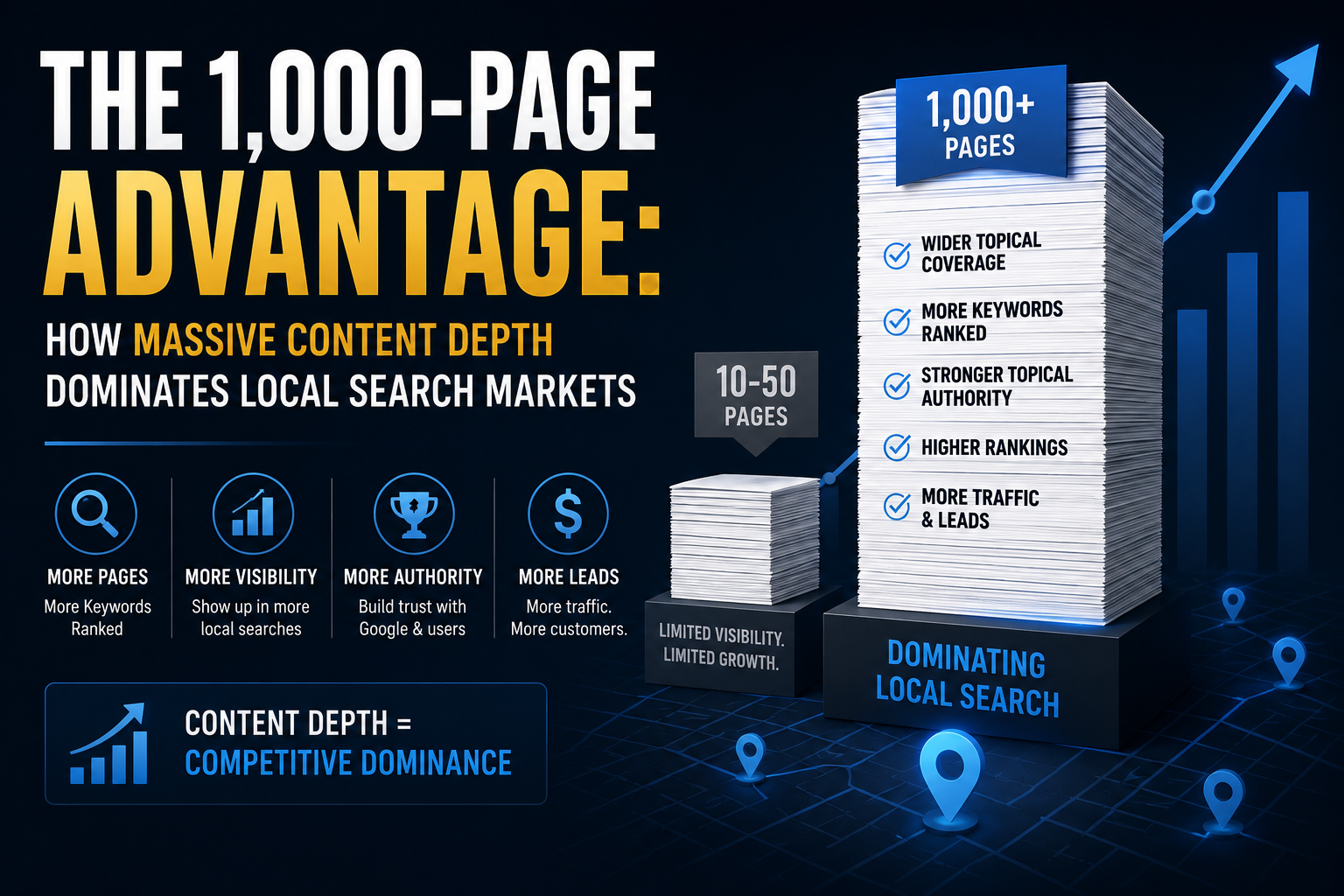
The 1,000-Page Advantage: How Massive Content Depth Dominates Local Search Markets
Direct Answer: A 1,000-page content ecosystem helps local businesses dominate search because it gives them more ways to answer buyer questions, rank for service-and-location searches, build topical authority, support AI search visibility, and convert homeowners before competitors enter the conversation. However, the advantage does not come from publishing random pages. It comes from building useful, connected, human-first digital real estate.
Most contractors think they need “better SEO.” However, in many cases, they actually need more useful search assets.
A roofing company with 15 pages can only compete for a limited number of searches. Meanwhile, a contractor with hundreds of thoughtful service pages, city pages, neighborhood pages, project pages, FAQs, and comparison guides can show up across the entire homeowner journey.
Therefore, the real advantage is not just having more content. Instead, it is having more helpful entry points into your business.
Google recommends creating helpful, reliable, people-first content, and structured data helps search systems better understand your pages. Therefore, local businesses should build content that genuinely helps people make decisions, not thin pages created only to chase keywords. Google explains helpful content, while Google explains structured data.
Key Takeaways
- Large content ecosystems create more opportunities to appear in local search and AI-generated answers.
- However, page count alone does not create authority.
- Therefore, every page should answer a real question, support a real service, or strengthen a real location market.
- Additionally, internal linking, schema, reviews, proof, and conversion paths turn content depth into business value.
- Ultimately, the strongest local brands do not only rank for a few terms. They own more of the buyer journey.
What the 1,000-Page Advantage Really Means
Direct Answer: The 1,000-page advantage means building a deep, connected library of useful pages that covers services, locations, questions, comparisons, projects, and buyer concerns across a local market.
The point is not to publish 1,000 weak pages. In fact, that approach can hurt the brand. Instead, the goal is to build a complete content ecosystem that helps homeowners at every stage of the buying process.
The Real Goal
A strong content ecosystem should help a homeowner understand their problem, compare options, trust the contractor, and take the next step. Therefore, every page needs a job.
Useful Page Types
- service pages
- city pages
- neighborhood pages
- storm damage guides
- insurance claim resources
- cost guides
- comparison pages
- project case studies
- FAQ pages
- review-supported landing pages
As a result, the website becomes more than a brochure. It becomes a market education platform.
Why Small Local Websites Hit a Ceiling
Direct Answer: Small local websites plateau because they do not have enough pages to capture the many ways customers search before choosing a provider.
A typical contractor website may have a homepage, an about page, a contact page, five service pages, a few city pages, and a small blog. That may work at first. However, the site eventually runs out of ranking opportunities.
The Growth Ceiling
Once the main pages have ranked as well as they can, growth slows. Additionally, competitors with broader content libraries begin capturing long-tail searches that the smaller website does not answer.
What Small Sites Miss
- specific service questions
- local suburb searches
- neighborhood-level searches
- repair vs. replacement searches
- cost-related searches
- material comparison searches
- storm damage questions
- insurance process questions
- project proof searches
Therefore, the website may look professional while still leaving most of the search market untouched.
Why Content Is Digital Real Estate
Direct Answer: Content is digital real estate because each strong page becomes a long-term asset that can attract traffic, build trust, support sales, and generate leads over time.
A paid ad disappears when the budget stops. However, a useful page can keep working for years. Additionally, that page can support ads, retargeting, sales conversations, internal links, and AI search visibility.
Digital Real Estate Works Because It Compounds
One page can rank. Another page can support it. A third page can answer a related question. Meanwhile, internal links can connect all three. As the ecosystem grows, the website becomes more useful and more authoritative.
Examples of Compounding Assets
- a roof repair page that links to a roof leak guide
- a city page that links to local project examples
- a gutter guard page that links to water damage FAQs
- a siding page that links to material comparisons
- a storm damage page that links to insurance claim steps
Consequently, the site becomes harder for a thin competitor to outrank.
The Search Surface Area Problem
Direct Answer: Search surface area is the number of relevant searches your website can realistically appear for across services, locations, problems, and buyer questions.
Most local businesses only cover a small portion of their actual search market. For example, a roofing contractor may target “roof replacement” and “roof repair,” but ignore dozens of valuable related searches.
A Larger Search Surface Includes
- roof repair in specific cities
- roof replacement in specific suburbs
- hail damage roof inspection questions
- roof leak causes
- metal roofing comparisons
- financing questions
- insurance claim questions
- neighborhood project pages
- commercial roofing searches
- emergency repair searches
Therefore, a larger content ecosystem gives the business more chances to be found by the right person at the right moment.
Why More Pages Only Work When Quality Stays High
Direct Answer: More pages only work when each page is useful, unique, accurate, and connected to a real buyer need.
Mass publishing weak pages is not a strategy. It creates clutter. Moreover, thin pages with swapped city names or repeated paragraphs can make the site feel cheap to both users and search systems.
Every Page Should Have
- a clear purpose
- a direct answer
- unique local or service context
- helpful explanations
- proof or examples when possible
- internal links
- a relevant CTA
- schema when appropriate
Additionally, the content should sound human. If a homeowner would not find the page useful, the page should not exist yet.
Service Pages: The Revenue Foundation
Direct Answer: Service pages are the foundation because they target the highest-value work a company wants to sell.
For contractors, service pages should do more than list offerings. Instead, they should explain problems, options, process, materials, timelines, financing, warranties, and next steps.
Core Home Improvement Service Pages
- roof replacement
- roof repair
- storm damage roof repair
- siding installation
- window replacement
- gutter installation
- gutter guards
- commercial roofing
- emergency roof repair
- insurance restoration
Furthermore, each service page should link to related city pages, FAQ pages, comparison pages, and project examples. As a result, the service page becomes a hub, not an isolated page.
City Pages: The Local Market Layer
Direct Answer: City pages help a local business show up when customers search for services in specific locations.
However, city pages must be unique. A good page should reflect real local context, common service needs, project examples, local reviews, and nearby neighborhoods.
Strong City Pages Include
- the main service offered in that city
- common local home issues
- nearby neighborhoods
- weather or housing context
- local reviews when available
- project examples
- service-specific FAQs
- a local CTA
Therefore, city pages should feel like they were written for that place, not copied from another page.
Neighborhood Pages: The Micro-Local Advantage
Direct Answer: Neighborhood pages capture highly specific local searches that many competitors ignore.
Most agencies stop at city pages. However, homeowners often search around neighborhoods, developments, communities, and nearby landmarks. Therefore, micro-local pages can create easier wins in competitive markets.
When Neighborhood Pages Make Sense
- the area has enough search demand
- the contractor has completed projects nearby
- the neighborhood has distinct home types
- the area has high-value homes
- the city is too competitive by itself
Additionally, these pages can support paid campaigns, local proof, and sales conversations. Consequently, they often become more valuable than their traffic numbers suggest.
FAQ Pages: The AI Search Layer
Direct Answer: FAQ pages help businesses appear for question-based searches and support AI search visibility because they provide clear answers to real buyer concerns.
Homeowners ask many questions before they contact a contractor. Therefore, each question can become an opportunity to build trust.
Useful FAQ Topics
- How do I know if my roof has storm damage?
- Should I repair or replace my roof?
- How long do replacement windows last?
- Are gutter guards worth it?
- What siding is best for cold weather?
- How does the insurance claim process work?
- What causes gutters to overflow?
- How do I compare roofing warranties?
Additionally, FAQs can link back to service pages, city pages, and comparison pages. As a result, they strengthen the entire content system.
Comparison Pages: The Decision Layer
Direct Answer: Comparison pages attract buyers who are closer to making a decision because they are weighing options.
A homeowner who searches “metal roof vs asphalt shingles” is not just browsing. They are comparing paths. Therefore, comparison pages can attract stronger intent than broad awareness blogs.
Good Comparison Topics
- roof repair vs roof replacement
- metal roofing vs asphalt shingles
- vinyl siding vs fiber cement siding
- 5-inch gutters vs 6-inch gutters
- double-hung windows vs casement windows
- gutter guards vs regular gutter cleaning
- insurance claim repair vs out-of-pocket repair
Furthermore, comparison pages help sales teams because they frame the decision before the appointment.
Project Pages: The Proof Layer
Direct Answer: Project pages turn completed work into searchable proof that supports local trust and conversion.
Many contractors take photos after a job but never turn those photos into content. However, each project can show location, service type, materials, problem solved, timeline, and outcome.
A Strong Project Page Includes
- project location
- service completed
- problem the homeowner had
- materials used
- before-and-after photos
- process summary
- local CTA
- related service links
Consequently, project pages help the company prove its work instead of only claiming expertise.
Internal Links: How the Ecosystem Works Together
Direct Answer: Internal links help search engines, AI systems, and users understand how your services, locations, questions, and proof assets connect.
A large website without internal links becomes hard to navigate. However, a connected website becomes an authority system. Therefore, every page should point users toward the next useful resource.
Smart Internal Link Paths
- service page → city page
- city page → neighborhood page
- FAQ page → service page
- comparison page → estimate CTA
- project page → related service page
- storm guide → insurance claim page
- blog article → relevant service hub
Additionally, internal links distribute authority across the website. As a result, strong pages can help newer pages gain traction faster.
How Content Depth Becomes a Lead Generation Moat
Direct Answer: Content depth becomes a lead generation moat when a business owns more search entry points, answers more buyer questions, and builds more trust before the first call.
A competitor can copy one page. They can copy an offer. They can even copy an ad. However, copying a deep content ecosystem takes serious time, planning, and investment.
Why It Becomes Hard to Compete Against
- the site ranks for more searches
- the brand appears more often
- the content answers more questions
- the site builds more retargeting audiences
- the internal links strengthen the whole domain
- the pages support sales conversations
- the brand earns more trust before contact
Therefore, content depth does not only improve traffic. It improves the quality and consistency of lead flow.
Roofing Example: 30 Pages vs. 1,000 Pages
Direct Answer: A 30-page roofing website can only target a small part of the market, while a 1,000-page ecosystem can cover services, cities, neighborhoods, storm damage, materials, costs, FAQs, comparisons, and projects.
The 30-Page Website
A small roofing website may include a few service pages, a few cities, and a small blog. It may rank for some terms. However, it misses most long-tail searches.
The Larger Ecosystem
A deeper roofing site can cover roof repair, replacement, storm damage, commercial roofing, metal roofing, insurance claims, emergency tarping, ventilation, gutters, city pages, neighborhoods, cost guides, comparison pages, and project proof.
The Difference
As the larger site grows, it captures homeowners earlier, supports retargeting, builds brand familiarity, and creates more ways to convert. Therefore, it becomes less dependent on buying shared leads or waiting for referrals.
How to Build the First 6 Months
Direct Answer: The first 6 months should focus on service pages, priority cities, high-value questions, project proof, internal linking, schema, and conversion tracking.
Month 1: Build the Foundation
Start with tracking, core service pages, analytics, CRM fields, and the main content map.
Month 2: Expand the Service Layer
Next, build deeper service pages for the most profitable offers.
Month 3: Add Priority City Pages
Then, create local pages for the most valuable markets.
Month 4: Publish Problem-Solving Content
Afterward, answer the questions homeowners ask before they request an estimate.
Month 5: Add Proof and Comparison Pages
Additionally, build project pages, before-and-after content, and decision-stage comparisons.
Month 6: Optimize and Expand
Finally, review rankings, leads, call quality, page engagement, and closed jobs. Then, expand based on what is working.
Metrics That Matter
Direct Answer: Measure content depth by visibility, engagement, lead quality, conversion rate, and revenue, not page count alone.
Track These Metrics
- organic impressions
- organic clicks
- city page traffic
- service page conversions
- FAQ page entrances
- internal link clicks
- form submissions
- phone calls
- booked appointments
- closed jobs
- gross profit by source
- branded search growth
- AI-search visibility
- retargeting audience growth
Additionally, track which content actually supports revenue. As a result, the site can grow intelligently instead of simply growing larger.
Common Mistakes
Direct Answer: The biggest mistake is confusing content volume with content strategy.
- publishing thin pages
- repeating the same city copy
- creating pages with no search intent
- ignoring internal links
- not adding proof
- not using schema
- not tracking leads by page
- not updating old content
- not connecting content to CTAs
- writing for algorithms instead of humans
- building pages faster than quality control allows
Instead, build fewer pages well, then scale the system carefully. Quality must stay ahead of quantity.
Frequently Asked Questions
Does a local business really need 1,000 pages?
Not every local business needs exactly 1,000 pages. However, larger content ecosystems often help companies capture more services, locations, questions, comparisons, and buyer stages.
Will more pages automatically improve rankings?
No. More pages only help when they are useful, unique, well-linked, and connected to real search intent.
What should contractors build first?
Contractors should usually start with core service pages, priority city pages, FAQs, proof pages, and high-intent comparison content.
Can too many pages hurt a website?
Yes. Thin, duplicated, or low-value pages can weaken the site. Therefore, quality control is essential.
How does content depth help AI search?
Content depth helps AI search because answer engines need clear, helpful, well-structured information across related questions and topics.
External Sources
Conclusion
Direct Answer: The 1,000-page advantage is not about flooding a website with content. It is about building a complete, useful, connected library that helps local buyers at every stage of the decision process.
Small websites compete for a few rankings. However, deep content ecosystems compete for the entire local search journey. They answer more questions, support more services, cover more neighborhoods, show more proof, and create more ways for buyers to trust the brand.
Therefore, the companies that win local search will not always be the ones with the prettiest homepage. Instead, they will be the ones that build the most useful digital real estate in their market.
Final Insight: More pages only matter when every page earns its place. Build for humans first, connect the ecosystem clearly, and the search advantage follows.
About the author : Anthony Paulino