Why Your Marketing Should Be an Asset, Not an Expense: The ROI of SEO-Led Growth
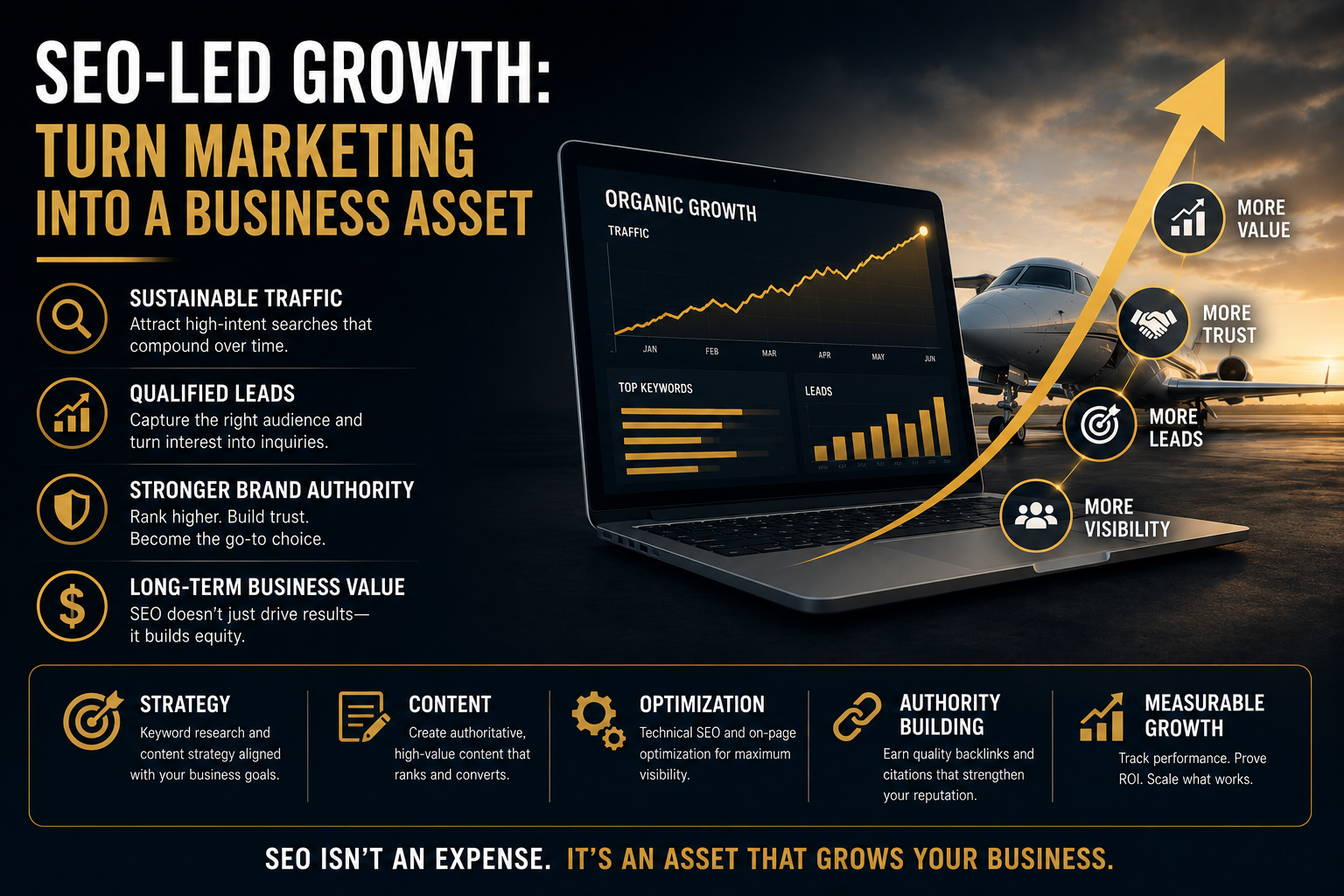
Direct Answer: Marketing becomes an asset when it continues generating visibility, authority, leads, customer data, and revenue after the original investment has been made. Therefore, SEO-led growth is different from short-term advertising because every service page, city page, authority article, FAQ, case study, review asset, and internal link can continue producing value over time.
Most companies treat marketing like a monthly bill. They spend money, generate leads, review the numbers, and repeat the same cycle again next month. However, that mindset creates a dangerous dependency. If every lead depends on fresh ad spend, the business never truly owns its growth engine.
Therefore, the better question is not, “How many leads did we buy this month?” Instead, the better question is, “What did we build this month that can still create value next year?”
Paid media can create speed. However, SEO-led infrastructure creates leverage. While ads disappear when the budget stops, strong digital assets can keep working. As a result, SEO-led growth becomes more than a marketing tactic. It becomes a business asset.
Google recommends creating helpful, reliable, people-first content, while structured data helps search systems understand pages and entities. Therefore, businesses that invest in useful, well-connected content ecosystems can build lasting authority instead of relying only on temporary traffic. Google explains helpful content, and Google explains structured data.
Key Takeaways
- Marketing becomes an asset when it creates lasting visibility, authority, leads, and data.
- However, paid advertising often behaves like an expense because results usually stop when spend stops.
- Therefore, SEO-led growth builds digital real estate that can compound over time.
- Additionally, strong SEO assets improve paid media, retargeting, sales enablement, and CRM attribution.
- Ultimately, businesses that own demand are less vulnerable than businesses that only rent attention.
Why Most Businesses Think About Marketing Incorrectly
Direct Answer: Most businesses think about marketing incorrectly because they focus only on immediate lead generation while ignoring long-term asset creation.
Short-term metrics matter. Cost per lead, cost per click, monthly return on ad spend, and conversion rate all help leadership understand performance. However, those metrics do not tell the entire story.
For example, a business may spend $25,000 on ads and generate leads quickly. Although that can be useful, the value often disappears once the campaign stops. Meanwhile, another business may spend the same amount building service pages, city pages, authority content, case studies, FAQs, and conversion assets.
At first, the second business may generate fewer leads. However, those assets remain online. Therefore, they can keep attracting prospects, supporting sales conversations, feeding retargeting audiences, and building authority over time.
Consequently, one business buys temporary attention while the other builds a long-term growth engine.
Expense Thinking vs. Asset Thinking
Direct Answer: Expense thinking asks what marketing produced this month, while asset thinking asks what marketing built that can keep producing value.
Expense Thinking
Expense thinking treats marketing as a necessary cost. The company pays for clicks, leads, placements, posts, campaigns, and vendors. Then, when the payment stops, the output usually slows down.
Asset Thinking
Asset thinking is different. It focuses on building owned visibility, owned content, owned customer data, owned conversion paths, and owned authority. Therefore, the business becomes less dependent on external platforms over time.
The Better Question
Instead of asking only, “What did this campaign produce?” leadership should also ask, “What remains after the campaign ends?” If the answer is nothing, the business likely bought an expense. If the answer is rankings, content, data, audience, trust, and conversion infrastructure, the business built an asset.
Renting Attention vs. Owning Attention
Direct Answer: Paid advertising rents visibility, while SEO-led growth builds owned attention through durable digital assets.
Imagine two companies in the same market. The first company spends $20,000 every month on ads. The second company invests $20,000 every month into content, local pages, authority hubs, GEO assets, conversion pages, and CRM-connected infrastructure.
After one month, the ad-driven company may win faster. However, after three years, the difference becomes much larger. The first company may still need the same monthly ad spend to maintain lead volume. Meanwhile, the second company may own hundreds of pages that rank, convert, educate, and support sales.
Therefore, one company keeps renting attention. The other company accumulates digital real estate.
Why SEO Behaves Like Digital Real Estate
Direct Answer: SEO behaves like digital real estate because strong pages can keep producing traffic, leads, trust, and data after they are built.
A paid ad is like renting a billboard. It can work, but it disappears when the rent stops. A strong service page, city page, or authority article behaves more like an owned property. It may require upfront investment, maintenance, and improvement. However, it can continue producing value over time.
Digital Assets Include
- service pages
- city pages
- neighborhood pages
- industry pages
- FAQ pages
- comparison pages
- case studies
- project pages
- review assets
- authority blogs
- knowledge hubs
Additionally, these assets support each other. A blog can link to a service page. A service page can link to a city page. A case study can support a conversion page. As a result, the site becomes stronger as the ecosystem grows.
The Compounding Curve of SEO-Led Growth
Direct Answer: SEO-led growth compounds because every useful page can strengthen the website’s authority, internal linking, topical coverage, and future ranking potential.
SEO rarely grows in a perfectly straight line. Instead, it often behaves more like investing. The early stages may feel slow because the business is building the foundation. However, as pages accumulate, internal links expand, brand searches increase, reviews grow, and authority strengthens, new assets can perform faster.
Compounding Happens When
- new pages support existing pages
- existing pages pass authority to new pages
- internal links connect related topics
- brand searches increase
- AI systems understand the entity better
- retargeting audiences grow
- CRM data improves targeting
- sales teams use content during follow-up
Consequently, the whole system can become more valuable than the sum of its pages.
What Happens After 12 Months?
Direct Answer: After 12 months, SEO-led growth usually begins shifting from foundation-building into measurable asset value.
In one year, a business can build a meaningful content base. Depending on the market, that may include core service pages, city pages, authority articles, FAQs, comparison pages, case studies, and internal links.
At first, each page may feel small. However, together they begin forming a search ecosystem. Additionally, the business starts learning which topics produce leads, which pages support sales, and which search terms reveal buyer intent.
Therefore, even if the business still uses paid media, it now owns a stronger foundation. The company has more pages to send traffic to, more assets to retarget from, more answers for buyers, and more data in the CRM.
What Happens After 36 Months?
Direct Answer: After 36 months, a business with consistent SEO-led growth often has a strong authority advantage that competitors struggle to copy quickly.
By year three, the business may have hundreds of indexed pages, thousands of keyword impressions, stronger branded search, more internal links, more local visibility, and better content-assisted conversions.
Meanwhile, competitors that only bought traffic may still be starting every month from zero. They may have leads, but they may not have accumulated much owned visibility.
As a result, the SEO-led company can become harder to compete against. Competitors are no longer trying to outrank one page. Instead, they are competing against an entire content ecosystem.
What Happens After 60 Months?
Direct Answer: After 60 months, SEO-led growth can change the company’s market position because the business may own a large portion of the search landscape.
Five years of consistent asset building can create a serious moat. The business may own service searches, local searches, problem searches, comparison searches, question searches, and AI-search visibility across an entire market.
Additionally, new content usually launches into a stronger environment. Pages can index faster, rank faster, and earn trust faster because the domain already has authority.
Therefore, the business may begin benefiting from the same force that protects real-world assets: accumulated ownership. It owns more of the market’s digital surface area than competitors can easily recreate.
Why Authority Reduces Customer Acquisition Costs
Direct Answer: Authority reduces customer acquisition costs because trusted brands usually convert attention into leads more efficiently.
When buyers view several providers as equal, price becomes the easiest comparison. However, authority changes the conversation. A company with deep content, strong reviews, helpful resources, case studies, and clear expertise does not feel interchangeable.
As a result, authority can improve:
- click-through rates
- conversion rates
- form completion rates
- phone call quality
- sales close rates
- referral rates
- retargeting performance
- pricing power
Therefore, SEO-led growth does not only create traffic. It can make every piece of traffic more valuable.
How SEO Improves Every Marketing Channel
Direct Answer: SEO improves other channels because strong content, better landing pages, and deeper authority make paid media, email, retargeting, and sales follow-up more effective.
SEO should not operate in a silo. In fact, SEO-led growth often becomes the foundation that supports every other channel.
Paid Ads
Google Ads and Meta Ads perform better when they send traffic to helpful, conversion-focused pages instead of thin landing pages.
Email campaigns become stronger when the company has useful guides, FAQs, comparisons, and case studies to send.
Retargeting
Retargeting audiences grow when more visitors enter the site through helpful content.
Sales
Sales teams close more effectively when they can send educational resources that answer objections before the next call.
Consequently, SEO-led growth strengthens the entire marketing system.
First-Party Data as an Asset
Direct Answer: First-party data becomes an asset because it helps businesses understand what buyers want, which pages create intent, and which channels produce revenue.
When a business owns its website, content, CRM, tracking, and conversion paths, it can learn from every visitor. Additionally, it can build retargeting audiences, track content-assisted conversions, and improve future campaigns.
First-Party Data Can Reveal
- which services attract demand
- which cities create better leads
- which pages assist conversions
- which search topics reveal high intent
- which campaigns create profitable customers
- which audiences should be retargeted
- which content supports sales conversations
Therefore, SEO-led growth does not only build pages. It builds intelligence.
Google’s business resources also emphasize the value of first-party data for generating insights and improving marketing strategy. Google Business discusses first-party data strategy.
GEO and AI Search as Asset Multipliers
Direct Answer: GEO and AI search multiply the value of SEO assets because helpful content can appear in traditional search, AI answers, summaries, and research workflows.
Search behavior is changing. Buyers no longer rely only on ten blue links. They also use ChatGPT, Gemini, Perplexity, Google AI features, voice assistants, and other answer engines.
Therefore, a business with deep, clear, helpful content has more opportunities to be understood, summarized, cited, and recommended. Additionally, structured data, FAQs, entity clarity, and internal links help search systems understand the relationship between services, locations, questions, and expertise.
As a result, SEO-led growth now supports both traditional visibility and AI-search visibility.
Enterprise Value and Business Valuation
Direct Answer: SEO-led growth can improve enterprise value because owned demand, organic visibility, first-party data, and authority reduce dependence on rented acquisition channels.
Business buyers and investors often care about customer acquisition, brand strength, recurring demand, and growth predictability. Therefore, a business that owns a strong digital footprint may appear more durable than one that depends entirely on paid ads or lead vendors.
Marketing Assets That Can Support Value
- organic traffic history
- lead generation systems
- ranking service pages
- local authority pages
- first-party data
- email and retargeting audiences
- case studies
- reviews
- content-assisted conversions
- CRM attribution
Consequently, SEO-led growth can become part of the company’s long-term equity story.
The Digital Fortress Framework
Direct Answer: A Digital Fortress is a connected marketing asset system designed to create owned visibility, owned trust, owned data, and owned demand.
The goal is not simply to publish content. Instead, the goal is to build a defensible ecosystem that competitors cannot easily copy.
A Digital Fortress Includes
- revenue service pages
- city and location pages
- authority blogs
- comparison pages
- FAQ libraries
- case studies
- review assets
- internal links
- schema markup
- CRM attribution
- retargeting audiences
- GEO-ready content
This connects directly to The Digital Fortress vs. The Brokers, because owned infrastructure creates leverage that rented channels cannot provide by themselves.
SEO vs. Paid Advertising
Direct Answer: Paid advertising creates speed, while SEO-led growth creates compounding asset value.
| Category | Paid Advertising | SEO-Led Growth |
|---|---|---|
| Speed | Fast | Slower at first |
| Long-Term Value | Often stops when spend stops | Can compound over time |
| Ownership | Platform-dependent | Owned website assets |
| Data | Campaign-based | First-party and content-based |
| Trust | Ad-driven | Authority-driven |
| Best Use | Immediate demand | Long-term market ownership |
Therefore, the strongest strategy is usually not SEO instead of paid advertising. Instead, it is paid media for speed and SEO-led assets for lasting value.
SEO vs. Lead Vendors
Direct Answer: Lead vendors sell access to opportunities, while SEO-led growth helps businesses create their own opportunities.
Lead vendors can produce short-term activity. However, they often do not build the company’s brand, authority, rankings, content library, retargeting audience, or first-party data. Therefore, the business may keep paying without building much equity.
This is why many companies are moving toward owned lead systems. Instead of buying every opportunity from a third party, they want to create direct demand that belongs to them.
For contractors, this connects closely to Why Contractors Are Moving Away From Shared Leads and Stop Buying Cheap Leads.
Metrics That Matter
Direct Answer: SEO-led growth should be measured by asset creation, visibility growth, lead quality, revenue contribution, and long-term market ownership.
Track These Metrics
- organic impressions
- organic clicks
- ranking page count
- service page conversions
- city page conversions
- content-assisted conversions
- branded search growth
- retargeting audience growth
- form submissions
- phone calls
- booked appointments
- closed revenue
- gross profit by source
- customer acquisition cost
- AI-search visibility
Additionally, leadership should measure what remains after spending. If the business built pages, data, authority, and audiences, it created assets. If it only bought temporary clicks, it mostly created activity.
Common Mistakes
Direct Answer: Businesses fail to turn marketing into an asset when they chase short-term results without building long-term infrastructure.
- treating SEO as a one-time project
- publishing thin content
- running ads to weak pages
- not building service pages
- not building city pages
- not using internal links
- not using schema
- not tracking content-assisted conversions
- not connecting CRM data
- not building retargeting audiences
- not updating older content
- not measuring asset value over time
Instead, businesses should use every campaign to build something that lasts.
Frequently Asked Questions
Why is SEO considered an asset?
SEO is considered an asset because it creates pages, authority, rankings, traffic, and visibility that can continue generating business value long after publication.
Is paid advertising still important?
Yes. Paid advertising provides speed. However, SEO provides compounding long-term value. The strongest growth strategies often combine both.
What is digital real estate?
Digital real estate refers to online assets such as service pages, city pages, authority content, reviews, and resource centers that continue generating traffic and leads.
How long does SEO-led growth take?
Most businesses begin seeing meaningful signals within months, although the greatest benefits often occur after sustained investment over a longer period.
Can SEO increase company valuation?
Strong organic visibility, lead generation systems, authority, and first-party data can strengthen the overall value and attractiveness of a business.
External Sources
Conclusion
Direct Answer: Marketing should be an asset, not just an expense, because the strongest growth systems continue producing value after the initial investment.
Paid advertising has a role. Lead vendors can create activity. However, businesses that depend only on rented attention remain vulnerable. The moment spending stops, momentum often disappears.
SEO-led growth changes that equation. Service pages, city pages, authority articles, FAQs, reviews, case studies, schema, internal links, retargeting audiences, and first-party data all become part of a compounding asset base.
Therefore, the most resilient companies do not only buy leads. They build the infrastructure that creates leads, trust, authority, and enterprise value over time.
Final Insight: Expenses are consumed. Assets keep working. The best marketing strategy does both: it creates leads today while building digital real estate for tomorrow.
About the author : Anthony Paulino