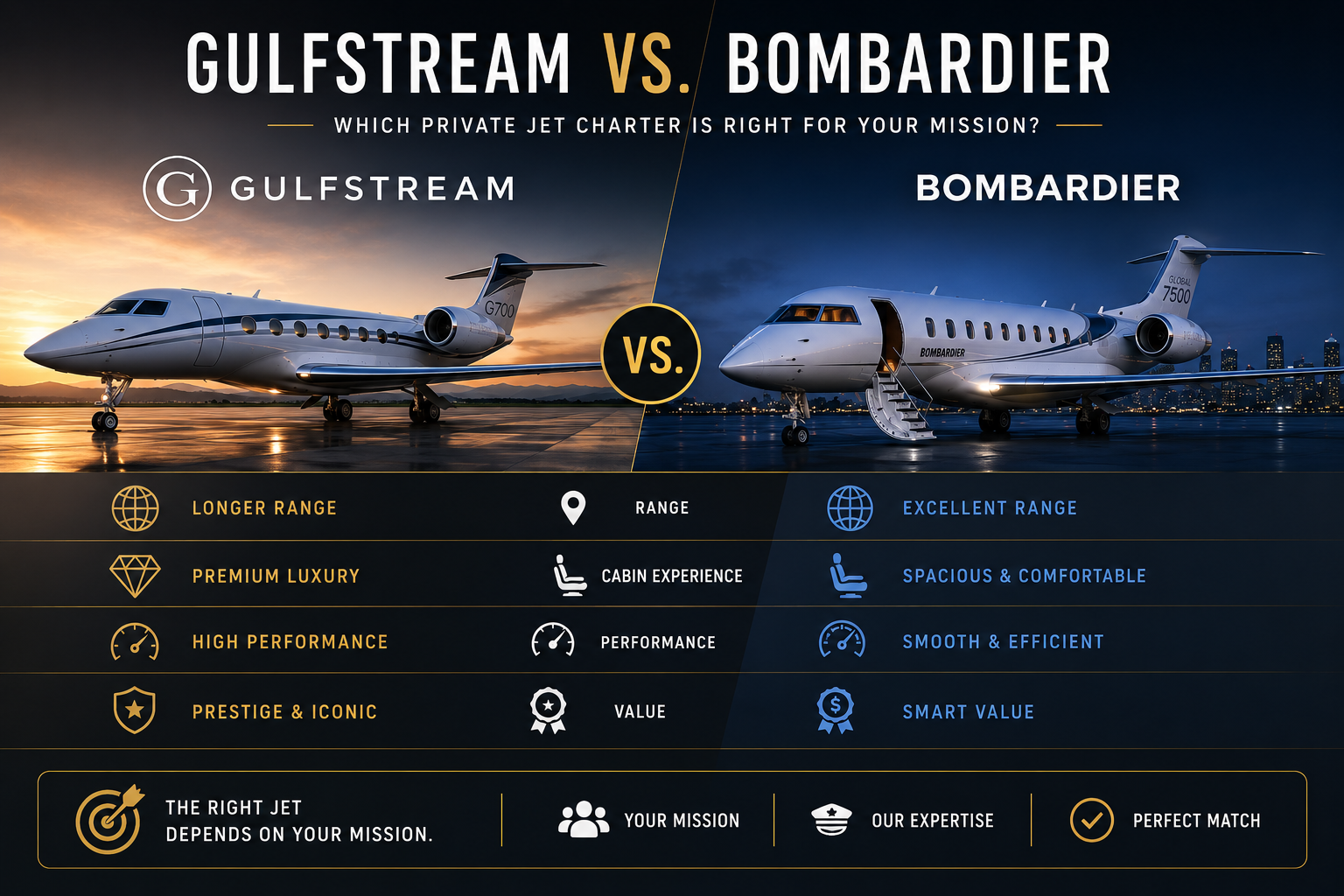
Gulfstream vs. Bombardier: Which Private Jet Charter Is Right for Your Mission?
Two aircraft can both look ideal on paper and still create very different travel experiences. One may give an executive team the faster mission profile it values. Meanwhile, another may give a family more living space, privacy, luggage flexibility, or room to sleep during an overnight flight.
That is why a useful Gulfstream vs. Bombardier comparison cannot stop at prestige, maximum range, or the newest flagship. Instead, the decision must begin with the route, passengers, baggage, schedule, airport constraints, desired cabin experience, and available charter inventory.
Which Is Better for Charter: Gulfstream or Bombardier?
Direct Answer: Neither Gulfstream nor Bombardier is automatically the better charter choice. Gulfstream often appeals to travelers who prioritize high-speed performance, signature cabin design, large windows, and efficient long-range missions. Meanwhile, Bombardier often appeals to travelers who prioritize spacious living areas, smooth ride quality, flexible cabin zones, and long-duration comfort. Therefore, the best aircraft is the one that fits the mission, not the badge on the tail.
For example, an executive flying from Teterboro to London may care about speed, connectivity, arrival readiness, and scheduling precision. However, a family flying from Los Angeles to Europe may care more about sleeping arrangements, cabin separation, baggage access, pets, and the ability to create distinct spaces for adults and children.
Consequently, a professional charter advisor should not simply ask which brand you prefer. The advisor should ask what the flight needs to accomplish.
Key Takeaways
- Gulfstream and Bombardier both produce highly capable large-cabin and ultra-long-range business aircraft.
- However, manufacturer reputation alone does not determine the best charter experience.
- Gulfstream often attracts buyers who value speed, recognizable design, large windows, and long-range efficiency.
- Meanwhile, Bombardier often attracts buyers who value broad cabins, multiple living zones, comfort, and flexible layouts.
- Aircraft age, interior configuration, maintenance, crew, operator standards, and availability can matter more than the brand name.
- Therefore, charter buyers should compare the actual aircraft offered for the trip rather than choosing from general brand assumptions.
Gulfstream vs. Bombardier at a Glance
The key point: Gulfstream and Bombardier overlap across major charter categories, yet travelers may experience meaningful differences in cabin philosophy, available layouts, fleet mix, and mission suitability.
| Charter Consideration | Gulfstream | Bombardier |
|---|---|---|
| Common buyer perception | Speed, range, prestige, distinctive windows, executive productivity | Cabin space, comfort, multiple zones, smooth long-range travel |
| Major aircraft families | Gulfstream large-cabin and ultra-long-range models | Challenger and Global aircraft families |
| Typical charter missions | Domestic executive travel, transatlantic flights, intercontinental missions | Corporate travel, family-office missions, group travel, long-duration flights |
| Cabin emphasis | Natural light, productivity, refined design, high-speed travel | Width, living zones, seating flexibility, long-flight comfort |
| Best choice | The specific aircraft, interior, operator, crew, route, and availability that best fit the trip | |
Although these broad distinctions help begin the comparison, they should not become rigid rules. A particular Gulfstream may offer the layout a family wants. Likewise, a specific Bombardier may be the faster, more efficient, or more readily available option for an executive mission.
Therefore, the buyer should compare aircraft-level details rather than reducing the choice to brand stereotypes.
Why the Mission Must Come Before the Manufacturer
The key point: The right private jet is the aircraft that completes the trip safely, comfortably, and efficiently under the actual mission conditions.
Before comparing Gulfstream with Bombardier, a charter advisor should understand the complete mission. Range is important, yet range alone does not reveal whether the aircraft can complete the planned route with the requested passenger count, luggage, winds, reserves, and airport conditions.
Start With These Questions
- Where are the passengers departing and arriving?
- Is the trip one-way, round-trip, or multi-leg?
- How many passengers will travel?
- How much luggage, equipment, or oversized baggage will they bring?
- Will passengers need beds or separate sleeping areas?
- Are pets traveling?
- Does the group need a flight attendant, galley, conference area, or private suite?
- Are smaller or performance-sensitive airports involved?
- Is nonstop capability essential, or is a fuel stop acceptable?
- Which aircraft are actually available through qualified operators?
Once those questions are answered, the brand comparison becomes more useful. Otherwise, the buyer risks selecting an aircraft for reputation rather than operational fit.
Where Gulfstream Often Stands Out for Charter Buyers
The key point: Gulfstream aircraft often stand out when travelers value high-speed cruise capability, long-range mission efficiency, bright cabins, recognizable design, and executive-focused travel.
Gulfstream has built a strong reputation around aircraft designed for serious business travel. Consequently, the brand often appears in conversations involving global executives, founders, boards, governments, and travelers who place a high value on time.
Large panoramic windows are one of the most recognizable elements of the Gulfstream cabin. Besides creating natural light, they can make a long flight feel more open. Additionally, many Gulfstream interiors support distinct areas for dining, working, relaxing, and sleeping.
Gulfstream May Be a Strong Fit When You Prioritize
- high-speed long-range travel
- a bright cabin with large windows
- an executive or corporate environment
- strong brand familiarity among travelers and assistants
- productive work zones and reliable connectivity
- efficient nonstop travel between major business centers
- specific Gulfstream availability within an operator’s fleet
However, the Gulfstream name does not guarantee that every aircraft will have the same interior quality. Older aircraft may have been refurbished differently, while two aircraft of the same model may have different seating, entertainment, connectivity, galley, and sleeping configurations.
Therefore, ask for current cabin photos and an exact layout before confirming the flight.
Where Bombardier Often Stands Out for Charter Buyers
The key point: Bombardier aircraft often stand out when travelers value broad cabins, flexible living areas, smooth long-range comfort, and a wide range of charter options across Challenger and Global models.
Bombardier’s portfolio gives buyers access to aircraft that serve several mission types. Challenger aircraft commonly support domestic, transcontinental, and medium-to-long-range travel. Meanwhile, Global aircraft serve large-cabin and ultra-long-range missions.
Many travelers associate the Global family with generous cabin volume and clearly separated living areas. That can matter during longer flights because passengers may want to work in one zone, dine in another, and sleep in a quieter area.
Bombardier May Be a Strong Fit When You Prioritize
- cabin width and perceived interior space
- multiple living zones
- family or group seating flexibility
- sleeping arrangements for overnight missions
- long-duration passenger comfort
- access to Challenger and Global options across different mission profiles
- an aircraft layout that separates work, dining, and rest
Nevertheless, the actual aircraft still matters more than the family name. A newly refurbished Challenger may provide a better experience than an older large-cabin jet with outdated connectivity or a less useful interior.
Consequently, compare the offered aircraft, not an idealized manufacturer brochure.
How Do Gulfstream and Bombardier Cabins Compare?
The key point: Gulfstream often emphasizes natural light, refined executive design, and high-speed travel, while Bombardier often emphasizes cabin volume, living zones, and long-duration comfort.
Natural Light and Windows
Gulfstream’s windows are a defining cabin feature. Therefore, travelers who dislike enclosed spaces or value daylight during long flights may prefer the atmosphere aboard certain Gulfstream models.
Bombardier cabins also provide a premium environment. However, buyers often focus more on overall cabin dimensions, seating areas, and the ability to divide the aircraft into functional zones.
Sleeping and Privacy
For overnight missions, model and configuration matter significantly. Some large aircraft can convert seating into beds, while others include separate private areas. Therefore, ask how many passengers can sleep comfortably rather than relying on the maximum passenger number.
Noise, Cabin Environment, and Fatigue
Noise levels, cabin pressure, humidity, lighting, seat comfort, flight duration, and turbulence response can influence how passengers feel after landing. Because of that, wellness-focused travelers increasingly compare the experience of the full mission, not only the cabin’s visual design.
IMR explores that broader buyer concern in Why Wellness-Focused Flyers Choose Specific Jets.
Connectivity and Productivity
Executives should confirm the installed connectivity system rather than assuming every aircraft offers the same service. Additionally, buyers should ask whether expected coverage and performance match the route.
Ultimately, the best cabin is the one configured around what passengers plan to do during the flight.
Which Brand Is Better for Range and Speed?
The key point: Both Gulfstream and Bombardier offer aircraft designed for demanding international missions, so the practical winner depends on the specific model and route.
Maximum published range can be useful for initial comparison. However, real charter planning must account for passenger load, baggage, forecast winds, routing, reserves, temperature, runway conditions, and alternate airports.
Therefore, an aircraft capable of a certain theoretical maximum range may not always fly every city pair nonstop under every condition.
When Speed Matters Most
- executive schedules with narrow meeting windows
- long international missions where small time savings compound
- multi-city trips completed in one day
- missions where arrival time protects a business opportunity
- trips where commercial alternatives create major opportunity cost
When Cabin Utility May Matter More
- overnight family travel
- long flights with several passengers
- missions requiring sleeping zones
- travel with large amounts of luggage
- trips where privacy between passenger groups matters
As a result, “faster” does not always mean “better.” The buyer should calculate what produces the best overall arrival condition and mission outcome.
Which Is Better for Baggage, Equipment, and Family Travel?
The key point: Baggage suitability depends on the exact aircraft, passenger count, compartment access, and the shape of the items—not simply the manufacturer.
A family traveling for several weeks may bring significantly more than an executive team traveling for one night. Likewise, skis, golf clubs, mobility equipment, product samples, musical instruments, pet supplies, and oversize cases may create special requirements.
Before Booking, Confirm
- total baggage compartment volume
- whether baggage is accessible during flight
- limits on individual bag dimensions
- space available after all passenger bags are loaded
- pet placement and cabin arrangements
- storage for skis, golf clubs, or large cases
- whether a full passenger load changes nonstop capability
Therefore, send the charter advisor an accurate baggage list before accepting the aircraft. A larger-looking jet is not automatically the better baggage solution if its interior or compartment configuration does not fit the trip.
Which Is Better for Executive and Corporate Travel?
The key point: Gulfstream and Bombardier both work well for executive travel, yet the right choice depends on schedule value, team size, work requirements, route, and cabin layout.
A Gulfstream may appeal to executives who prioritize speed, recognizable global capability, natural light, and a strong productivity environment. Meanwhile, a Bombardier may appeal to teams that want more cabin separation, larger gathering areas, or distinct spaces for working and resting.
Questions for Executive Missions
- Can the team hold a private meeting during flight?
- Can passengers work without disturbing those resting?
- Does the aircraft offer suitable connectivity for the route?
- Can the mission operate nonstop with the planned passenger load?
- Will the departure airport save ground travel time?
- How much schedule flexibility does the operator provide?
For corporate travelers, time compression often matters more than luxury. Therefore, the best aircraft is the one that helps the team complete the mission and arrive ready to perform.
Which Is Better for Family and Leisure Travel?
The key point: Family and leisure travelers should prioritize usable space, sleep, privacy, baggage, pets, galley capability, and cabin configuration rather than brand prestige.
Bombardier’s larger Global cabins may appeal to families that want clear separation between passenger activities. However, Gulfstream’s large-cabin aircraft can also provide highly capable family layouts, abundant natural light, and multiple living spaces.
Therefore, the deciding factor is usually the individual aircraft configuration.
Family Charter Questions
- Where will children sleep?
- Can adults work or rest in a separate zone?
- How many enclosed lavatories are available?
- Can the galley support the requested catering?
- Will pets remain comfortably in the cabin?
- Can all luggage travel without compromising the mission?
- Is the cabin crew experienced with families?
Consequently, families should request a cabin diagram and recent interior images before booking.
Do Airport and Runway Requirements Change the Choice?
The key point: Airport elevation, runway length, weather, temperature, and operating restrictions can affect which aircraft is appropriate for a specific mission.
Not every trip begins at a major international airport with a long runway. Ski destinations, island airports, regional fields, and high-elevation locations may create different performance requirements.
In those cases, the largest or longest-range aircraft is not automatically the best option. A different Gulfstream, Challenger, Global, or another aircraft category may provide better operational flexibility.
Therefore, the advisor should evaluate the exact airports, season, passenger load, and expected conditions before recommending a jet.
Which Gulfstream and Bombardier Models Do Charter Buyers Compare?
The key point: Buyers commonly compare aircraft within similar mission categories, yet charter availability differs by market and operator.
Large-Cabin and Long-Range Comparisons
- Gulfstream G500 or G600 versus Bombardier Global 5500 or Global 6500
- Gulfstream G650 or G650ER versus Bombardier Global 7500
- Newer Gulfstream flagship aircraft versus newer Bombardier Global flagship aircraft
Super-Midsize and Large-Cabin Alternatives
- Bombardier Challenger 350-series aircraft for transcontinental and regional missions
- Bombardier Challenger 650 for larger-cabin missions below the ultra-long-range category
- Gulfstream aircraft available through operators serving similar regional or long-range needs
However, a charter buyer should not assume the newest model is automatically the best value. A well-maintained aircraft with a recent interior, strong connectivity, experienced crew, and favorable positioning may create a better overall trip.
Therefore, compare mission outcomes rather than manufacturing years alone.
Why the Charter Operator Matters More Than the Logo
The key point: Crew quality, maintenance, operational control, safety culture, communication, and service consistency can influence the trip more than the manufacturer.
A beautiful aircraft cannot compensate for poor communication, weak trip planning, avoidable delays, unclear operational responsibility, or an inadequate safety culture. Therefore, buyers should evaluate who operates the aircraft and who holds operational control.
Ask the Charter Provider
- Who is the direct air carrier operating the flight?
- Under what authority will the flight operate?
- Who has operational control?
- What safety standards and management systems does the operator use?
- What experience does the assigned crew have?
- Is the aircraft shown in the quote the aircraft expected to operate?
- What happens if maintenance or positioning changes availability?
- What cancellation, deicing, international, and repositioning terms apply?
The FAA identifies legitimate on-demand charter as operations conducted under applicable Part 135 requirements. Additionally, the NBAA charter consumer guide encourages buyers to understand the questions they should ask when selecting an operator.
Therefore, safety and operational clarity should come before cabin preference.
How Should You Compare Two Charter Quotes?
The key point: Compare the complete trip, not only the hourly rate or aircraft model.
Two quotes may show similar aircraft yet include different positioning, taxes, catering, deicing assumptions, international fees, cancellation terms, connectivity, and operational arrangements.
Compare These Details Side by Side
| Question | Why It Matters |
|---|---|
| What exact aircraft and registration are proposed? | Models can have very different ages, cabins, Wi-Fi, and configurations. |
| Who operates the flight? | The operator controls safety, crew, maintenance, and execution. |
| What is included in the total? | Taxes, catering, deicing, international fees, and positioning may differ. |
| Can the trip operate nonstop as planned? | Payload and conditions may change the mission. |
| What are the cancellation and recovery terms? | Flexibility matters when schedules or aircraft availability change. |
| Does the cabin match the passenger plan? | Maximum seats do not equal ideal comfort or sleeping capacity. |
Consequently, the lowest quote may not create the best value. A slightly higher quote may include a better operator, more suitable cabin, stronger recovery plan, or fewer mission risks.
A Simple Gulfstream vs. Bombardier Charter Decision Framework
The key point: Choose the aircraft by scoring mission fit before considering preference or prestige.
- Define the mission. Confirm route, dates, passengers, baggage, pets, schedule, and airport preferences.
- Set the non-negotiables. Decide whether nonstop range, sleeping space, cabin separation, connectivity, or runway access matters most.
- Compare exact aircraft. Review current photos, cabin layout, refurbishment details, Wi-Fi, baggage, and sleeping capacity.
- Evaluate the operator. Confirm operational control, safety, crew, maintenance, and recovery support.
- Compare the full quote. Review all costs, terms, assumptions, and possible extras.
- Select the best outcome. Choose the aircraft that creates the safest, smoothest, and most useful total trip.
By following that process, a buyer can choose between Gulfstream and Bombardier without allowing brand familiarity to hide practical tradeoffs.
Why Gulfstream vs. Bombardier Content Attracts Better Charter Leads
The key point: Aircraft comparison searches often come from buyers who have moved beyond general private aviation interest and are actively evaluating mission options.
A person searching broadly for private jets may still be exploring. However, a buyer comparing Gulfstream with Bombardier is showing more advanced intent. They may already understand the value of charter and now need help selecting the right aircraft.
Therefore, charter companies should build useful comparison pages that answer practical questions around routes, cabins, passengers, sleep, luggage, airport access, safety, and availability.
This fits the broader customer journey described in Why the UHNWI Search Starts Months Before Booking. Additionally, it supports the aircraft-content strategy inside the IMR Digital Marketing Strategy Guide for Private Aviation Companies.
High-Intent Supporting Pages Can Include
- Gulfstream G650ER vs. Bombardier Global 7500
- Gulfstream G700 vs. Bombardier Global 8000
- Best aircraft for New York-to-London charter
- Best private jets for overnight family travel
- Best aircraft for executives who need separate work and sleep zones
- Challenger vs. Gulfstream for transcontinental missions
As a result, aircraft comparison content can educate buyers, qualify inquiries, and give sales teams a stronger starting point.
Frequently Asked Questions
Is Gulfstream better than Bombardier?
Direct answer: No manufacturer is universally better. Gulfstream may fit travelers who prioritize speed, large windows, and executive efficiency, while Bombardier may fit travelers who prioritize cabin volume, living zones, and long-duration comfort.
Is Bombardier more comfortable than Gulfstream?
Direct answer: Comfort depends on the exact aircraft and interior. Some Bombardier aircraft offer especially spacious multi-zone cabins, while Gulfstream aircraft can provide bright, refined spaces with strong work, dining, and sleeping configurations.
Which brand has better long-range private jets?
Direct answer: Both manufacturers offer advanced long-range and ultra-long-range aircraft. The better option depends on the route, passenger load, baggage, weather, speed requirement, and available charter aircraft.
Which is better for New York to London?
Direct answer: Several Gulfstream and Bombardier models can suit New York-to-London missions. The best choice depends on departure airport, passenger count, cabin preference, baggage, winds, and operator availability.
Which is better for families?
Direct answer: Families should compare sleeping arrangements, cabin zones, baggage access, pets, galley capability, lavatories, and crew service. The individual configuration matters more than the manufacturer.
Which is better for corporate travel?
Direct answer: Both work well for corporate missions. Gulfstream may appeal to teams prioritizing speed and executive productivity, while Bombardier may appeal to teams wanting broader cabins or more separated working and resting spaces.
Does Gulfstream fly faster than Bombardier?
Direct answer: Speed varies by aircraft model and mission. Buyers should compare the exact aircraft offered rather than applying one speed assumption to either manufacturer’s full portfolio.
Should I request a Gulfstream or let the charter advisor choose?
Direct answer: You can state a preference, yet the advisor should still compare mission fit, operator quality, cabin configuration, availability, and total trip cost before confirming the aircraft.
Why can two aircraft of the same model feel different?
Direct answer: Aircraft of the same model can have different interiors, seating, refurbishment dates, connectivity, entertainment systems, galleys, and maintenance histories.
What matters most when booking either brand?
Direct answer: Operator legitimacy, safety culture, crew quality, aircraft condition, mission suitability, transparent pricing, and reliable trip execution matter most.
External Authority Resources
Final Verdict: Gulfstream or Bombardier?
Direct Answer: Choose Gulfstream when the specific aircraft best satisfies your speed, range, productivity, cabin, and schedule requirements. Choose Bombardier when the offered aircraft better satisfies your space, comfort, zoning, baggage, and long-duration travel needs. In either case, choose the operator and mission fit before choosing the brand.
Both manufacturers build exceptional business aircraft. Therefore, there is no credible one-line verdict that applies to every charter buyer.
A Gulfstream may be the ideal aircraft for a time-sensitive executive mission. Meanwhile, a Bombardier may be the better choice for an overnight family trip requiring several living zones. On a different date, aircraft availability, airport conditions, positioning, or operator quality may reverse the recommendation.
Ultimately, the smartest charter buyer does not ask, “Which brand is better?” Instead, the buyer asks, “Which exact aircraft, crew, and operator will produce the best outcome for this mission?”
Build Aircraft Comparison Content That Attracts Better Charter Buyers
Private aviation buyers search by aircraft, route, airport, cabin requirement, passenger count, safety concern, and mission profile long before they submit a quote request. Therefore, charter companies need more than a polished fleet page. They need a connected authority system that answers those questions before competitors do.
Explore IMR’s complete private aviation digital marketing strategy to see how aircraft pages, comparison content, route authority, SEO, GEO, AI search visibility, paid media, and CRM attribution can work together.
About the author : Anthony Paulino