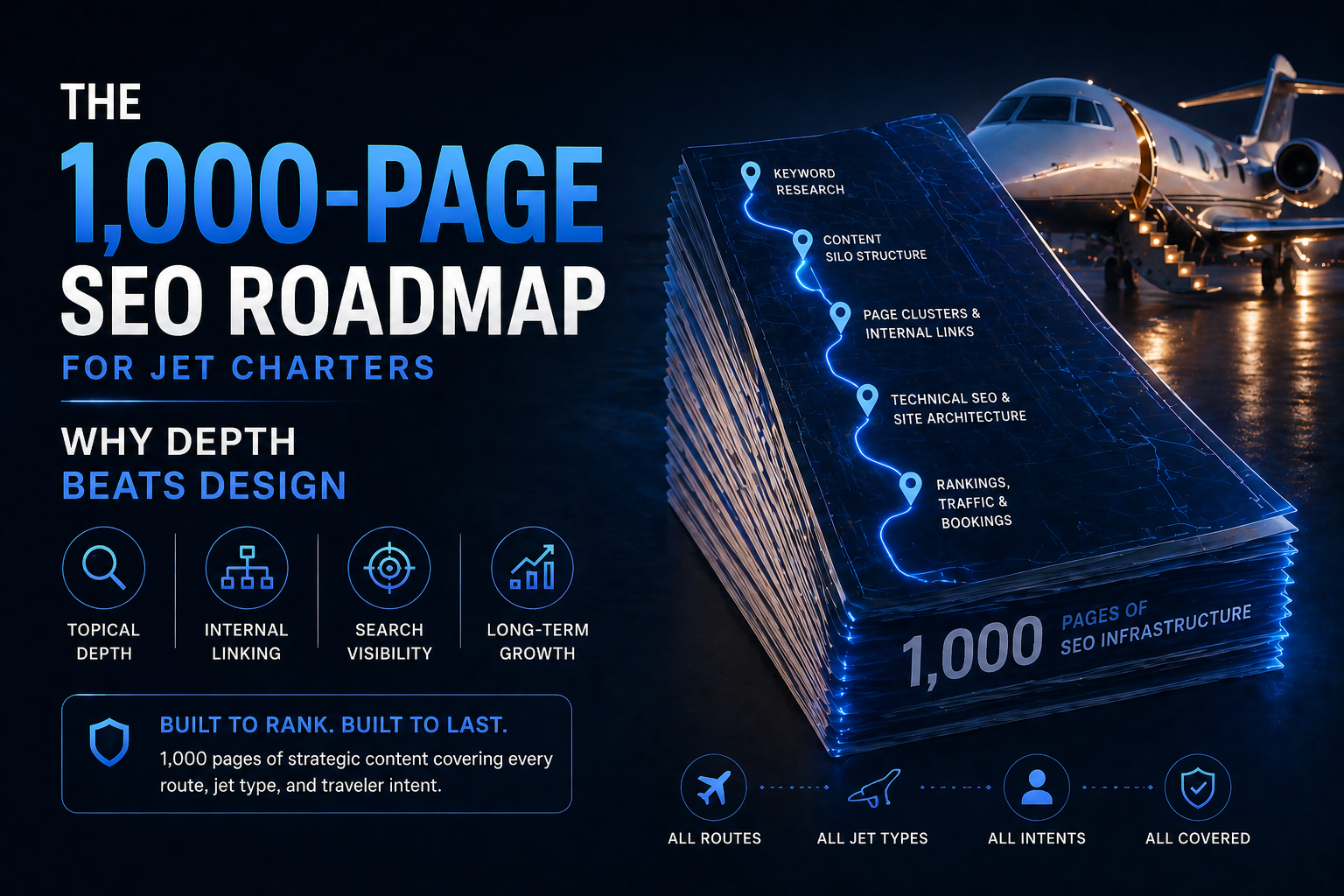
The 1,000-Page SEO Roadmap for Jet Charters: Why Depth Beats Design
Definition: A 1,000-page SEO roadmap for jet charters is a large-scale authority system that helps private aviation companies rank for aircraft, routes, airports, cities, mission profiles, buyer questions, and AI-search answers.
Direct Answer: A beautiful 10-page jet charter website can look premium. However, it usually cannot capture enough high-intent demand. Therefore, a 1,000-page SEO roadmap for jet charters beats design-first marketing because it builds topical authority, local visibility, route coverage, aircraft relevance, and AI-search trust at scale.
Most private jet charter websites look impressive on the surface. They use luxury photography, polished copy, clean design, and elegant booking forms. However, design alone does not create search authority. It does not answer every buyer question. It does not rank for every aircraft mission. Moreover, it does not make ChatGPT, Gemini, Google AI Overviews, or Perplexity view the brand as the most complete source in the category.
Because of that, private aviation companies need more than a premium website. They need a digital fortress. In other words, they need deep search infrastructure that covers every profitable way a serious charter buyer searches before booking.
That is where a 1,000-page SEO roadmap becomes powerful. Instead of relying on a few broad pages, the company builds hundreds or thousands of precise pages around real buyer intent. Consequently, the website becomes harder to ignore, harder to outrank, and easier for both search engines and AI systems to understand.
Ultimately, luxury design helps trust. However, depth creates discovery. Therefore, the winning jet charter website needs both, yet depth must come first if the goal is scalable lead generation.
Key Takeaways
- A premium design builds trust, yet deep SEO builds discovery.
- Jet charter buyers search by aircraft, route, airport, city, passenger count, range, cabin need, and mission profile.
- A 10-page website cannot cover enough high-value private aviation search intent.
- A 1,000-page SEO roadmap creates topical authority across private aviation search.
- AI search favors clear, structured, authoritative answers.
- City, route, aircraft, comparison, and question-led pages can create compounding visibility.
- Therefore, a digital fortress can become a long-term lead generation asset.
Why Depth Beats Design in Jet Charter SEO
Private aviation buyers do not all search the same way. Some search by route. Others search by aircraft. Meanwhile, many search by specific need, such as pet access, luggage capacity, nonstop range, cabin width, Wi-Fi quality, sleep configuration, airport convenience, or privacy.
Because of that, a small website misses most of the market. A homepage, fleet page, about page, contact page, and a few service pages cannot answer thousands of high-value search paths.
However, a deep SEO system can. It can create specific pages for specific intent. Therefore, instead of asking one page to rank for everything, the website builds one page for each meaningful buyer question.
For example, a buyer searching “best private jet for NYC to London with pets” has different intent than a buyer searching “Gulfstream G700 charter Teterboro to Van Nuys.” Likewise, a buyer searching “private jet from Miami to Aspen during ski season” has different needs than a buyer searching “which jet has the quietest cabin for overnight flights.”
Therefore, depth beats design because depth matches real demand. Design helps the buyer trust the brand after discovery. However, without depth, many buyers never discover the brand at all.
What Jet Charter Buyers Actually Search
Jet charter buyers search with high specificity because the purchase involves comfort, money, timing, privacy, risk, and logistics. Therefore, broad keywords such as “private jet charter” represent only one part of the opportunity.
In reality, buyers search across several intent layers:
- Aircraft model searches
- Route searches
- Airport and FBO searches
- City and local charter searches
- Passenger capacity searches
- Cabin comfort searches
- Pet-friendly charter searches
- Range and nonstop capability searches
- Business aviation mission searches
- Luxury travel planning searches
- Safety and operator credibility searches
- Cost and comparison searches
Additionally, many buyers now ask conversational questions. Because of AI search, those questions matter even more. For example, a buyer might ask, “Which aircraft offers the best sleep setup for an overnight Asia-to-Europe flight?” or “Can a Citation Latitude make a transcontinental flight with full passenger payload?”
Consequently, the site that answers those questions clearly has a stronger chance of being found, cited, and trusted.
Why 10-Page Jet Charter Websites Fail
A 10-page website can look impressive. However, it usually creates a thin search footprint. That means the brand only has a few opportunities to rank.
Moreover, broad pages are often too generic. A fleet page may list aircraft, yet it may not answer route-specific questions. A destinations page may list cities, yet it may not explain airport strategy, peak travel timing, or aircraft fit. Likewise, a pricing page may mention estimates, yet it may not answer cost questions by route, aircraft size, passenger count, season, or mission type.
As a result, the site depends heavily on paid ads, referrals, brokers, or brand searches. That can work for a while. However, it does not create a compounding search asset.
Therefore, the problem is not that design-first websites are bad. The problem is that they are incomplete. They look like luxury brands, yet they do not behave like authority platforms.
The 1,000-Page SEO Roadmap
A strong 1,000-page SEO roadmap for jet charters should not be random. Instead, it should organize pages around actual buyer intent. That means every page must serve a purpose.
At a high level, the roadmap should include:
- Core private aviation service pages
- Aircraft model pages
- Aircraft comparison pages
- Route pages
- Airport pages
- FBO-focused pages
- City charter pages
- Mission profile pages
- FAQ pages
- Private aviation buyer question pages
- Safety and trust pages
- Luxury travel use-case pages
- AI-search optimized answer pages
Consequently, the site becomes a complete knowledge base, not only a brochure.
This connects directly to the broader strategy behind SEO Services for Businesses and Generative Engine Optimization, because both search engines and AI systems need depth, clarity, and authority signals.
The Page Types Every Jet Charter Brand Needs
A 1,000-page system works best when each page type has a clear role. Therefore, the roadmap should not simply duplicate pages with swapped city names. Instead, each cluster should answer a different buyer need.
1. Core Service Pages
These pages define the main offer. For example, private jet charter, aircraft management, empty legs, group charter, corporate charter, and luxury travel support all need clear service pages.
2. Aircraft Pages
These pages explain specific models, cabin features, range, use cases, routes, and buyer fit. Therefore, they attract model-aware searchers.
3. Route Pages
These pages capture high-intent searches between major airports, cities, and luxury destinations.
4. Airport Pages
These pages help the brand show up for airport-specific charter intent.
5. Question-Led Pages
These pages answer exact questions buyers ask Google and AI tools. Therefore, they support both SEO and GEO.
6. Comparison Pages
These pages help buyers compare aircraft, routes, cabin types, operators, or charter options.
7. Trust Pages
These pages explain safety, booking process, operator standards, insurance, privacy, and service quality.
Because of this structure, the website can target buyers at every stage of the decision process.
Aircraft-Specific SEO Pages
Aircraft-specific pages are essential because many serious buyers search by model. They may already know they want a Gulfstream, Bombardier, Falcon, Citation, or Challenger. However, they may still need help choosing the right aircraft for their route and passenger needs.
Therefore, aircraft pages should go beyond basic specs. They should explain:
- Best mission profiles
- Passenger capacity
- Cabin layout
- Sleep configuration
- Baggage capacity
- Range considerations
- Common routes
- Pet suitability
- Wi-Fi and business use
- Comparable aircraft
- When to choose a different jet
For example, a page about a Gulfstream G700 should not only list speed and range. Instead, it should explain who the jet fits, which long-haul missions it supports, and how it compares with a Bombardier Global 7500.
Additionally, aircraft pages should link naturally to related comparison pages and route pages. As a result, the site builds internal authority around aircraft selection.
Route and Mission Profile Pages
Route pages are powerful because charter buyers often search around real missions. They may want New York to London, Miami to Aspen, Los Angeles to Cabo, Teterboro to Van Nuys, or London to Maldives.
However, route pages should not be thin. A strong route page should explain:
- Typical flight time
- Best aircraft categories
- Airport options
- Seasonal travel considerations
- Luggage considerations
- Pet considerations
- Cabin comfort needs
- Fuel stop considerations
- FBO strategy
- Booking timing
Consequently, the page becomes useful, not merely searchable.
Moreover, route pages work well for AI search because they answer complex buyer questions in one place. For example, AI systems can cite pages that clearly explain aircraft fit, route constraints, and passenger considerations.
Airport and FBO Authority Pages
Airport pages help jet charter brands capture local and logistical intent. Many buyers search by airport because convenience matters. Therefore, pages around Teterboro, Van Nuys, Miami-Opa Locka, West Palm Beach, Las Vegas, Scottsdale, Aspen, and other private aviation hubs can be valuable.
However, these pages must provide real value. They should explain:
- Why the airport matters for private aviation
- Nearby luxury markets
- FBO options
- Peak travel periods
- Traffic and access considerations
- Best aircraft types for common routes
- Nearby business or leisure destinations
- Common client profiles
Additionally, airport pages can support local SEO and route SEO at the same time. As a result, they become high-value authority nodes inside the larger site.
City and Local Intent Pages
City pages help capture buyers searching from specific markets. However, private aviation city pages must avoid generic city swaps. Instead, they should include real local context.
For example, a strong city page should mention:
- Private aviation demand in the region
- Nearby executive neighborhoods
- Primary airports and FBOs
- Common business routes
- Luxury leisure destinations
- Seasonal travel behavior
- Corporate and event demand
Therefore, a city page for Palm Beach should feel different from a city page for Dallas, Scottsdale, Cleveland, or Los Angeles.
Because of that, local depth matters. Search engines and AI systems both need clear entity signals, and buyers need proof that the brand understands their market.
Comparison Pages for High-Intent Buyers
Comparison pages matter because buyers often narrow decisions before they inquire. Therefore, a jet charter brand should help them compare options honestly.
Strong comparison topics include:
- Gulfstream G700 vs. Bombardier Global 7500
- Falcon 8X vs. Global 6500 cabin comfort
- Super midsize vs. heavy jet for transcontinental routes
- Private charter vs. jet card for frequent flyers
- Teterboro vs. Westchester for New York-area departures
- Van Nuys vs. Burbank for Los Angeles private aviation
Moreover, comparison pages work because they meet the buyer at a serious decision stage. Instead of chasing broad awareness only, the brand helps the buyer evaluate tradeoffs.
As a result, the page can create trust before the buyer ever speaks to a charter advisor.
Question-Led GEO Pages
Question-led pages are now critical because buyers ask search engines and AI platforms full questions. Therefore, the site should answer those questions directly.
Examples include:
- Which jet has the widest cabin for a mobile office setup?
- Which aircraft offers the best sleep mode for overnight flights?
- Can a PC-24 land on grass or unpaved strips?
- What is the best private jet for large dogs in the cabin?
- How much time does private aviation save versus first class?
- Which aircraft handles trans-Atlantic headwinds best?
These pages should start with a direct answer. Then, they should explain the factors that shape the answer. Additionally, they should include examples, comparison tables, FAQs, schema, and relevant internal links.
Consequently, they serve both human buyers and AI answer engines.
Why GEO and AI Search Change the Game
Search is no longer only about blue links. Buyers now ask AI tools for recommendations, comparisons, summaries, and planning help. Therefore, jet charter companies must think beyond traditional SEO.
Generative Engine Optimization, or GEO, focuses on making a brand more visible inside AI-generated answers. That means content must be clear, structured, authoritative, and easy to extract.
For private aviation, this matters because buyers ask complex questions. They do not only search “private jet charter.” Instead, they ask questions such as:
- Which jet is best for seven passengers flying New York to London?
- Can a midsize jet fly nonstop from Miami to Aspen?
- What is the best private jet for large dogs in the cabin?
- Which aircraft has the quietest cabin for overnight flights?
- Which airport should executives use near Los Angeles?
Therefore, a 1,000-page roadmap should include precise, answer-focused content. Moreover, each answer should use clear headings, direct definitions, tables, FAQs, and schema.
For more on this strategy, see Generative Engine Optimization.
The Conversion Layer Behind the Content
Depth creates discovery. However, conversion turns discovery into revenue. Therefore, every page needs a conversion layer.
Strong jet charter pages should include:
- Clear calls to action
- Trust signals
- Concierge language
- Fast response expectations
- Privacy reassurance
- Route-specific inquiry prompts
- Aircraft-fit consultation offers
- Proof of expertise
Additionally, the CTA should match the page intent. For example, an aircraft comparison page should invite the reader to request aircraft-fit guidance. Meanwhile, a route page should invite the reader to check availability for a specific trip.
Consequently, the site avoids generic “contact us” language and creates a more natural path to inquiry.
The 12-Month Implementation Plan
A 1,000-page build should follow a strategic rollout. Otherwise, the site can become messy, inconsistent, or difficult to manage.
Months 1–2: Strategy and Architecture
First, build the keyword map, URL structure, page templates, schema system, internal linking plan, and content standards.
Months 3–4: Core Pages and Trust Pages
Next, build the foundational service pages, safety pages, process pages, and conversion assets.
Months 5–6: Aircraft and Comparison Pages
Then, build aircraft model pages and aircraft comparison pages. These pages help capture informed buyer intent.
Months 7–8: Route and Airport Pages
After that, build route clusters and airport authority pages around high-value markets.
Months 9–10: City and Local Pages
Next, build city pages with real local detail and internal links to airport, route, and aircraft content.
Months 11–12: Question-Led GEO Pages
Finally, build AI-ready question pages that answer complex private aviation buyer questions.
As a result, the site grows with structure instead of chaos.
Common Mistakes Jet Charter Companies Make
- Relying on design while ignoring search depth
- Writing generic aircraft pages with no buyer guidance
- Creating city pages without local aviation context
- Ignoring route-based search intent
- Publishing thin AI content that adds no expertise
- Using the same CTA on every page
- Failing to use schema
- Forgetting internal links between related clusters
- Ignoring GEO and AI-search optimization
- Building content without a conversion strategy
Ultimately, the biggest mistake is treating SEO as a blog strategy. For jet charters, SEO should be an authority infrastructure strategy.
Frequently Asked Questions
Why does a jet charter company need 1,000 SEO pages?
A jet charter company needs deep SEO coverage because buyers search by route, city, aircraft, airport, mission profile, and question. Therefore, a small website misses too much high-intent demand.
Does design still matter for private aviation websites?
Yes. Design builds luxury trust. However, design does not replace authority, content depth, or search visibility.
What pages should a private jet charter company build first?
Start with core service pages, aircraft pages, route pages, airport pages, city pages, and high-intent buyer question pages.
How does GEO help jet charter companies?
GEO helps jet charter companies become more visible in AI-generated answers by creating clear, structured, authoritative content that answers specific buyer questions.
Is a 1,000-page SEO roadmap better than paid ads?
It depends on timing. Paid ads can create immediate visibility. However, a 1,000-page SEO roadmap can create compounding authority and long-term lead generation.
How long does a 1,000-page SEO build take to work?
Results vary by domain strength, competition, publishing speed, content quality, and internal linking. However, the strongest results usually compound over time.
Final Verdict
The 1,000-page SEO roadmap for jet charters wins because it matches how serious buyers search. Instead of relying on a beautiful but shallow website, it builds authority across every profitable search path.
Therefore, depth beats design when discovery is the goal. However, the best strategy combines both. Build the depth first, then use premium design to convert the buyers who find you.
Ultimately, private aviation companies do not need another brochure website. They need a digital fortress that search engines, AI systems, and serious buyers cannot ignore.
About the author : Anthony Paulino