How Wealthy Clients Research Before Booking a Private Jet
Many private aviation companies believe the customer journey begins when someone searches for “private jet charter” or submits a quote request.
In reality, that’s often one of the final steps.
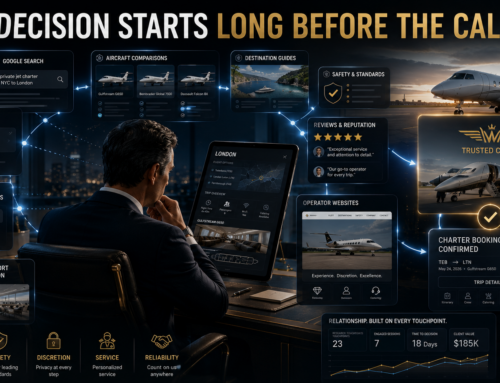
Long before an affluent traveler speaks with a charter broker, they have already begun building confidence in who they trust. They compare aircraft, evaluate operators, research airports, explore destinations, verify safety standards, and increasingly ask artificial intelligence platforms dozens of highly specific questions.
The buying journey has become dramatically more sophisticated.
Today’s ultra-high-net-worth individuals, corporate executives, family offices, professional athletes, entertainers, and luxury leisure travelers rarely make significant purchasing decisions after a single search. Instead, they gather information from numerous trusted sources before narrowing their options to only a handful of providers.
This behavior isn’t unique to private aviation.
Whether purchasing a multimillion-dollar home, selecting an investment firm, acquiring a luxury yacht, or chartering a private aircraft, affluent buyers invest considerable time researching before making contact.
Private aviation is no exception.
Every Google search, every AI conversation, every airport guide, every aircraft comparison, every safety article, and every destination resource helps shape the buyer’s perception of which companies deserve their trust.
Consequently, the companies winning more charter bookings aren’t necessarily spending the most on advertising.
They’re becoming the businesses affluent travelers repeatedly discover throughout their research journey.
That distinction matters more than ever.
Google AI Overviews, ChatGPT, Perplexity, Gemini, Claude, and other AI-powered search platforms are fundamentally changing how executives gather information. Rather than typing short keywords into Google, they’re asking complete questions and expecting personalized recommendations backed by trustworthy sources.
As a result, charter companies must think beyond generating leads.
They must become trusted educators.
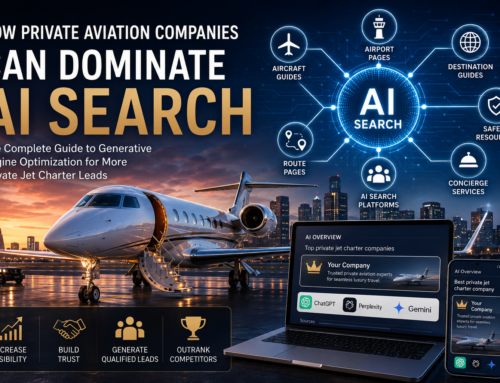
In this guide, you’ll learn how wealthy clients actually research before booking a private jet, why trust is built long before the sales conversation begins, and how creating a comprehensive digital authority ecosystem helps private aviation companies become the obvious choice throughout the entire buying journey.
Direct Answer
Affluent private aviation clients rarely book after a single search. Instead, they spend days or even weeks researching aircraft, airports, operators, safety standards, destinations, concierge services, and travel logistics across Google, AI search, luxury publications, and trusted industry resources. Charter companies that consistently educate buyers throughout this journey build greater trust, stronger authority, and generate more qualified charter bookings.
The Private Jet Buying Journey Has Changed
For years, marketing in private aviation revolved around a simple assumption.
If someone searched for a charter flight, they were ready to buy.
That assumption is becoming less accurate every year.
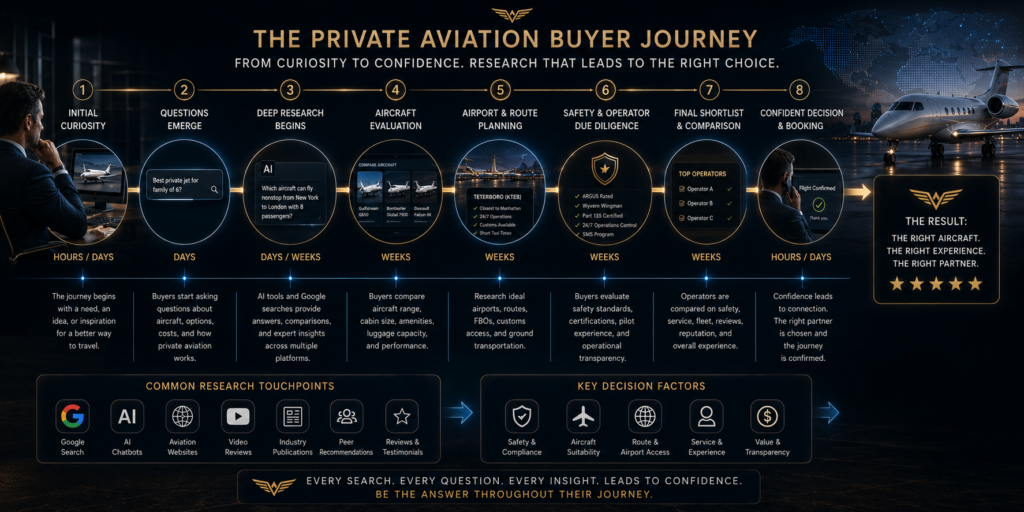
Today’s affluent travelers conduct extensive research before they ever request a quote. By the time they speak with your sales team, they’ve often eliminated dozens of competitors without those companies ever realizing they were being considered.
Why?
Because wealthy buyers don’t purchase transportation.
They purchase confidence.
When executives, celebrities, professional athletes, entrepreneurs, or family offices charter an aircraft, they’re trusting an operator with their time, safety, privacy, reputation, and often millions of dollars in business opportunities. Consequently, they approach the decision very differently than someone booking a commercial airline ticket.
Their journey usually begins with curiosity rather than intent.
For example, a prospective client might initially search:
- What is the safest private jet?
- How does private jet charter work?
- Which airports are closest to Aspen?
- What aircraft can fly nonstop to Europe?
- Should I charter or join a jet card program?
- How much luggage fits on a Challenger 350?
- Can I bring pets on a private jet?
- What is the difference between Part 91 and Part 135?
None of these searches ask for a charter quote.
Yet every one represents a future customer beginning the buying journey.
As their research continues, those questions become increasingly detailed.
They begin comparing operators, reviewing aircraft performance, evaluating safety standards, researching destination airports, exploring concierge services, and reading educational content that helps them make informed decisions.
By the time they finally search for a charter provider, they may already have a shortlist of companies they trust.
If your business wasn’t present throughout that research process, you may never even have the opportunity to compete.
Today’s Buyer Journey Is Non-Linear
One of the biggest mistakes charter companies make is assuming every customer follows the same path.
They don’t.
Some buyers begin by researching aircraft.
Others begin with destinations.
Corporate travel managers may focus on safety and operational standards, while leisure travelers often research luxury experiences and airport convenience.
Meanwhile, family offices may compare operators over several months before making contact.
Every journey is different.
However, one characteristic remains consistent across nearly all affluent buyers.
They gather information from many different sources before making a decision.
That means every educational article, aircraft guide, airport page, FAQ, comparison page, and destination resource becomes another opportunity to introduce your company long before a competitor receives the inquiry.
Research Now Happens Across Multiple Platforms
Google remains incredibly important, but it is no longer the only place wealthy clients conduct research.
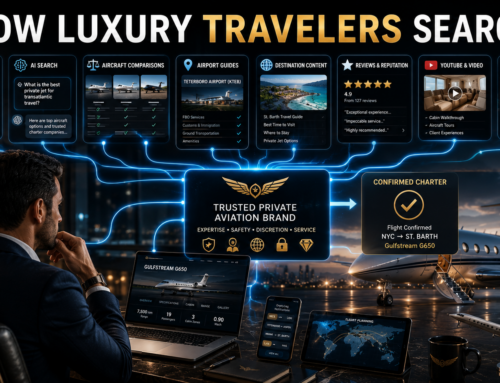
Increasingly, affluent travelers move seamlessly between search engines, AI assistants, video platforms, manufacturer websites, luxury publications, and social proof before making purchasing decisions.
A typical research session today might include:
- Google Search
- Google AI Overviews
- ChatGPT
- Perplexity AI
- Gemini
- YouTube aircraft reviews
- Luxury travel publications
- Manufacturer websites
- Airport information
- Operator safety resources
- Peer recommendations
Each platform answers different questions.
Together, they shape perception.
The companies appearing consistently across these touchpoints become increasingly familiar, trustworthy, and credible in the eyes of prospective clients.
That’s why digital authority has become one of the most valuable competitive advantages in private aviation marketing.
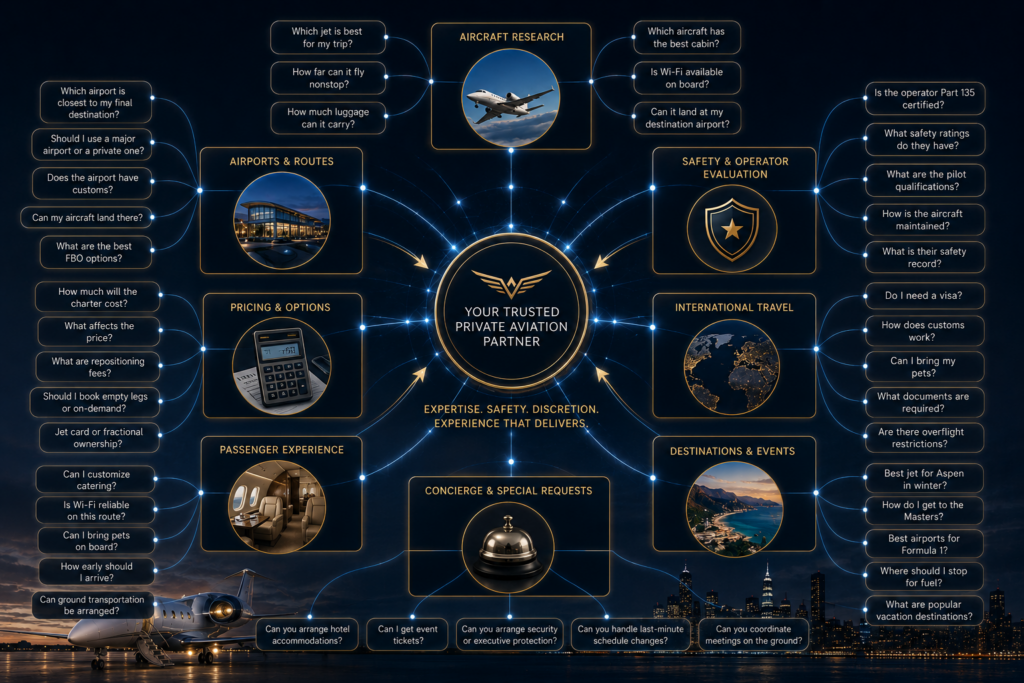
The Questions Wealthy Clients Ask Before They Call
Affluent travelers rarely begin by asking which charter company has the lowest price.
Instead, they ask questions that reduce uncertainty.
They want to know whether the aircraft is appropriate, whether the operator is trustworthy, whether the airport is convenient, and whether the entire experience will meet their expectations.
These questions reveal something important.
The research process is not simply about gathering information.
It is about removing risk.
That is especially true in private aviation, where the buyer may be coordinating international travel, protecting a demanding schedule, transporting family members, managing sensitive business discussions, or planning around high-value events.
As a result, the most valuable content opportunities often come from the questions buyers ask before they ever speak with a broker.
Aircraft Questions
Many clients begin by trying to understand which aircraft fits their mission.
They may ask:
- Which private jet is best for six passengers?
- What aircraft can fly nonstop from New York to London?
- Which jet has the most comfortable cabin?
- How much baggage fits on a Gulfstream G650?
- What is the difference between a light jet and a super-midsize jet?
- Which aircraft has the best Wi-Fi?
- Can a Challenger 350 carry skis and golf clubs?
- What aircraft is best for transcontinental business travel?
- Which jet offers the quietest cabin?
- What is the best private jet for families?
These are not casual questions.
They often come from buyers who are already considering a specific trip.
Therefore, a charter company with detailed aircraft guides can influence the decision before the client ever requests availability.
Airport and Route Questions
Airport research is another major part of the buying journey.
Private aviation clients frequently compare airport convenience, runway capability, customs access, ground transportation, and proximity to their final destination.
Common questions include:
- Which private airport is closest to Manhattan?
- Should I use Teterboro or White Plains?
- What airport is best for Aspen?
- Can private jets land at smaller regional airports?
- Which airport is closest to Palm Beach?
- Does the airport offer customs clearance?
- Can a large-cabin jet land there?
- How far is the FBO from the resort?
- What is the best private airport for Formula 1 travel?
- Are there curfews or operating restrictions?
These searches often have strong commercial intent.
Someone comparing airports is frequently much closer to booking than someone searching for a broad term like “private jet charter.”
That is why airport guides and route pages can attract highly qualified visitors.
Safety and Operator Questions
For many affluent buyers, safety is the most important factor.
However, they may not know how to evaluate it.
Therefore, they research certifications, operator standards, pilot qualifications, maintenance procedures, and regulatory requirements.
They may ask:
- How do I know if a charter operator is safe?
- What is Part 135?
- What is the difference between Part 91 and Part 135?
- What safety certifications should a charter company have?
- How many hours should a private jet pilot have?
- How often are charter aircraft inspected?
- What is ARGUS certification?
- What is Wyvern?
- Who is responsible for aircraft maintenance?
- How can I verify an operator’s safety record?
A company that explains these topics clearly does more than improve rankings.
It demonstrates transparency.
That transparency can become a major trust signal during the buying process.
Service and Experience Questions
Wealthy clients also research what the flight will feel like.
They want to understand privacy, convenience, onboard service, connectivity, and how much customization is available.
Typical questions include:
- Can I choose my catering?
- Can pets travel in the cabin?
- Is Wi-Fi available during the flight?
- Can I hold confidential meetings onboard?
- How early do I need to arrive?
- Can the flight leave ahead of schedule?
- What happens if my plans change?
- Can ground transportation be arranged?
- Can I request security services?
- Can the operator coordinate hotel and concierge arrangements?
These questions help the buyer imagine the experience before making a commitment.
Consequently, service-oriented content can influence both conversion and perceived value.
International Travel Questions
International private travel introduces even more uncertainty.
Clients may need information about customs, visas, permits, overflight restrictions, documentation, and arrival procedures.
They may ask:
- How does customs work on a private jet?
- Do I need a passport for private aviation?
- Can pets travel internationally?
- How are visas handled?
- Can a private jet land directly at my destination?
- What happens during customs clearance?
- Are there international overflight fees?
- Which airports have private customs facilities?
- Can I travel internationally on short notice?
- What documents are required?
Companies that answer these questions become valuable before the buyer even contacts the sales team.
Instead of appearing like another charter provider, they begin to look like a trusted advisor.
Pricing and Program Questions
Affluent travelers may not always choose the lowest-priced option, but they still want to understand how pricing works.
They often research:
- How is private jet charter priced?
- What affects the cost of a charter flight?
- What are repositioning fees?
- What is an empty-leg flight?
- Should I use on-demand charter or a jet card?
- Are membership programs worth it?
- What is included in a charter quote?
- Why do prices change between operators?
- How much does deicing cost?
- Are international taxes included?
Transparent educational content helps buyers understand value instead of focusing only on the final number.
That matters because premium positioning depends on explaining what separates a reliable, high-quality charter experience from a cheaper alternative.
The company that answers the buyer’s questions first often earns the opportunity to provide the quote.
Trust Is Built Long Before the Quote
By the time a wealthy client submits a charter request, they have often already decided which companies feel credible.
The sales call does not create that perception from nothing.
It confirms or weakens a judgment that has already begun to form.
That judgment may be based on dozens of small signals.
The buyer notices whether your website looks current, whether your aircraft information feels complete, whether your safety content is transparent, and whether your company appears across multiple trustworthy search results.
They also notice what is missing.
Your Digital Presence Becomes the First Sales Conversation
Before the client speaks with anyone, your website has already answered several unspoken questions.
- Does this company understand private aviation?
- Does it appear established?
- Does it explain complex topics clearly?
- Does it understand clients like me?
- Would I trust this team with a sensitive itinerary?
- Does this company seem prepared?
A thin website can create doubt even when the company provides excellent service.
Conversely, a comprehensive digital presence can establish confidence before the first conversation begins.
That is why educational content should not be treated as separate from sales.
It is part of the sales process.
Affluent Buyers Look for Evidence, Not Claims
Almost every charter company says it offers safety, luxury, reliability, and personalized service.
Those claims are expected.
However, sophisticated buyers want evidence.
They want to see detailed safety explanations, aircraft expertise, destination knowledge, case studies, operational standards, client testimonials, and clear answers to difficult questions.
In other words, they want proof that the company can deliver what it promises.
A brand that repeatedly demonstrates expertise becomes more believable than one that only describes itself with premium language.
Familiarity Reduces Perceived Risk
Familiar brands often feel safer.
That does not mean the buyer must see the same advertisement repeatedly.
Instead, they may encounter the company through several useful resources.
For example, they might first discover an airport guide, then read an aircraft comparison, see the company cited in an AI answer, and later return through a safety article.
By the time they request a quote, the brand no longer feels unfamiliar.
It feels established.
This repeated discovery is especially powerful in private aviation because trust and risk reduction strongly influence the final decision.
Reviews Matter, but They Are Only One Trust Signal
Reviews remain important.
However, affluent buyers often evaluate much more than star ratings.
They look for:
- Depth of expertise
- Operational transparency
- Quality of educational content
- Professional presentation
- Third-party citations
- Safety information
- Case studies
- Executive-level communication
- Consistency across platforms
A company with strong reviews but weak content may still appear less credible than a competitor that demonstrates expertise throughout the entire research journey.
Therefore, trust should be built through a complete digital footprint rather than one isolated signal.
The Best Leads Often Arrive Already Convinced
When a prospect has consumed several of your resources before contacting you, the sales conversation changes.
They no longer need a basic explanation of who you are.
They already understand your perspective, expertise, and approach.
As a result, the discussion can move faster toward aircraft availability, itinerary details, service expectations, and booking.
These leads are often more qualified because they have educated themselves before making contact.
They are not merely browsing.
They are validating a decision.
The strongest digital authority does not simply create more inquiries.
It creates better-prepared buyers.
AI Search Is Changing Luxury Buyer Behavior
Wealthy travelers are no longer limited to scrolling through traditional search results.
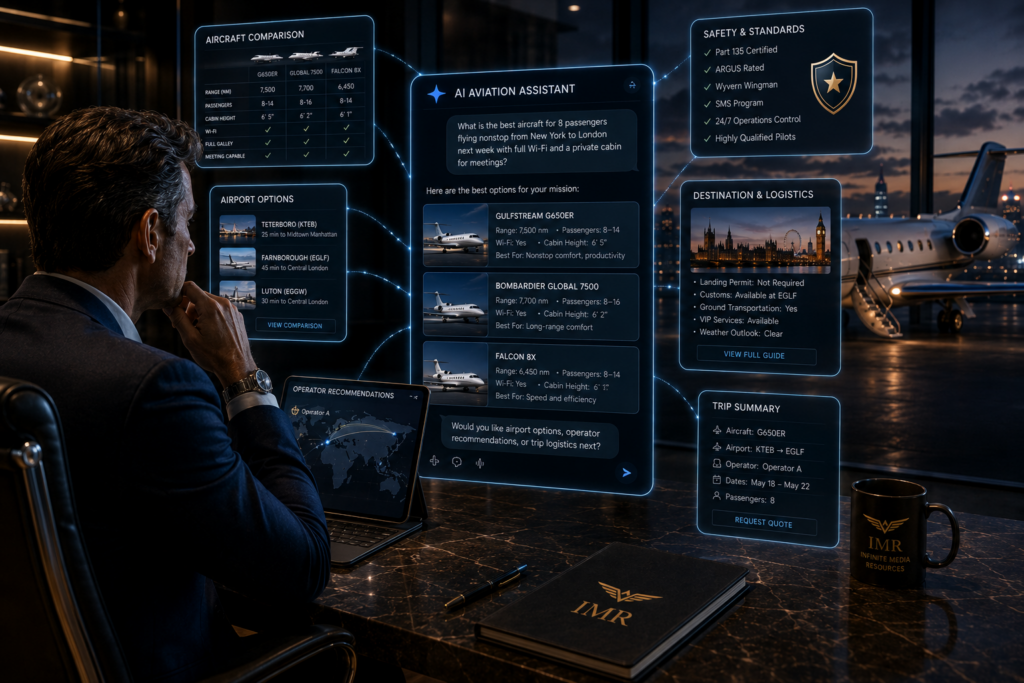
Increasingly, they use AI platforms to research complex travel decisions through natural conversations.
Instead of typing a broad phrase like “private jet charter to Europe”, an executive can now ask:
- What aircraft is best for eight passengers flying nonstop from New York to Paris?
- Which private airports offer the fastest access to central London?
- What should I verify before choosing a charter operator?
- Which aircraft has enough baggage space for a two-week family vacation?
- Should I use a jet card or on-demand charter for twelve annual trips?
- What safety certifications matter most when booking a private jet?
These questions reflect how real buyers think.
They are specific, contextual, and tied to an actual mission.
AI search is particularly well suited to this behavior because it can combine multiple considerations into one answer. It can discuss aircraft range, passenger capacity, airport access, safety, luggage, pricing models, and destination logistics within the same conversation.
As a result, the private aviation buying journey is becoming more personalized before the customer ever contacts a company.
Affluent Buyers Are Asking Complete Questions
Traditional SEO often focused on short keyword phrases.
However, affluent travelers rarely think in isolated keywords.
They think in complete situations.
A family office may need to move several executives between three cities in forty-eight hours. A luxury traveler may need an aircraft that can transport pets, skis, and significant baggage into a high-altitude airport. Meanwhile, a corporate travel manager may care more about safety documentation, schedule reliability, privacy, and contingency planning.
Those needs are difficult to express through one broad search term.
Therefore, buyers increasingly use conversational search to explain the entire problem.
For example, they may ask:
“What is the best private jet for six executives traveling from Cleveland to Geneva with enough cabin space to work comfortably and avoid a fuel stop?”
An AI platform can break that question into several connected topics:
- Passenger count
- Route distance
- Aircraft range
- Cabin dimensions
- Business amenities
- Airport compatibility
- International flight requirements
To appear in answers like this, a charter company needs more than one generic service page.
It needs detailed, structured, and interconnected information across the entire mission.
AI Recommendations Can Shape the Shortlist
When Google displays a list of results, the buyer still chooses which websites to explore.
AI recommendations can influence the process earlier.
A platform may summarize the best aircraft categories, explain which airports make the most sense, identify important safety considerations, and reference companies or resources that appear credible.
That answer can shape the buyer’s shortlist before they visit a single charter website.
Therefore, visibility inside AI-generated answers is becoming an important part of private aviation marketing.
A company that earns repeated mentions may appear more established and knowledgeable. Conversely, a company with a thin digital footprint may remain invisible even if it provides exceptional service.
This creates a new competitive divide.
Some charter companies will continue competing only for traditional keyword rankings.
Others will build the depth of information required to influence both search rankings and AI-generated recommendations.
AI Needs Clear Information It Can Understand
Artificial intelligence does not evaluate a website in the same way a human visitor does.
Although visual quality still matters for conversion, AI systems rely heavily on clear language, structured information, recognizable entities, consistent facts, and relationships between topics.
For example, a strong aircraft guide should clearly explain:
- Aircraft category
- Typical passenger capacity
- Maximum range
- Cabin dimensions
- Baggage capacity
- Common routes
- Best use cases
- Airport limitations
- Comparable aircraft
- Frequently asked questions
Likewise, an airport guide should explain runway access, FBO options, customs availability, operating restrictions, nearby destinations, ground transportation, and aircraft compatibility.
When this information is organized consistently, AI systems can understand it more easily and connect it to relevant user questions.
This is one reason structured content and schema markup have become increasingly important.
They help search systems interpret what each page represents and how it relates to the rest of the website.
AI Visibility Begins With Topical Depth
A charter company cannot become a trusted AI source by publishing one article about artificial intelligence.
It earns visibility by becoming genuinely useful across the topics buyers research.
That means creating depth around:
- Aircraft
- Airports
- Routes
- Destinations
- Safety
- International travel
- Corporate aviation
- Luxury experiences
- Charter pricing
- Membership options
- Concierge services
- Passenger questions
The more completely a company covers these subjects, the more opportunities AI platforms have to discover, understand, cite, and recommend its information.
Therefore, AI optimization is not a separate tactic.
It is the result of building strong digital authority.
AI search does not eliminate the need for expertise.
It increases the value of companies that can prove it.
Every Question Is Another Marketing Opportunity
Most charter companies focus their marketing on a small group of transactional searches.
They compete for terms such as:
- Private jet charter
- Private jet rental
- Charter flights near me
- Private jet cost
- Luxury jet charter
These searches matter.
However, they represent only a small portion of the buyer’s complete research journey.
Before someone reaches the transactional stage, they may ask thirty, fifty, or even one hundred supporting questions.
Every one of those questions creates another opportunity for your company to become part of the decision.
Research Questions Reveal Commercial Intent
A broad keyword may attract many visitors, but a detailed question often reveals more about the buyer’s real needs.
Consider the difference between these two searches:
Broad search: Private jet charter
Detailed search: Best private jet for eight passengers flying from Chicago to Cabo with golf clubs
The second search has lower volume.
However, it provides far more commercial context.
The buyer has likely identified:
- Departure city
- Destination
- Passenger count
- Baggage requirements
- Possible travel purpose
- Aircraft-selection need
This visitor may be significantly closer to booking than someone conducting a broad introductory search.
Therefore, private aviation companies should not judge opportunities only by keyword volume.
They should also consider buyer intent.
One Buyer Can Enter Through Dozens of Pages
An affluent traveler does not need to discover your company through the homepage.
They may first arrive through:
- An aircraft comparison
- An airport guide
- A destination article
- A safety FAQ
- An international travel guide
- A pet-travel resource
- A route page
- A jet card comparison
- An executive travel article
- An AI-generated citation
Each page becomes another entrance into your digital ecosystem.
Once the buyer arrives, internal links can guide them toward related resources and eventually toward your charter services.
For example, someone researching the best aircraft for Aspen might move through this journey:
- Reads an article about high-altitude airport operations.
- Visits a guide comparing Aspen and Eagle airports.
- Explores aircraft suitable for mountain destinations.
- Reviews winter weather considerations.
- Reads the company’s safety standards.
- Requests a quote for an upcoming trip.
None of those first five interactions were direct sales pages.
Yet each one increased confidence and moved the buyer closer to booking.
Match Every Question With the Right Content Asset
Buyer Research Question |
Best Content Opportunity |
|---|---|
| Which jet is best for Aspen? | Aircraft selection guide for high-altitude destinations |
| Which airport is closest to my resort? | Detailed airport and destination guide |
| How can I verify charter safety? | Safety standards and operator verification hub |
| Can my pet travel internationally? | International pet-travel guide |
| Should I use a jet card? | Jet card versus on-demand charter comparison |
| Can this aircraft carry golf clubs? | Aircraft baggage-capacity guide |
| What is the best airport for Formula 1? | Event travel and airport planning page |
| How does private customs clearance work? | International travel and customs resource |
| Which aircraft offers the best cabin Wi-Fi? | Aircraft connectivity comparison |
| How should a company manage executive travel? | Corporate private aviation planning hub |
One research question can support one valuable page.
Hundreds of questions can support an entire authority ecosystem.
Educational Content Can Pre-Qualify the Buyer
Strong content does not merely attract visitors.
It helps buyers understand what they need before contacting the company.
For example, an aircraft guide may help a client recognize that a light jet cannot complete the desired route nonstop. A safety article may explain why one quote costs more than another. Meanwhile, a destination guide may help the client choose a more suitable airport.
As a result, the inquiry becomes more informed.
The customer may arrive knowing:
- The likely aircraft category
- The preferred airport
- The expected service level
- The important safety questions
- The approximate booking model
- The required travel dates
This can shorten the sales process and improve lead quality.
Instead of spending the first conversation explaining basic concepts, the team can focus on the itinerary and booking decision.
Specific Content Attracts Specific Buyers
Broad marketing often generates broad interest.
Specific content attracts more defined customer segments.
For example:
- Family aviation guides attract luxury family travelers.
- Corporate route pages attract executive travel managers.
- Sports equipment guides attract golfers and ski travelers.
- Pet-travel resources attract high-value leisure clients.
- International safety content attracts family offices and global businesses.
- Event travel pages attract buyers planning around Formula 1, the Masters, Art Basel, or the Super Bowl.
This allows a private aviation company to build authority around the exact clients it wants to attract.
Therefore, the objective should not be publishing content for everyone.
It should be creating the most useful resources for the company’s highest-value buyers.
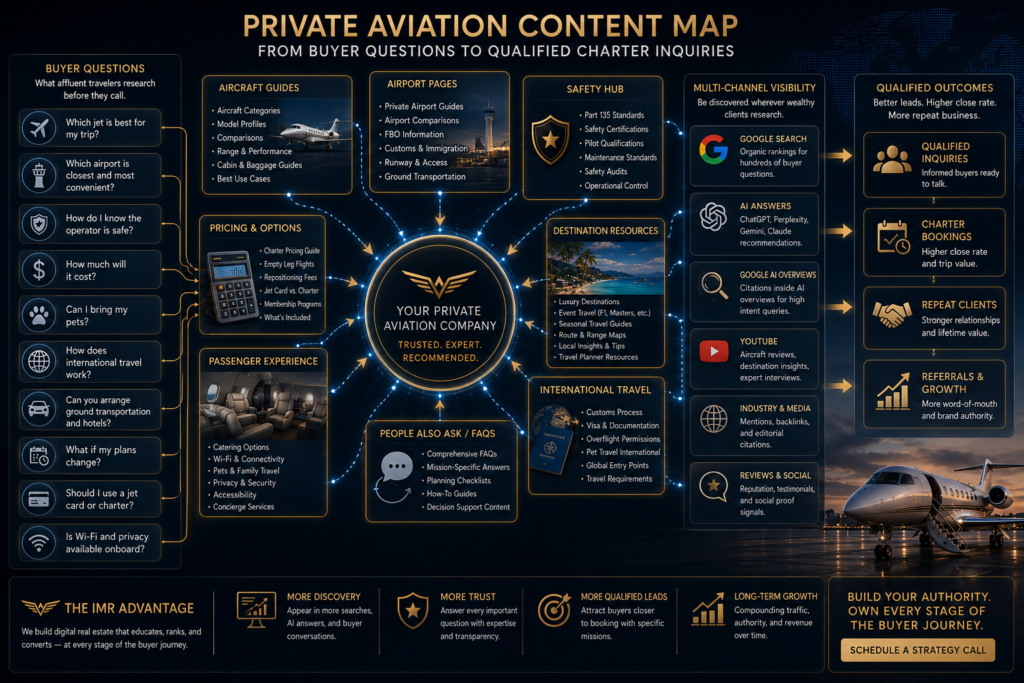
If a wealthy buyer asks fifty questions before booking, your company should aim to answer all fifty.
Building a Digital Authority Ecosystem
Answering one buyer question can create one useful page.
However, answering the complete research journey creates something far more valuable.
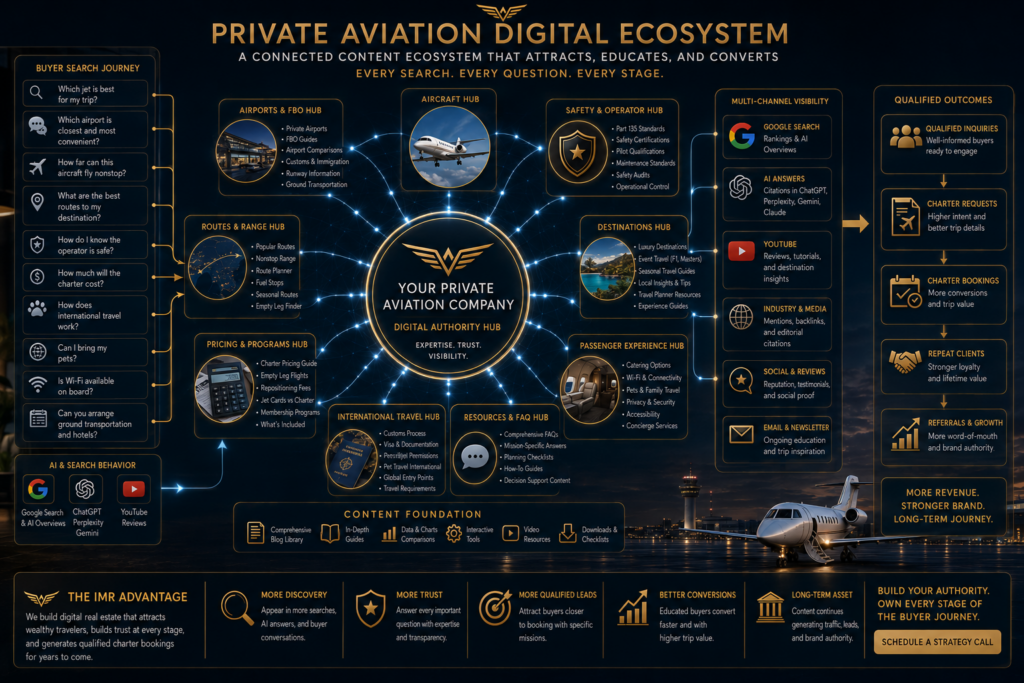
It creates a digital authority ecosystem.
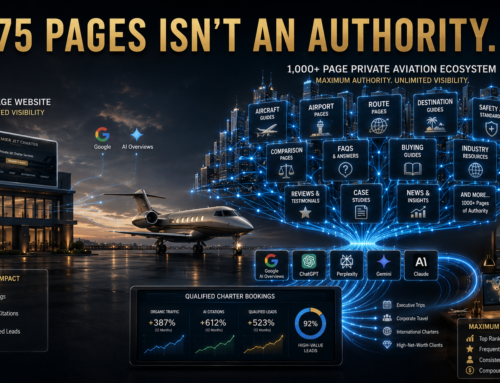
A digital authority ecosystem is a connected network of educational resources designed around the real questions prospective clients ask before booking. Rather than relying on a small brochure-style website, the company builds deep coverage across aircraft, airports, routes, destinations, safety, pricing, ownership alternatives, international travel, concierge services, and passenger needs.
Each page serves a specific purpose.
At the same time, every page strengthens the authority of the larger website.
This approach helps the company become visible at more stages of the buyer journey, support more detailed search intent, and provide AI systems with a broader body of information to understand.
A Website Promotes the Company. An Ecosystem Guides the Buyer.
A traditional charter website usually focuses on the company itself.
It may include a homepage, an about page, an aircraft overview, a safety page, several destination pages, and a contact form.
Those pages are necessary.
However, they rarely address the full range of questions an affluent buyer asks.
A digital ecosystem takes a different approach.
Instead of asking only, “What does our company want to say?” it asks, “What does the buyer need to understand before making a confident decision?”
That shift changes the entire content strategy.
Traditional Charter Website |
Digital Authority Ecosystem |
|---|---|
| Focuses primarily on the company | Focuses on the buyer’s complete research journey |
| Targets a few broad keywords | Targets hundreds of specific questions and missions |
| Uses general aircraft descriptions | Builds detailed aircraft guides and comparisons |
| Lists destinations | Explains routes, airports, logistics, events, and travel scenarios |
| Mentions safety | Educates buyers on standards, certifications, pilots, and operations |
| Relies heavily on paid traffic | Builds long-term organic and AI-search visibility |
| Asks visitors to request a quote quickly | Builds confidence before presenting the conversion opportunity |
The difference is not simply page count.
It is strategic depth.
Build Around the Buyer’s Decision Categories
A strong private aviation ecosystem should reflect the major categories buyers investigate before booking.
These categories can become interconnected content hubs.
Aircraft Authority
An aircraft hub can help buyers understand categories, models, performance, cabin experience, luggage capacity, airport access, and mission suitability.
Supporting resources may include:
- Aircraft category pages
- Individual aircraft model guides
- Aircraft comparison pages
- Cabin height and width comparisons
- Range and nonstop-route guides
- Baggage-capacity resources
- Pet-friendly aircraft guides
- Business travel aircraft comparisons
- Family and leisure aircraft recommendations
This content attracts buyers who know they need private aviation but have not yet selected the right aircraft.
Airport and Route Authority
Airport and route content helps buyers understand how private aviation can improve convenience, reduce ground travel, and create more flexible itineraries.
This ecosystem may include:
- Private airport guides
- Major route pages
- Airport comparison pages
- FBO guides
- Customs and international-entry information
- High-altitude airport resources
- Runway and aircraft-access considerations
- Ground transportation planning
- Regional airport alternatives
These pages can capture travelers with highly specific and commercially valuable missions.
Destination and Event Authority
Destination research often begins long before the traveler chooses a charter provider.
Therefore, destination content can introduce the company during the earliest planning stages.
Useful resources may cover:
- Luxury leisure destinations
- Business travel markets
- Ski destinations
- Island travel
- International financial centers
- Formula 1 travel
- The Masters
- Art Basel
- The Super Bowl
- Luxury resort access
Each destination page can connect the experience to aircraft selection, airport access, seasonal considerations, and booking logistics.
Safety and Operational Authority
Safety content can be one of the strongest trust-building assets on a private aviation website.
A comprehensive safety hub may include:
- Part 135 standards
- Part 91 versus Part 135
- Pilot qualifications
- Maintenance procedures
- Safety audit explanations
- ARGUS and Wyvern guidance
- Aircraft inspection standards
- Weather decision-making
- Operational control
- Emergency and contingency planning
This content helps buyers evaluate operators more intelligently while demonstrating that the company is comfortable discussing serious operational questions.
Passenger Experience Authority
The passenger experience includes more than the aircraft cabin.
It includes every detail before, during, and after the flight.
Relevant resources may cover:
- Catering
- Ground transportation
- Pet travel
- Family travel
- Accessibility
- Wi-Fi and connectivity
- Privacy
- Security
- Schedule changes
- International documentation
These pages help clients understand the level of service they can expect and reduce uncertainty surrounding the trip.
Internal Links Turn Individual Pages Into a Guided Journey
Publishing hundreds of disconnected pages is not enough.
The pages must work together.
Internal links help buyers move naturally from one question to the next.
For example, an airport guide for Aspen can link to:
- Aircraft suitable for high-altitude airports
- Winter private aviation planning
- Ski equipment baggage guides
- Nearby airport alternatives
- Luxury ground transportation
- Private jet safety standards
- A relevant charter request page
This creates a guided research experience.
It also helps search engines and AI systems understand the relationship between aircraft, airports, destinations, and customer needs.
For a deeper explanation of this strategy, see IMR’s guide to the 1,000-page digital real estate model.
Digital Authority Compounds Over Time
Paid advertising stops producing traffic when the budget stops.
Authority content can continue creating discovery long after publication.
A useful aircraft guide may attract visitors for years. An airport page may surface whenever buyers plan a particular route. A safety resource may earn citations from search engines, AI systems, publications, and other websites.
As the ecosystem grows, the benefits can compound.
New pages strengthen existing topic clusters.
Existing pages help new pages gain context.
Internal links distribute authority across the website.
Meanwhile, the company gains more opportunities to appear across Google, AI Overviews, ChatGPT, Gemini, Perplexity, and other discovery platforms.
This is why content should be treated as a long-term business asset rather than a short-term campaign.
IMR explains this broader shift in The Complete Private Aviation Digital Marketing Strategy Guide.
The Goal Is Not More Traffic. It Is More Influence.
Traffic alone does not guarantee charter bookings.
A large audience with weak intent may create little business value.
The stronger objective is influence across the decision-making process.
A private aviation company should aim to influence:
- Which aircraft the buyer considers
- Which airport they choose
- Which safety questions they ask
- Which booking model they prefer
- Which operators enter the shortlist
- Which company ultimately receives the inquiry
When your content helps shape those decisions, your website becomes more than a marketing channel.
It becomes part of the client’s advisory process.
The most valuable private aviation brand is not simply the one buyers find at the end.
It is the one that guides them from the beginning.
Frequently Asked Questions
How do wealthy clients choose a private jet charter company?
Direct answer: Wealthy clients typically compare safety, aircraft suitability, operator credibility, service quality, schedule flexibility, digital reputation, reviews, and expertise before choosing a charter company. Many form a shortlist through online research before requesting a quote.
How long do affluent travelers research before booking a private jet?
Direct answer: Research time varies by trip, buyer experience, and complexity. A repeat traveler may decide quickly, while a first-time client, family office, or corporate travel manager may research aircraft, airports, safety, and operators over several days, weeks, or months.
What information do private jet clients research first?
Direct answer: Many clients begin with the mission. They research route distance, passenger count, aircraft options, baggage capacity, airport access, safety standards, travel restrictions, and expected service before comparing charter providers.
Do wealthy clients care about private jet pricing?
Direct answer: Yes. However, many affluent buyers evaluate price alongside safety, reliability, convenience, aircraft quality, flexibility, and service. They often want transparent explanations that help them understand why quotes differ and what each option includes.
How does website content build trust with affluent travelers?
Direct answer: Detailed content demonstrates expertise before the sales call. Aircraft guides, airport resources, safety explanations, route pages, FAQs, and operational information help buyers reduce uncertainty and determine whether a company understands their needs.
Does AI influence private jet booking decisions?
Direct answer: AI platforms increasingly influence early research by summarizing aircraft options, airport choices, safety considerations, and travel logistics. These answers can shape which companies and resources enter the buyer’s consideration set.
Why do charter companies need more than service pages?
Direct answer: Service pages target buyers near the end of the journey. Educational pages reach prospective clients earlier, when they are researching aircraft, destinations, airports, safety, pricing, and logistics. Together, both page types support a complete acquisition strategy.
What is a private aviation digital authority ecosystem?
Direct answer: A digital authority ecosystem is an interconnected network of aircraft guides, airport pages, route content, destination resources, safety information, FAQs, comparisons, and service pages built around the buyer’s complete research journey.
Can educational content generate qualified charter leads?
Direct answer: Yes. Specific educational content often attracts visitors with defined routes, passenger counts, aircraft needs, safety concerns, or destination plans. These visitors may arrive more informed and closer to making a booking decision.
Why are airport and route pages valuable for charter companies?
Direct answer: Airport and route pages capture specific travel intent. A buyer researching the best airport, nonstop range, customs access, or nearby destination often has a real trip in mind, making this traffic potentially more commercially valuable than broad traffic.
How can a charter company improve AI-search visibility?
Direct answer: Charter companies can improve AI visibility by publishing clear, accurate, structured, and interconnected content across aircraft, airports, destinations, safety, pricing, routes, and passenger needs. Strong schema, consistent facts, and topical depth also support machine understanding.
Does a larger private aviation website automatically rank better?
Direct answer: No. Page count alone does not create authority. The website needs useful content, strong topic coverage, clear architecture, internal links, original expertise, trustworthy information, and pages that directly answer real buyer questions.
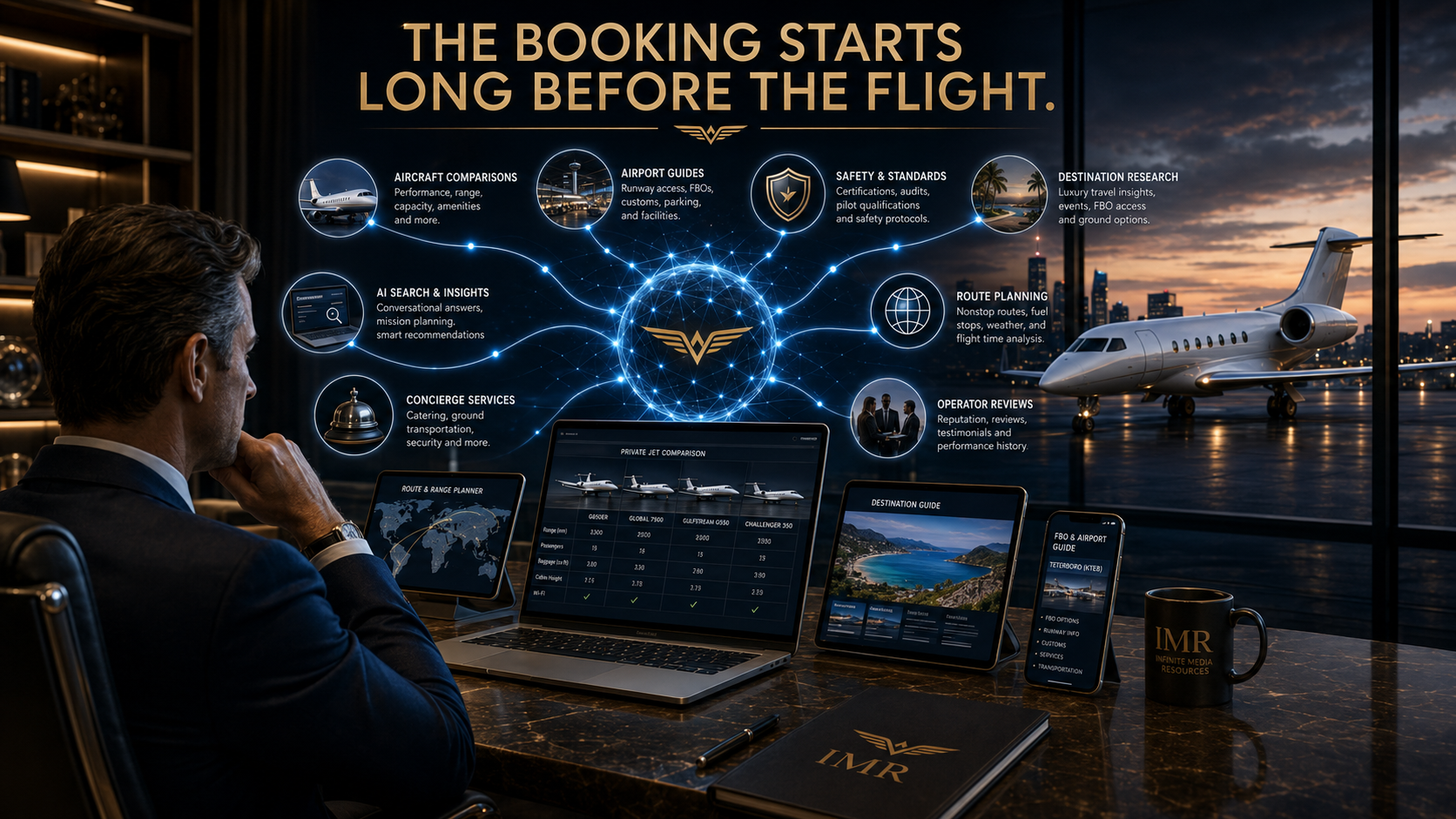
The Booking Begins Long Before the Flight
A wealthy traveler rarely wakes up, selects the first charter company they find, and books a private jet without further consideration.
The decision develops across many moments.
It begins with questions about aircraft, airports, routes, safety, comfort, privacy, pricing, logistics, and service. It continues through Google searches, AI conversations, reviews, recommendations, manufacturer websites, airport resources, and educational articles.
Every interaction shapes trust.
Every answer influences the shortlist.
Every useful resource creates another opportunity for a private aviation company to become part of the decision.
Therefore, the strongest charter marketing strategy does not begin by asking how to generate the fastest lead.
It begins by asking how to become the most useful and trusted resource throughout the buyer’s complete journey.
That requires more than a beautiful website.
It requires a connected digital authority ecosystem built around the questions affluent clients actually ask.
When a company provides those answers consistently, it gains more than rankings.
It gains familiarity.
It gains trust.
Most importantly, it earns the opportunity to receive the call when the buyer is finally ready to book.
Build the Digital Authority Wealthy Clients Discover Before They Call
Infinite Media Resources helps private aviation companies build comprehensive digital ecosystems designed around aircraft, routes, airports, destinations, safety standards, buyer questions, Google search, and AI discovery.
Instead of relying only on paid advertising or a limited brochure website, IMR builds digital real estate that can attract highly qualified prospects throughout the entire research journey.
Schedule a private aviation digital strategy conversation with Infinite Media Resources.
About the author : Anthony Paulino