Why Charter Companies Lose Customers Before They Call
Most private aviation companies believe they lose bookings after the first phone call.
They assume the quote was too high, another operator responded faster, the aircraft wasn’t available, or the prospect simply decided not to travel.
Sometimes that’s true.
However, many charter companies lose the customer long before their sales team ever has an opportunity to compete.
Today’s ultra-high-net-worth traveler doesn’t wake up, search “private jet charter,” and immediately call the first company they find.
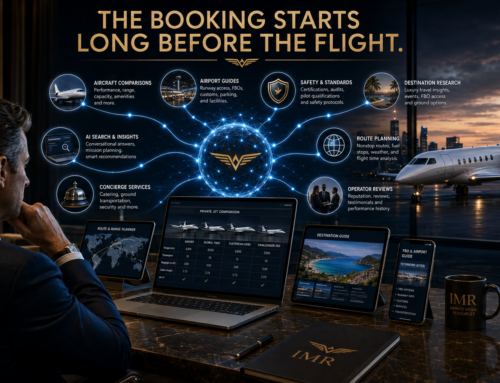
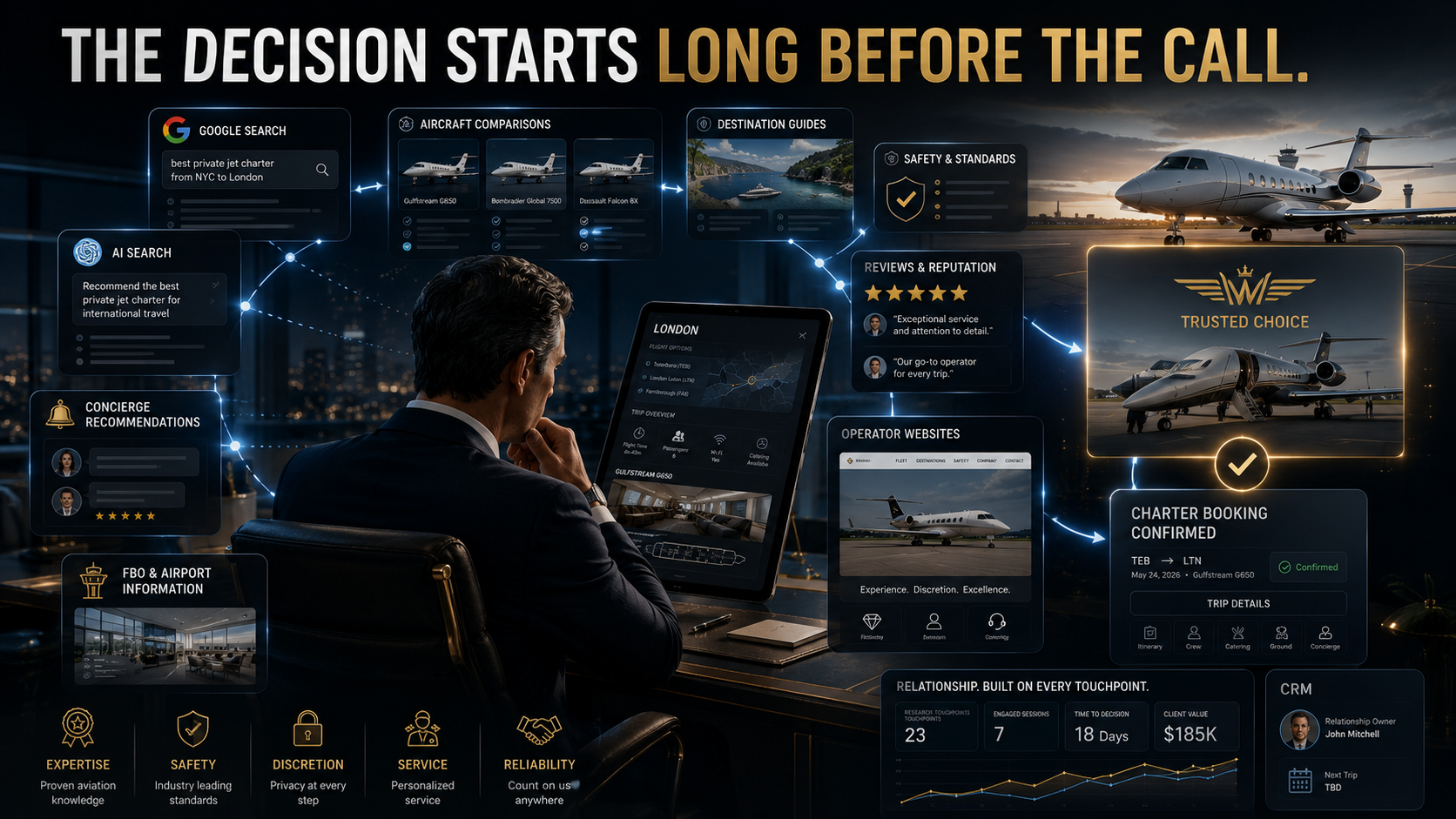
Instead, they spend days—or even weeks—researching operators, aircraft, safety standards, destinations, FBOs, concierge services, cabin layouts, luggage capacity, international procedures, pricing expectations, reviews, and countless other questions before narrowing their options.
By the time they finally contact a charter provider, they’ve often eliminated dozens of companies without anyone inside those organizations ever knowing they existed.
That’s the hidden cost of weak digital authority.
The buying decision increasingly happens before the conversation.
Companies that dominate Google Search, AI search, educational content, aircraft resources, destination guides, comparison pages, reviews, and trust signals consistently appear during every stage of that research journey. Meanwhile, companies with thin websites, limited educational resources, weak search visibility, and minimal digital proof disappear from consideration before the sales process begins.
The question is no longer whether your sales team can close the deal.
The question is whether your company survives the research phase long enough to receive the opportunity.
Direct Answer
Most charter companies lose customers before the first phone call because modern private aviation buyers conduct extensive research long before contacting an operator. Google Search, AI search, aircraft guides, destination content, reviews, safety information, comparison pages, concierge recommendations, and digital authority influence which charter providers make the final shortlist. Companies that build comprehensive digital ecosystems consistently earn more opportunities before competitors ever receive a chance to quote.
[IMAGE: Featured Hero Image]
Most Charter Bookings Begin Months Before the First Conversation
One of the biggest misconceptions in private aviation marketing is that bookings begin when a prospect submits a quote request.
In reality, the buying process usually starts much earlier.
An executive planning international travel, a family organizing a ski vacation, a business arranging a multi-city roadshow, or a first-time charter customer often begins with research rather than booking. They want to understand aircraft categories, airport options, customs procedures, travel times, cabin layouts, baggage limitations, Wi-Fi capabilities, pet policies, safety standards, membership programs, and expected pricing before they ever contact a charter advisor.
Every one of those questions represents an opportunity for a charter company to become the trusted source of information.
Unfortunately, many operators provide only a small fleet page and a basic quote form.
Consequently, prospects leave the website to continue researching elsewhere. Every additional search creates another opportunity for a competing charter company to become the trusted authority before the first conversation ever happens.
The first phone call is rarely the beginning of the buying journey.
It’s often the final step of a much longer research process.
Ultra-High-Net-Worth Travelers Research Far More Than the Aircraft
Many charter companies assume their aircraft fleet is the primary factor influencing buying decisions. While aircraft selection certainly matters, it represents only one piece of a much larger evaluation process.
Ultra-high-net-worth travelers are not simply purchasing transportation. They are selecting a company responsible for privacy, safety, flexibility, reliability, and an experience that often reflects directly on their family, executive team, or personal brand.
Consequently, their research extends far beyond cabin dimensions or hourly rates.
A prospective client may begin by comparing aircraft capable of flying from New York to London. However, that same traveler often continues researching airport options, customs procedures, FBO facilities, onboard connectivity, pet accommodations, catering expectations, baggage limitations, flight attendants, concierge services, international regulations, and the operator’s reputation before ever requesting a quote.
Every search represents another opportunity for your company to become part of the decision—or another opportunity for a competitor to earn that trust instead.
This behavior explains why educational content has become one of the most valuable marketing assets in private aviation. Instead of waiting for prospects to request information from a sales advisor, leading operators answer those questions proactively through aircraft guides, destination resources, travel planning content, comparison pages, FAQs, and detailed operational information.
As a result, they establish expertise before pricing ever enters the conversation.
| What Travelers Search | What They’re Really Evaluating |
|---|---|
| Aircraft comparisons | Whether the operator understands mission planning |
| Airport guides | Operational expertise and convenience |
| International travel procedures | Experience with complex itineraries |
| Safety standards | Risk management and professionalism |
| Reviews and testimonials | Trust and consistency |
| Membership programs | Long-term relationship potential |
| Destination guides | Luxury travel expertise |
| Pet, luggage, and concierge questions | Attention to client experience |
Google’s guidance on helpful, people-first content aligns perfectly with this behavior. Rather than creating pages solely to rank for keywords, successful aviation companies publish genuinely useful information that answers the questions travelers are already asking.
When those answers consistently appear throughout the buying journey, the operator becomes far more than another charter provider. It becomes the trusted source prospects return to throughout their decision-making process.
Trust Is Built Long Before the Charter Quote Arrives
Private aviation is built on trust.
Unlike many consumer purchases, booking a private aircraft requires significant financial commitment while placing family members, executives, clients, and valuable schedules into another company’s hands. That responsibility naturally encourages extensive due diligence.
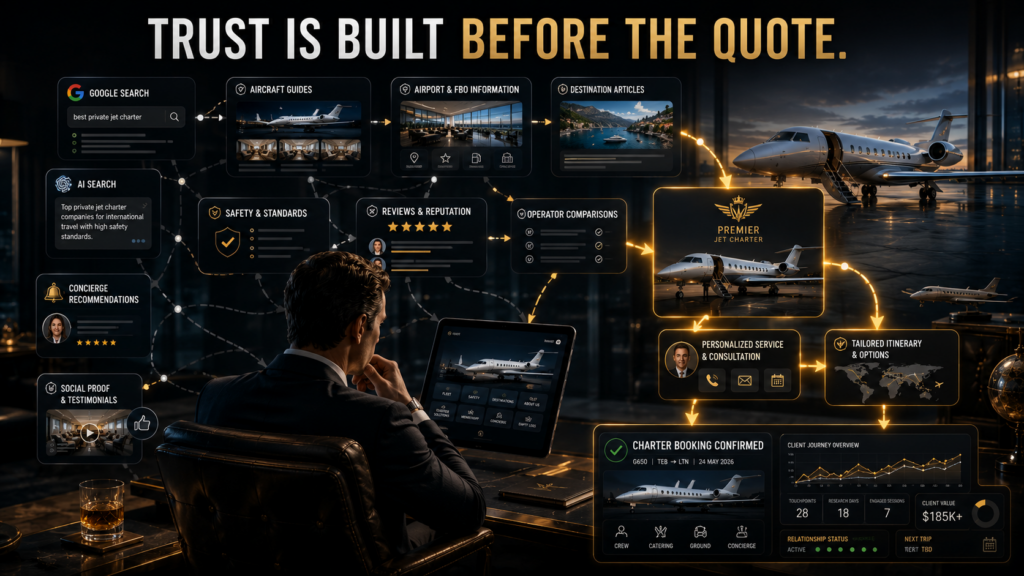
Long before requesting a quote, sophisticated travelers begin evaluating subtle trust signals across the company’s digital presence.
They review the professionalism of the website, read educational resources, compare aircraft information, examine destination expertise, search for third-party reviews, evaluate safety messaging, inspect photography quality, review executive leadership, and determine whether the company appears established enough to manage high-value travel.
Many charter companies unknowingly fail this evaluation without realizing prospects ever visited the website.
A thin fleet page, outdated content, generic service descriptions, limited educational material, or weak search visibility quietly erode confidence. Although none of those issues alone may eliminate a company, together they create uncertainty. For ultra-high-net-worth travelers, uncertainty often leads to continuing the search rather than requesting a quote.
By contrast, operators with comprehensive digital ecosystems communicate confidence before the first interaction. Every aircraft guide, airport resource, route comparison, international travel article, safety explanation, and customer story reinforces expertise while reducing perceived risk.
Luxury buyers don’t simply purchase the flight.
They purchase confidence in the company operating the flight.
That confidence develops gradually across dozens of small interactions rather than one dramatic sales conversation.
Every Search Quietly Eliminates Charter Companies
Most charter providers imagine prospects comparing several quotes after contacting operators.
In reality, much of the competition disappears long before pricing discussions begin.
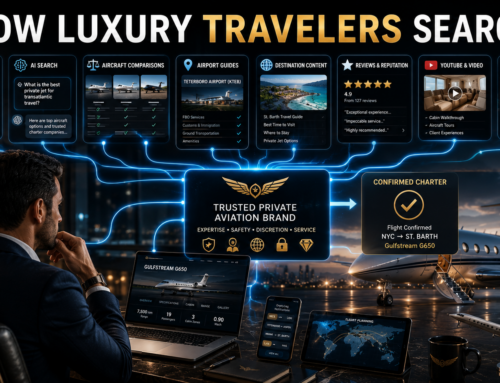
Imagine a traveler researching a summer itinerary from Teterboro to Nice. During that process they may search for the best aircraft, compare airport options, investigate customs procedures, evaluate cabin layouts, read destination recommendations, explore catering expectations, review operator credentials, and ask AI platforms for guidance.
Each answer naturally introduces new companies.
Each unanswered question removes others.
If your organization provides detailed aircraft pages while another company offers only a fleet list, your business earns another opportunity to build trust. Likewise, if your airport guides answer operational questions better than competitors, your company remains visible longer throughout the research journey.
This process repeats across dozens of decisions.
Consequently, by the time the traveler finally requests quotes, many operators have already been removed from consideration—not because they lacked aircraft or competitive pricing, but because they never appeared often enough during the research phase to establish confidence.
| Research Stage | Companies Often Eliminated Because… |
|---|---|
| Google Search | Poor search visibility |
| AI Search | Limited authoritative content |
| Aircraft Research | Thin fleet information |
| Destination Planning | No travel expertise demonstrated |
| Safety Evaluation | Weak trust signals |
| Review Comparison | Insufficient reputation evidence |
| Website Evaluation | Generic marketing without depth |
| Quote Request | Only the most trusted companies remain |
This explains why improving digital authority often increases quote requests without changing pricing or fleet availability. More qualified prospects simply reach the sales team because the company survives every earlier stage of evaluation.
Our guide on How Luxury Travelers Actually Search for Private Jets explores this evolving research behavior in greater depth and demonstrates why traditional advertising alone rarely controls the full buying journey.
Digital Authority Determines Who Makes the Final Shortlist
Years ago, digital marketing focused primarily on rankings.
Today, digital authority has become far more important.
Search engines, AI platforms, luxury travelers, executive assistants, family offices, and concierge professionals all evaluate whether a charter company consistently demonstrates expertise across many related subjects. Instead of looking at one webpage, they assess the overall depth of the organization’s digital footprint.
That footprint includes far more than SEO.
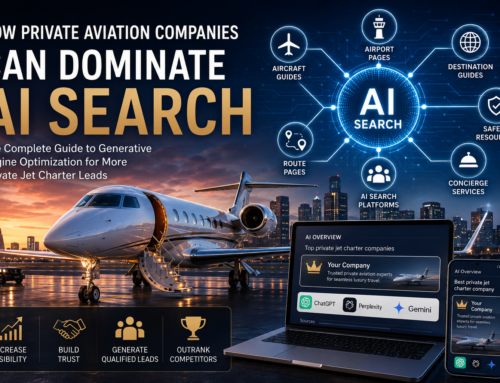
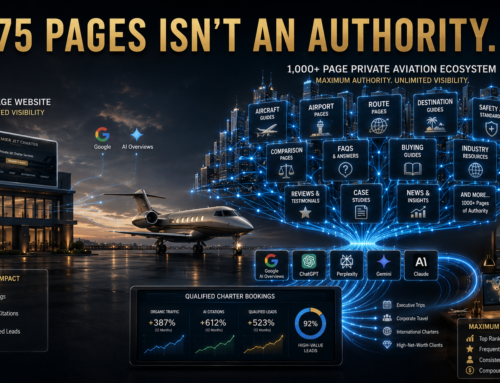
It includes aircraft guides, destination content, airport resources, route planning, operational explanations, educational blogs, comparison pages, reviews, structured data, AI citations, media coverage, and dozens of other trust signals that reinforce one another.
Every new resource strengthens the entire ecosystem because it provides another opportunity to appear during research while supporting the credibility of every existing page through contextual internal linking.
This is precisely why IMR approaches private aviation marketing as a digital real estate strategy rather than a campaign strategy. Instead of creating isolated advertisements, we build interconnected assets that continue educating travelers, supporting search visibility, strengthening AI understanding, and generating qualified opportunities long after publication.
Our Private Aviation hub and Generative Engine Optimization (GEO) hub explain how search engines and AI systems increasingly reward organizations demonstrating comprehensive topical authority instead of isolated optimization.
As AI search becomes a larger part of luxury travel planning, this shift will only accelerate.
Companies investing in authoritative educational ecosystems today are positioning themselves to become tomorrow’s default recommendations.
Your Sales Team Never Gets the Chance to Win Many Bookings
Most charter companies invest heavily in improving sales performance.
They refine discovery calls, train charter advisors, improve quoting speed, negotiate pricing, and build stronger follow-up processes. Although those improvements certainly matter, they only affect prospects who actually make contact.
The larger opportunity often exists before the sales department becomes involved.
If a prospective traveler never places the call, requests the quote, or submits the inquiry, even the world’s best charter advisor cannot influence the outcome.
This creates one of the largest blind spots in private aviation marketing.
Leadership often measures quote volume, close rate, revenue, and average charter value. However, almost nobody measures how many qualified prospects quietly eliminated the company during research.
Imagine two charter operators.
Operator A receives one hundred qualified quote requests and closes thirty bookings.
Operator B receives sixty quote requests and closes the same percentage.
At first glance, both sales teams appear equally effective.
However, if Operator B disappeared from hundreds of research journeys because of weak digital authority, poor search visibility, limited educational content, or insufficient trust signals, then the marketing system—not the sales team—is limiting growth.
The sales department cannot close opportunities it never receives.
| Traditional Sales Metric | Hidden Marketing Metric |
|---|---|
| Quote requests | Qualified researchers who never contacted you |
| Close rate | Companies eliminated before comparison |
| Average charter value | High-value prospects never entering the pipeline |
| Response speed | Search visibility across the research journey |
| Sales conversions | Digital authority before first contact |
Improving these upstream metrics often produces larger long-term growth than attempting to increase sales conversion by a few percentage points because the entire opportunity pool becomes larger before selling even begins.
What Charter Companies Should Actually Measure
Many aviation companies evaluate marketing using only quote requests and booked flights.
Although those numbers remain essential, they provide only a partial view of how buyers discover and evaluate the business.
Modern private aviation marketing requires measurement throughout the complete customer journey.
Leadership should understand where travelers first discover the company, which educational resources influence trust, how prospects move between search channels, what pages encourage deeper engagement, and which digital assets consistently contribute to booked charters.
That broader perspective transforms marketing from a cost center into an acquisition system that can be refined continuously.
| Marketing Metric | Business Question It Answers |
|---|---|
| Organic search visibility | Are qualified travelers discovering the company? |
| AI search visibility | Is the company appearing inside AI-generated recommendations? |
| Aircraft page engagement | Which aircraft generate the most buying interest? |
| Destination content performance | Which travel routes influence booking decisions? |
| CRM attribution | Which digital touchpoints contributed to the booking? |
| Repeat client percentage | Is marketing creating long-term relationships? |
| Lifetime customer value | How valuable are acquired clients over time? |
| Customer acquisition cost | How efficiently is the company generating new business? |
Instead of celebrating page views or impressions alone, charter companies should evaluate how every digital asset contributes to long-term client acquisition. Aircraft guides, airport resources, destination articles, educational blogs, and AI-search visibility all become measurable investments rather than isolated marketing activities.
When connected through CRM attribution, leadership gains a much clearer understanding of why certain bookings occur—and why others never reach the sales team.
AI Search Is Compressing the Buying Journey Even Further
Artificial intelligence is rapidly changing how affluent travelers research private aviation.
Instead of opening dozens of browser tabs and manually comparing operators, many travelers now begin with conversational questions. They ask AI systems to recommend aircraft, explain route options, compare cabins, estimate flight times, identify airports, summarize operator differences, or suggest the best charter solution for a specific mission.
That shift creates both an opportunity and a risk.
Companies with deep educational ecosystems provide AI platforms with abundant evidence supporting their expertise. Organizations relying on a handful of marketing pages provide comparatively little information for AI systems to understand.
Consequently, AI increasingly favors businesses demonstrating broad topical authority across many interconnected subjects.
Fortunately, the same investments that strengthen traditional SEO also support AI search.
- Comprehensive aircraft guides
- Airport and FBO resources
- Destination expertise
- Route planning content
- Operational education
- Structured data
- Consistent internal linking
- Authoritative topical coverage
Google explains through its documentation on structured data that organized semantic information helps search systems understand relationships between entities. Likewise, Schema.org provides the vocabulary enabling organizations to describe aircraft, services, articles, FAQs, organizations, reviews, and many other important entities.
As AI assistants become trusted travel advisors for executives, family offices, and concierge professionals, digital authority will increasingly determine which charter operators appear during those recommendations.
The companies teaching AI today are the companies AI will recommend tomorrow.
Eight Reasons Charter Companies Lose Customers Before the First Call
Most private aviation operators do not lose opportunities because they own the wrong aircraft or charge the wrong hourly rate. More often, prospects quietly eliminate them during research because the digital experience fails to build enough confidence.
-
The website answers almost none of the buyer’s questions
Travelers researching complex international trips expect educational guidance, not just a quote form.
-
The fleet pages contain only specifications
Aircraft pages should explain missions, passenger experience, luggage considerations, airport flexibility, range, cabin comfort, and ideal traveler profiles.
-
Destination expertise is missing
Luxury travelers often evaluate operators based on operational knowledge, not simply aircraft availability.
-
Search visibility is limited
If prospects cannot consistently discover the company while researching, another operator becomes the trusted source instead.
-
The website lacks authority signals
Weak reviews, limited educational content, outdated photography, and generic messaging reduce confidence before pricing is ever discussed.
-
The company depends almost entirely on paid advertising
Advertising creates visibility, but owned digital authority creates long-term trust that continues influencing bookings after campaigns end.
-
AI search receives little consideration
Organizations failing to build comprehensive educational ecosystems provide AI systems with fewer reasons to recommend their expertise.
-
Marketing and sales operate independently
The strongest operators align educational content, CRM nurturing, charter advisors, and follow-up into one continuous buying journey instead of isolated departments.
Every one of these issues reduces the number of travelers who ever reach the quoting stage. Consequently, solving them often produces more qualified charter opportunities without changing fleet size, pricing strategy, or sales staffing.
Frequently Asked Questions About Losing Charter Customers Before They Call
Why do private jet charter companies lose customers before receiving inquiries?
Most travelers research operators extensively before requesting a quote. Search visibility, AI recommendations, aircraft content, destination expertise, reviews, safety information, and digital trust all influence which companies survive the research phase long enough to receive an inquiry.
How do ultra-high-net-worth travelers choose charter companies?
They typically evaluate far more than fleet availability. Aircraft suitability, operational expertise, destination knowledge, concierge capabilities, safety reputation, digital authority, reviews, responsiveness, and overall confidence all contribute to the final shortlist.
Does educational content really influence luxury charter bookings?
Yes. Educational content demonstrates expertise before pricing discussions begin. Aircraft guides, airport resources, route planning, international procedures, destination articles, and buyer education help reduce uncertainty while positioning the operator as a trusted advisor rather than simply another vendor.
How does AI search affect private aviation marketing?
AI platforms increasingly summarize information from authoritative sources. Charter companies with comprehensive educational ecosystems, structured data, topical authority, and well-connected content are generally better positioned to appear throughout AI-assisted research.
Should charter companies invest in SEO if they already advertise?
Yes. Advertising creates immediate visibility, while SEO builds owned digital assets that continue attracting qualified travelers over time. Together they reduce dependence on continuously purchasing every opportunity.
Final Thoughts: The Booking Is Often Won Before the Charter Advisor Answers
Private aviation companies rarely lose every opportunity during the quote process. Many lose the traveler much earlier, when a prospect searches for aircraft information, compares airport options, evaluates destination expertise, reviews safety signals, asks an AI platform for guidance, or decides whether the company appears credible enough to contact.
That distinction changes how charter companies should think about marketing. The website cannot function only as a fleet brochure and quote-request portal. Instead, it must support the entire research journey by helping travelers understand their options, evaluate mission requirements, reduce uncertainty, and recognize why the operator deserves serious consideration.
When charter companies build comprehensive aircraft pages, route resources, airport guides, destination content, safety explanations, comparison pages, reviews, FAQs, and client-focused educational assets, they begin influencing the decision long before pricing enters the conversation. Moreover, those assets continue working across Google Search, AI platforms, digital advertising, CRM nurturing, referrals, and sales follow-up.
As a result, the sales team receives a different type of inquiry. Prospects arrive with greater familiarity, stronger confidence, and a clearer understanding of the company’s expertise. Therefore, charter advisors spend less time proving basic credibility and more time matching the traveler with the right aircraft, itinerary, and service experience.
The first call does not create the customer’s opinion of your charter company.
It confirms the opinion your digital presence has already built.
The operators that understand this shift will not compete only for quote requests. Instead, they will compete to become the trusted source travelers repeatedly encounter throughout the entire private aviation buying journey.
Earn the Charter Booking Before the Prospect Requests a Quote
Private aviation travelers are already researching aircraft, airports, destinations, safety, service models, and operators before they contact your sales team. Therefore, every unanswered question and every missing digital touchpoint creates another opportunity for a competitor to become the trusted option first.
Infinite Media Resources builds private aviation marketing systems designed around that complete research journey. Our strategies combine private aviation SEO, Generative Engine Optimization, AI-search visibility, aircraft content, route and destination authority, airport resources, conversion architecture, digital PR, paid advertising, CRM nurturing, and attribution into one connected acquisition system.
Instead of competing only after a traveler requests pricing, your company can begin earning trust during the weeks or months leading up to the inquiry. Consequently, prospects arrive with greater confidence, stronger familiarity, and a clearer understanding of why your organization belongs on the final shortlist.
The result is not simply more website traffic. Your company gains an expanding digital authority asset that supports charter advisors, strengthens advertising performance, improves AI visibility, and increases the number of qualified travelers who reach the sales conversation.
Do not wait for the first call to begin selling the charter experience.
Build the authority that makes your company the preferred choice before the phone ever rings.
Schedule a private aviation marketing strategy consultation with Infinite Media Resources to discuss a digital acquisition system built around your fleet access, services, markets, ideal clients, and long-term growth goals.
About the author : Anthony Paulino