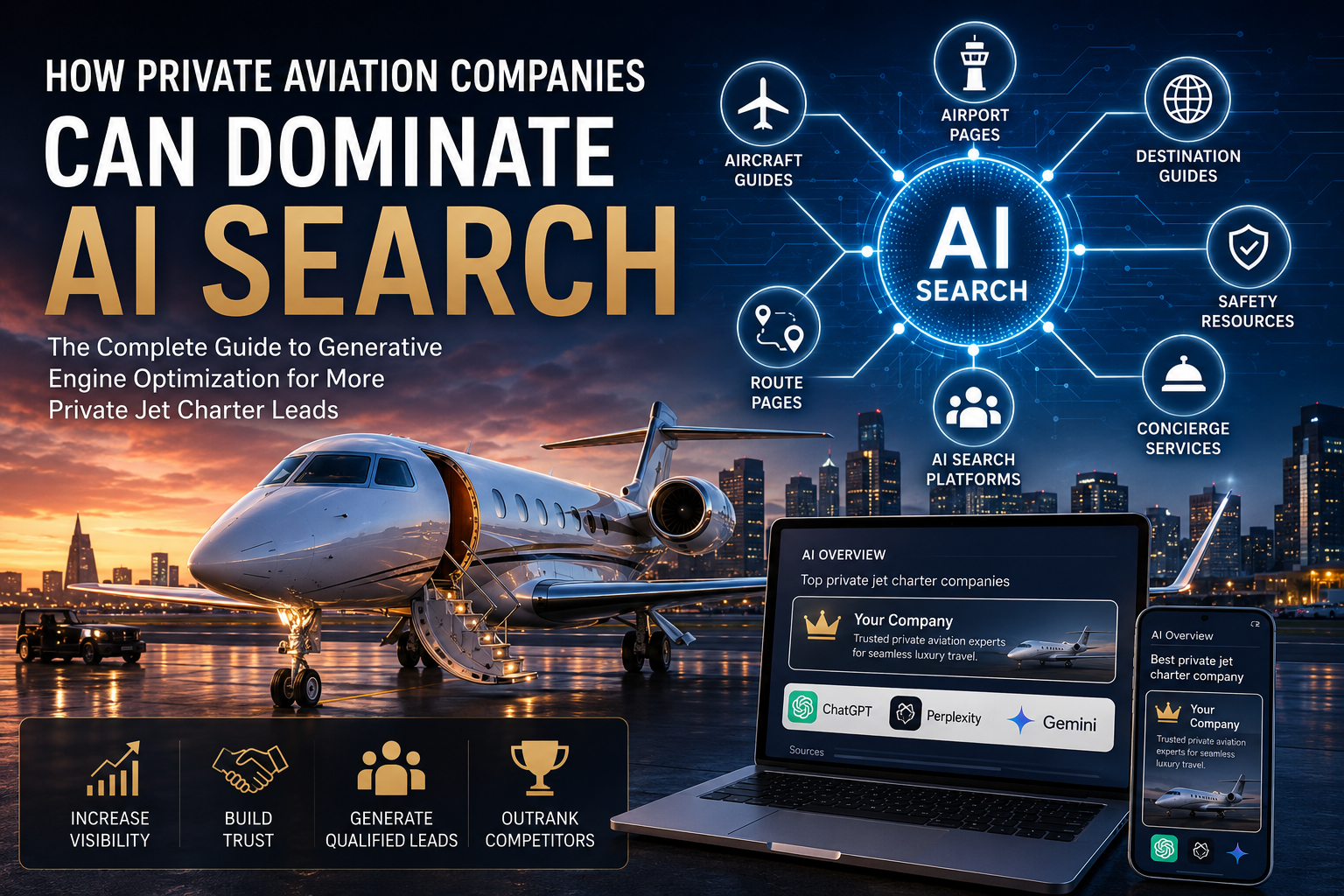
How Private Aviation Companies Can Dominate AI Search
For nearly two decades, private aviation marketing focused on one objective: ranking higher in Google Search.
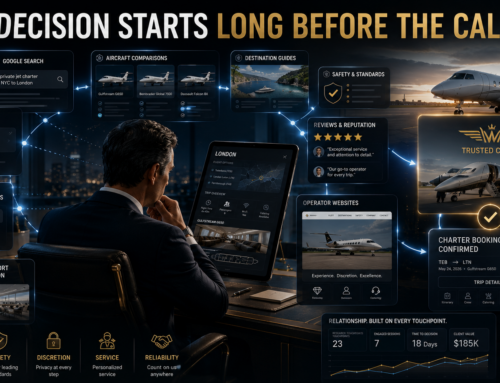
Today, however, affluent travelers are beginning their buying journey somewhere entirely different.
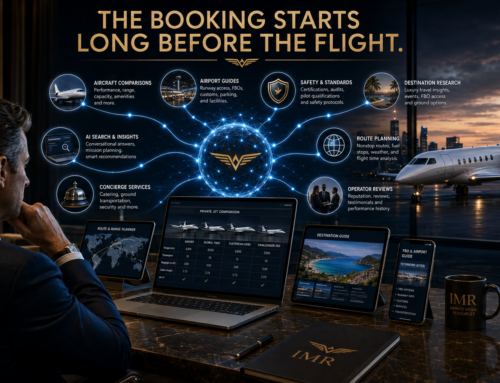
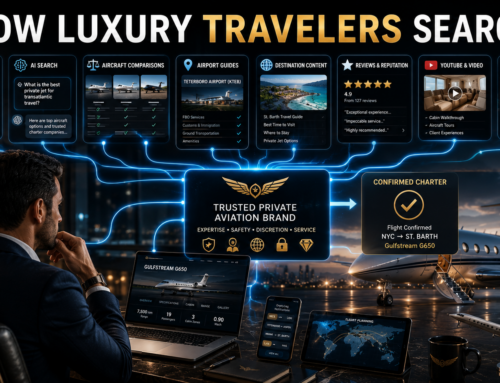
Instead of typing short keywords into a search engine, they’re asking AI assistants complex questions about aircraft, operators, destinations, safety, concierge services, and international travel. Platforms like Google AI Overviews, ChatGPT, Perplexity, Gemini, and Claude are increasingly becoming the first place executives, family offices, travel managers, and ultra-high-net-worth individuals go for recommendations.
That shift fundamentally changes how charter companies compete online.
Rather than choosing from ten blue links, travelers are receiving one comprehensive answer. If your company becomes part of that answer, you gain credibility before a prospect ever visits your website. Conversely, if AI platforms cannot confidently understand or reference your business, you may disappear from the conversation altogether—even if your traditional SEO remains strong.
This represents one of the biggest opportunities the private aviation industry has seen since search engines first transformed customer acquisition.
Unlike traditional SEO, AI search rewards organizations that demonstrate genuine expertise across an entire subject. It favors companies with comprehensive aircraft resources, airport guides, route information, destination content, FAQs, structured data, reviews, authoritative citations, and clear topical authority.
In other words, AI doesn’t simply rank webpages.
It evaluates knowledge.
The operators that build the strongest digital knowledge ecosystem today are positioning themselves to become tomorrow’s recommended charter companies across every major AI platform.
Direct Answer
Private aviation companies can dominate AI search by building comprehensive digital authority rather than relying on keyword optimization alone. AI platforms evaluate expertise across aircraft guides, airport resources, route pages, destination content, FAQs, structured data, reviews, authoritative citations, and interconnected topical coverage. Companies that consistently publish trustworthy aviation knowledge are significantly more likely to appear in AI-generated recommendations.
AI Search Is Becoming the New First Impression
Every major technology company is investing billions of dollars into AI-powered search because people increasingly want answers instead of lists of websites.
Consider how an ultra-high-net-worth traveler plans a trip today.
Instead of searching for “private jet charter New York,” they may ask:
- Which private jet is best for a nonstop flight from Teterboro to Nice?
- Who has the strongest safety reputation for international charter flights?
- Which charter operator is best for executives traveling with pets?
- What aircraft can comfortably sleep eight passengers on an overnight flight?
- Which operator specializes in corporate roadshows across Europe?
Those aren’t keyword searches.
They’re conversations.
Consequently, AI systems need far more information than a traditional search engine ever required. They must understand aircraft capabilities, airport logistics, charter operations, traveler preferences, destination expertise, safety considerations, and operator credibility before generating a recommendation.
The future of search isn’t ranking higher.
It’s becoming the answer.
For private aviation companies willing to invest in long-term digital authority, that shift creates a significant competitive advantage while much of the industry is still focused solely on traditional SEO.
How AI Chooses Which Private Aviation Companies to Recommend
Understanding how AI search works is the first step toward earning more visibility.
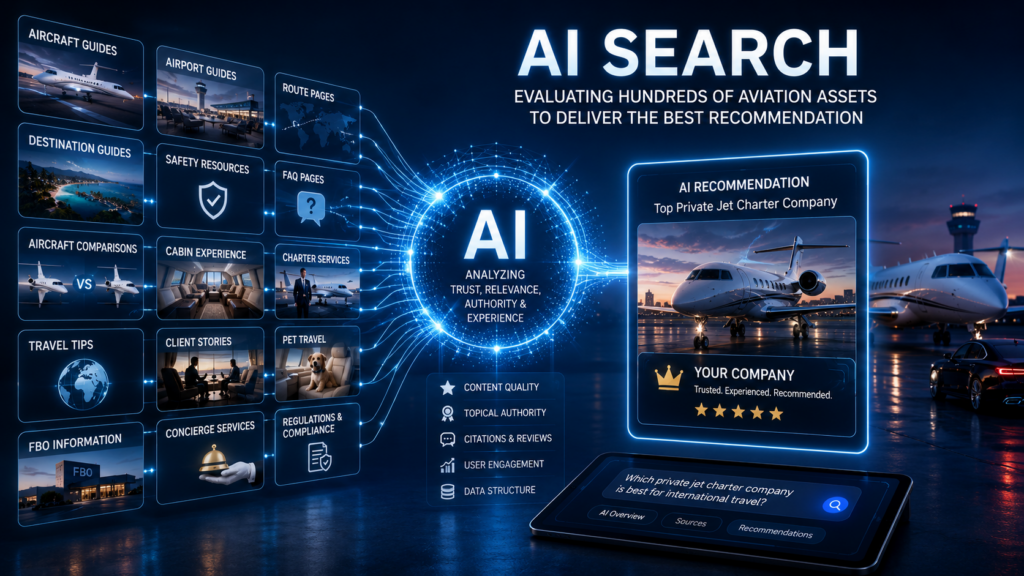
Unlike traditional search engines that primarily rank webpages, AI platforms evaluate information from multiple trusted sources before generating an answer. Their goal is not simply to find a page with the right keywords. Instead, they attempt to recommend the most trustworthy and complete answer for the user’s question.
As a result, companies that invest in digital authority often have a significant advantage over competitors that focus only on ranking a handful of service pages.
Although every AI platform uses different models, they generally look for many of the same trust signals.
These include:
- Depth of topical expertise
- Clear website structure
- Accurate structured data
- Authoritative citations
- Consistent branding across the web
- High-quality educational content
- Strong internal linking
- User engagement signals
- Fresh, regularly updated information
Consequently, AI begins connecting all of these signals together to determine whether your company truly understands private aviation or simply advertises charter services.
That distinction becomes incredibly important when affluent travelers ask detailed questions that require industry expertise rather than a sales pitch.
AI Looks for Topic Experts, Not Just Service Providers
Imagine two charter companies operating in the same city.
The first company has:
- Five service pages
- A contact page
- A fleet page
- A few blog posts
The second company has invested in building a true aviation knowledge center that includes:
- Aircraft buying guides
- Airport guides
- International destination guides
- Route comparisons
- Private jet cost calculators
- Safety resources
- Pet travel guides
- Aircraft comparison pages
- Cabin size comparisons
- Range charts
- Frequently asked questions
- Travel planning resources
- Executive travel advice
- Private aviation terminology guides
Both companies may offer exceptional charter services.
However, the second company demonstrates significantly more expertise across the entire private aviation ecosystem.
Therefore, AI has substantially more evidence supporting its credibility.
Instead of relying on assumptions, the model can reference hundreds of pages covering nearly every topic an executive traveler might research before booking a flight.
The company with the largest collection of genuinely helpful aviation knowledge often becomes the company AI trusts the most.
Authority Is Built Through Connected Knowledge
One excellent article rarely changes how AI understands a business.
Hundreds of interconnected resources do.
Every page should strengthen another page.
For example, an aircraft guide can naturally connect to airport pages. Those airport pages can connect to destination guides. Destination guides can reference charter planning articles, concierge services, seasonal travel advice, and aircraft recommendations.
As this ecosystem expands, AI begins recognizing your website as a comprehensive source of private aviation knowledge rather than a collection of isolated webpages.
This is exactly why large digital authority websites continue gaining momentum over time.
Each new page increases the value of every page already published.
The result is a compounding effect that becomes increasingly difficult for competitors to replicate.
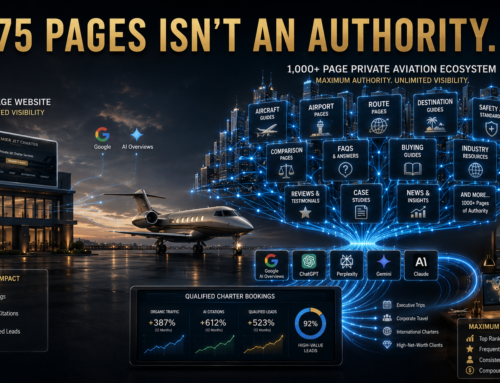
[TABLE: Traditional Website vs Digital Authority Ecosystem]
| Traditional Charter Website | AI Authority Website |
|---|---|
| 5–20 core pages | 500–1,000+ interconnected resources |
| Primarily sales focused | Education-first strategy |
| Few internal links | Extensive topic clusters |
| Basic fleet information | Complete aircraft knowledge library |
| Limited airport coverage | Airport, route, and destination hubs |
| Keyword optimization | Entity and topical authority optimization |
| Competes for rankings | Competes to become the AI recommendation |
Trust Signals Matter More Than Ever
AI systems are designed to reduce uncertainty.
Therefore, they naturally favor organizations that demonstrate consistent trust signals across their digital presence.
Examples include:
- Verified business information
- Strong customer reviews
- Industry certifications
- FAA-related educational content
- Clearly identified authors
- Updated aircraft information
- Professional photography
- Consistent company branding
- Structured data that explains every page
Although none of these factors guarantees an AI recommendation by itself, together they help create the confidence AI systems seek before referencing a business.
Ultimately, AI is attempting to minimize risk for the user.
If your website consistently provides accurate, comprehensive, and trustworthy information, your company becomes a far more reliable candidate for AI-generated answers.
The Knowledge Assets Every Private Aviation Company Needs to Win AI Search
Most charter operators think of their website as a digital brochure.
AI platforms, however, treat it much differently.
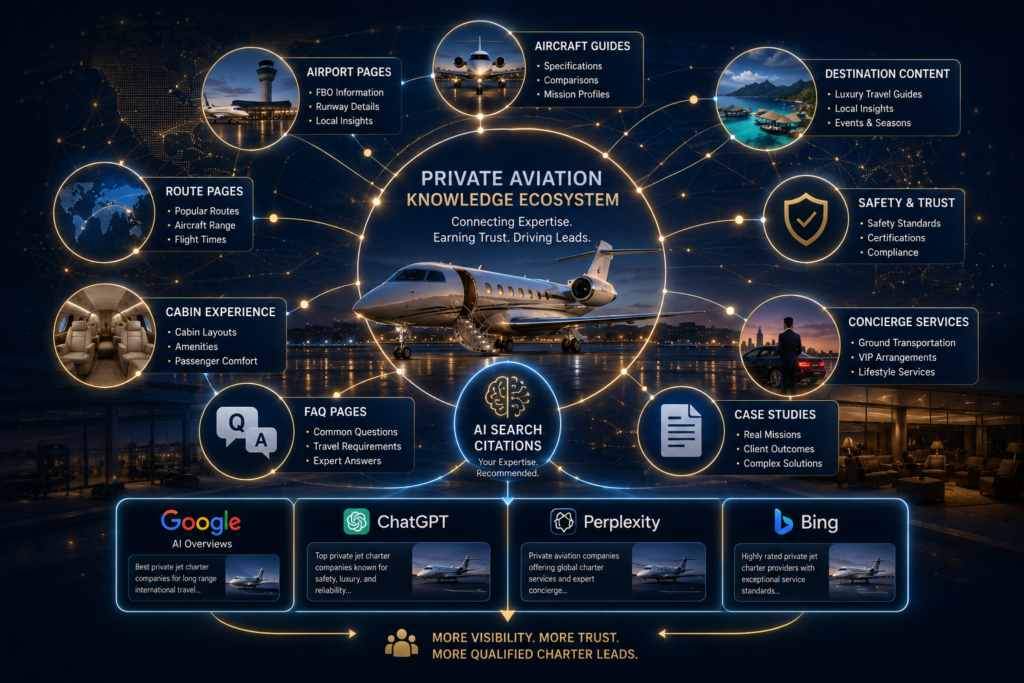
They evaluate whether your website represents a complete source of knowledge for the private aviation industry. Consequently, the companies that publish the widest range of helpful, interconnected resources are far more likely to become trusted references across AI-generated answers.
This doesn’t mean creating hundreds of random blog posts. Instead, it means strategically building an ecosystem where every page answers a specific question while reinforcing the authority of every other page.
Over time, this creates a digital asset that continues attracting qualified traffic long after each page is published.
Aircraft Guides Build Product Expertise
Aircraft pages are among the most valuable resources a private aviation website can publish because they answer questions prospects ask throughout the buying journey.
Rather than listing only basic specifications, comprehensive aircraft guides should explain who each aircraft is designed for, its ideal mission profile, cabin experience, baggage capacity, range limitations, airport compatibility, and comparisons with competing models.
For example, instead of creating a single fleet page, build dedicated resources covering topics such as:
- Gulfstream G700 Guide
- Bombardier Global 7500 Guide
- Cessna Citation Latitude Guide
- Embraer Praetor 600 Guide
- Dassault Falcon 8X Guide
- Pilatus PC-24 Guide
- HondaJet Guide
- Light Jet vs Midsize Jet Comparisons
- Large Cabin vs Ultra-Long-Range Aircraft
Each guide strengthens your topical authority while creating additional opportunities for AI platforms to reference your expertise.
Airport Pages Capture Local Intent
Many charter searches begin with a departure airport rather than a city.
Executives frequently search for airports like Teterboro, Van Nuys, Palm Beach International, Scottsdale, or Aspen because they already know where they intend to depart.
Dedicated airport pages should explain:
- Airport advantages
- FBO information
- Runway capabilities
- Typical aircraft served
- Popular destinations
- Ground transportation options
- Nearby luxury accommodations
- Frequently requested charter routes
These resources help AI understand that your company possesses detailed knowledge of the airports your clients actually use.
Route Pages Answer Real Travel Questions
One of the fastest-growing categories in AI search involves route-specific planning.
Instead of searching for a charter company, travelers increasingly ask whether a certain aircraft can complete a specific trip nonstop or which aircraft offers the best experience for that mission.
Examples include:
- New York to London
- Los Angeles to Aspen
- Miami to Nassau
- Chicago to Scottsdale
- Dallas to Cabo San Lucas
- Teterboro to Paris
- Palm Beach to St. Barths
Each route page can naturally discuss recommended aircraft, estimated flight times, seasonal considerations, customs requirements, airport recommendations, and passenger experience.
Consequently, your website becomes useful throughout the travel planning process rather than only during the booking stage.
Destination Guides Build Authority Beyond Aviation
Luxury travelers don’t simply book aircraft.
They plan experiences.
Therefore, destination content expands your authority into topics AI frequently associates with private aviation.
High-quality destination guides might cover:
- Major events
- Luxury resorts
- Golf destinations
- Ski travel
- Yachting locations
- Business conferences
- Formula 1 weekends
- Seasonal travel advice
- Local transportation
Although these pages extend beyond charter services, they increase the number of relevant conversations where AI can confidently reference your website.
[TABLE: High-Value Content Categories for AI Search]
| Content Category | Primary Goal | AI Value |
|---|---|---|
| Aircraft Guides | Demonstrate fleet expertise | ★★★★★ |
| Airport Pages | Capture local searches | ★★★★★ |
| Route Guides | Answer trip planning questions | ★★★★★ |
| Destination Guides | Support luxury travel planning | ★★★★☆ |
| Safety Resources | Build trust | ★★★★★ |
| Aircraft Comparisons | Support buying decisions | ★★★★★ |
| FAQs | Answer conversational queries | ★★★★★ |
| Case Studies | Demonstrate real-world expertise | ★★★★☆ |
Frequently Asked Questions Match How People Use AI
Unlike traditional search engines, AI platforms excel at answering natural-language questions.
Accordingly, your website should contain dedicated pages that answer the exact questions travelers ask every day.
Examples include:
- Can private jets fly internationally?
- How much luggage fits on a Challenger 3500?
- Can I bring pets on a private jet?
- Which aircraft is best for Aspen?
- How early should I arrive for a private flight?
- Can private jets land at smaller airports?
- What’s the difference between Part 135 and Part 91?
- How safe is private aviation?
Because AI systems frequently receive these exact questions, comprehensive answers significantly increase your opportunities to appear in AI-generated responses.
Case Studies Prove Real Experience
Educational content establishes expertise, but case studies demonstrate real-world execution.
Sharing anonymized client success stories, complex mission planning, last-minute aircraft sourcing, international logistics, or weather-related rerouting illustrates practical experience that AI systems can associate with your brand.
Furthermore, these stories provide unique information that competitors cannot easily duplicate.
Original content remains one of the strongest ways to differentiate your website in an increasingly AI-driven search landscape.
The goal isn’t to publish more content than your competitors.
The goal is to build the most complete private aviation knowledge ecosystem in your market.
Generative Engine Optimization Is the Next Evolution of Aviation Marketing
Search engine optimization isn’t disappearing.
Instead, it’s expanding.
Generative Engine Optimization (GEO) focuses on helping AI platforms understand, trust, and reference your business when generating answers. While traditional SEO remains the foundation, GEO emphasizes comprehensive topical authority, entity relationships, structured data, and trustworthy information that AI models can confidently synthesize.
For private aviation companies, this means every new aircraft guide, airport page, route resource, comparison article, FAQ, and case study increases the probability that AI platforms recognize your organization as an authority across hundreds of future conversations.
The companies investing in these digital assets today aren’t simply improving search rankings—they’re positioning themselves to become the trusted recommendation before a prospective client ever requests a quote.
How to Build an AI Search Strategy for Your Private Aviation Company
Knowing what AI platforms value is only half of the equation.
The real competitive advantage comes from implementing a long-term strategy that consistently builds digital authority. While many charter companies continue investing primarily in paid advertising or a handful of SEO keywords, forward-thinking operators are building digital assets that continue producing visibility for years.
The objective isn’t to chase every algorithm update. Instead, it’s to create the most trusted source of private aviation information in your market.
That strategy compounds over time.

Step 1: Build Your Core Authority Pages
Every successful AI search strategy starts with a strong foundation.
Your website should thoroughly explain who you are, what services you provide, and why travelers should trust your company. However, those pages should go far beyond marketing copy.
Core authority pages typically include:
- Private jet charter services
- Aircraft management
- Jet card programs
- Corporate aviation services
- Empty leg flights
- International charter services
- Safety standards
- About your company
- Meet your team
Each page should answer common customer questions while linking naturally to related educational resources throughout the website.
Step 2: Create Topic Clusters Around Customer Questions
Every booking begins with questions.
Some travelers want to understand pricing. Others compare aircraft. Many research destinations, airports, safety, or baggage limitations before contacting an operator.
Consequently, your content strategy should revolve around answering those questions before prospects ever request a quote.
For example, one aircraft guide can naturally connect to:
- Aircraft comparison pages
- Airport compatibility guides
- Route recommendations
- Passenger capacity resources
- Baggage planning articles
- International travel requirements
- Pet travel information
- Luxury cabin amenities
Instead of publishing disconnected articles, every page becomes part of one larger knowledge ecosystem.
Step 3: Become the Local Authority
Private aviation may serve a global audience, but many charter decisions still begin with a local airport.
Accordingly, operators should build comprehensive resources around the airports and regions they serve.
Examples include:
- Teterboro Airport Charter Guide
- Van Nuys Airport Charter Guide
- Palm Beach International Charter Guide
- Scottsdale Airport Charter Guide
- Aspen Airport Charter Guide
- White Plains Airport Guide
- Dallas Love Field Charter Guide
Additionally, city pages should discuss local business travel, seasonal events, nearby luxury destinations, and popular charter routes. This provides AI with significantly more context than a generic service page ever could.
Step 4: Build Topical Depth Before Expanding
Many companies make the mistake of covering dozens of unrelated topics.
A better strategy is to completely dominate one subject before moving to the next.
For example, instead of writing one article about aircraft, publish an entire aircraft knowledge center.
Likewise, rather than creating one airport page, build comprehensive resources for every airport you regularly serve.
This depth sends a much stronger topical authority signal to AI platforms.
[TABLE: Example AI Search Content Roadmap]
| Topic Cluster | Example Assets | Priority |
|---|---|---|
| Aircraft | Guides, comparisons, specifications, mission profiles | High |
| Airports | Airport guides, FBOs, runway information, nearby hotels | High |
| Routes | Popular charter routes and aircraft recommendations | High |
| Destinations | Luxury travel guides and seasonal recommendations | Medium |
| Safety | Certifications, regulations, operational standards | High |
| FAQs | Conversational questions asked by travelers | High |
| Case Studies | Mission planning and client success stories | Medium |
Step 5: Think Like an AI, Not a Search Engine
Traditional SEO often encouraged marketers to focus on individual keywords.
AI search rewards complete understanding.
Before publishing a page, ask yourself:
- Does this completely answer the user’s question?
- Would an executive confidently rely on this information?
- Does it connect naturally to related topics?
- Is it more comprehensive than competing resources?
- Would an AI system consider this a trustworthy reference?
If the answer is yes, you’re creating content that has lasting value regardless of how search technology evolves.
The Competitive Advantage Compounds Over Time
The most important aspect of AI search is that success compounds.
Every new page increases your authority. Every internal link strengthens your content network. Every guide expands the range of questions your business can answer. Over time, AI platforms develop a deeper understanding of your expertise because your digital footprint becomes richer and more interconnected.
This creates a widening gap between companies that consistently invest in digital authority and those that rely solely on advertising.
Paid campaigns stop producing leads when budgets end.
Digital authority continues generating visibility, trust, and qualified prospects long after each page is published.
The goal isn’t to rank for one keyword.
The goal is to become the most trusted private aviation knowledge source AI can confidently recommend.
The Future of Private Aviation Marketing Belongs to Authority
Artificial intelligence isn’t replacing search—it’s redefining how people discover information.
Affluent travelers increasingly expect immediate, personalized answers instead of scrolling through dozens of websites. As AI assistants become embedded into search engines, browsers, smartphones, vehicles, and business software, companies with the strongest digital authority will enjoy a growing advantage.
Private aviation operators that begin building comprehensive knowledge ecosystems today are investing in an asset that becomes more valuable each year. Every aircraft guide, airport resource, destination page, FAQ, and case study expands the number of conversations where AI can confidently introduce your company to prospective clients.
Ultimately, the companies that dominate AI search won’t necessarily have the biggest advertising budgets.
They’ll be the organizations that invest in becoming the industry’s most trusted source of information.
Frequently Asked Questions About AI Search for Private Aviation
Can AI search really generate more private jet charter leads?
Direct answer: Yes. AI search introduces your company to prospective clients much earlier in the buying journey. Instead of finding you only after they search for a charter company, travelers may discover your expertise while researching aircraft, destinations, safety, airports, or international travel. Consequently, you have the opportunity to build trust before competitors even enter the conversation.
Is traditional SEO still important for private aviation companies?
Direct answer: Absolutely. Traditional SEO remains the foundation of online visibility. However, AI search builds upon that foundation by evaluating expertise, topical authority, structured information, and trust across your entire website. Companies should view SEO and Generative Engine Optimization (GEO) as complementary strategies rather than competing approaches.
How many pages does a private aviation website need to compete in AI search?
Direct answer: There is no fixed number. Nevertheless, websites with hundreds of interconnected resources generally demonstrate greater topical authority than websites containing only a handful of service pages. The focus should always remain on publishing genuinely helpful content that answers real customer questions instead of creating pages simply to increase volume.
What type of content performs best in AI search?
Direct answer: Educational content consistently performs well because it helps AI answer user questions. Aircraft guides, airport pages, destination resources, route comparisons, safety information, FAQs, pricing explanations, and travel planning articles all contribute to stronger topical authority while supporting prospective clients throughout their decision-making process.
Will AI replace Google Search?
Direct answer: AI is more likely to reshape search than replace it entirely. Google has already integrated AI Overviews into many searches, while platforms like ChatGPT and Perplexity continue gaining popularity. As these technologies evolve, businesses that build comprehensive digital authority will be better positioned regardless of which platform a traveler chooses.
What is Generative Engine Optimization (GEO)?
Direct answer: Generative Engine Optimization is the process of helping AI platforms understand, trust, and reference your business when generating answers. It expands upon traditional SEO by emphasizing topical authority, structured data, entity relationships, and comprehensive educational content that AI systems can confidently recommend.
Should private aviation companies rely primarily on paid advertising?
Direct answer: Paid advertising can generate leads quickly, but those leads stop when the advertising budget ends. Conversely, investing in digital authority creates long-term assets that continue generating visibility through search engines and AI platforms for years after publication. The strongest marketing strategies typically combine both approaches.
How long does it take to build AI search authority?
Direct answer: Building authority is a long-term investment rather than a short-term campaign. While improvements can begin appearing within months, meaningful topical authority develops as a website consistently publishes high-quality resources and strengthens its overall knowledge ecosystem over time.
Conclusion
Private aviation marketing is entering a new era.
While traditional search engine optimization remains essential, AI-powered search is rapidly changing how affluent travelers discover charter companies, research aircraft, compare operators, and plan their journeys. Businesses that continue relying on a small collection of service pages will likely find it increasingly difficult to compete as AI platforms prioritize organizations demonstrating deeper expertise.
Fortunately, this shift creates an extraordinary opportunity.
By building comprehensive aircraft guides, airport resources, destination content, route pages, FAQs, safety information, and interconnected topic clusters, private aviation companies can establish themselves as trusted authorities before a prospective client ever requests a quote.
Most importantly, these digital assets continue working long after they are published. Unlike paid advertising, they compound over time, strengthening your authority with every additional page and every new internal connection.
Ultimately, the companies that dominate AI search won’t simply have the best website.
They’ll have the most complete, trustworthy, and interconnected knowledge ecosystem in private aviation.
Build a Private Aviation Website AI Can Recommend
The next generation of private aviation marketing isn’t about publishing more content than your competitors—it’s about building the strongest digital authority in your market.
At Infinite Media Resources, we help private aviation companies develop comprehensive AI-ready marketing ecosystems that combine traditional SEO, Generative Engine Optimization, topical authority, and long-term digital asset creation.
Instead of chasing rankings one keyword at a time, we help businesses build hundreds of interconnected resources designed to generate qualified traffic, increase trust, and position their brand as the authority AI platforms confidently recommend.
Ready to future-proof your private aviation marketing strategy?
Schedule a consultation with Infinite Media Resources today.
About the author : Anthony Paulino