Why Your 75-Page Private Aviation Website Still Doesn’t Rank
Many private aviation companies believe they have a search engine optimization problem.
In reality, most have an authority problem.
After all, a modern charter website with 75 professionally designed pages sounds impressive. It likely includes aircraft pages, service pages, destination information, company history, safety content, a few blog posts, and perhaps several airport pages. Compared to many competitors, that feels like a substantial digital presence.
Unfortunately, Google doesn’t compare your website against the average charter operator.
Neither does ChatGPT.
Nor do Google AI Overviews, Perplexity, Gemini, Claude, or the next generation of AI-powered search engines.
Instead, they evaluate something much larger.
They evaluate whether your company appears to be one of the most knowledgeable, trustworthy, and comprehensive sources of private aviation information available anywhere online.
That distinction changes everything.
Search engines no longer reward businesses simply because they have a nice website or publish a few optimized pages. Increasingly, they reward organizations that demonstrate complete topical authority across an industry. Likewise, AI platforms prioritize businesses that consistently answer questions better than everyone else.
Consequently, many private aviation companies continue investing thousands of dollars into redesigns, technical SEO, and paid advertising without addressing the real issue.
Their website simply isn’t large enough—or connected enough—to establish meaningful authority.
A 75-page website may look complete to a business owner.
However, to Google’s Knowledge Graph and modern AI systems, it often represents only a tiny fraction of the information necessary to confidently recommend a charter company across thousands of possible searches.
That’s why companies with beautiful websites frequently struggle to rank while organizations with massive content ecosystems continue expanding their visibility year after year.
The difference isn’t luck.
It isn’t secret ranking factors.
It isn’t even who has the biggest advertising budget.
It’s who has built the strongest digital authority.
In this guide, you’ll learn why even a 75-page private aviation website often struggles to compete, how Google and AI platforms actually evaluate expertise, and what separates an ordinary charter website from a digital authority ecosystem capable of generating qualified leads for years to come.
Direct Answer
A 75-page private aviation website often struggles to rank because search engines and AI platforms reward comprehensive topical authority rather than page count alone. Companies that build hundreds of interconnected aircraft guides, airport pages, destination resources, route guides, safety content, FAQs, comparisons, and educational articles demonstrate significantly greater expertise, making them more likely to earn rankings, AI citations, and qualified charter leads.
Why 75 Pages Still Isn’t Enough to Dominate Private Aviation Search
The biggest misconception in private aviation marketing is that websites compete against other websites.
They don’t.
They compete against entire knowledge ecosystems.
Imagine an executive asking Google AI, ChatGPT, or Perplexity:
- What’s the safest aircraft for a nonstop flight to Europe?
- Which private jet works best for ski trips to Aspen?
- What airport should I use for Palm Beach?
- Which operator specializes in Fortune 500 executive travel?
- Can a Challenger 350 fly nonstop from Chicago to Cabo?
- What’s the difference between Part 91 and Part 135?
- Which aircraft has the largest baggage compartment?
- Can I bring pets on a private jet?
Every one of those questions represents another opportunity for a company to demonstrate expertise.
If your website doesn’t answer them, another website will.
Multiply those questions by thousands of aircraft, airports, routes, destinations, travel scenarios, regulations, concierge services, and customer concerns, and the scale of the opportunity becomes obvious.
That’s why the companies dominating tomorrow’s search results won’t simply own the best-designed websites.
They’ll own the largest, most trusted, and most interconnected private aviation knowledge ecosystems on the internet.
Authority Matters More Than Website Size
The number of pages on your website isn’t the real ranking factor.
Authority is.
Two private aviation companies could each have 75 pages. However, one may consistently appear in Google, AI Overviews, ChatGPT, and Perplexity while the other struggles to rank for even its own city.
The difference isn’t simply page count.
It’s how much trust and expertise those pages communicate.
Search engines have evolved well beyond matching keywords. Likewise, AI platforms attempt to understand which organizations genuinely possess the deepest knowledge of an industry before recommending them.
Consequently, every page should strengthen your overall authority instead of existing as an isolated piece of content.
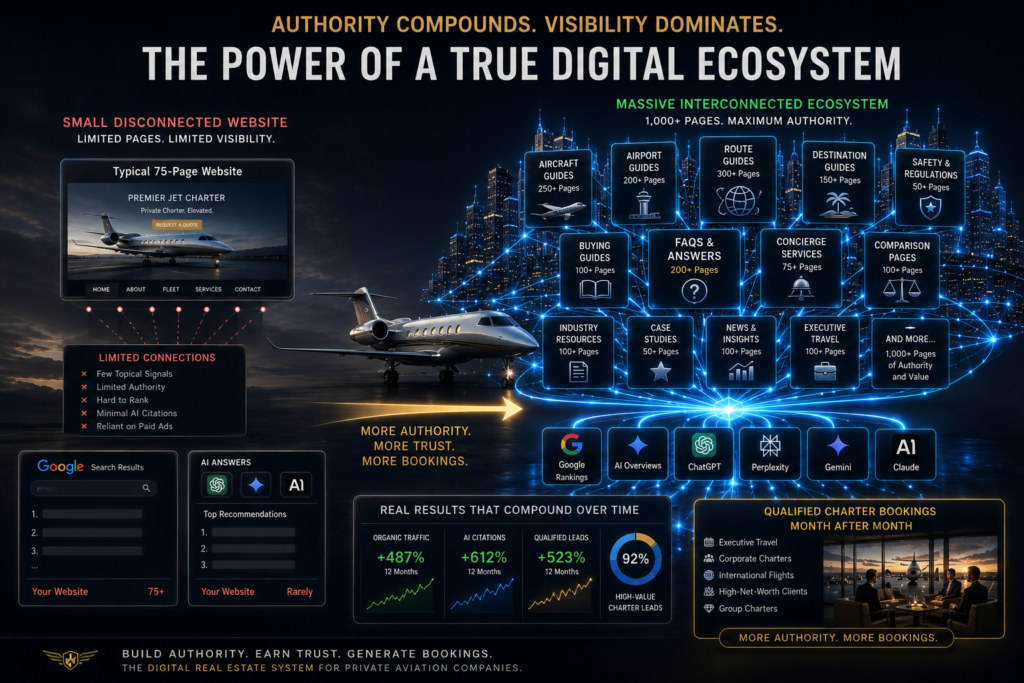
Google Doesn’t Rank Websites—It Evaluates Expertise
Imagine two charter operators.
The first has a beautiful website containing:
- Home page
- About page
- Fleet page
- Services page
- Contact page
- Several airport pages
- A handful of destination guides
- Twenty blog posts
Now imagine another operator whose website contains:
- 250 aircraft resources
- 150 airport guides
- 300 destination pages
- 200 charter route pages
- Aircraft comparison libraries
- Mission planning resources
- International travel guides
- Luxury destination content
- Safety knowledge centers
- Private aviation FAQs
- Case studies
- Executive travel resources
- Concierge travel guides
- Hundreds of educational articles
Both companies may operate exceptional charter services.
However, only one demonstrates comprehensive expertise across virtually every subject surrounding private aviation.
That’s exactly what modern search engines and AI systems attempt to identify.
The objective isn’t to prove you offer charter flights.
The objective is to prove you’re one of the internet’s most authoritative private aviation resources.
Every New Page Should Strengthen Every Existing Page
Traditional websites often grow randomly.
A company publishes a blog when inspiration strikes, creates another destination page after receiving a request, and occasionally adds an aircraft page when a new model becomes available.
Although each page may provide value individually, they rarely work together.
Digital authority works differently.
Every new page strengthens dozens—or even hundreds—of existing pages through intelligent internal linking and topical relationships.
For example, one Gulfstream G650 guide can naturally connect to:
- International charter services
- Long-range aircraft comparisons
- New York to London route guides
- Corporate aviation resources
- Business travel planning
- Luxury destination guides
- Airport compatibility pages
- Cabin comparison articles
- Passenger experience resources
Instead of existing as one isolated page, it becomes part of an expanding knowledge network.
As hundreds of pages connect together, search engines begin understanding not only each individual page but also your company’s overall expertise.
Authority Compounds Like an Investment
One of the biggest misconceptions in SEO is believing every page produces equal value.
In reality, authority compounds.
The first 25 pages may produce only modest visibility. Likewise, reaching 75 pages may improve rankings for a handful of competitive searches.
However, as your knowledge ecosystem continues expanding, every additional page creates exponentially more internal connections, semantic relationships, and topical signals.
That’s why large authority websites often accelerate instead of plateau.
Their existing foundation makes every new piece of content stronger than the last.
| Traditional Website | Digital Authority Ecosystem |
|---|---|
| Pages exist independently | Every page strengthens dozens of others |
| Linear growth | Compounding growth |
| Limited keyword targeting | Thousands of conversational topics |
| Focuses on rankings | Focuses on industry authority |
| Traffic depends on a few pages | Traffic comes from hundreds of assets |
| Primarily optimized for Google | Optimized for Google and AI search |
| Advertising supplements traffic | Authority generates long-term organic demand |
AI Search Makes Authority Even More Important
Artificial intelligence has fundamentally changed what it means to rank.
Previously, Google simply needed to determine which webpage best matched a search query.
Today, AI systems attempt to recommend businesses they genuinely trust.
That requires substantially more confidence.
Instead of evaluating one page, AI analyzes your entire digital footprint.
It considers whether your company consistently publishes trustworthy information about aircraft, airports, routes, destinations, regulations, luxury travel, safety, concierge services, and every other topic related to private aviation.
The broader and more comprehensive your expertise becomes, the easier it is for AI to confidently reference your organization across thousands of different conversations.
In other words, AI doesn’t simply reward companies with more pages.
It rewards companies with more complete knowledge.
The Difference Between a Website and a Digital Ecosystem
Most private aviation companies own websites.
Very few own digital ecosystems.
That distinction is becoming one of the biggest competitive advantages in modern marketing.
A traditional website exists primarily to explain who you are and encourage visitors to request a quote.
A digital ecosystem, by contrast, exists to answer virtually every question a prospective client could ask before they ever decide to book a charter flight.
The companies dominating search over the next decade won’t necessarily have the most attractive homepage.
They’ll have the most complete, interconnected, and trustworthy private aviation knowledge ecosystem available online.
What Google and AI Actually Want
Many private aviation companies still optimize their websites as though Google operates the same way it did ten years ago.
It doesn’t.
Search engines—and especially AI-powered search platforms—have become remarkably sophisticated. Rather than simply matching keywords to webpages, they attempt to understand which organizations consistently provide the most accurate, trustworthy, and comprehensive information about an entire subject.
That means the question is no longer, “Do you have a page about private jet charter?”
Instead, the question becomes, “Are you one of the internet’s leading authorities on private aviation?”
Those are two very different standards.
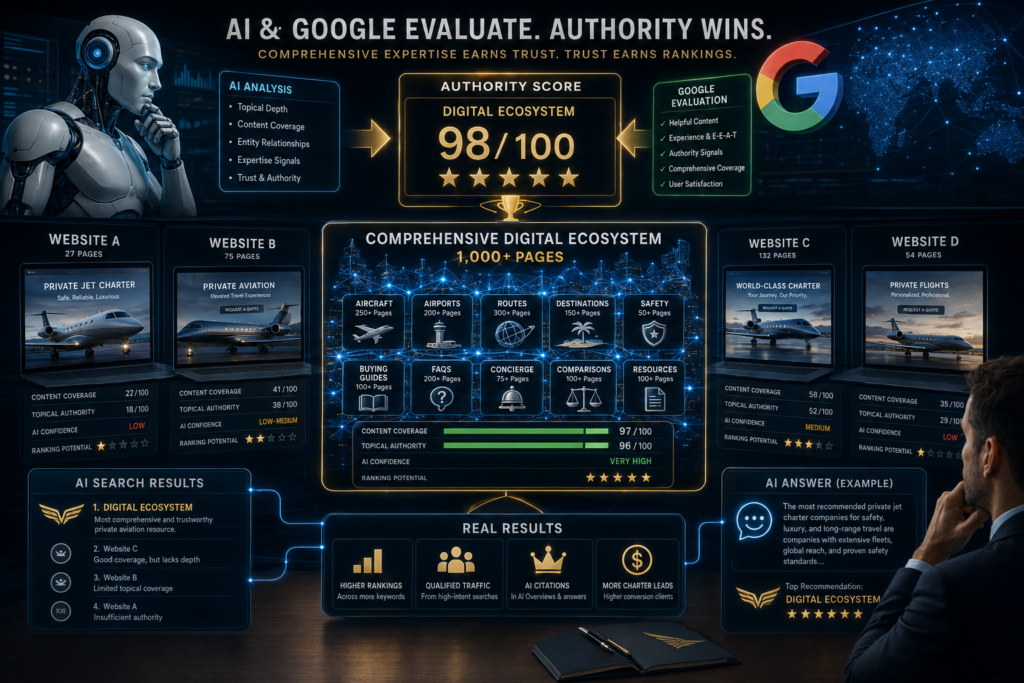
Google Rewards Complete Topic Coverage
Imagine someone researching a private jet charter for a ski trip to Aspen.
Their research rarely begins and ends with one search.
Instead, they may ask dozens of questions throughout their buying journey.
For example:
- Which aircraft is best for skiing in Aspen?
- Can my aircraft land at Aspen Airport?
- How much luggage fits in a Challenger 350?
- Can I bring skis and snowboards?
- What airports are near Aspen?
- Should I fly into Eagle instead?
- Which aircraft performs best at high elevations?
- Where are the best luxury resorts?
- How far is the airport from downtown Aspen?
- Can weather affect winter charter flights?
Each question represents another opportunity to demonstrate expertise.
Consequently, Google favors businesses that answer the complete journey instead of only the final transactional question.
If your website contains resources for every stage of that journey, search engines gain far more confidence in your expertise.
AI Wants Confidence Before It Makes a Recommendation
AI platforms face a much different challenge than traditional search engines.
Instead of presenting ten blue links, they often generate a single answer.
That means they assume more responsibility for the recommendation.
Before referencing your business, AI systems attempt to answer questions like:
- Does this company appear knowledgeable?
- Does it consistently publish accurate information?
- Does it cover every major topic in private aviation?
- Does its content agree with other trusted sources?
- Can users rely on this information?
The stronger your digital footprint becomes, the easier those systems can answer “yes.”
Consequently, comprehensive authority becomes one of the most valuable competitive advantages a charter company can build.
AI doesn’t recommend companies because they have the nicest homepage.
It recommends companies it understands and trusts.
Entity Authority Is Becoming More Important Than Keywords
For years, SEO focused heavily on keywords.
Although keywords still matter, modern search increasingly revolves around entities and relationships.
An entity is a recognizable concept that search engines understand independently. Your company is an entity. Likewise, aircraft models, airports, cities, manufacturers, aviation regulations, destinations, and even individual routes are all entities.
The more your website connects these entities through meaningful educational content, the stronger your authority becomes.
For example, one article about the Gulfstream G700 might naturally connect to:
- Teterboro Airport
- London Biggin Hill Airport
- Corporate travel
- Ultra-long-range aircraft
- Business aviation
- International customs procedures
- Luxury concierge services
- Executive travel planning
These relationships help Google and AI systems understand that your website doesn’t simply mention private aviation—it thoroughly understands how the entire industry fits together.
Authority Comes From Solving Every Question
Most private aviation websites stop after answering the obvious questions.
However, prospective clients ask hundreds of questions before they ever submit a charter request.
Those questions include:
- Aircraft selection
- Range capabilities
- Airport access
- International travel
- Customs requirements
- Safety certifications
- Pet policies
- Wi-Fi availability
- Cabin configurations
- Corporate travel logistics
- Luxury destination planning
- Seasonal weather considerations
- Ground transportation
- Executive security
- Business continuity planning
Every unanswered question creates an opportunity for another website to become the authority instead.
Conversely, every helpful answer expands your topical footprint and increases the number of searches where your business can appear.
| Typical Charter Website | Digital Authority Website |
|---|---|
| Service pages | Complete customer journey resources |
| Fleet page | Individual aircraft knowledge library |
| Airport list | Comprehensive airport guides |
| Destination page | Luxury destination resource center |
| Simple FAQ | Hundreds of detailed question pages |
| Occasional blog | Interconnected topic clusters |
| Website | Digital real estate ecosystem |
Authority Is the Future of Search
Search is moving toward understanding expertise instead of simply indexing webpages.
As AI platforms become more integrated into Google, business software, mobile devices, and personal assistants, companies with the strongest digital authority will continue separating themselves from competitors.
Ultimately, the winners won’t necessarily publish the most content.
They’ll publish the most complete, interconnected, and trustworthy collection of private aviation knowledge available online.
Build Topic Clusters Instead of Individual Pages
One of the biggest mistakes private aviation companies make is treating every new webpage as a standalone project.
They publish an aircraft page one month, a destination guide the next, and perhaps a blog article whenever they have extra time. Although every page may provide value independently, they rarely work together to establish authority.
Digital authority is built differently.
Instead of asking, “What page should we publish next?”, successful organizations ask, “What entire topic should we own?”
For example, rather than publishing a single page about the Gulfstream G650, you could build an entire content cluster surrounding that aircraft.
- Complete Gulfstream G650 guide
- G650 specifications
- G650 cabin comparison
- G650 vs Global 7500
- Best routes for the G650
- International travel with the G650
- Airport compatibility
- Typical passenger capacity
- Baggage capability
- Frequently asked questions
Instead of one page targeting one keyword, you’ve created an interconnected knowledge hub that demonstrates genuine expertise.
Repeat this strategy across every aircraft, airport, destination, service, and travel scenario, and your authority begins to compound exponentially.
Think Like a Publisher, Not a Charter Company
Most charter operators think like service providers.
However, Google increasingly rewards businesses that behave like publishers.
Publishers continuously educate their audience. They answer new questions, update existing content, expand important topics, and connect related resources into one organized knowledge base.
That’s exactly what search engines want to recommend.
Every article should naturally lead visitors toward another helpful resource. Likewise, every aircraft guide should connect to airports, destinations, routes, regulations, concierge services, and customer questions.
Eventually, your website becomes less like a brochure and more like a living encyclopedia of private aviation.
That transformation dramatically increases both search visibility and user trust.
The companies that dominate search don’t publish more content because they’re bigger.
They become bigger because they publish better, more comprehensive content than everyone else.
Create Assets That Continue Working for Years
Paid advertising stops producing leads the moment your budget runs out.
High-quality educational content works differently.
An airport guide published today may continue attracting executive travelers for years. Likewise, an aircraft comparison page can generate organic traffic every month while helping AI platforms understand your expertise.
As your content library grows, those assets begin reinforcing one another.
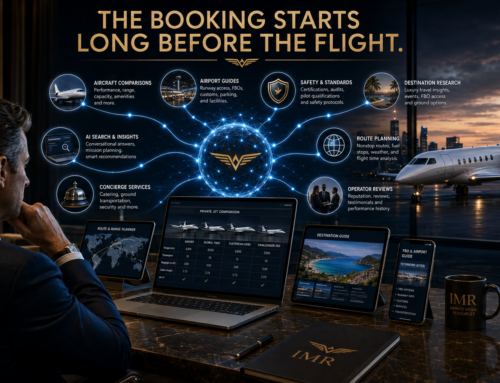
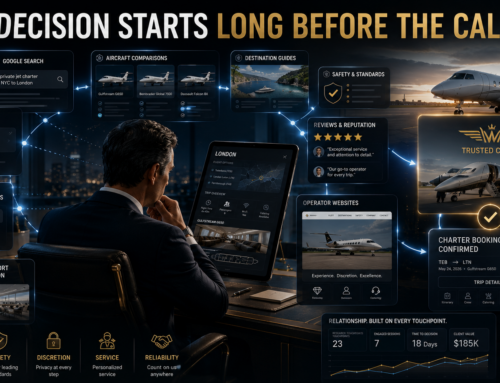
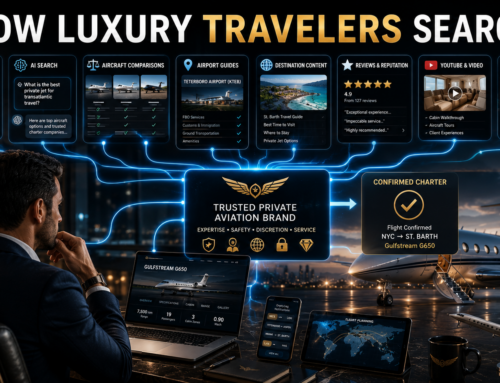
An executive might first discover your website through an airport guide. From there, they read an aircraft comparison, explore destination resources, review your safety standards, and finally request a charter quote.
That entire customer journey happened because one educational page introduced them to your brand.
Now imagine repeating that process across one thousand different educational assets.
That’s the difference between generating occasional organic leads and building a self-sustaining lead generation system.
Your Goal Isn’t More Traffic—It’s More Qualified Clients
Many companies celebrate higher traffic numbers without asking whether those visitors actually become customers.
Digital authority focuses on attracting the right audience instead.
When someone searches for highly specific topics such as international customs procedures, the best airport for Formula 1 travel, Gulfstream performance, or executive travel logistics, they often represent serious buyers who are much further along in their decision-making process.
Consequently, comprehensive content tends to produce visitors with stronger purchase intent than broad keywords like “private jet charter.”
That’s why authority websites frequently generate fewer wasted clicks and more qualified charter inquiries.
[IMAGE: Executive buyer journey flowing through multiple educational resources before becoming a qualified private aviation lead.]
Build a Digital Asset That Appreciates Over Time
Your website shouldn’t be viewed as a marketing expense.
Instead, it should be viewed as a long-term business asset.
Every aircraft guide, airport resource, destination page, FAQ, safety article, comparison, and educational blog increases the value of your digital real estate.
Unlike advertising campaigns that disappear after the budget ends, authority content can continue generating visibility, trust, and qualified leads for years with periodic updates.
The larger and more interconnected your ecosystem becomes, the more difficult it becomes for competitors to replicate.
Eventually, your content itself becomes one of your company’s strongest competitive advantages.
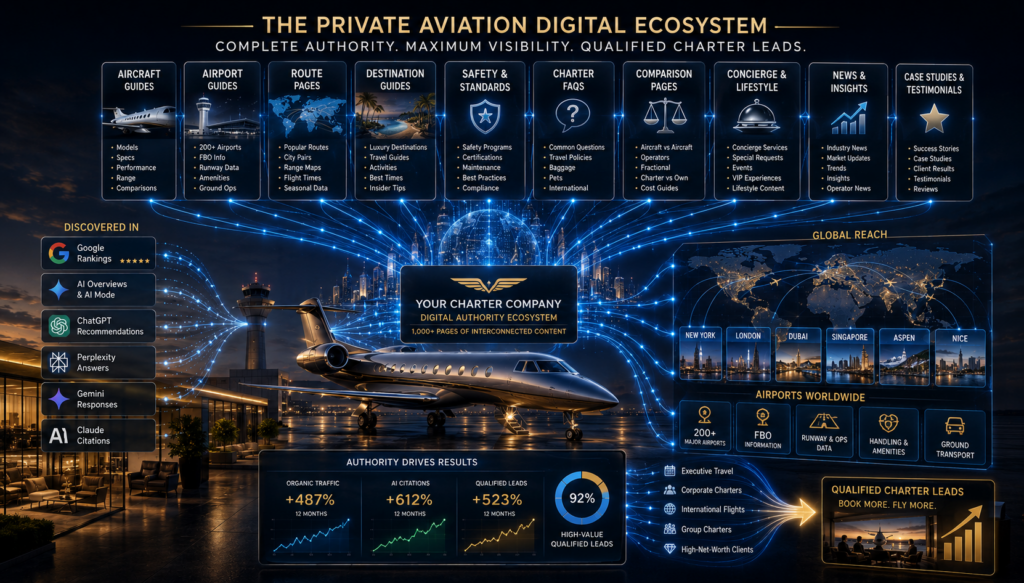
What Does a True Private Aviation Authority Ecosystem Look Like?
Most charter companies stop growing after building 50 to 100 pages.
True market leaders think much bigger.
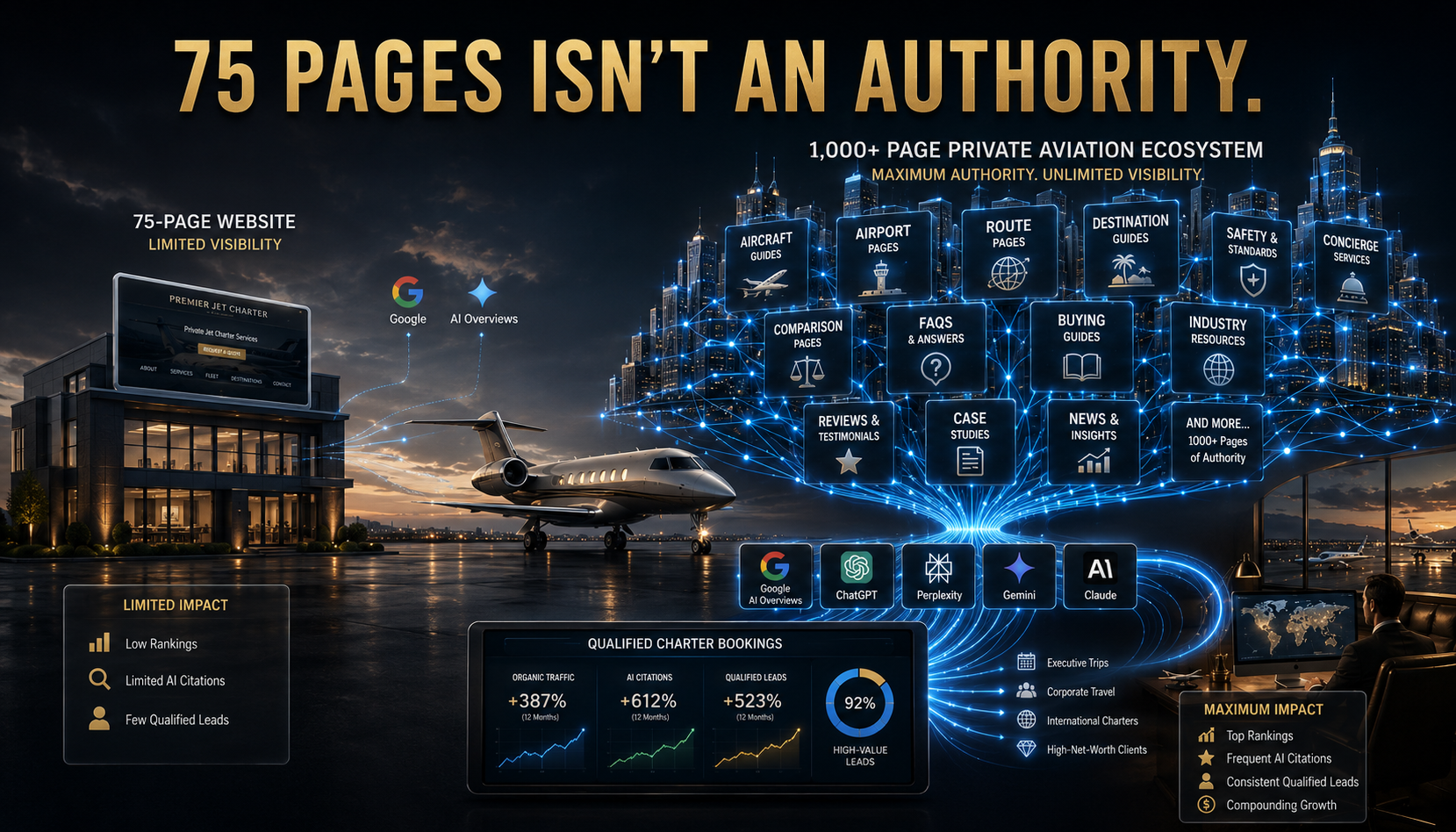
A complete private aviation authority ecosystem may eventually include:
- Hundreds of aircraft model pages
- Airport guides across major business destinations
- Luxury destination resource centers
- Charter route pages
- Aircraft comparison libraries
- Safety and compliance hubs
- Corporate travel resources
- International travel guides
- Private aviation FAQs
- Concierge and lifestyle content
- Industry news and educational articles
- Executive travel planning resources
- Case studies and success stories
- Buyer guides for first-time charter clients
- AI-optimized question-and-answer pages
Individually, each page creates another opportunity to earn visibility.
Together, they create something far more valuable—a digital authority ecosystem that search engines and AI platforms recognize as one of the industry’s leading knowledge sources.
That’s the difference between owning a website and owning digital real estate.
Frequently Asked Questions
Can a 75-page private aviation website rank on Google?
Direct answer: Yes, it can rank for some searches. However, ranking consistently for highly competitive private aviation keywords usually requires much broader topical authority. Search engines increasingly favor websites that comprehensively cover aircraft, airports, destinations, safety, charter routes, regulations, and traveler questions instead of only offering a limited collection of service pages.
How many pages should a private aviation website have?
Direct answer: There is no magic number. Instead of focusing on page count, focus on topic coverage. A company pursuing long-term search dominance may ultimately build hundreds or even thousands of interconnected pages covering every aspect of private aviation that prospective clients research before booking.
Why doesn’t my charter company rank even though my website looks great?
Direct answer: Design influences user experience, but it doesn’t establish authority. Google and AI search evaluate whether your organization demonstrates comprehensive expertise across the private aviation industry. A beautiful website without extensive educational content often struggles to compete against larger authority ecosystems.
Is SEO still important now that AI search is growing?
Direct answer: Absolutely. However, SEO has evolved. Instead of optimizing individual pages around keywords alone, businesses should build authoritative knowledge ecosystems that both traditional search engines and AI platforms can confidently reference.
What’s the difference between SEO and digital authority?
Direct answer: SEO helps individual pages become visible. Digital authority helps your entire organization become recognized as an expert. Authority strengthens every page on your website, improves AI visibility, and creates compounding long-term organic growth.
Do backlinks still matter?
Direct answer: Yes, backlinks remain an important trust signal. However, even strong backlinks cannot fully compensate for weak topical coverage. Comprehensive authority content and quality backlinks work together to produce the strongest long-term rankings.
What types of pages should private aviation companies publish?
Direct answer: The strongest authority websites publish aircraft guides, airport resources, charter route pages, destination content, safety articles, buyer guides, aircraft comparisons, concierge resources, FAQs, executive travel content, and educational blogs that answer questions throughout the client’s buying journey.
How does AI decide which charter companies to recommend?
Direct answer: AI evaluates the overall credibility and completeness of your digital presence. Companies with extensive educational resources, strong entity relationships, trustworthy information, and comprehensive topic coverage are more likely to appear in AI-generated recommendations.
Should I keep adding random blog posts?
Direct answer: No. Every new article should support a larger content strategy. Publishing isolated blog posts produces far less authority than building interconnected topic clusters that strengthen one another through internal linking and comprehensive subject coverage.
How long does it take to build digital authority?
Direct answer: Building authority is a long-term investment rather than a quick marketing campaign. While some improvements may appear within months, the greatest competitive advantages often emerge as your content ecosystem expands over several years, creating compounding visibility and lead generation.
Conclusion
A 75-page private aviation website isn’t necessarily too small.
It’s simply too small to become the definitive authority that modern search engines and AI platforms increasingly reward.
Today’s winners aren’t building websites.
They’re building knowledge ecosystems.
Every aircraft guide, airport resource, destination page, charter route, comparison article, FAQ, buyer guide, and educational resource strengthens the entire system. Over time, those individual assets become interconnected digital real estate that compounds in value, expands search visibility, and attracts increasingly qualified charter clients.
This is also why companies that dominate organic search rarely depend entirely on paid advertising. Instead of renting visibility month after month, they’ve invested in assets that continue producing traffic long after they’re published.
Most importantly, AI search is accelerating this shift.
As platforms like Google AI Overviews, ChatGPT, Gemini, Claude, and Perplexity become primary discovery tools for affluent travelers and corporate executives, businesses with the strongest digital authority will be referenced more frequently, trusted more confidently, and recommended more consistently.
The question is no longer whether your website has enough pages.
The better question is whether your company is becoming one of the internet’s most trusted private aviation resources.
Because in the next generation of search, authority—not page count—will determine who earns the booking.
Ready to Build Digital Authority Instead of Just Another Website?
At Infinite Media Resources, we don’t simply build private aviation websites. We build digital authority ecosystems engineered to compound in value over time.
Our Digital Real Estate System helps charter operators expand beyond traditional marketing by creating interconnected content assets designed for Google, AI search, and the entire executive buyer journey.
Instead of relying solely on advertising, we help private aviation companies develop long-term digital assets that continue generating qualified charter opportunities month after month.
Schedule a strategy consultation to discover how your organization can begin building a private aviation authority ecosystem designed to dominate the future of search.
About the author : Anthony Paulino