The Biggest SEO Mistakes Home Service Companies Make (And How to Fix Them)
Most home service companies don’t struggle with SEO because Google is unfair.
They struggle because they’re solving the wrong problem.
When rankings drop or lead volume slows, many contractors immediately redesign their website, buy more backlinks, publish a few blog posts, or hire another SEO company promising first-page rankings within weeks. Although those tactics may produce temporary improvements, they rarely address the underlying reason the website fails to become a consistent lead-generation asset.
The biggest SEO mistakes home service companies make are usually structural rather than tactical.
Many businesses build websites instead of digital ecosystems. They optimize a handful of pages while ignoring hundreds of homeowner questions. They chase rankings instead of authority. They publish content for search engines instead of real people. Consequently, they remain dependent on paid advertising, purchased leads, referrals, or seasonal demand because organic visibility never compounds the way it should.
Meanwhile, the contractors dominating local search often aren’t winning because they have secret SEO techniques.
They’re winning because they consistently create more useful content, demonstrate deeper expertise, build stronger local authority, answer homeowner questions better, organize their websites intelligently, and continue expanding those assets year after year.
As AI search becomes increasingly important, these differences become even more significant. Search engines and AI platforms reward organizations that demonstrate comprehensive expertise across entire topics rather than isolated keyword optimization.
The companies fixing these mistakes today are building digital assets that may continue generating homeowner leads for years.
The companies ignoring them will likely find themselves purchasing increasingly expensive advertising simply to remain visible.
Direct Answer
The biggest SEO mistakes home service companies make include building thin websites, creating weak service pages, ignoring local SEO, failing to answer homeowner questions, publishing low-value content, neglecting internal linking, overlooking technical SEO, depending entirely on paid leads, and failing to prepare for AI search. Companies that correct these issues create stronger digital authority, higher search visibility, and more consistent long-term lead generation.
The Biggest SEO Mistake Happens Before SEO Even Begins
Most contractors believe SEO starts after the website launches.
In reality, SEO begins with how the website is planned.
A company that launches with ten pages has already limited how much expertise it can demonstrate. Although those pages may describe the business, they rarely answer enough homeowner questions to become the dominant resource within the market.
Consider a roofing company serving fifteen cities.
If the website contains only one roofing page and one contact page, it ignores hundreds of searches homeowners perform every month. Those homeowners aren’t searching only for “roofing contractor.”
They’re searching for:
- Roof replacement cost
- Hail damage roof inspection
- Roof repair vs replacement
- Architectural shingles vs metal roofing
- Insurance claim roofing process
- Roof ventilation problems
- Emergency roof leak repair
- Roof financing options
- Best roofer in their city
- Warranty comparisons
Each of those searches represents a different stage of the homeowner journey.
Each deserves its own resource.
When those resources do not exist, competitors become the educators, the trusted experts, and ultimately the companies receiving the estimate requests.
The biggest SEO mistake isn’t poor optimization.
It’s building too little digital real estate.
This principle applies to every home service industry, including roofing, HVAC, plumbing, electrical, remodeling, landscaping, pest control, concrete, painting, flooring, and dozens of others.
The companies winning organic search rarely have better keywords.
They simply answer far more homeowner questions than everyone else.
Mistake #1: Treating Your Website Like a Digital Brochure Instead of a Lead Generation System
This is easily the most common SEO mistake home service companies make.
Most contractor websites are designed to explain the business.
Very few are designed to dominate homeowner searches.
A typical contractor website contains:
- Home
- About
- Services
- Gallery
- Reviews
- Contact
That’s enough information for someone who already knows the company exists.
It is nowhere near enough information to become the authority Google or AI platforms recommend when homeowners begin researching.
Today’s homeowner journey is significantly more complicated.
Before requesting an estimate, homeowners often ask dozens of questions.
- How much does this project cost?
- Should I repair or replace it?
- What material is best?
- Which brands are worth buying?
- What should I expect during installation?
- How long will the project take?
- How do I compare contractors?
- What warranties matter?
- What financing options exist?
- What questions should I ask before hiring?
If your website answers none of these questions, Google must send homeowners somewhere else.
That “somewhere else” is usually your competitor.
Instead of viewing the website as an online brochure, contractors should think of it as a digital salesperson that educates homeowners twenty-four hours a day.
The more useful information it provides, the more opportunities Google has to recommend it.
Brochure websites explain the company.
Authority websites educate the customer.
This philosophy also aligns with Google’s recommendations for publishing helpful, people-first content that genuinely answers user questions instead of simply targeting keywords.
Mistake #2: Targeting Too Few Keywords
Many SEO campaigns begin by choosing ten or twenty “important keywords.”
While that approach may have worked years ago, modern search behavior has become dramatically more complex.
Homeowners rarely perform only one search before hiring a contractor.
Instead, they perform dozens.
For example, someone replacing an HVAC system might search:
- Best HVAC company near me
- AC replacement cost
- Heat pump vs furnace
- How long do HVAC systems last?
- Best HVAC brands
- Signs my furnace is failing
- SEER ratings explained
- HVAC financing
- Questions to ask an HVAC contractor
- Energy-efficient HVAC options
Every one of these searches represents another opportunity to earn trust.
However, many contractors optimize only one HVAC service page.
That single page cannot realistically answer every one of those questions in enough depth to compete against dedicated resources.
The companies dominating organic search understand this.
Rather than chasing one keyword, they build topical authority.
| Old SEO Approach | Authority-Based SEO Approach |
|---|---|
| One service page | Complete service hub with supporting pages |
| Ten keywords | Hundreds of homeowner searches |
| Ranking individual pages | Owning entire topics |
| Short-term optimization | Long-term digital asset growth |
| Traffic focus | Homeowner education focus |
Instead of asking, “What keywords should we target?” contractors should ask:
“What questions does every homeowner ask before buying our service?”
That single shift often leads to hundreds of future content opportunities that collectively create far greater authority than one optimized landing page ever could.
This strategy also supports AI search because comprehensive topical coverage gives AI systems more evidence that your company understands the subject thoroughly.
Mistake #3: Ignoring the Complete Homeowner Journey
Another major SEO mistake home service companies make is focusing only on homeowners who are ready to request estimates today.
Unfortunately, that’s only a small percentage of potential customers.
Most homeowners spend days—or even months—researching before contacting anyone.
During that time they compare products, learn terminology, estimate costs, evaluate financing, read reviews, compare contractors, and gather recommendations.
If your website appears only when they’re ready to request an estimate, you’ve already missed dozens of opportunities to build trust.
Successful SEO follows the homeowner through every stage.
| Homeowner Stage | SEO Opportunity |
|---|---|
| Problem awareness | Educational blogs |
| Solution research | Comparison pages |
| Cost evaluation | Pricing guides |
| Contractor comparison | Case studies and reviews |
| Purchase decision | Service pages |
| After the project | Maintenance resources |
Notice something important.
The service page appears near the end.
Yet many contractor websites contain only service pages.
Consequently, competitors educate the homeowner throughout the research journey while your company enters the conversation only after trust has already been established elsewhere.
This is precisely why IMR recommends building comprehensive digital real estate ecosystems rather than isolated SEO pages. Every article, FAQ, comparison page, city page, project case study, and educational guide supports the others through strategic internal linking while answering another homeowner question.
Instead of competing for one search, your business begins participating in the homeowner’s entire decision-making process.
Our guide on The Digital Real Estate Strategy Every Contractor Should Build explains this ecosystem approach in much greater detail.
Mistake #4: Treating Local SEO as Only a Google Business Profile
Ask many contractors what local SEO means, and they’ll immediately mention Google Business Profile.
Although your Business Profile remains extremely important, local SEO extends much further.
Google evaluates an entire collection of local signals when determining which contractors deserve visibility.
Those signals include:
- Service-area pages
- City-specific content
- Location relevance
- Reviews
- Business consistency
- Project locations
- Locally relevant backlinks
- Structured data
- Internal linking
- Helpful local resources
For example, imagine a plumbing company serving twenty cities.
Many websites simply list those cities inside one paragraph.
Meanwhile, a stronger competitor creates dedicated city pages explaining common plumbing issues, local water conditions, neighborhood examples, emergency services, financing options, completed projects, and frequently asked questions specific to each service area.
Which company appears more useful?
Google’s local ranking documentation emphasizes relevance, prominence, and distance—not merely business listings. A complete local ecosystem provides substantially stronger relevance than a single paragraph listing city names.
Local SEO is not one listing.
It’s an entire network of local authority.
When local pages, service pages, reviews, case studies, blogs, FAQs, and internal links reinforce one another, search engines gain much stronger evidence that your company genuinely serves those communities.

Mistake #5: Building Weak Internal Links
One of the most overlooked SEO mistakes isn’t visible to homeowners at all.
It’s how your pages connect to one another.
Many contractor websites treat every page like an island. A visitor lands on a service page, reads for a few minutes, and then leaves because there is nowhere else to go.
Google experiences the same problem.
Internal links help search engines understand how pages relate to one another, which topics your company specializes in, and which pages deserve the most authority.
Unfortunately, many home service websites contain little more than a navigation menu and a contact button.
That wastes tremendous SEO potential.
Imagine a homeowner reading a roof replacement guide.
That page should naturally guide them toward related information, including:
- Roof replacement cost guides
- Roof financing options
- Insurance claim resources
- Roof repair comparisons
- Local city service pages
- Completed roofing projects
- Roof material comparison articles
- Warranty explanations
- Frequently asked questions
- Estimate request page
Each additional page keeps visitors engaged while reinforcing your topical authority.
Instead of dozens of disconnected pages, your website becomes one interconnected knowledge network.
| Weak Website | Authority Website |
|---|---|
| Pages rarely connect | Every page supports related topics |
| Few user pathways | Multiple educational journeys |
| Low crawl efficiency | Strong crawlability |
| Minimal topic reinforcement | High topical authority |
| Higher bounce rates | Longer engagement |
Internal links also prepare your website for AI search.
When related content consistently references supporting resources, AI systems gain a clearer understanding of your expertise across an entire subject instead of viewing every article independently.
Every page should answer one question.
Every page should also lead naturally to the next question.
Mistake #6: Publishing Thin Service Pages
Many contractor websites contain service pages that are only a few hundred words long.
Although those pages describe the service, they rarely become the best resource available on the topic.
Search engines have access to thousands of competing pages.
If yours contains only basic marketing language, there is little reason for Google to recommend it over stronger alternatives.
A truly comprehensive service page should answer nearly every question a homeowner has before contacting your company.
Instead of simply describing what you do, explain:
- How the service works
- Signs homeowners need the service
- Repair versus replacement decisions
- Typical timelines
- Cost considerations
- Materials and product options
- Maintenance recommendations
- Common misconceptions
- Frequently asked questions
- What makes your process different
As the page grows more helpful, it naturally becomes useful for additional searches without forcing keywords into the copy.
This is especially important because homeowners increasingly ask conversational questions rather than typing short keyword phrases.
Consequently, pages that provide complete answers tend to perform better across both traditional search engines and AI-powered search experiences.
Instead of creating ten average service pages, focus on building ten definitive resources that homeowners actually bookmark and share.
Mistake #7: Ignoring AI Search and Answer Engines
Search behavior is changing faster than many contractors realize.
Increasingly, homeowners receive answers directly from AI platforms before they ever visit a website.
Whether they use Google AI Overviews, ChatGPT, Perplexity, or another AI-powered search experience, people expect complete, trustworthy answers immediately.
That means ranking well in traditional search is no longer the entire goal.
Your content must also be understandable, trustworthy, well-structured, and comprehensive enough for AI systems to reference confidently.
Companies that continue writing solely for old-style keyword rankings may gradually lose visibility as AI becomes a larger part of the search journey.
Fortunately, the same practices that build excellent SEO often strengthen AI visibility as well.
| Traditional SEO | AI Search Optimization |
|---|---|
| Keywords | Comprehensive answers |
| Individual pages | Complete topic coverage |
| Ranking pages | Building trusted entities |
| Backlinks | Authority, clarity, and citations |
| Traffic focus | Answer visibility and trust |
Rather than replacing SEO, AI search builds upon it.
Contractors with well-organized content libraries, strong internal linking, structured data, local authority, and genuine expertise are significantly better positioned as search continues evolving.
At Infinite Media Resources, we refer to this broader strategy as Generative Engine Optimization (GEO), which prepares businesses for visibility across both search engines and AI-generated answers.
The future isn’t SEO versus AI.
The future belongs to companies that optimize for both.
Mistake #8: Expecting SEO to Produce Instant Results
Perhaps the most expensive SEO mistake isn’t technical at all.
It’s unrealistic expectations.
Many contractors begin investing in SEO expecting dramatic ranking improvements within a few weeks.
When those results don’t arrive immediately, they switch agencies, abandon the strategy, or move all of their budget back into paid advertising.
Unfortunately, that’s exactly when long-term growth is usually beginning.
SEO behaves much more like building commercial real estate than purchasing advertisements.
Each page, article, guide, city resource, project case study, FAQ, and service page becomes another digital asset working for the business every day.
Unlike advertising, those assets continue attracting homeowners long after they are published.
| Paid Advertising | SEO Digital Assets |
|---|---|
| Traffic stops when spending stops | Traffic compounds over time |
| Constant acquisition cost | Declining acquisition cost |
| Short-term visibility | Long-term authority |
| Rents attention | Owns attention |
The contractors dominating search today rarely reached that position overnight.
Instead, they consistently invested in content, local authority, technical improvements, and homeowner education year after year.
SEO rewards consistency far more than occasional bursts of activity.

Mistake #9: Neglecting Technical SEO and Website Performance
Even excellent content can struggle when the website underneath it performs poorly.
Technical SEO determines whether search engines can efficiently crawl, understand, index, and rank your pages. At the same time, website performance shapes whether homeowners remain long enough to read those pages and request service.
Unfortunately, many home service websites carry years of technical problems.
Common issues include:
- Slow page-loading speeds
- Oversized images and videos
- Broken internal links
- Duplicate pages
- Missing canonical tags
- Incorrect redirects
- Poor mobile layouts
- Pages blocked from indexing
- Weak heading structures
- Missing structured data
- Unclear URL architecture
- Outdated plugins and scripts
These issues often accumulate gradually. Therefore, the website may look acceptable to the business owner while quietly becoming harder for search engines and homeowners to use.
Mobile performance matters especially for home service companies because many urgent searches happen on smartphones.
A homeowner dealing with a leaking roof, failed furnace, overflowing drain, electrical problem, or broken air conditioner will not wait patiently for a slow website. Instead, the homeowner will return to the search results and contact another company.
| Technical Problem | Potential Business Effect |
|---|---|
| Slow mobile pages | More visitors leave before contacting the company |
| Broken links | Users and search engines reach dead ends |
| Duplicate content | Multiple pages compete for the same topic |
| Poor site architecture | Important pages receive less internal authority |
| Missing structured data | Search systems receive less contextual information |
| Indexing errors | Valuable pages may never appear in search |
However, technical SEO should not become an excuse to avoid publishing useful content.
A perfectly optimized five-page website still cannot demonstrate the same authority as a technically sound website containing hundreds of valuable, interconnected resources.
Therefore, contractors need both.
They need a strong technical foundation and a growing content ecosystem built around real homeowner needs.
Technical SEO makes your digital assets accessible.
Useful content makes those assets worth discovering.
Mistake #10: Measuring Rankings Instead of Revenue
Rankings matter, but they are not the final business objective.
Home service companies invest in SEO to generate profitable projects, increase market share, reduce dependence on purchased leads, and build a long-term customer acquisition asset.
Nevertheless, many SEO reports focus almost entirely on:
- Keyword positions
- Impressions
- Website traffic
- Backlink counts
- Domain authority scores
Those metrics can help diagnose performance. However, none of them proves that SEO creates profitable growth.
A contractor could rank for hundreds of low-value terms while generating few qualified inquiries. Conversely, another contractor could attract less traffic while producing more high-ticket projects because its content reaches homeowners with stronger purchasing intent.
Therefore, SEO measurement must connect visibility to actual business outcomes.
| SEO Metric | Business Question |
|---|---|
| Organic visibility | Are more homeowners discovering the company? |
| Service-page traffic | Are visitors researching profitable services? |
| Conversion rate | Are visitors requesting estimates or calling? |
| Qualified leads | Do inquiries match the ideal project profile? |
| Booked jobs | How many organic leads become customers? |
| Average project value | What revenue does organic search influence? |
| Customer acquisition cost | How efficiently does SEO create customers? |
| Lifetime value | How much long-term value does each customer create? |
Contractors should also examine assisted conversions.
A homeowner may first discover the company through an educational article, return through a branded Google search, read a city page, review completed projects, click a retargeting advertisement, and finally call from the Google Business Profile.
Last-click reporting may credit only the final interaction. However, SEO helped create trust throughout the journey.
Consequently, companies that measure only form submissions directly attributed to organic search often underestimate the real value of their content.
The strongest measurement systems connect analytics, call tracking, form submissions, CRM records, estimates, booked jobs, project revenue, and customer lifetime value.
That connection allows the company to identify which services, locations, questions, and content themes generate the most profitable customers.
Traffic is activity.
Qualified revenue is the result.
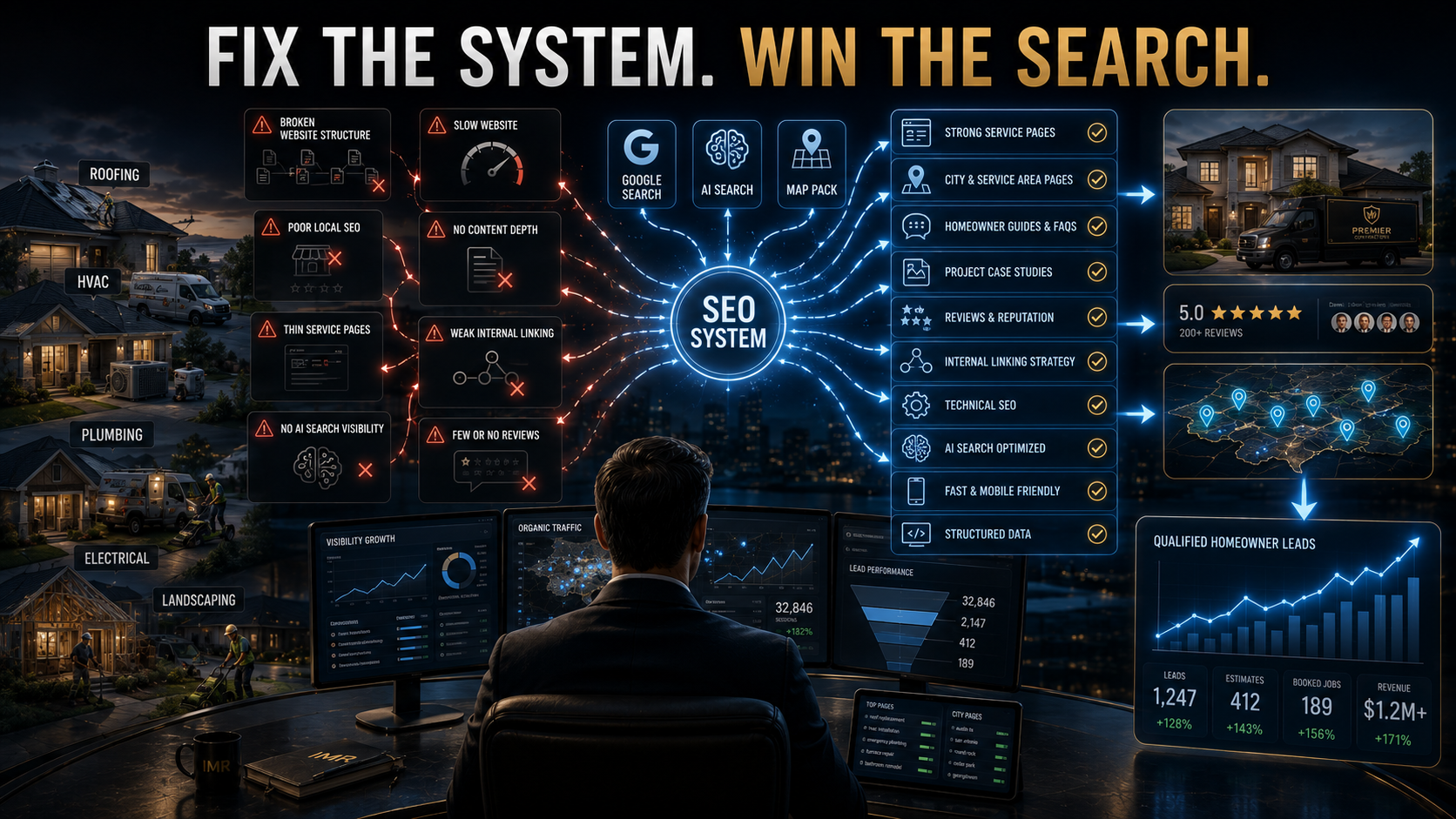
What a Strong Home Service SEO System Should Include
Fixing one mistake may improve performance. However, home service companies create the greatest advantage when every element works together as one system.
A complete home service SEO strategy should include:
- Comprehensive service hubs
- Detailed supporting service pages
- City and service-area pages
- Homeowner question articles
- Pricing and cost guides
- Product and material comparisons
- Project case studies
- Review and reputation development
- Strategic internal linking
- Technical SEO
- Google Business Profile optimization
- Structured data
- AI-search optimization
- Conversion-focused calls to action
- CRM and revenue attribution
Each component strengthens the others.
For example, an HVAC replacement page can link to a heat pump comparison, financing guide, project case study, local service page, maintenance article, and estimate request. Meanwhile, those supporting pages can link back to the main HVAC hub.
That structure helps homeowners research naturally while showing search engines how the information fits together.
Moreover, each new resource adds another potential entry point into the website.
Over time, the company stops relying on one or two competitive keywords. Instead, it gains visibility across hundreds or thousands of searches related to problems, services, products, prices, locations, comparisons, and buying decisions.
This is how SEO becomes a digital business asset rather than a monthly marketing activity.
Which SEO Mistakes Should Home Service Companies Fix First?
Contractors do not need to correct everything simultaneously.
However, they should address the problems in an order that supports long-term growth.
- Fix major technical and indexing problems. Ensure search engines can access the website and homeowners can use it easily.
- Strengthen the highest-value service pages. Build definitive resources around the services that generate the most profitable projects.
- Improve local relevance. Create accurate service-area structures, strengthen the Google Business Profile, and connect local proof to relevant pages.
- Build supporting content. Answer homeowner questions about cost, timing, materials, repairs, comparisons, warranties, financing, and project expectations.
- Create intentional internal links. Connect every resource to the next logical question and reinforce the most important service hubs.
- Add case studies and proof. Show completed projects, problems solved, locations served, processes used, and measurable outcomes.
- Prepare for AI search. Improve answer clarity, topic depth, entity consistency, structured data, and authoritative sourcing.
- Connect SEO to revenue. Track qualified inquiries, estimates, booked projects, acquisition cost, and lifetime value.
This sequence creates a foundation before expansion. Therefore, every new page contributes to a system that search engines can understand and homeowners can trust.
Frequently Asked Questions About Home Service SEO Mistakes
What is the biggest SEO mistake home service companies make?
The biggest mistake is treating the website like a small digital brochure instead of a comprehensive customer acquisition system. A handful of basic pages cannot answer the full range of questions homeowners ask before hiring. Therefore, contractors need interconnected service pages, location resources, guides, comparisons, case studies, reviews, and FAQs.
Why is my home service website not ranking?
Your website may lack content depth, local relevance, technical stability, internal links, authority, or clear topic organization. Additionally, competitors may have stronger service pages, more reviews, better city coverage, more useful educational content, or a longer history of consistent publishing.
How many pages should a home service website have?
There is no universal ideal number. The website should contain enough high-quality pages to cover the company’s services, locations, customer questions, project types, products, costs, comparisons, and buying journey. For a growing multi-service contractor, that may eventually require hundreds of useful pages rather than ten generic ones.
Do home service companies need city pages?
City pages can strengthen local relevance when each page provides useful, location-specific information. However, contractors should not publish hundreds of nearly identical pages that only replace city names. Strong pages include local projects, service details, neighborhood considerations, reviews, FAQs, and relevant proof.
How often should contractors publish SEO content?
Contractors should publish at a pace they can sustain without sacrificing quality. Consistency matters more than a temporary burst of low-value articles. A structured production plan can gradually expand service hubs, city coverage, cost guides, comparisons, case studies, and homeowner education.
Are backlinks still important for contractor SEO?
Relevant, legitimate backlinks can strengthen authority, but backlinks cannot rescue a weak website permanently. Home service companies also need useful content, technical stability, local relevance, internal linking, reviews, brand credibility, and strong user experiences.
Does blogging help home service companies rank?
Blogging helps when the content answers questions connected to profitable services and supports a larger topic structure. Random articles published only to meet a posting schedule provide less value. Every article should strengthen a service hub, solve a homeowner problem, and guide readers toward another useful resource.
How long does home service SEO take?
Meaningful SEO growth often takes several months, while competitive market leadership may require sustained investment over multiple years. Timelines depend on the website’s current condition, competition, market size, authority, content production, local presence, and technical quality.
Can SEO replace paid advertising for contractors?
SEO can reduce long-term dependence on advertising, but the strongest strategies often use both. Paid advertising creates immediate demand capture, while SEO builds owned digital assets that compound. Together, they can increase visibility throughout the homeowner journey.
What is the difference between local SEO and traditional SEO?
Local SEO emphasizes geographic relevance, Google Business Profile visibility, reviews, service areas, local citations, and location-specific content. Traditional SEO more broadly focuses on organic rankings, content, links, technical performance, and topical authority. Home service companies generally need both.
How does AI search affect contractor marketing?
AI search changes how homeowners discover and compare service providers by delivering summarized answers directly within search experiences. Contractors need clear answers, comprehensive topic coverage, reliable business information, structured data, authority signals, and content that AI systems can interpret confidently.
Should contractors use AI to write all their SEO content?
Contractors can use AI to support research, organization, drafting, and editing, but they should not publish generic content without expert review. The strongest pages incorporate real project experience, local conditions, original insights, accurate service information, brand expertise, and human quality control.
How should a contractor measure SEO success?
Contractors should connect rankings and traffic to qualified leads, estimates, booked jobs, project value, acquisition cost, and customer lifetime value. They should also track assisted conversions because SEO often influences homeowners before the final call or form submission.
Why are internal links important for home service SEO?
Internal links help homeowners continue researching and help search engines understand how pages relate. They also distribute authority throughout the website, reinforce service hubs, improve crawlability, and connect educational content to conversion-focused pages.
What content should a home service company create first?
Start with the most profitable core services, then build supporting pages around homeowner questions, costs, comparisons, problems, products, warranties, financing, local areas, and completed projects. This creates depth around the topics most likely to generate valuable customers.
Final Thoughts: Stop Looking for SEO Tricks and Build a Better System
The biggest SEO mistakes home service companies make rarely come from one missing keyword or one imperfect title tag.
Instead, they come from thinking too small.
Contractors build thin websites, target a handful of keywords, ignore most homeowner questions, publish disconnected content, rely on one local listing, overlook technical problems, and measure marketing without connecting it to revenue.
Then, when the website fails to generate consistent leads, they conclude that SEO does not work.
However, SEO works very differently when the website becomes a complete digital authority system.
Every service page explains another solution. Every city page reinforces a market. Every article answers another question. Every case study proves real experience. Every internal link strengthens the customer journey. Every review increases trust. Every technical improvement makes the system easier to use. Furthermore, every structured answer gives search engines and AI platforms more information about the company.
Over time, these assets compound.
The contractor gains visibility across more searches, reaches homeowners earlier, reduces uncertainty, strengthens branded demand, supports paid advertising, and gives the sales team better-informed prospects.
The goal is not to rank one page.
The goal is to build the most useful digital resource in your market.
Home service companies that correct these mistakes will not merely improve their keyword positions. Instead, they will create a long-term acquisition asset capable of generating demand, trust, and qualified opportunities across traditional search, local search, and AI-powered discovery.
Build a Home Service SEO System That Compounds
Your website should do more than confirm that your company exists.
It should educate homeowners, dominate high-value service topics, strengthen every market you serve, prepare your company for AI search, and consistently move qualified prospects toward an estimate.
Infinite Media Resources builds comprehensive digital authority systems for home service companies. Our strategies combine technical SEO, service hubs, city pages, homeowner education, project case studies, internal linking, Generative Engine Optimization, conversion architecture, paid lead generation, CRM follow-up, and revenue attribution.
Instead of depending entirely on purchased leads or advertising platforms, your company can begin building an owned digital asset that grows more valuable with every page, review, project, link, and customer interaction.
Schedule a home service marketing strategy consultation with Infinite Media Resources to discuss an SEO and lead-generation system built around your services, markets, margins, growth targets, and ideal projects.
About the author : Anthony Paulino