Why SEO Beats Buying Leads Every Month
Every contractor eventually reaches the same crossroads.
The phone isn’t ringing enough, crews have openings in the schedule, and revenue begins slowing. Almost immediately, someone suggests buying more leads. After all, lead providers promise immediate opportunities, quick appointments, and a faster path to growth than building long-term marketing assets.
On the surface, the decision seems obvious.
If your business needs work today, buying leads appears to solve today’s problem. The calls start coming in, estimates get scheduled, and your sales team becomes busy again. For a while, it feels like the marketing strategy is working exactly as planned.
Then next month arrives.
The phone slows down again. Another invoice appears. Another batch of leads must be purchased. The cycle repeats itself over and over until buying leads becomes less of a strategy and more of a monthly obligation.
Most contractors don’t realize they’re renting their growth.
Every lead they purchase creates an opportunity, but it rarely creates an asset. Once the estimate is complete, the value disappears. Next month begins exactly where the previous one ended because nothing from yesterday’s marketing automatically generates tomorrow’s customers.
Companies investing in SEO experience something entirely different.
Instead of purchasing opportunities one month at a time, they build digital assets that continue producing visibility long after they’re published. Every service page, educational article, city page, case study, customer review, and completed project strengthens the entire marketing system. As those assets accumulate, the business becomes easier to find, easier to trust, and easier to choose.
That’s why the conversation shouldn’t be about SEO versus buying leads.
It should be about building a business that becomes more valuable every month instead of one that starts over every thirty days.
Direct Answer
SEO consistently outperforms buying leads because it builds long-term digital assets that continue generating qualified customers after the initial investment. Purchased leads stop producing the moment spending ends, while SEO compounds over time by increasing authority, visibility, trust, and organic lead generation, ultimately lowering customer acquisition costs and increasing business value.
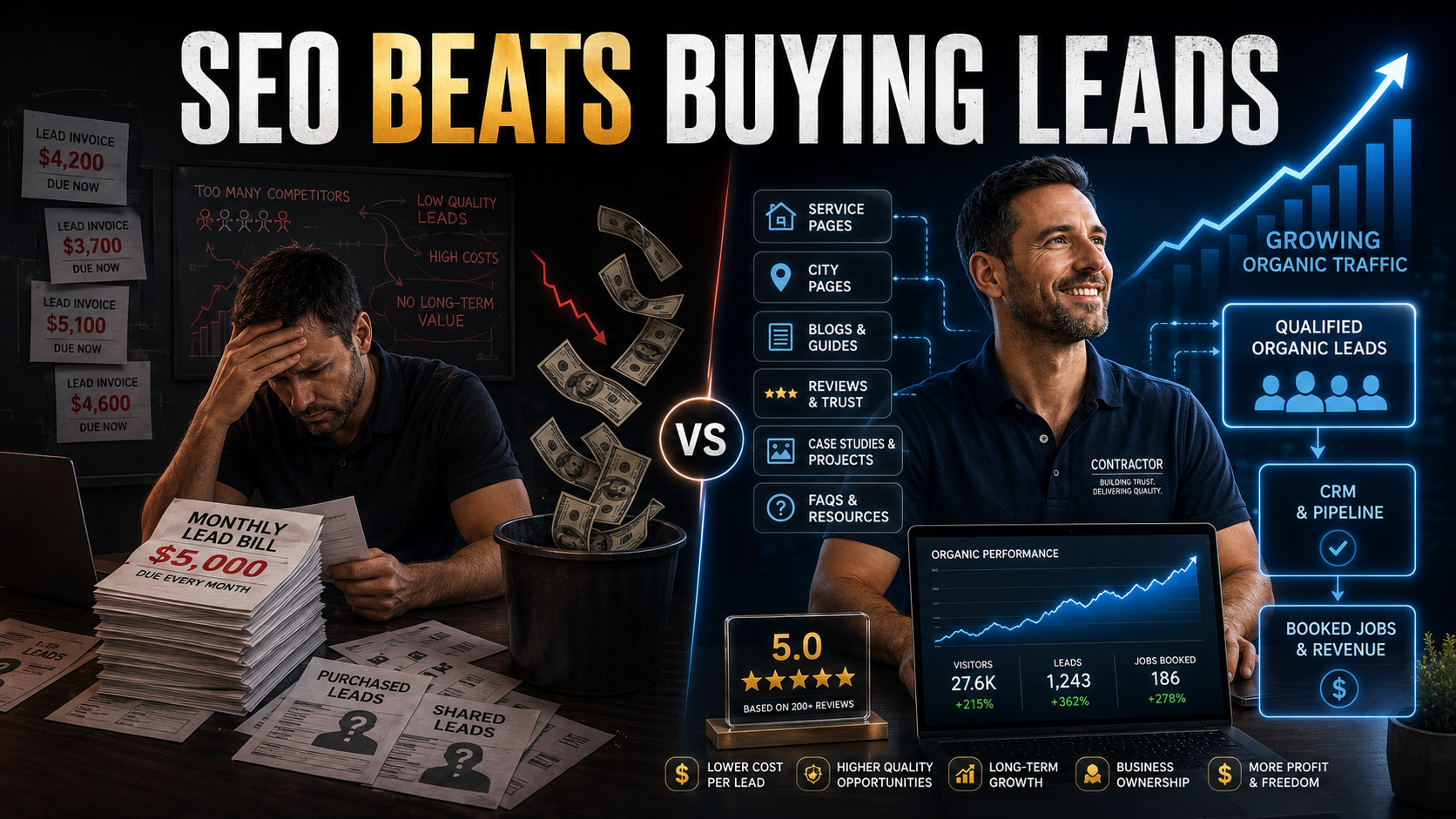
[IMAGE: Featured Hero Image]
The Difference Between Renting and Owning Growth
Imagine two contractors starting the year with identical goals. Both want to increase revenue, hire another crew, and dominate their local market. They have similar reputations, provide comparable workmanship, and invest roughly the same amount of money into marketing.
The first contractor spends that budget buying leads every month. The second invests the same dollars into SEO, content creation, local authority, and expanding their website into a comprehensive digital resource for homeowners.
Twelve months later, both companies may have generated new business. However, only one company owns something significantly more valuable than when the year began.
The contractor buying leads owns exactly what they owned twelve months ago. The leads are gone, the advertising budget has been spent, and next month’s pipeline depends on writing another check.
The contractor investing in SEO owns an expanding library of service pages, city pages, educational blogs, comparison guides, customer reviews, case studies, and search authority. Those assets continue attracting homeowners every day without being repurchased.
Buying leads purchases opportunities.
SEO builds assets.
That’s one of the biggest differences between short-term marketing and long-term business growth. One creates activity today. The other creates value that continues working tomorrow.
The Monthly Lead Buying Trap
Lead providers often market convenience because convenience sells. They promise to deliver homeowners directly to your business without requiring you to invest months building a stronger online presence. For companies needing immediate work, that message is understandably attractive.
The problem isn’t that lead generation companies exist.
The problem is that many contractors unknowingly build their entire growth strategy around them.
Every month begins with another invoice. Every estimate competes against other contractors purchasing the same opportunities. Close rates fluctuate, acquisition costs increase, and profitability becomes increasingly difficult to predict because your pipeline depends on someone else’s platform.
Eventually, something unexpected happens.
Your marketing budget stops buying growth.
It starts buying maintenance.
Instead of investing in assets that make future marketing easier, every dollar simply keeps the current system alive for another month. The business stays busy, but it never becomes less dependent on purchased opportunities.
That’s a difficult position for any contractor because growth should create independence, not greater dependence.
Why SEO Creates Business Assets Instead of Temporary Results
Every investment a business makes should answer one important question.
Will this still create value a year from now?
That’s where SEO separates itself from nearly every other lead generation strategy.
A purchased lead has an extremely short lifespan. You receive the contact information, schedule an estimate, submit a proposal, and either win or lose the project. Regardless of the outcome, the opportunity eventually disappears. If you want another opportunity next month, you have to buy another lead.
SEO works differently because every improvement becomes part of your business.
A service page explaining roof replacement doesn’t disappear after one homeowner reads it. A city page optimized for a nearby community continues attracting searches every week. An article explaining how to identify hail damage may answer questions for thousands of homeowners over the next several years.
Unlike purchased leads, these assets continue working long after they’re published.
More importantly, they begin working together.
Your blogs strengthen your service pages. Your service pages reinforce your city pages. Your reviews improve conversion rates. Your completed project galleries increase trust. Every new page strengthens the authority of the entire website, making future content easier to rank than the content you published before.
That’s why SEO compounds.
You’re not simply adding more pages.
You’re increasing the value of everything you’ve already built.
Every piece of quality content becomes another employee working for your business twenty-four hours a day.
SEO Gets Stronger While Purchased Leads Reset Every Month
Imagine planting an orchard instead of buying fruit every week.
Buying fruit solves today’s problem because you have something to sell immediately. However, once it’s gone, you’re forced to return to the store and spend more money all over again.
Planting an orchard requires patience. You don’t receive the same immediate reward, but every year the trees become larger, healthier, and more productive. Eventually, the orchard produces more fruit than you could ever have purchased with the same amount of money.
SEO behaves much like that orchard.
The first few months focus on building a foundation. Service pages are optimized. Educational articles begin answering customer questions. Local authority grows through reviews, citations, and completed projects. Search engines gradually develop greater confidence in your business because your website demonstrates expertise rather than simply advertising services.
Then something remarkable happens.
The content you published six months ago continues attracting visitors while the content you published last week starts gaining traction. Search visibility expands across dozens, then hundreds, of different customer searches. Instead of relying on one homepage to rank for everything, your website begins generating qualified traffic from hundreds of entry points.
That’s when momentum starts replacing effort.
Every new page makes the next page easier to rank. Every completed project creates another case study. Every satisfied customer becomes another review that strengthens trust. Every homeowner who discovers your business organically becomes another opportunity to earn referrals, repeat work, and neighborhood visibility.
Purchased leads never experience this compounding effect.
Every month begins at zero.
SEO begins where last month ended.
| Buying Leads | Investing in SEO |
|---|---|
| Must purchase new opportunities every month. | Content continues generating opportunities year after year. |
| Stops immediately when spending stops. | Continues producing traffic after publication. |
| Little long-term business value. | Creates lasting digital assets. |
| Shared competition is common. | Generates exclusive organic opportunities. |
| Limited scalability. | Scales as authority grows. |
| Marketing budget resets monthly. | Marketing compounds over time. |
Homeowners Trust Businesses They Discover—Not Businesses That Chase Them
There’s another advantage to SEO that rarely appears on marketing reports.
Intent.
When homeowners actively search for information, they’re already trying to solve a problem. They aren’t being interrupted by an advertisement while scrolling social media or receiving another sales call during dinner. They’re looking for answers because they have a genuine need.
That changes the relationship before your business ever enters the conversation.
Imagine two homeowners.
The first clicks an advertisement because it happened to appear while reading the news. They may not even be ready to hire a contractor. The second searches, “How much does a roof replacement cost?” or “Signs of hail damage on asphalt shingles.” They spend fifteen minutes reading your educational content, browse your completed projects, compare roofing systems, and eventually schedule an inspection.
Which homeowner do you think is more likely to trust your company?
The answer has very little to do with advertising.
Trust grows naturally when your business consistently helps people before asking them to become customers. Every educational article, every FAQ, every comparison guide, and every project gallery moves that relationship forward before your estimator even arrives.
That’s one of the biggest reasons SEO often produces higher-quality opportunities. Homeowners aren’t simply contacting another contractor.
They’re contacting the company that already answered their questions.
Your Website Should Appreciate Like Real Estate
Business owners understand the value of owning appreciating assets.
Commercial buildings gain equity. Equipment increases production capacity. Skilled employees strengthen the organization. Each investment improves the long-term value of the company rather than simply covering this month’s expenses.
Your website should work exactly the same way.
Every optimized page, every educational blog, every city page, every review, every project gallery, and every internal link increases the value of your digital real estate. Over time, your website evolves from a simple online brochure into one of the company’s most valuable business assets.
That’s why we often describe SEO as digital real estate investing rather than digital marketing.
You’re not buying temporary visibility.
You’re building an appreciating asset capable of generating qualified customers for years to come.
[IMAGE PROMPT: Create a premium 16:9 infographic in IMR’s signature dark blue and gold style. Show a contractor website growing into a massive digital real estate ecosystem. Service pages, city pages, educational blogs, FAQs, comparison pages, customer reviews, and project case studies all connect through glowing blue pathways into a central dashboard receiving exclusive homeowner leads. On the opposite side, show stacks of monthly lead invoices disappearing into a trash bin. Very little text. The only headline should read: “BUILD ASSETS. NOT DEPENDENCE.”]
The Biggest Difference Is Ownership
Imagine spending $5,000 every month for five years on purchased leads.
That’s a $300,000 investment.
Now ask yourself a simple question.
What does your business actually own at the end of those five years?
Most contractors struggle to answer because the truthful answer is very little. The leads have already been sold, the advertising platforms have already been paid, and the opportunities disappeared as quickly as they arrived. Although the business may have completed projects during that time, the marketing itself created very little lasting value.
Now imagine investing those same dollars into building a digital marketing ecosystem.
Your website expands into hundreds of service pages that answer homeowner questions before competitors do. City pages establish authority throughout your service area. Educational blogs become trusted resources that homeowners discover months before they need an estimate. Case studies demonstrate the quality of your work, while reviews, FAQs, and comparison guides strengthen trust at every stage of the buying journey.
Five years later, your company owns an asset that continues producing results every single day.
The difference isn’t just marketing performance.
It’s ownership.
One strategy rents opportunities. The other builds equity.
The businesses that dominate local markets usually own their marketing instead of renting it.
The Cost Per Lead Isn’t the Metric That Matters
One of the biggest mistakes contractors make is obsessing over the price of an individual lead. They’ll compare one lead provider against another, negotiate lower costs, or chase whichever company promises the cheapest opportunities this month.
Unfortunately, lower-priced leads rarely translate into lower acquisition costs.
Imagine purchasing twenty inexpensive leads that produce only two estimates and one closed project. Compare that with generating ten highly qualified homeowners through organic search who already trust your company because they’ve spent time reading your educational content and exploring your completed projects.
Which strategy actually costs less?
The answer depends on far more than the original lead price.
True marketing efficiency comes from measuring the complete customer acquisition process. That includes lead quality, close rates, project size, customer lifetime value, referrals, repeat business, and overall profitability rather than simply evaluating what happened at the very beginning of the funnel.
That’s why successful contractors stop asking, “How much does a lead cost?”
Instead, they ask, “How efficiently does this marketing system produce profitable customers?”
| Question | Better Business Question |
|---|---|
| How much does this lead cost? | How profitable is the customer? |
| How many leads did we receive? | How many qualified jobs did we close? |
| How much traffic did we get? | How much revenue did the traffic produce? |
| Did rankings improve? | Did the business become more valuable? |
| How many clicks did we buy? | How many customers now find us organically? |
The Future Belongs to Businesses That Build Digital Authority
Search is changing.
Artificial intelligence is changing.
Consumer behavior is changing.
Yet one principle remains remarkably consistent.
Businesses that become trusted authorities continue attracting customers regardless of how technology evolves.
Google’s algorithms may change. AI search may continue reshaping how homeowners discover contractors. Advertising platforms will continue introducing new features and new bidding strategies. However, homeowners will always need trustworthy companies capable of solving real problems.
That’s why investing in digital authority has become more valuable than investing solely in lead generation. Authority isn’t dependent on one advertising platform, one algorithm, or one vendor. It grows stronger every time your company publishes another helpful resource, documents another successful project, earns another five-star review, or answers another homeowner’s question.
Instead of reacting to every change in marketing, businesses with strong authority benefit from each new opportunity because they’ve already built the trust those platforms want to recommend.
Authority becomes the foundation.
Everything else builds upon it.
Frequently Asked Questions
Is SEO better than buying contractor leads?
For long-term growth, yes. Buying leads can generate immediate opportunities, but SEO builds lasting digital assets that continue attracting qualified homeowners long after the initial investment. Over time, SEO typically produces lower acquisition costs and greater business value.
Should contractors stop buying leads completely?
Not necessarily. Purchased leads can help fill short-term gaps in production or support seasonal demand. However, they should complement a long-term SEO strategy rather than replace it. Contractors relying entirely on purchased leads often become dependent on continuous monthly spending.
How long does SEO take to generate contractor leads?
SEO is a long-term investment. While timelines vary based on competition and website authority, businesses usually see meaningful improvements over several months. Unlike purchased leads, however, those improvements continue compounding instead of resetting each month.
Why are SEO leads often higher quality?
Organic visitors actively search for answers and solutions. By the time they contact your company, they’ve often read your content, explored your services, viewed completed projects, and developed trust in your expertise. That typically produces better-qualified opportunities than many purchased lead sources.
Does SEO still matter with AI search?
Absolutely. AI search actually increases the importance of authoritative content because platforms such as Google AI Overviews and ChatGPT rely on trusted sources when generating recommendations. Businesses with comprehensive digital ecosystems are better positioned for both traditional search and AI-powered search experiences.
What should contractors invest in first?
Contractors should begin by building a technically sound website, optimizing local SEO, expanding service and city pages, collecting reviews, publishing educational content, and documenting completed projects. These assets create a strong foundation that continues producing value for years.
Final Thoughts: Stop Renting Your Growth
Buying leads isn’t inherently bad.
Many successful contractors use lead generation companies to supplement their marketing, enter new markets, or keep crews busy during slower seasons. The problem begins when purchased leads become the entire growth strategy instead of one tool within a larger marketing system.
Businesses that dominate their markets think differently.
Instead of asking how to buy more opportunities next month, they ask how to create assets that generate opportunities for the next decade. Every service page, every city page, every educational article, every customer review, and every completed project becomes another investment in the long-term value of the company.
Eventually, the conversation changes.
The goal is no longer buying enough leads to survive another month.
The goal becomes owning a marketing system that continues producing qualified homeowners whether advertising budgets increase, decrease, or disappear altogether.
Advertising can generate business.
SEO builds businesses.
That’s why contractors focused on long-term growth don’t simply invest in rankings.
They invest in digital real estate that becomes more valuable every year.
Can SEO replace purchased leads immediately?
No. SEO normally requires time to build rankings, authority, and consistent organic traffic, whereas purchased leads can create opportunities almost immediately. Therefore, many contractors use paid lead sources temporarily while developing an owned SEO system that gradually reduces their dependence on outside providers.
How does SEO lower customer acquisition costs over time?
SEO lowers customer acquisition costs by allowing service pages, location pages, articles, reviews, and case studies to generate opportunities repeatedly without requiring a separate payment for every lead. As visibility and authority grow, the same digital assets can reach more qualified homeowners and support higher conversion rates.
Are SEO leads exclusive?
Organic leads contact your business directly after discovering your website, Google Business Profile, content, reviews, or other digital assets. Although those homeowners may still compare contractors, the lead itself is not being sold simultaneously by a marketplace to several competing businesses.
What types of SEO content generate contractor leads?
The strongest content strategy combines high-intent service pages, location pages, project case studies, homeowner guides, comparison pages, FAQs, cost explanations, financing resources, and maintenance advice. Together, these pages reach prospects throughout the entire buying journey rather than targeting only people ready to request an estimate immediately.
Can contractors use SEO and paid advertising together?
Yes. In fact, paid advertising often performs better when it supports a strong organic foundation because prospects can research the business, read useful content, review completed work, and verify its reputation before converting. SEO builds trust and long-term visibility, while advertising can accelerate demand during specific seasons or market expansions.
How should contractors measure SEO ROI?
Contractors should measure qualified inquiries, booked estimates, completed projects, organic customer acquisition cost, revenue from organic traffic, close rates, and customer lifetime value. Rankings and traffic provide useful diagnostic information, but profitable work remains the ultimate measure of whether SEO is creating business value.
Build a Lead Generation Asset Your Business Actually Owns
Purchased leads may help solve an immediate pipeline problem, but they should not control the future of your company. A stronger long-term strategy combines SEO, local authority, useful content, reviews, project proof, conversion optimization, AI-search readiness, and carefully targeted advertising into one system that grows more valuable over time.
Infinite Media Resources builds large-scale digital marketing systems for contractors and service businesses that want to reduce dependence on rented leads. Instead of chasing isolated rankings or publishing disconnected articles, we develop interconnected service pages, location resources, buying guides, case studies, FAQs, and authority content designed to attract qualified prospects throughout the entire decision-making process.
The result is more than an increase in website traffic. Your company gains a digital asset that supports sales, strengthens trust, improves future campaigns, and creates exclusive opportunities across traditional search and emerging AI platforms.
Stop rebuilding your pipeline every month. Start building a marketing system that compounds.
Contact Infinite Media Resources to discuss an SEO and digital authority strategy designed around your market, services, and long-term growth goals.
About the author : Anthony Paulino