Why Most Contractor Websites Never Generate Leads
Most contractors do not have a website problem. They have a contractor website lead generation problem that has been disguised as a design project. The website may look professional, load correctly, and showcase completed work, yet it still fails at the one job the business expected it to perform: consistently turning qualified homeowners into real sales opportunities.
The disappointment usually begins several months after launch. The new design receives compliments, the project photos look impressive, and the company finally feels represented professionally online. However, the contact forms remain quiet, organic traffic barely moves, and the sales pipeline still depends on referrals, paid advertisements, or purchased leads.
At that point, many contractors assume the design agency failed. Others believe SEO no longer works, their local market has become too competitive, or homeowners simply prefer large national brands. Although any of those factors can influence performance, the more common explanation is much simpler: the website was built to present the company, not to generate demand.
A brochure can describe your services. A lead generation system must do far more.
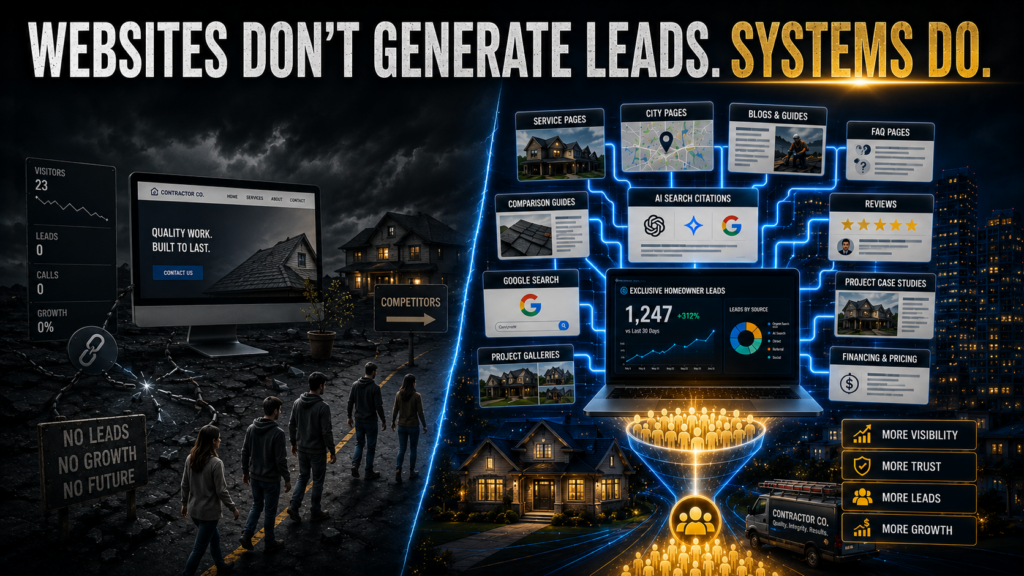
It must help homeowners discover your company before they know whom to hire, answer the questions they ask while researching, prove that your team has solved similar problems, and guide each visitor toward a logical next step. Therefore, effective contractor website lead generation depends on the entire system surrounding the design—not merely the appearance of the homepage.
Direct Answer
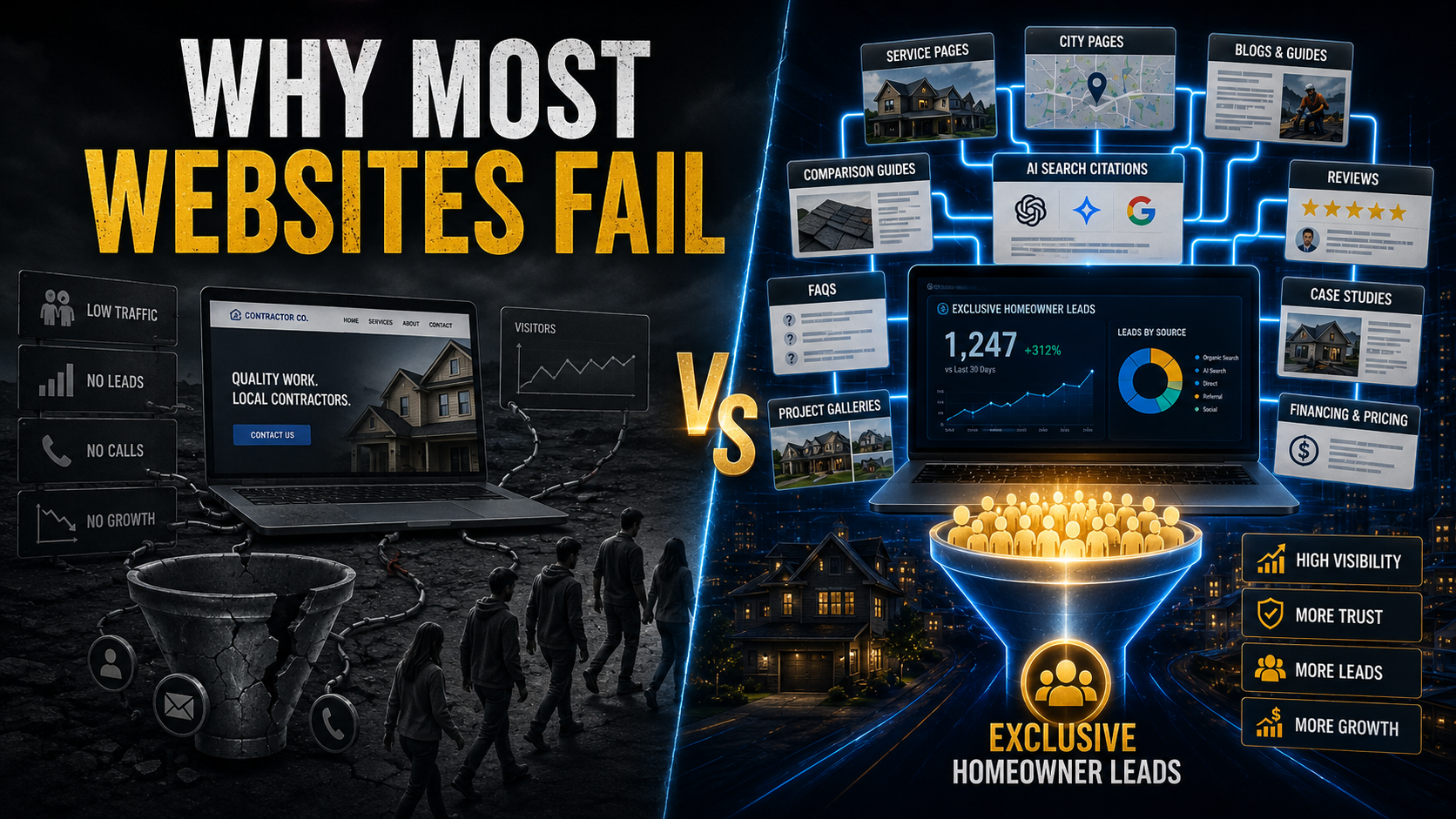
Most contractor websites never generate consistent leads because they contain too few useful pages, attract limited search visibility, provide insufficient proof, and lack clear conversion paths. Effective contractor website lead generation requires an interconnected system of service pages, local resources, educational content, case studies, reviews, technical SEO, internal links, and calls to action built around how homeowners actually make decisions.
[IMAGE: Featured Hero Image]
A Contractor Website Is Not Automatically a Lead Generation System
A website becomes a lead generation system only when every important component works toward attracting, educating, qualifying, and converting homeowners. Unfortunately, most contractor websites stop after the first step. They establish an online presence, but they do not build the infrastructure required to produce predictable opportunities.
Consider the typical contractor website. It includes a homepage, an About page, a short list of services, several project photos, and a contact form. Those pages may reassure someone who already knows the company, but they create very few opportunities to reach homeowners who are still researching their problems and comparing possible solutions.
That distinction matters because most prospects do not begin with your brand name. They begin with a leaking roof, damaged siding, old windows, an uncomfortable room, a remodeling idea, or uncertainty about what a project should cost. Unless your website contains useful resources addressing those moments, your company remains invisible during much of the buying journey.
This is why a basic site can look excellent while producing almost no measurable business. Design influences credibility after someone arrives, whereas a complete SEO strategy helps qualified homeowners discover the site in the first place. Conversion architecture then determines whether those visitors continue researching, request an estimate, or return to Google and choose someone else.
A website proves that your company exists. A lead generation system gives homeowners a reason to discover, trust, and contact it.
What Contractor Website Lead Generation Actually Requires
Contractor website lead generation begins by connecting four functions that many businesses manage separately: visibility, education, proof, and conversion. If even one function remains weak, the entire system loses efficiency. More traffic cannot fix weak trust, and a beautiful design cannot overcome a lack of qualified visitors.
Visibility places the company in front of homeowners through organic search, local results, referrals, paid media, and emerging AI platforms. Education answers the questions those homeowners ask before hiring anyone. Proof demonstrates that the contractor can produce the promised outcome, while conversion architecture makes the next step clear and appropriate for the visitor’s stage of research.
| Lead Generation Function | What the Website Must Provide | What Happens When It Is Missing |
|---|---|---|
| Visibility | Technical SEO, service pages, local pages, crawlable links, and search-focused content | Qualified homeowners never discover the company |
| Education | Guides, comparisons, FAQs, pricing context, maintenance advice, and process explanations | Visitors leave to find answers elsewhere |
| Proof | Reviews, project case studies, photos, credentials, warranties, and documented results | Homeowners remain uncertain about credibility |
| Conversion | Relevant calls to action, estimate forms, phone options, internal pathways, and follow-up systems | Traffic fails to become real sales opportunities |
Google’s Search Essentials recommends using the language people search for in prominent areas and making internal links crawlable. Likewise, its guidance on helpful, people-first content emphasizes creating information that genuinely serves the intended audience instead of publishing pages only to manipulate rankings.
Those principles align directly with what homeowners need. A successful contractor site should use clear service language, answer meaningful questions, connect related resources, and help people make better decisions. Therefore, SEO quality and customer usefulness should reinforce each other rather than compete.
Homeowners Start With a Problem, Not Your Company Name
Contractors often view their websites from the perspective of someone already familiar with the business. Homeowners usually arrive from a very different position. They may understand the visible problem, yet they often remain uncertain about the cause, urgency, available solutions, expected investment, and contractor they should trust.
A homeowner who notices water staining the ceiling may first research whether the problem comes from damaged shingles, flashing, condensation, plumbing, or ventilation. Another homeowner considering replacement windows may compare materials, efficiency ratings, financing, installation timelines, and expected resale value before contacting a company. Each search represents a distinct opportunity to enter the customer journey.
However, a five-page contractor website cannot realistically address that range of intent. It may rank for the company’s name and occasionally for a broad local service term, but it leaves hundreds of valuable questions unanswered. Consequently, competitors with stronger content ecosystems meet the homeowner earlier and begin building trust before the smaller site ever appears.
This is the strategy behind treating SEO as an owned business asset. IMR’s guide to the 1,000-page digital real estate model explains how service coverage, local coverage, buyer questions, and internal pathways create searchable territory that can keep producing value over time. Likewise, the Digital Real Estate Resources hub organizes the asset-building concepts that turn individual pages into a connected authority system.
The objective is not publishing pages merely to reach a large number. Instead, the goal is to build the most useful collection of resources in the market, with every page serving a clear purpose within the homeowner’s decision process.
The Website Usually Fails Because the Most Valuable Pages Were Never Built
When a contractor website underperforms, owners often focus on changing colors, replacing photos, rewriting the homepage, or moving the contact form. Those adjustments may improve presentation, but they rarely solve the larger structural problem. The website still lacks the pages that generate visibility and support real buying decisions.
A roofing contractor may have one general roofing page but no dedicated resources for roof replacement, leak repair, storm damage, insurance claims, ventilation, financing, material comparisons, warranties, commercial systems, or the individual cities it serves. A remodeling company may showcase finished kitchens without explaining project planning, cabinet choices, layouts, timelines, budgets, permits, or what homeowners should expect during construction.
These omissions leave the website dependent on broad, highly competitive searches. More importantly, they prevent the company from building trust with homeowners who need education before they feel ready to request an estimate.
A stronger content architecture typically includes:
- Dedicated pages for every major service and meaningful service variation
- Local pages built around real market differences and customer needs
- Educational guides answering early-stage homeowner questions
- Comparison pages that help prospects evaluate materials and approaches
- Project case studies documenting the challenge, process, and outcome
- Pricing, financing, warranty, timeline, and maintenance resources
- Frequently asked questions based on actual sales conversations
- Internal links connecting each resource to the next logical decision
Google explains in its SEO Starter Guide that clear site organization helps users and search engines understand how pages relate. Therefore, a contractor should not view these assets as disconnected blog posts. They should form a deliberate network that moves homeowners from awareness to understanding, proof, and action.
The IMR website marketing guide expands on this distinction by treating the website as the center of a broader marketing system rather than an isolated design asset. That approach creates more value because search, paid traffic, content, social campaigns, and sales follow-up can all use the same growing library of resources.
Great Contractor Website Lead Generation Starts With Being Found
A contractor website cannot generate leads if homeowners never discover it. Although that statement seems obvious, many companies spend the majority of their marketing budget improving a website that receives very little qualified traffic.
Search visibility is the foundation of contractor website lead generation because every estimate begins with someone finding your business. Sometimes that discovery happens through Google Search. Increasingly, however, it also occurs through Google AI Overviews, ChatGPT, Perplexity, social platforms, local map results, referrals, YouTube, and shared links from previous customers.
Each discovery channel relies on one common factor.
It needs useful information.
That is why successful contractor websites invest in far more than service pages. They build educational resources that answer homeowner questions before competitors do. Every guide, comparison article, project case study, maintenance checklist, financing explanation, and frequently asked question creates another opportunity to appear when homeowners begin researching.
Search visibility also compounds over time. A single page may answer one question, but an interconnected collection of hundreds of pages demonstrates expertise across an entire topic. Search engines become more confident recommending your company because your website consistently provides comprehensive, trustworthy information.
Google’s guidance on creating helpful, people-first content reinforces this approach by encouraging websites to publish original information that genuinely satisfies user needs instead of producing content solely for rankings.
For contractors, that means every page should exist because it helps a homeowner solve a problem—not simply because it targets another keyword.
Traffic doesn’t begin with better advertising.
It begins with becoming the best answer.
Trust Is Built Long Before Someone Requests an Estimate
Many contractors assume the estimate appointment is where they earn the homeowner’s trust.
In reality, that process usually starts online.
Before making contact, homeowners evaluate dozens of signals that influence whether they believe a contractor is experienced, reliable, and worth inviting onto their property. Reviews, completed projects, certifications, warranties, educational content, company history, local expertise, and transparent communication all contribute to that decision.
Your website should intentionally reinforce those signals at every stage of the visitor’s journey.
For example, someone reading about roof replacement should naturally discover completed roofing projects, warranty explanations, financing information, customer testimonials, and answers to common homeowner concerns. Instead of ending with a generic contact form, the page should guide visitors toward the information they are most likely to need next.
This is where many contractor websites lose potential customers.
Pages become dead ends.
Visitors receive one answer, but the website provides no logical pathway toward the next question. Consequently, homeowners return to Google, continue researching, and often discover another contractor before requesting an estimate.
Effective contractor website lead generation removes that friction. Every page should connect naturally to related resources, keeping homeowners engaged while continuously strengthening trust.
That’s one reason our guide on why SEO beats buying leads every month emphasizes building owned digital assets instead of relying entirely on temporary traffic sources. The longer homeowners remain inside your ecosystem, the more opportunities your business has to demonstrate expertise before competitors ever enter the conversation.
Your Website Should Become Digital Real Estate, Not a Digital Brochure
Contractors understand the value of owning appreciating assets.
Equipment, commercial buildings, skilled employees, and operational systems all contribute to the long-term strength of the business because they continue producing value after the initial investment.
Your website should operate the same way.
Every high-quality page becomes another digital asset your company owns. Unlike paid advertisements, those assets don’t disappear when the monthly budget ends. Instead, they continue attracting homeowners, supporting search visibility, strengthening authority, and improving conversion performance.
That’s why we refer to this strategy as digital real estate.
Each service page expands your market coverage.
Each city page strengthens local authority.
Each educational guide builds trust.
Each comparison article helps homeowners make better decisions.
Each project case study provides proof that your company can deliver the promised results.
As those assets accumulate, the website becomes increasingly valuable because every new page strengthens the entire ecosystem. Search engines understand more of your expertise. AI systems gain additional evidence supporting your authority. Homeowners discover more entry points into your business, while internal links encourage them to continue learning instead of leaving your website.
This long-term strategy is explained in greater detail throughout our Digital Real Estate Strategy for Contractors, where we compare digital assets to appreciating business investments rather than recurring marketing expenses.
| Traditional Contractor Website | Contractor Website Lead Generation System |
|---|---|
| 10–20 pages | Hundreds of interconnected assets |
| Company-focused content | Homeowner-focused education |
| Few organic entry points | Hundreds of searchable opportunities |
| Minimal internal linking | Connected knowledge ecosystem |
| Occasional inquiries | Predictable lead generation engine |
| Marketing expense | Appreciating business asset |
AI Search Is Raising the Standard for Contractor Website Lead Generation
Artificial intelligence is rapidly changing how homeowners evaluate local businesses.
Instead of reviewing ten blue links on a search results page, more people are asking conversational questions and expecting complete recommendations. They want to know which contractor appears trustworthy, which roofing material makes sense for their home, how insurance claims typically work, or whether replacement is better than repair.
Those answers require context.
A contractor website containing only a homepage and a few service descriptions provides very little information for AI systems to understand. By comparison, an extensive digital ecosystem filled with educational guides, comparison resources, project documentation, FAQs, reviews, and structured data gives search engines and AI platforms far greater confidence when interpreting your expertise.
This doesn’t replace traditional SEO.
Instead, AI search builds on the same fundamentals. Helpful content, logical site architecture, strong internal linking, technical quality, and topical authority all become even more valuable because AI systems rely on those signals when evaluating credibility.
Google’s documentation on structured data explains how schema helps search engines understand the entities and relationships throughout your website. Likewise, Schema.org provides the vocabulary used to describe organizations, services, reviews, articles, FAQs, and many other elements that strengthen machine understanding.
The businesses preparing for AI search today are not abandoning SEO.
They’re expanding it.
As we explain throughout our Generative Engine Optimization (GEO) hub, contractor website lead generation increasingly depends on becoming a trusted source of information rather than simply achieving another first-page ranking.
How to Measure Whether Contractor Website Lead Generation Is Actually Working
Contractors often judge website performance using surface-level metrics such as traffic, rankings, impressions, or contact-form submissions. Although those numbers help diagnose performance, they do not reveal whether the website is creating profitable business. A contractor website lead generation strategy succeeds only when qualified homeowners move from discovery to scheduled estimates, completed projects, and measurable revenue.
That means every important website action should connect to a business outcome. Phone calls should be tracked by source, estimate forms should feed into the CRM, and organic visitors should remain connected to the projects they eventually purchase. Otherwise, the company may celebrate higher traffic while remaining unaware that most visitors never become real customers.
Consider two websites that each generate one hundred inquiries. The first attracts mostly low-intent homeowners requesting rough prices, while the second produces fewer but better-qualified prospects who understand the company, value its expertise, and are ready to schedule an inspection. Lead volume alone may make the first website look stronger, even though the second produces substantially more revenue and profit.
Therefore, the best measurement system follows the entire customer journey rather than stopping at the contact form.
| Website Metric | Business Metric It Should Connect To |
|---|---|
| Organic traffic | Qualified homeowners entering the website |
| Page rankings | Visibility for profitable services and markets |
| Phone calls | Booked inspections and estimates |
| Form submissions | Sales-qualified opportunities |
| Conversion rate | Percentage of visitors becoming viable prospects |
| Booked estimates | Proposals delivered and projects sold |
| Organic revenue | Gross profit generated by the website |
| Customer acquisition cost | Total marketing cost required to acquire a profitable customer |
Once these connections become visible, the website stops being a vague marketing expense. It becomes a measurable acquisition system whose strengths and weaknesses can be improved deliberately. Pages producing traffic but few conversions may need stronger proof or clearer calls to action, while pages generating profitable projects can become models for expanding into related services and markets.
Every Page Needs a Conversion Path That Matches the Homeowner’s Intent
One of the most common contractor website mistakes is placing the same aggressive estimate request on every page. A homeowner reading an early-stage guide about siding materials may not be ready to schedule a sales appointment, while someone viewing an emergency roof repair page may need immediate assistance. Treating both visitors identically creates unnecessary friction.
Effective contractor website lead generation uses different calls to action for different stages of the buying journey. Early-stage visitors may benefit from another comparison guide, a downloadable checklist, or a project gallery. Meanwhile, high-intent visitors should see clear phone, inspection, and estimate options without having to search for them.
The goal is not to force every visitor into a form as quickly as possible. Instead, the website should help each person take the most logical next step. When that progression feels natural, homeowners remain engaged longer and reach the sales conversation with greater confidence.
| Homeowner Stage | Typical Question | Best Next Step |
|---|---|---|
| Problem awareness | Why is my roof leaking? | Diagnostic guide or related FAQ |
| Solution research | Should I repair or replace it? | Repair-versus-replacement comparison |
| Option evaluation | Which roofing material should I choose? | Material guide, project gallery, or case study |
| Contractor evaluation | Can this company handle my project? | Reviews, credentials, warranties, and local proof |
| Purchase intent | When can someone inspect the roof? | Estimate form, phone call, or scheduling option |
This intent-based approach also improves the performance of paid campaigns. Visitors arriving through Google Ads, Meta Ads, email, or remarketing can enter a website that already contains the education and proof required to support the advertisement. Consequently, the site helps every marketing channel convert more efficiently instead of acting as a passive destination after the click.
Your Website and Sales Team Should Tell the Same Story
A contractor website can generate interest and still lose the customer when the online message does not match the sales experience. If the website emphasizes education, transparency, and premium service but the follow-up feels rushed or generic, trust begins disappearing as quickly as it was built.
The strongest contractor website lead generation systems align marketing and sales around the same customer journey. Sales representatives know which articles prospects may have read, understand the promises made on service pages, and use relevant case studies or comparison guides during follow-up. As a result, the transition from website visitor to sales conversation feels continuous rather than disconnected.
Website content can also remove repetitive work from the sales team. Instead of explaining financing, warranties, project timelines, materials, and maintenance during every appointment, representatives can send detailed resources before or after the estimate. That gives homeowners time to review the information while allowing the salesperson to focus on the project’s specific needs.
Over time, real sales conversations should also shape future content. When homeowners repeatedly ask the same question or raise the same objection, the website has identified another resource worth building. This feedback loop allows marketing to become increasingly useful because it reflects what actual customers need to know before moving forward.
Your best website content should answer the questions your best salespeople hear every week.
Seven Reasons Contractor Website Lead Generation Usually Breaks Down
Underperforming contractor websites rarely fail because of one isolated problem. More often, several small weaknesses combine to reduce visibility, trust, and conversion performance. Identifying those weaknesses makes it easier to determine whether the business needs another redesign or a fundamentally stronger system.
-
The website targets too few searches
A small website may rely on a handful of broad service terms while ignoring hundreds of valuable local, educational, comparison, and project-specific searches. Consequently, it reaches only a small portion of the homeowners researching within the market.
-
The content describes services without helping homeowners decide
Generic service copy explains what the company offers but often fails to address pricing concerns, material differences, timelines, warranties, maintenance, and common mistakes. Without those answers, visitors continue researching on competing websites.
-
The website lacks local proof
Homeowners want evidence that a contractor understands their market and has completed similar work nearby. Location pages without local substance, project examples, or community relevance rarely create the same confidence as documented work within the area.
-
Every page leads to the same generic contact form
Visitors at different stages need different next steps. When every page immediately asks for an estimate, early-stage homeowners may leave before the website has earned enough trust to justify that commitment.
-
Project galleries show photos without telling the story
Finished images provide visual proof, but case studies provide context. Explaining the original problem, recommended solution, materials, challenges, process, and outcome gives homeowners a clearer reason to believe the contractor can solve their situation.
-
The website receives traffic but lacks follow-up systems
Missed calls, slow responses, weak CRM processes, and inconsistent nurturing can erase the value created by strong SEO and content. Lead generation does not end when the form is submitted; it ends when the opportunity receives effective follow-up and enters the sales process.
-
The company treats the website as finished
Markets, customer questions, services, search behavior, and AI platforms continue evolving. A website that stops growing eventually loses ground to competitors that keep publishing, documenting projects, strengthening internal links, and updating their resources.
These failures explain why another visual redesign often produces only temporary excitement. Unless the underlying search, content, proof, conversion, and measurement systems improve, the new website will eventually produce the same disappointing result as the old one.
Frequently Asked Questions About Contractor Website Lead Generation
What is contractor website lead generation?
Contractor website lead generation is the process of using a contractor’s website to attract qualified homeowners, educate them about their options, demonstrate credibility, and guide them toward scheduling an estimate or consultation. It combines SEO, local content, project proof, internal links, conversion paths, tracking, and sales follow-up rather than relying on design alone.
Why does my contractor website get traffic but no leads?
Traffic may fail to convert when visitors do not find enough trust, relevance, proof, or direction after arriving. Common causes include generic service pages, weak calls to action, poor mobile usability, limited reviews, unclear positioning, slow load times, and content that attracts informational visitors without guiding them toward a service.
How many pages does a contractor website need to generate leads?
No universal page count guarantees results. However, contractors serving multiple cities and offering several services usually need far more than a basic brochure website. Each meaningful service, location, customer question, comparison, and project can justify a dedicated resource when the page provides unique value and supports the larger site architecture.
What pages should a contractor website include?
A strong contractor website should include comprehensive service pages, useful location pages, homeowner education, comparison guides, project case studies, reviews, financing information, warranty explanations, FAQs, company credentials, and clear conversion options. The exact mix should reflect the services, markets, and questions most relevant to the company’s customers.
How important are project case studies for contractor lead generation?
Project case studies provide some of the strongest conversion proof because they show how the contractor solved a real problem. The best case studies explain the property, challenge, recommended solution, materials, process, complications, and final outcome rather than presenting finished photos without context.
Does contractor website design affect lead generation?
Design affects credibility, usability, mobile performance, and how easily visitors find important information. However, attractive design cannot replace search visibility, useful content, proof, or conversion architecture. The strongest results come from combining professional design with a complete acquisition system.
How long does contractor website lead generation take?
Paid campaigns can produce traffic quickly, while organic contractor website lead generation usually develops over several months. The timeline depends on market competition, the website’s current authority, technical condition, content depth, local reputation, and how consistently the business expands and improves the system.
Can a contractor website replace purchased leads?
A mature website can significantly reduce dependence on purchased leads, but the transition rarely happens immediately. Many contractors continue using paid media or lead sources while building organic visibility, local authority, content, reviews, and conversion systems that gradually create more owned opportunities.
How does local SEO support contractor website lead generation?
Local SEO helps contractors appear when homeowners search for services within specific cities and service areas. It combines optimized local pages, consistent business information, reviews, Google Business Profile activity, locally relevant content, and proof of completed work within the market.
Do internal links help contractor websites generate more leads?
Yes. Internal links help search engines understand page relationships while guiding homeowners toward relevant services, comparisons, case studies, and conversion opportunities. Strong internal linking turns isolated pages into a connected research journey that can build trust over multiple interactions.
How does AI search affect contractor website lead generation?
AI search increases the value of comprehensive, well-structured, trustworthy content. Contractors that answer customer questions, demonstrate experience, use clear entities, document projects, earn reviews, and implement relevant structured data give AI systems more evidence to understand and potentially reference their businesses.
What is the best way to measure contractor website leads?
The best measurement system connects website sources to phone calls, forms, booked estimates, sold projects, revenue, gross profit, and acquisition cost. Rankings and traffic remain useful, but the website’s true value appears in the profitable customers it helps create.
Final Thoughts: Build the System Homeowners Need Before They Call
Most contractor websites never generate dependable leads because they were designed as finished presentations instead of evolving acquisition systems. They tell visitors who the company is, yet they fail to reach homeowners early, answer enough questions, demonstrate sufficient proof, or create a clear path from research to action.
Contractor website lead generation requires a different mindset. The website must become a connected library of services, locations, education, comparisons, reviews, and real project outcomes. Every asset should help the homeowner make a better decision while strengthening the visibility and authority of the entire site.
When that system is built correctly, the website begins supporting far more than SEO. It improves paid advertising, strengthens sales conversations, provides resources for follow-up, increases AI-search readiness, and creates an owned source of qualified opportunities that becomes more valuable as the business continues investing in it.
The goal is not to launch another contractor website.
The goal is to build the digital system homeowners trust before they ever request an estimate.
Turn Your Contractor Website Into an Owned Lead Generation System
A contractor website should do more than confirm that your company exists. It should introduce your business during the earliest stages of homeowner research, answer the questions that delay buying decisions, provide convincing proof, and guide qualified prospects toward an estimate when they are ready to move forward.
Infinite Media Resources builds complete contractor website lead generation systems rather than isolated websites. Our strategies combine technical SEO, local search optimization, service and location architecture, homeowner education, project case studies, conversion planning, internal linking, Generative Engine Optimization, structured data, analytics, and sales alignment into one connected digital ecosystem.
As that ecosystem grows, your website becomes more useful to homeowners and more valuable to the business. It can attract qualified prospects through traditional search, strengthen paid campaign performance, support sales follow-up, and provide AI platforms with the information required to understand your expertise.
The objective is not simply to generate another contact-form submission. Instead, the objective is to build an owned acquisition asset that produces better-qualified opportunities, lowers dependence on rented lead sources, and strengthens your market position over time.
Stop treating your website like a finished design project.
Build the contractor website lead generation system your future growth requires.
Schedule a strategy consultation with Infinite Media Resources to discuss a contractor website, SEO, and digital-authority system built around your services, markets, and long-term growth goals.
About the author : Anthony Paulino