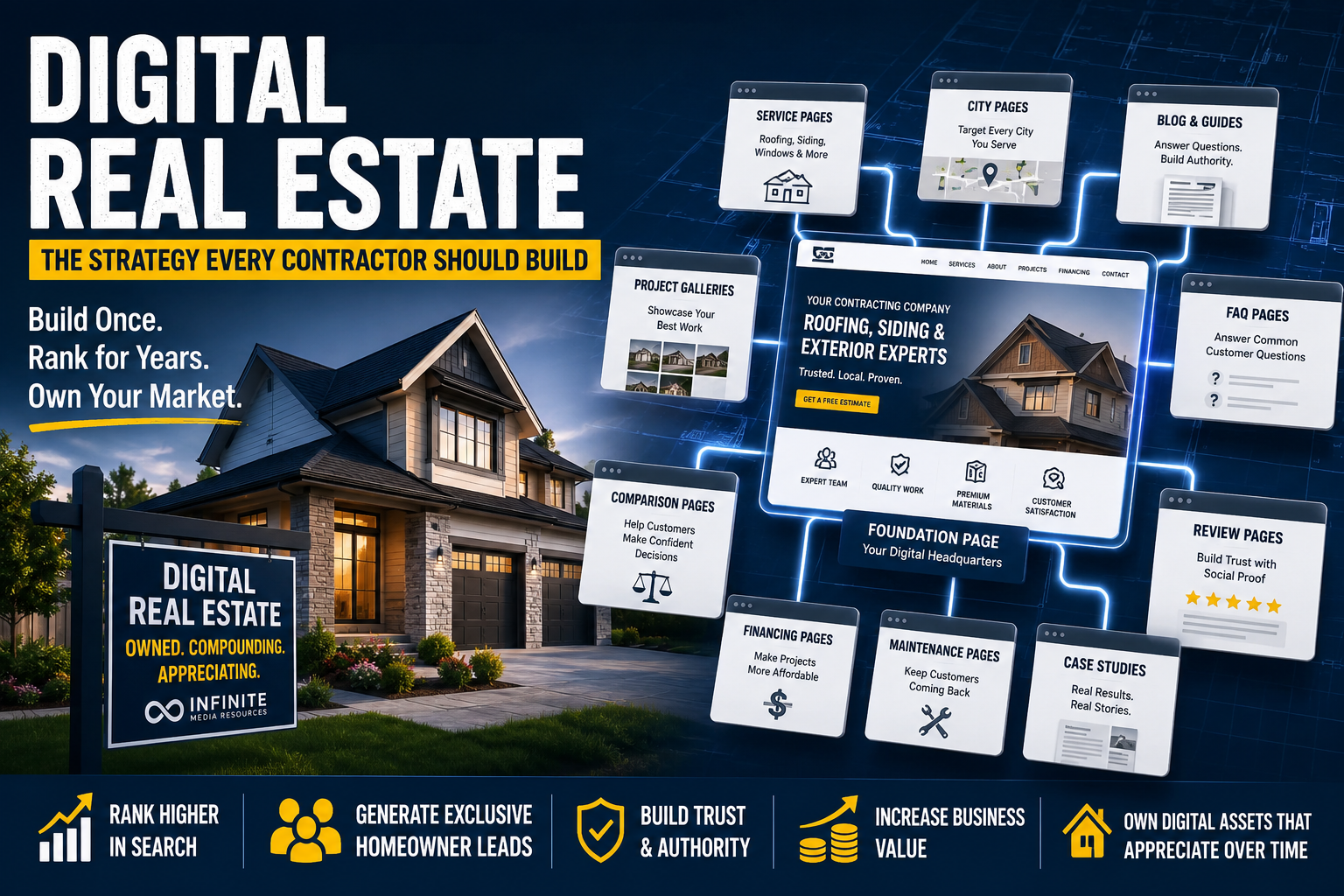
The Digital Real Estate Strategy Every Contractor Should Build
Every contractor understands the value of owning appreciating assets.
A larger office creates room for growth. Better equipment improves production. Additional trucks allow another crew to serve more customers. Every investment strengthens the business because ownership creates long-term value that continues paying dividends long after the initial purchase.
Ironically, many contractors think completely differently about marketing.
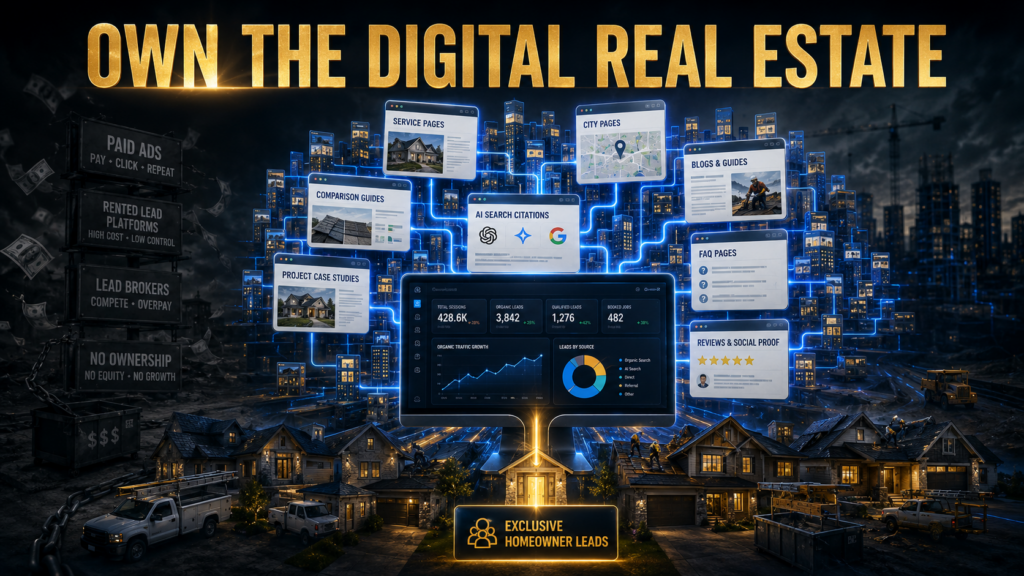
Instead of building assets they own, they spend thousands of dollars every month renting visibility. They purchase leads, increase advertising budgets, boost social media posts, and compete in bidding platforms that disappear the moment payments stop. The marketing generates activity, but it rarely creates lasting equity for the business.
That’s the biggest difference between traditional marketing and digital real estate.
One rents attention.
The other builds an asset that becomes more valuable every year.
Imagine owning hundreds of digital properties spread throughout your service area. Each one answers a different homeowner question, targets a different city, explains a different service, showcases a different project, or solves a different problem. Together, those pages create an interconnected ecosystem capable of attracting qualified homeowners every day without requiring you to purchase every opportunity individually.
That’s exactly what digital real estate looks like.
It’s not a single homepage.
It’s not ten service pages.
It’s an expanding network of digital assets that work together to build authority, earn trust, improve search visibility, strengthen AI recommendations, and continuously generate qualified leads for your business.
The contractors dominating organic search over the next decade won’t simply have better websites.
They’ll own more digital real estate than everyone else.
Direct Answer
Digital real estate is a long-term marketing strategy where contractors build hundreds of interconnected digital assets—including service pages, city pages, educational blogs, project galleries, comparison guides, FAQs, and case studies—that continue generating qualified homeowners long after they’re published. Unlike rented advertising, digital real estate compounds in value, lowers acquisition costs, strengthens AI search visibility, and increases the overall value of the business.
Your Website Should Appreciate Like Commercial Property
Ask any experienced contractor whether they’d rather own a commercial building or rent warehouse space forever.
The answer is almost always the same.
Ownership creates options. It builds equity. It increases business value while reducing long-term dependence on someone else’s property. Although renting may solve today’s problem, ownership usually creates tomorrow’s opportunity.
Your marketing should follow the same philosophy.
Unfortunately, many businesses treat their websites as digital brochures instead of appreciating assets. They launch a handful of pages, list their services, upload a few project photos, and assume the website is finished. Then they spend years purchasing traffic because the website never became capable of generating consistent organic demand.
Digital real estate changes that mindset entirely.
Instead of asking, “How can we get more leads this month?” the better question becomes, “What digital asset can we build this month that continues generating leads for years?”
Every new page becomes another property within your digital portfolio.
Some target roof replacements. Others focus on siding, windows, gutters, insurance claims, storm restoration, financing, maintenance, or commercial services. City pages establish local authority throughout your market, while blogs answer homeowner questions long before someone requests an estimate.
None of those assets work alone.
Together, they create an expanding network that becomes more valuable every time another page is added.
Contractors who own the most valuable digital real estate usually own the largest share of organic demand.
The Best Marketing Investment Doesn’t Expire
Think about how most contractors evaluate marketing.
If a campaign generates enough jobs this month, it’s considered successful. If lead volume drops next month, the budget increases again. That cycle repeats indefinitely because every month’s marketing depends on another month’s spending.
Digital real estate breaks that cycle.
A service page explaining roof replacement doesn’t disappear after one homeowner reads it. A city page continues attracting searches every week. A hail damage guide educates homeowners after every major storm. A financing article helps families understand their options months before they request an estimate.
Each asset continues creating opportunities without requiring another purchase.
That’s what makes digital real estate fundamentally different from rented marketing.
Instead of buying another temporary opportunity, you’re investing in something your company owns permanently.
Digital Assets Become More Valuable Every Time You Publish Something New
One of the biggest misconceptions about SEO is that every page succeeds or fails on its own.
That’s rarely how modern search works.
Search engines and AI platforms don’t simply evaluate individual pages. They evaluate entire websites, topical authority, internal relationships, expertise, and how comprehensively a business answers the questions people are asking.
That’s why digital real estate compounds.
Imagine publishing one article explaining roof replacement. That page may perform well for a handful of searches, but its impact remains relatively limited. Now imagine surrounding that page with dozens of related resources covering roof inspections, insurance claims, financing, storm damage, ventilation, shingle comparisons, maintenance, warranties, common homeowner mistakes, and city-specific roofing information.
Suddenly, every page becomes stronger because each one reinforces the others.
Search engines gain greater confidence that your business genuinely understands roofing rather than simply advertising roofing services. Internal links strengthen topical relationships, visitors spend more time exploring your website, and homeowners discover answers to questions they didn’t even know they had.
Instead of creating isolated pages, you’re creating an interconnected knowledge system.
That’s exactly what makes digital real estate appreciate over time.
Every new page doesn’t simply create another opportunity.
It increases the value of every page you’ve already published.
The Goal Isn’t a Bigger Website. It’s a Better Digital Ecosystem.
Many contractors hear about building hundreds of pages and immediately picture a bloated website filled with repetitive content.
That’s not digital real estate.
A successful digital ecosystem isn’t measured by page count alone. It’s measured by usefulness, organization, and authority. Every page should answer a real question, solve a real problem, or help a homeowner make a better decision.
Think about the journey someone takes before hiring a contractor.
First, they discover a problem.
Then they research possible causes.
Next, they compare solutions.
After that, they evaluate contractors, read reviews, explore completed projects, compare materials, understand pricing, review financing, and determine whether they trust a particular company enough to invite them to their home.
Your website should support every one of those decisions.
That means your digital ecosystem extends far beyond service pages. Educational blogs answer early-stage questions. City pages establish local relevance. Comparison articles help homeowners evaluate options. Project galleries demonstrate craftsmanship. Case studies prove results. FAQs eliminate uncertainty, while customer reviews reinforce confidence throughout the buying journey.
When those resources work together, your website stops functioning like a brochure.
It begins functioning like your company’s most knowledgeable salesperson.
Why the 1,000-Page Model Works So Well
One of the questions we hear most often is whether contractors really need hundreds of pages.
The answer depends on the size of the business they want to build.
If your goal is simply maintaining a small operation with limited growth, a basic website may be enough. However, businesses aiming to dominate multiple cities, add crews, increase revenue, or expand into new markets require a much larger digital footprint.
Every service can become multiple pages.
Every city becomes another opportunity.
Every homeowner question becomes another educational resource.
Every completed project becomes another case study.
Every comparison creates another chance to earn visibility.
Over time, those opportunities multiply into hundreds or even thousands of valuable digital assets that collectively attract homeowners across every stage of the buying journey.
More importantly, they protect your business against future changes in search behavior.
Whether homeowners use Google, Google AI Overviews, ChatGPT, Perplexity, voice assistants, or technologies that haven’t even been released yet, companies with the strongest digital ecosystems will consistently provide the information those platforms need to recommend trustworthy businesses.
| Traditional Contractor Website | Digital Real Estate Strategy |
|---|---|
| 10–20 pages | 500–1,000+ strategic assets |
| Basic service descriptions | Comprehensive homeowner education |
| Homepage generates most traffic | Hundreds of independent entry points |
| Limited local authority | City-by-city market ownership |
| SEO focused | SEO + AI Search + Authority |
| Traffic is the goal | Business value is the goal |
AI Search Makes Digital Real Estate Even More Valuable
Artificial intelligence is changing how homeowners discover contractors.
Instead of reviewing page after page of search results, more consumers are asking conversational questions through AI-powered platforms. They want recommendations, comparisons, explanations, and direct answers instead of simply receiving another list of websites.
That shift increases the importance of comprehensive digital ecosystems.
AI platforms need trustworthy information before they can confidently recommend a business. Contractors with extensive educational content, structured data, local authority, completed projects, reviews, and interconnected resources provide significantly more evidence than businesses operating with only a handful of marketing pages.
In other words, digital real estate doesn’t just improve traditional SEO.
It prepares your business for the future of search.
That’s why every article, FAQ, city page, comparison guide, service page, and project gallery contributes to something much larger than individual rankings. Together, they build the authority modern search engines—and increasingly AI systems—want to recommend.
Digital Real Estate Creates Competitive Advantages That Compound for Years
Most contractors think they’re competing for leads.
They’re actually competing for digital territory.
Every homeowner question that remains unanswered creates an opening for another contractor to earn visibility. Every city without dedicated content becomes another market your competitors can dominate. Every missing comparison guide, financing page, maintenance article, project case study, or FAQ leaves another gap in your digital footprint.
Now imagine two roofing companies serving the same metropolitan area.
The first operates a traditional website with fifteen pages. The second has spent several years building an ecosystem of service pages, neighborhood pages, storm damage resources, insurance claim guides, roof replacement comparisons, financing articles, maintenance checklists, project galleries, customer success stories, warranty explanations, and hundreds of educational resources.
Which company is more likely to appear throughout a homeowner’s research journey?
The answer becomes obvious.
The larger digital ecosystem isn’t competing for one keyword. It’s competing for thousands of searches, hundreds of homeowner questions, and nearly every stage of the buying process. Instead of relying on a handful of opportunities each month, it owns a growing share of the market’s digital attention.
That’s what digital real estate ultimately creates.
It transforms marketing from a monthly expense into a long-term competitive advantage that becomes increasingly difficult for competitors to replicate.
Your competitors can copy an advertisement.
They cannot easily copy years of accumulated digital authority.
Your Website Should Increase the Value of Your Business
Business owners often evaluate marketing by asking one question: “Did it generate leads?” While that’s certainly important, it overlooks something much bigger.
Marketing should also increase the value of the company itself.
Consider how investors evaluate businesses.
They don’t simply look at current revenue. They examine systems, recurring demand, brand recognition, customer acquisition efficiency, market position, and long-term scalability. Businesses that own dependable lead generation systems often command higher valuations because future growth is easier to predict.
Your website can become one of those systems.
Instead of relying exclusively on referrals or paid advertising, your business develops an owned acquisition engine that consistently introduces qualified homeowners to your brand. As the website expands, the business becomes less dependent on outside platforms and more capable of generating opportunities independently.
That’s valuable whether you plan to grow aggressively, expand into new cities, add additional crews, or eventually sell the company.
Digital real estate isn’t simply creating more website traffic.
It’s creating a stronger business.
Digital Real Estate Future-Proofs Your Marketing
Marketing platforms will continue changing.
Advertising costs will continue fluctuating.
Search algorithms will continue evolving.
Artificial intelligence will continue transforming how homeowners discover local businesses.
Those changes create uncertainty for companies relying on a single marketing channel. However, businesses that own extensive digital ecosystems remain remarkably resilient because their authority extends across multiple platforms instead of depending on one source of traffic.
A comprehensive website supports traditional Google rankings. It improves visibility within Google Business Profile searches. It strengthens AI-generated recommendations. It creates content for social media, email marketing, video production, and remarketing campaigns. It even provides valuable resources that sales representatives can share with prospective customers during the buying process.
In other words, one digital asset fuels nearly every other marketing channel.
That’s exactly why digital real estate becomes more valuable as technology continues advancing.
The platforms may change.
Your authority doesn’t have to.
Frequently Asked Questions
What is digital real estate?
Digital real estate refers to the collection of online assets a business owns, including service pages, city pages, educational blogs, project galleries, comparison guides, FAQs, videos, reviews, and other content that continues generating visibility and customers over time. Unlike paid advertising, these assets remain under the company’s control and can appreciate in value.
Why should contractors invest in digital real estate?
Contractors benefit because digital real estate generates long-term organic visibility, strengthens local authority, reduces dependence on purchased leads, improves customer trust, supports AI search visibility, and creates an appreciating business asset that continues producing opportunities long after it’s built.
How many pages should a contractor website have?
There isn’t a universal number because every market differs. However, contractors pursuing significant growth often benefit from building hundreds of strategic pages covering services, locations, homeowner questions, project case studies, comparisons, financing, maintenance, and educational topics rather than relying on a small brochure-style website.
Does every page need to target a different keyword?
No. Every page should primarily solve a unique customer problem or answer a specific question. While keyword targeting remains important, creating genuinely useful resources that satisfy different stages of the buying journey usually produces stronger long-term results than building pages solely around individual keywords.
Can AI search increase the value of digital real estate?
Yes. AI-powered search platforms increasingly reward comprehensive, trustworthy, and well-structured content. Businesses with large digital ecosystems provide significantly more information for AI systems to understand, reference, and recommend than companies with limited websites.
Is digital real estate only about SEO?
No. Strong digital real estate supports SEO, AI search, paid advertising, email marketing, social media, sales enablement, customer education, and brand authority. Each digital asset contributes value across multiple marketing channels rather than serving only one purpose.
How long does digital real estate continue producing results?
High-quality digital assets can continue attracting homeowners for many years when they are maintained, updated, and expanded over time. Their value often increases as additional related content strengthens the authority of the entire website.
What should contractors build first?
Most contractors should begin with comprehensive service pages, location pages, project galleries, customer reviews, FAQs, educational homeowner resources, and case studies. From there, they can continue expanding into comparison guides, maintenance content, financing resources, and AI-ready knowledge hubs.
Final Thoughts: Stop Thinking Like a Marketer. Start Thinking Like an Investor.
The most successful contractors don’t build wealth by renting everything.
They buy equipment instead of leasing forever. They invest in people, systems, and facilities that strengthen the company year after year. Every decision is made with long-term ownership in mind because ownership creates equity while temporary expenses rarely do.
Your marketing deserves the same mindset.
Every service page you publish becomes another property within your digital portfolio. Every city page expands your footprint into another market. Every educational guide strengthens your authority. Every completed project increases trust. Every customer review reinforces your reputation. Together, those assets create something far more valuable than another month’s worth of advertising.
They create a business that becomes easier to find, easier to trust, and increasingly difficult to compete against.
Don’t build a website.
Build digital real estate your competitors will spend years trying to catch.
That’s the strategy that compounds.
That’s the strategy that survives algorithm updates.
Most importantly, that’s the strategy that increases the long-term value of your business while generating qualified homeowners for years to come.
Start Building Digital Real Estate That Appreciates Every Year
Most contractors spend years renting visibility without realizing they’re building someone else’s business instead of strengthening their own. Every month they purchase more advertising, buy more leads, or increase another marketing budget that immediately disappears once the spending stops.
Digital real estate offers a different path.
Instead of paying for temporary attention, you build permanent assets that continue attracting homeowners long after they’re published. Every service page, city page, comparison guide, educational article, project gallery, customer review, FAQ, and case study becomes another piece of owned digital property working around the clock for your business.
At Infinite Media Resources, we build comprehensive digital ecosystems designed to generate long-term growth rather than short-term spikes in lead volume. Our systems combine advanced SEO, local SEO, Generative Engine Optimization (GEO), AI search optimization, technical SEO, authority content, structured data, conversion optimization, and digital PR into one scalable marketing asset that compounds year after year.
Our objective isn’t simply to help you rank higher.
It’s to help your business own more digital real estate than every competitor in your market.
Don’t rent your future.
Build digital assets that increase the value of your business every single day.
Schedule a strategy consultation with Infinite Media Resources and discover how a digital real estate strategy can transform your contractor website into one of your company’s most valuable long-term business assets.
About the author : Anthony Paulino