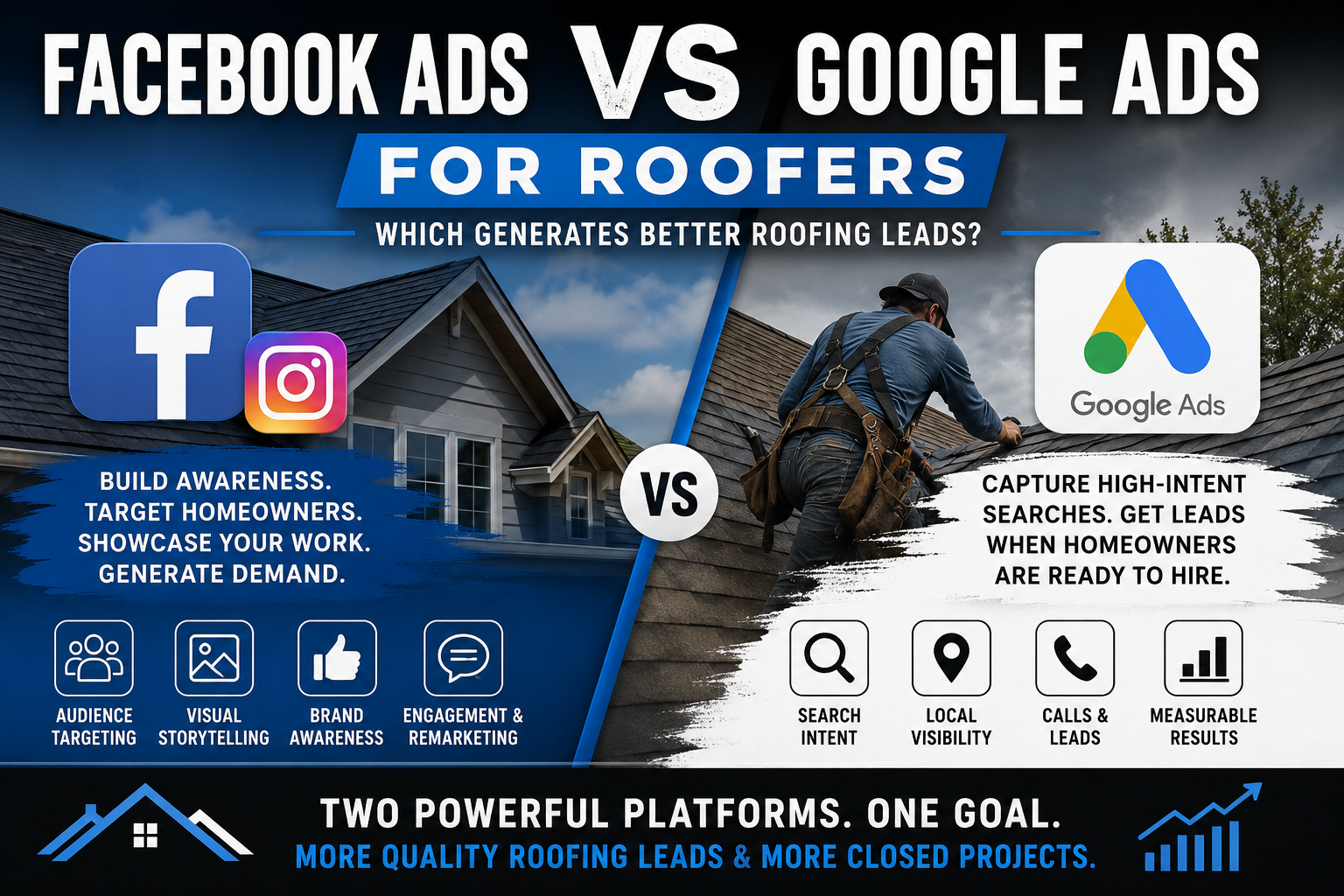
Facebook Ads vs Google Ads for Roofers: Which Generates Better Roofing Leads?
Every roofing company eventually asks the same question.
Should we spend our marketing budget on Facebook Ads or Google Ads?
Unfortunately, most contractors approach that question as though one platform must always outperform the other. They search for a single winner instead of understanding why each platform reaches homeowners at completely different moments during the buying journey.
That’s where many roofing companies waste thousands of advertising dollars.
Google Ads places your business in front of homeowners who are actively searching for roofing services. Meanwhile, Facebook Ads introduces your company to homeowners who may not yet realize they need a roofer—or who haven’t decided which contractor they should trust.
Those are two completely different audiences.
Consequently, they require different messaging, different landing pages, different offers, and different expectations for return on investment. Comparing them solely by cost per click or cost per lead ignores the much larger question of where each homeowner is in the decision-making process.
The highest-performing roofing companies don’t build their marketing strategy around platforms.
They build it around homeowner behavior.
Once you understand how homeowners actually research roof replacements, storm damage, insurance claims, financing, and contractor selection, the answer becomes much clearer. Facebook Ads and Google Ads aren’t competitors. They’re two powerful tools serving different purposes inside the same lead generation system.
Direct Answer
Google Ads generally produces the highest-intent roofing leads because homeowners are actively searching for roofing services. Facebook Ads excels at creating awareness, generating future demand, building trust, and fueling remarketing audiences. The strongest roofing marketing systems combine Facebook Ads, Google Ads, SEO, AI search optimization, and digital authority to guide homeowners throughout the complete buying journey.
Facebook Ads vs Google Ads for Roofers Starts With Understanding Homeowner Intent
The biggest mistake contractors make when comparing Facebook Ads vs Google Ads for roofers is assuming both platforms reach homeowners in the same mindset.
They don’t.
Imagine a homeowner discovers a large water stain spreading across the ceiling after a severe thunderstorm. They’re worried about additional damage, insurance deadlines, and protecting their home before another storm arrives.
That homeowner doesn’t open Facebook hoping an advertisement appears.
Instead, they immediately search Google for phrases such as “roof leak repair near me,” “emergency roofer,” “hail damage roofing contractor,” or “roof replacement company.”
Google Ads performs exceptionally well because it captures existing demand. The homeowner already knows they need professional help. They’re simply deciding which roofing company deserves the phone call.
Now imagine another homeowner.
The roof isn’t leaking today. However, it’s nearly twenty years old. Several neighbors recently replaced their roofs after storm season, and the homeowner has started wondering whether they should inspect theirs before problems become expensive.
That homeowner is far more likely to encounter educational Facebook content while scrolling social media than to search Google immediately.
Facebook Ads reach homeowners before the buying decision fully develops.
Google Ads reach homeowners after the buying decision has largely been made.
That’s the single biggest distinction between the two platforms.
Google captures demand.
Facebook creates future demand.
As you’ll see throughout this guide, understanding that difference changes how successful roofing companies allocate every advertising dollar.
Google Ads Win When Homeowners Need Roofing Services Immediately
Google Ads remains one of the strongest lead generation channels for roofing companies because it targets homeowners actively searching for solutions. Rather than interrupting someone scrolling social media, Google places your business directly in front of people requesting help.
Those searches often include:
- Roof replacement near me
- Emergency roofing contractor
- Roof leak repair
- Storm damage roofer
- Roof inspection
- Insurance claim roofing contractor
- Best roofing company near me
Every one of those searches represents existing buying intent.
That’s why Google Ads often produces excellent lead quality.
However, buying intent also creates intense competition. Every roofing company wants those same searches, especially after severe storms. Consequently, cost per click can become extremely expensive, making conversion rate optimization just as important as bidding strategy.
A roofing company paying for Google Ads should never send visitors to a generic homepage.
Instead, every advertisement should connect homeowners to highly relevant landing pages that answer the exact problem they searched for. Those pages should include project photos, customer reviews, financing information, warranties, FAQs, and strong calls to action that support immediate scheduling.
Google itself emphasizes creating useful landing experiences and relevant content within its advertising ecosystem, reinforcing the importance of matching user intent with the destination page.
Google Ads performs best when urgency already exists.
It doesn’t create the need.
It captures homeowners after the need already develops.
Facebook Ads Win Before the Homeowner Starts Searching
Facebook Ads operate at a completely different stage of the roofing buyer journey. Instead of waiting for homeowners to search for a contractor, Facebook and Instagram allow roofing companies to introduce a problem, explain why it matters, and create interest before an urgent need sends the homeowner to Google.
This makes Meta advertising especially valuable for roof replacements, storm inspections, financing offers, neighborhood campaigns, seasonal promotions, and educational content. A homeowner may not be actively searching for a roofer today, yet a well-timed advertisement can remind them that their roof is aging, expose signs of recent storm damage, or explain why delaying an inspection may create larger repair costs.
In other words, Facebook Ads can reach homeowners before competitors know an opportunity exists.
That advantage becomes particularly valuable after a storm. While many roofing companies immediately compete for expensive Google searches, Facebook campaigns can educate entire neighborhoods about hail damage, wind damage, insurance documentation, inspection timelines, and the warning signs homeowners should not ignore. As awareness grows, the roofing company becomes familiar before the homeowner begins comparing contractors.
However, Facebook leads must be handled differently from Google leads. Someone who clicks a Google Ad may already want an inspection, whereas a homeowner responding to a Facebook campaign may still be exploring whether a problem exists. Therefore, the sales process should include education, qualification, timely follow-up, and nurturing rather than assuming every submission is ready to sign a contract immediately.
Facebook Ads do not always find people who are ready to buy today. They help create the people who may be ready to buy tomorrow.
This is also why the website matters so much. After seeing a roofing advertisement, many homeowners will research the company before responding. They may read reviews, explore completed projects, compare services, or investigate whether the business appears trustworthy. A complete contractor website lead generation system gives that homeowner enough proof to continue instead of losing confidence after the initial click.
The Facebook Campaigns Most Likely to Work for Roofing Companies
Roofing companies often struggle with Facebook Ads because they use the platform like Google Search. They publish a generic advertisement that says, “Need a new roof?” and immediately ask cold homeowners to request an estimate. Although that approach may generate some opportunities, it ignores the reason people use social media in the first place.
Most homeowners are not scrolling Facebook hoping to encounter a contractor. Therefore, the advertisement must earn attention by presenting a relevant problem, useful insight, compelling visual, or timely reason to act. The strongest campaigns often connect roofing services to something the homeowner already recognizes, such as a recent storm, visible neighborhood activity, an aging roof, rising repair risk, or available financing.
| Facebook Campaign Type | Why It Can Work | Best Next Step |
|---|---|---|
| Storm damage awareness | Connects recent weather to potential hidden roof damage | Offer a professional inspection or educational damage checklist |
| Neighborhood project campaign | Uses nearby completed work to establish local relevance and social proof | Send homeowners to a local project case study |
| Roof age education | Helps homeowners recognize when replacement planning should begin | Provide a roof-life guide or inspection option |
| Financing campaign | Removes the assumption that replacement requires one large upfront payment | Explain available financing pathways clearly |
| Material comparison campaign | Engages homeowners already considering appearance, durability, or efficiency | Link to a detailed roofing comparison guide |
| Remarketing campaign | Reaches homeowners who previously visited the website but did not convert | Show reviews, project proof, warranties, or a stronger offer |
These campaigns work because they match the homeowner’s level of awareness. Rather than forcing an immediate estimate request, they create a logical bridge from curiosity to education and eventually to action.
The landing experience should continue that same conversation. If the advertisement discusses hail damage, the visitor should reach a focused storm-damage resource rather than a general homepage. Likewise, an advertisement featuring a completed neighborhood project should connect to a case study explaining what the homeowner faced, what the roofing company recommended, and how the project turned out.
That alignment improves trust because the message remains consistent from the advertisement through the website and into the sales conversation.
Facebook Ads vs Google Ads for Roofers Cannot Be Judged by Cost Per Lead Alone
Roofing companies frequently compare platforms by asking which one generates the cheapest lead. Although cost per lead matters, it can become dangerously misleading when the two platforms reach homeowners with different levels of intent.
A Google lead may cost more because the homeowner is actively searching for a roofing company and may be ready to schedule an inspection immediately. A Facebook lead may cost less because the homeowner responded to an educational message or offer before reaching the same level of urgency. Comparing those leads as though they are identical ignores the work still required to convert each one into a profitable project.
The more useful measurement is customer acquisition cost. That calculation includes the complete path from advertising spend to qualified lead, booked inspection, delivered estimate, sold project, and gross profit. Once those outcomes are connected, the platform producing the lowest-cost form submission may not be the platform producing the most profitable roofing customers.
| Metric | What It Reveals | What It Can Hide |
|---|---|---|
| Cost per click | How expensive it is to attract one website visit | Whether the visitor is qualified or converts |
| Cost per lead | How much each inquiry costs | Lead quality, intent, and sales readiness |
| Booked inspection rate | How many leads become real appointments | Whether those appointments become projects |
| Close rate | How effectively estimates become signed jobs | Project size and profitability |
| Customer acquisition cost | Total marketing cost required to acquire a customer | Lifetime value, referrals, and repeat work |
| Return on ad spend | Revenue generated relative to advertising spend | Gross margin and operational costs |
This is why strong attribution matters. Phone calls, forms, messages, booked inspections, and closed projects should connect back to the campaign that generated them. Otherwise, the roofing company may continue funding advertisements that produce activity without producing enough profitable work.
Likewise, the company should avoid publishing specific lead-cost claims as universal benchmarks. Market size, competition, seasonality, weather, reputation, landing-page quality, sales speed, and service mix all influence results. The best comparison uses the roofing company’s own closed-project data rather than a generic number from another market.
Google Leads Often Arrive Hotter, but Facebook Can Create Better Positioning
Google Ads usually have an advantage when urgency drives the search. A homeowner dealing with active water intrusion, visible storm damage, or an immediate insurance concern may contact several roofers within a short period. Because the problem already demands action, the lead often reaches the sales team closer to a decision.
However, higher urgency does not automatically mean the company has a strong competitive position. The homeowner may click several advertisements, request multiple inspections, and compare contractors primarily by response time, reviews, availability, and price. Consequently, even high-intent Google leads can enter an aggressive bidding environment.
Facebook Ads can create a different advantage by introducing the company before that bidding process begins. A homeowner may watch an educational video, see a neighborhood project, read a storm-damage guide, and encounter remarketing advertisements over several weeks. When the need becomes urgent, the company no longer feels unfamiliar.
That familiarity can improve future performance across other channels. The homeowner may later search the company’s name directly, click a Google Ad with greater confidence, visit the organic listing, or contact the business after seeing several reviews. Therefore, Facebook should not always receive credit only for the final form submission it generated directly.
This multi-touch journey is one reason isolated campaign reporting can underestimate the value of awareness and remarketing. The platform that introduced the roofing company may influence the booking even when another channel receives the final attribution.
Google may capture the final search, while Facebook may have created the trust that won the click.
The Platform Matters Less When the Landing Experience Is Weak
Roofing companies often blame the advertising platform when campaigns produce weak results. Sometimes the targeting or campaign structure does need improvement. However, the larger problem frequently appears after the click.
A homeowner who searches for emergency roof repair should not land on a generic homepage that discusses every service the company offers. Likewise, someone responding to a Facebook advertisement about hail damage should not have to search through multiple menus to find information about storm inspections.
Each campaign needs a landing experience aligned with the homeowner’s intent. The page should confirm that the visitor reached the right place, explain the problem clearly, establish local credibility, provide relevant proof, answer common objections, and present a sensible next step.
Strong roofing landing pages often include:
- A headline that matches the advertisement or search
- Clear explanations of the service or homeowner problem
- Relevant project photos and local case studies
- Customer reviews connected to similar work
- Warranty, financing, insurance, or scheduling information when appropriate
- Frequently asked questions that reduce uncertainty
- A visible phone number and focused estimate or inspection form
- Fast mobile performance and simple navigation
These elements support both paid advertising and organic visibility. In fact, the strongest advertising systems often use the same expanding digital assets that support long-term SEO lead generation. Paid traffic creates immediate demand, while SEO, reviews, educational content, and case studies improve the visitor’s confidence after arrival.
As a result, the website becomes the bridge connecting Facebook awareness with Google intent.
Remarketing Is Where Facebook and Google Begin Working Together
Most homeowners do not hire a roofing contractor after one advertisement or website visit. They may research the problem, speak with a spouse, review financing, wait for an insurance response, compare materials, or collect multiple estimates before making a final decision.
Remarketing keeps the roofing company visible during that delay. A homeowner who discovers the business through Google can later encounter project proof, customer reviews, financing options, and educational videos across Facebook and Instagram. Likewise, someone introduced through Facebook may later see the company again when searching Google for a roofing service.
This repeated exposure helps the brand feel familiar without relying on one platform to complete the entire sale. Each touchpoint can answer a different question, reinforce a different trust signal, or move the homeowner one step closer to scheduling an inspection.
However, remarketing should not repeat the same generic advertisement indefinitely. Strong sequences change according to what the homeowner has already seen. Someone who visited a storm-damage guide may receive a local case study, while a visitor who explored financing may see an explanation of payment options or a customer story involving a similar project.
That creates a more relevant buying experience because the marketing responds to behavior instead of broadcasting the same message to everyone.
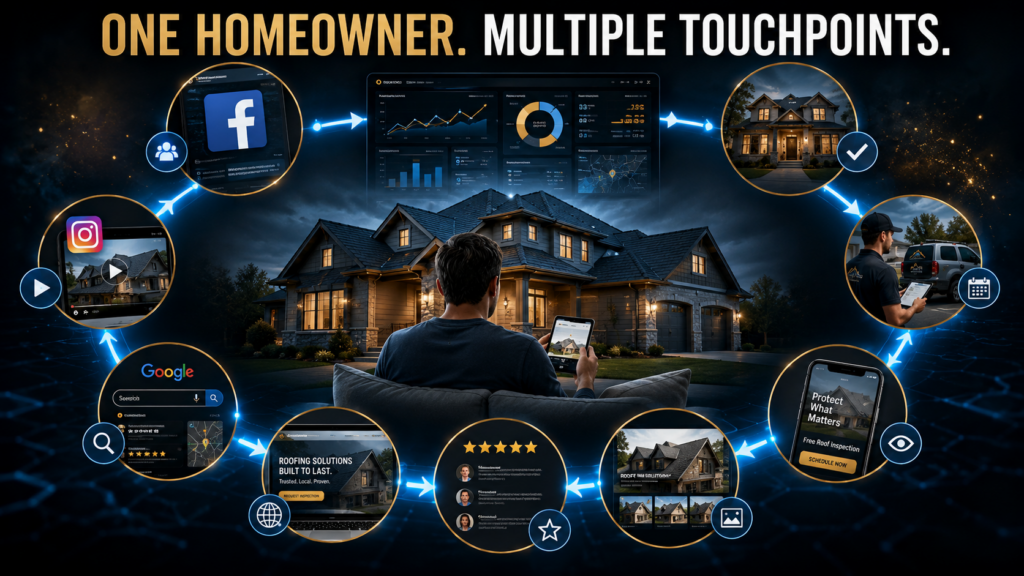
The Best Roofing Strategy Does Not Choose Facebook or Google
The strongest answer to Facebook Ads vs Google Ads for roofers is rarely choosing one platform and ignoring the other. Instead, the best roofing companies assign each channel a specific job inside a larger customer acquisition system. Google captures urgent demand, while Facebook introduces the company earlier, builds familiarity, and keeps the brand visible while homeowners continue researching.
This combined approach reflects how homeowners actually make roofing decisions. Someone may first see a storm-damage video on Facebook, visit an educational guide, leave without scheduling, search Google several days later, read reviews, and finally request an inspection after seeing a remarketing advertisement. No single platform created the customer alone because each touchpoint moved the homeowner closer to action.
That is why roofing companies should stop asking which advertising platform deserves the entire budget. A better question is how Facebook, Google, SEO, local search, reviews, case studies, and sales follow-up can work together without creating disconnected experiences.
A complete system may look like this:
-
Facebook creates awareness
Educational videos, storm alerts, neighborhood projects, financing messages, and roof-age campaigns introduce the company before the homeowner begins actively searching. These campaigns can also build valuable audiences based on video views, website visits, and engagement.
-
The website builds trust
Focused landing pages, homeowner guides, project case studies, reviews, FAQs, and financing information help visitors understand the problem and evaluate the contractor. A weak website can waste traffic from both platforms, while a strong contractor website lead generation system makes every advertising dollar more productive.
-
Google captures active demand
When the homeowner becomes ready to schedule an inspection, Google Search and local results place the roofing company in front of that immediate need. Branded searches can become especially valuable because previous Facebook exposure may cause the homeowner to search for the company directly instead of comparing unfamiliar contractors.
-
Remarketing maintains visibility
Facebook, Instagram, Google Display, YouTube, and other remarketing channels keep the company visible during the decision period. Instead of repeating one offer, the sequence can introduce reviews, warranties, completed projects, financing, and educational proof based on the homeowner’s behavior.
-
CRM follow-up converts interest into appointments
Fast calls, text messages, email nurturing, missed-call responses, and organized sales follow-up determine whether the opportunity becomes a booked inspection. Advertising generates attention, but the operational system converts that attention into revenue.
The best roofing companies do not run separate Facebook and Google campaigns. They build one homeowner journey powered by multiple channels.
How Roofers Should Allocate Budget Between Facebook Ads and Google Ads
There is no universal budget split that works for every roofing company. The right allocation depends on market competition, seasonality, storm activity, service mix, current brand awareness, website quality, sales capacity, and how urgently the company needs new opportunities.
A roofing company with strong local recognition may use Google Ads heavily because branded trust already exists. Meanwhile, a newer contractor entering a competitive market may need more Facebook awareness, educational content, and remarketing before high-intent search campaigns can convert efficiently.
The service being promoted also matters. Emergency leak repair naturally fits Google because urgency drives immediate searches. Roof replacement, financing, maintenance, neighborhood campaigns, and storm education may perform well on Facebook because those offers can create interest before homeowners feel pressure to act.
| Business Situation | Google Ads Role | Facebook Ads Role |
|---|---|---|
| Emergency roof repair | Capture immediate searches and phone calls | Support remarketing and local awareness |
| Storm restoration campaign | Capture active damage and insurance searches | Educate neighborhoods and create inspection demand |
| Roof replacement growth | Reach homeowners already comparing contractors | Build awareness around roof age, financing, and project proof |
| New market expansion | Capture existing local search demand | Introduce the brand and build familiarity in the market |
| Strong organic presence | Fill high-intent gaps and protect valuable searches | Expand reach and strengthen remarketing audiences |
| Limited sales capacity | Focus on narrow, high-intent services | Use controlled nurturing rather than excessive lead volume |
The budget should also follow closed-project data rather than platform preferences. If one campaign generates fewer leads but produces larger, more profitable roofing projects, it may deserve more investment than a campaign creating inexpensive inquiries that rarely become signed work.
Therefore, roofers should review budget allocation regularly. Storm events, seasonal demand, market saturation, and sales performance can change which platform deserves more attention. A flexible system responds to those changes instead of following one permanent percentage throughout the year.
Paid Ads Become More Profitable When SEO and Digital Authority Support Them
Facebook Ads and Google Ads can generate traffic immediately, but neither platform operates in isolation. Homeowners frequently investigate the roofing company before scheduling an inspection, even when the advertisement already captured their attention. They search the company name, read reviews, explore completed projects, compare services, and evaluate whether the business appears established enough to trust.
This research means SEO and digital authority influence paid advertising performance, even when organic search did not create the first click. A roofing company with hundreds of useful pages, strong reviews, local case studies, detailed service information, and clear project proof gives prospects more reasons to convert after encountering an advertisement.
By comparison, a company with a thin website may lose interested homeowners during the verification stage. The advertisement creates curiosity, yet the digital footprint fails to confirm the promise. As a result, the homeowner returns to Google and chooses a competitor with stronger evidence.
This is why IMR treats paid advertising and search engine optimization as complementary systems. Advertising can accelerate visibility, while SEO and content create the trust infrastructure that helps paid traffic convert. Over time, those owned assets also reduce dependence on purchasing every opportunity.
The same principle applies to emerging AI search. Homeowners increasingly ask platforms to compare roofing materials, explain storm damage, or recommend local contractors. A roofing company with deep topical authority gives search engines and AI systems more information to understand than a company relying only on advertisements.
As explained in IMR’s guide to how AI search is changing local marketing, future visibility will depend increasingly on becoming a trusted source rather than merely buying another placement. Paid campaigns may earn the first interaction, but authority often determines whether the homeowner believes the company deserves the project.
The Platform Cannot Fix Slow Roofing Lead Follow-Up
Roofing companies sometimes blame Facebook or Google when leads fail to convert, even though the larger problem occurs after the inquiry. Homeowners often contact several contractors, especially during storm season, and the company that responds first gains an immediate advantage.
Speed alone does not guarantee the sale, but delayed follow-up creates unnecessary friction. A homeowner dealing with active damage may continue calling until someone answers. Meanwhile, a Facebook lead with lower urgency may forget why they submitted the form if the roofing company waits until the next day to respond.
Strong lead handling should include immediate confirmation, rapid personal contact, clear qualification, appointment scheduling, and organized follow-up. Missed calls should trigger an automated text, form submissions should enter the CRM instantly, and sales representatives should understand which campaign created the inquiry so they can continue the correct conversation.
For example, a homeowner responding to a financing advertisement should not receive the same opening script as someone searching for emergency leak repair. The salesperson should know the message that attracted the lead and use that context to make the conversation relevant.
This alignment improves conversion because the homeowner does not have to explain the entire journey again. The advertising, landing page, and sales conversation feel like one connected experience rather than three unrelated systems.
| Lead Source | Likely Homeowner Mindset | Best Follow-Up Approach |
|---|---|---|
| Emergency Google search | Urgent, actively seeking help | Call immediately and prioritize scheduling |
| Roof replacement Google search | Comparing contractors and options | Confirm needs, explain proof, and schedule inspection |
| Facebook storm campaign | Concerned but may still need education | Explain inspection value and qualify the situation |
| Facebook financing campaign | Interested but concerned about affordability | Clarify financing pathways without overpromising |
| Remarketing conversion | Already familiar with the company | Reference prior interest and remove remaining uncertainty |
Eight Mistakes That Make Both Facebook Ads and Google Ads Fail
Roofing advertising usually fails through a combination of strategic and operational mistakes rather than one platform defect. Correcting these issues often improves performance faster than moving the entire budget from Facebook to Google or from Google to Facebook.
-
Sending every campaign to the homepage
A general homepage forces homeowners to search for the information promised in the advertisement. Focused landing pages create stronger message alignment and reduce the effort required to understand the offer.
-
Judging platforms only by cost per lead
Cheap leads can become expensive when they rarely schedule, close, or produce profitable projects. Roofers should evaluate customer acquisition cost, close rate, revenue, and gross profit instead of celebrating low form costs alone.
-
Using the same message on both platforms
Google users often express immediate intent, while Facebook users may need education and awareness. The same advertisement rarely speaks effectively to both mindsets.
-
Ignoring reviews and project proof
Homeowners frequently verify the roofing company after clicking an advertisement. Weak reviews, limited case studies, or an incomplete website can destroy trust before the sales team receives a chance to compete.
-
Following up too slowly
Roofing leads lose value quickly, especially when homeowners contact several companies. Fast, relevant, and organized follow-up remains one of the strongest controllable factors in advertising performance.
-
Running campaigns without proper attribution
Without call tracking, CRM integration, campaign tagging, and closed-project reporting, the company cannot identify which ads generate profitable work. Decisions then rely on incomplete platform dashboards instead of real business results.
-
Stopping campaigns before enough data exists
Advertising systems require sufficient conversion data to identify useful patterns. Constantly changing audiences, offers, and creative can prevent the company from learning what actually works.
-
Depending on paid ads without building owned authority
Advertising can generate immediate traffic, but it stops when spending ends. Contractors should simultaneously build reviews, SEO, case studies, educational content, and digital real estate for contractors that strengthen every future campaign.
Facebook Ads vs Google Ads for Roofers: Which One Should You Choose First?
A roofing company forced to choose one platform should base the decision on its immediate business problem. Companies needing urgent opportunities from homeowners already searching may begin with Google Ads. Meanwhile, businesses with strong operational capacity but limited brand awareness may use Facebook to build demand and introduce the company earlier.
However, the website and sales system must be ready before either platform receives a significant budget. Advertising cannot compensate for poor reviews, weak landing pages, slow follow-up, unclear offers, or limited proof. In fact, increased traffic often makes those weaknesses more expensive because the company pays to expose more homeowners to an incomplete experience.
Use the following decision framework:
- Choose Google Ads first when the company needs high-intent demand, offers urgent roofing services, has strong reviews, and can respond quickly.
- Choose Facebook Ads first when the company needs awareness, operates in a relationship-driven market, promotes financing or inspections, and has a nurturing process.
- Use both platforms together when the company has sufficient budget, strong landing pages, CRM tracking, and enough sales capacity to manage different lead types properly.
- Delay expansion when the website, reviews, attribution, or follow-up process cannot yet support additional traffic efficiently.
The goal should not be winning a debate between Facebook and Google. The goal should be building the most efficient path from homeowner attention to profitable roofing project.
Choose the platform based on the homeowner’s stage, then build the system that moves them forward.
Frequently Asked Questions About Facebook Ads vs Google Ads for Roofers
Are Facebook Ads or Google Ads better for roofing companies?
Google Ads generally work better when homeowners are actively searching for roof repair, replacement, inspections, or storm restoration. Facebook Ads usually perform better for creating awareness, educating homeowners, promoting financing, showcasing nearby projects, and remarketing to people who have already interacted with the roofing company.
Therefore, the better platform depends on the homeowner’s stage in the buying journey. Roofing companies with the budget, tracking, website, and sales capacity to support both platforms can often produce stronger results by using them together.
Which platform generates higher-quality roofing leads?
Google Ads often generate higher-intent roofing leads because the homeowner has already identified a problem and started searching for a contractor. However, those homeowners may also contact several roofing companies, which can create intense competition around response time, reputation, pricing, and availability.
Facebook Ads can generate valuable roofing opportunities earlier in the decision process. Although some leads may require more education and follow-up, the roofing company has an opportunity to build familiarity before the homeowner begins requesting estimates from competitors.
Are Facebook roofing leads cheaper than Google roofing leads?
Facebook can sometimes produce a lower cost per inquiry because advertisers are reaching homeowners before they begin actively searching. However, a cheaper inquiry does not automatically create a lower customer acquisition cost because the lead may require additional qualification, nurturing, and follow-up before becoming a booked inspection.
Roofers should compare each platform using sold projects, revenue, gross profit, close rates, and total acquisition costs rather than relying solely on the cost displayed inside the advertising dashboard.
Why are Google Ads expensive for roofers?
Roofing keywords can become expensive because several contractors compete for the same high-intent homeowners, particularly during storm season or periods of strong replacement demand. Google Ads uses an auction system, so competition, ad quality, landing-page relevance, location, device, bidding strategy, and expected performance can all influence advertising costs.
Improving the complete conversion system can make those clicks more valuable. Relevant landing pages, strong reviews, rapid follow-up, clear offers, and accurate conversion tracking may improve profitability without requiring the company to win every auction through higher bids.
Do Facebook Ads work for roof replacement companies?
Yes. Facebook Ads can work especially well for roof-age education, financing campaigns, neighborhood project promotions, storm-damage awareness, material comparisons, and before-and-after creative. These campaigns introduce replacement considerations before homeowners necessarily feel enough urgency to search Google.
The advertisement should lead into a relevant educational or conversion experience rather than immediately forcing every cold visitor to request an estimate. A well-planned nurture and remarketing sequence can then move interested homeowners closer to scheduling an inspection.
Should roofing companies send ad traffic to their homepage?
Usually, no. A general homepage must address several audiences and services, which can weaken the connection between the advertisement and the homeowner’s immediate need. A person searching for emergency roof repair should reach a different experience than someone responding to a Facebook campaign about financing a planned replacement.
Focused landing pages should match the campaign message, explain the relevant service, include appropriate proof, answer common questions, and present a clear next step. Google also recommends aligning ads and landing pages around relevance and a useful customer experience.
Can roofers run Facebook Ads and Google Ads at the same time?
Yes. Running both platforms can help roofing companies reach homeowners before, during, and after active search. Facebook can create awareness and build remarketing audiences, while Google can capture homeowners when they begin searching for immediate roofing solutions.
However, using both platforms effectively requires sufficient budget, separate messaging, relevant landing pages, reliable attribution, and a sales team that understands the difference between early-stage social leads and high-intent search leads.
How much should a roofer spend on Facebook Ads and Google Ads?
There is no universal advertising budget for every roofing company. The right investment depends on market size, competition, services, average project value, gross margin, close rate, seasonality, storm activity, website quality, and the number of leads the sales team can handle effectively.
Roofers should begin with a budget large enough to generate meaningful conversion data without exceeding operational capacity. Afterward, investment should move toward the campaigns producing profitable completed projects rather than the campaigns producing the most clicks or cheapest forms.
How quickly should a roofing company contact an advertising lead?
The company should respond as quickly as its operations reasonably allow, especially for urgent Google searches involving leaks, storm damage, or emergency repairs. Homeowners may contact several contractors, so unnecessary delays can allow another company to schedule the inspection first.
Facebook leads also benefit from quick follow-up, although the conversation may require more education. Automated confirmations, missed-call texts, CRM notifications, and clear assignment rules help prevent inquiries from becoming lost opportunities.
What should roofing companies track in paid advertising?
Roofers should track phone calls, form submissions, messages, qualified leads, booked inspections, completed estimates, signed contracts, project revenue, gross profit, and customer acquisition cost. Google Ads supports website, phone-call, and offline conversion measurement, while Meta provides tools such as the Meta Pixel and Conversions API for tracking and optimization.
Connecting advertising platforms to a CRM provides a more complete picture than relying on platform-reported leads. The campaign that generates the cheapest inquiry may not generate the most profitable roofing projects.
Does SEO make Facebook Ads and Google Ads more effective?
Yes. Homeowners frequently research a roofing company after seeing an advertisement, so strong organic visibility, useful content, reviews, local project proof, and detailed service information can increase confidence before conversion. SEO also creates additional entry points that continue attracting homeowners after paid campaigns end.
Therefore, roofing companies should not treat SEO and paid advertising as competing investments. Advertising accelerates demand, while owned digital authority strengthens conversion performance and gradually reduces dependence on purchasing every opportunity.
Should roofers use Meta lead forms or website landing pages?
Meta lead forms reduce friction because homeowners can submit their information without leaving Facebook or Instagram. However, that convenience may also produce inquiries from people who have completed less research and require more qualification before scheduling.
Website landing pages create an opportunity to educate the homeowner, display reviews, showcase relevant projects, and explain the service before collecting information. Many roofing companies test both approaches and judge performance based on qualified appointments and sold work rather than form volume alone.
Final Thoughts: Follow the Homeowner Instead of Choosing a Platform
The debate over Facebook Ads vs Google Ads for roofers becomes much easier once the company stops comparing platforms in isolation. Google reaches homeowners who have already identified a roofing need, while Facebook helps create awareness, trust, and future demand before many of those homeowners begin searching.
Each platform can generate profitable roofing projects, and each can waste money when the surrounding system remains weak. Poor landing pages, incomplete tracking, slow follow-up, limited reviews, generic messaging, and an underdeveloped website can undermine even a well-built advertising campaign.
The strongest roofing companies connect the entire journey. Facebook introduces the problem, educational content builds understanding, Google captures active search, remarketing maintains familiarity, the website establishes proof, and the sales team converts that trust into a scheduled inspection and signed project.
Do not ask whether Facebook or Google wins.
Ask how every channel helps the homeowner move toward choosing your roofing company.
Once every platform has a defined role, advertising becomes easier to measure and improve. More importantly, the roofing company stops buying disconnected leads and starts building an integrated customer acquisition system capable of producing both immediate demand and long-term market authority.
Build a Roofing Advertising System That Produces Profitable Projects
Facebook Ads and Google Ads can both generate roofing leads, but traffic alone does not create predictable growth. The roofing company also needs platform-specific messaging, focused landing pages, reliable attribution, strong reviews, rapid follow-up, educational content, and a website capable of turning homeowner research into trust.
Infinite Media Resources builds integrated roofing marketing systems that connect Meta advertising, Google Ads, SEO, local search, AI-search optimization, content, remarketing, conversion architecture, CRM follow-up, and closed-project reporting. Instead of managing every channel as a separate campaign, we create one connected journey designed around how homeowners actually discover and choose roofing companies.
This approach helps the business understand which campaigns create qualified appointments, which touchpoints influence the sale, and which investments generate profitable completed projects. Meanwhile, the company continues building owned digital assets that support future advertising rather than relying entirely on rented visibility.
Stop choosing between Facebook and Google.
Build the roofing lead system that makes both platforms more profitable.
Schedule a strategy consultation with Infinite Media Resources to discuss a roofing advertising and digital-authority system built around your market, services, sales capacity, and growth goals.
About the author : Anthony Paulino