The “UHNWI Filter”: Advanced Meta Targeting for Private Aviation
Direct Answer: The UHNWI Filter is a private aviation Meta ads strategy that uses compliant audience signals, creative qualifiers, offer framing, retargeting, CRM feedback, and conversion filtering to separate serious high-net-worth charter prospects from casual plane spotters. Therefore, instead of chasing cheap leads, the campaign system filters for people with real travel intent, route need, aircraft awareness, and financial readiness.
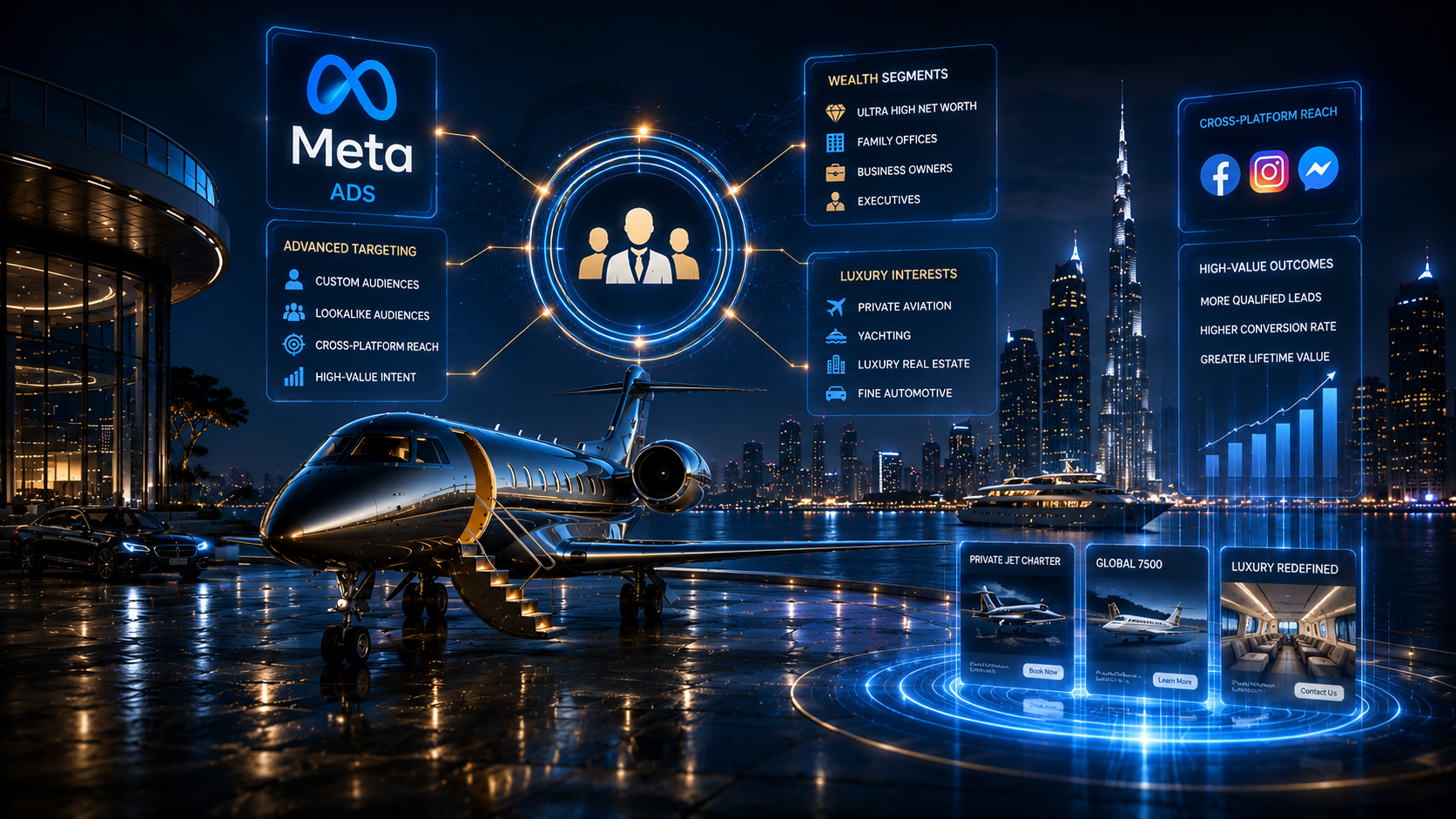
Meta targeting has changed. Previously, advertisers could rely more heavily on granular interest targeting. However, privacy changes, automation, data restrictions, and platform learning now require a better strategy. Therefore, private aviation campaigns should not depend on one “rich people” audience. Instead, they should build a layered filter that qualifies users through messaging, creative, landing pages, lead forms, and follow-up systems.
Additionally, private aviation requires more discretion than normal consumer marketing. UHNWI prospects do not want to feel tracked, exposed, or aggressively chased. Therefore, the best Meta ads strategy should respect privacy while still guiding qualified prospects toward a clear next step.
Meta explains that website custom audiences let advertisers reach people who have already shown interest in a business, while custom audiences can be built from advertiser data sources or Meta engagement data. Therefore, a strong aviation funnel should combine first-party traffic, CRM lists, engagement signals, and conversion feedback instead of relying only on cold targeting. Meta explains website custom audiences and Meta explains custom audiences.
Key Takeaways
- The UHNWI Filter focuses on lead quality, not cheap lead volume.
- Meta ads should qualify prospects through creative, offer, form, landing page, and follow-up design.
- Private aviation campaigns should avoid creepy, over-personalized, or privacy-invasive messaging.
- Retargeting works best when audience segments reflect real intent signals.
- Ultimately, Meta becomes stronger when CRM feedback teaches the system which leads become real opportunities.
What Is the UHNWI Filter?
Direct Answer: The UHNWI Filter is a layered Meta advertising system that improves private aviation lead quality by filtering users through intent, context, and qualification signals.
It does not mean targeting people by invasive personal assumptions. Instead, it means building a funnel that naturally attracts people with real private travel needs while discouraging casual engagement. Therefore, the campaign should not only ask, “Who can we target?” It should also ask, “Who should self-select into this offer?”
The filter works through seven layers:
- Audience signals
- Creative qualifiers
- Mission-based offers
- Lead form questions
- Landing page context
- Retargeting behavior
- CRM quality feedback
As a result, Meta becomes less of a broad awareness channel and more of a controlled qualification system.
Why Meta Targeting Is Hard for Private Aviation
Direct Answer: Meta targeting is hard for private aviation because many users engage with jet content without having charter intent or financial readiness.
Private jets attract attention. However, attention does not always equal demand. Plane spotters, aviation enthusiasts, luxury dreamers, and low-budget travelers may click beautiful aircraft ads. Therefore, if the campaign optimizes only for cheap leads, it can fill the CRM with unqualified inquiries.
Additionally, Meta’s automation may chase the easiest conversions unless the funnel sends better quality signals. Therefore, the advertiser must design the campaign so the easiest conversion is not the wrong conversion.
Proof Breadcrumb: broad aircraft ad → cheap engagement → weak leads. Mission-specific ad → fewer clicks → better opportunity quality.
The UHNWI Filter Framework
Direct Answer: The best private aviation Meta funnels filter at every stage, not only inside the targeting settings.
Use this formula:
UHNWI Filter = Audience Quality × Creative Qualification × Mission Offer × Form Friction × CRM Feedback × Privacy Trust
Each variable matters. First, the audience creates the starting pool. Next, the creative filters attention. Additionally, the offer clarifies mission relevance. Then, the form qualifies intent. Meanwhile, CRM feedback reveals lead quality. Finally, privacy trust protects the brand experience.
Therefore, a successful campaign is not just a targeting trick. Instead, it is a full conversion architecture.
Step 1: Build Compliant Audience Layers
Direct Answer: Start with compliant audience layers based on first-party data, website behavior, engagement, and broad market signals.
Because privacy and targeting rules continue to evolve, private aviation campaigns should rely more on first-party intent signals and less on fragile interest stacks. Therefore, the foundation should include website custom audiences, engagement audiences, customer list custom audiences when permitted, and broad prospecting supported by strong creative.
Audience Layers to Build
- Website visitors from aircraft pages
- Website visitors from route-pair pages
- Website visitors from airport authority pages
- Video viewers who watched high-intent aviation content
- Instagram and Facebook engagers
- Qualified CRM customer lists when properly collected and permitted
- Lookalike or automated expansion from qualified seed data when appropriate
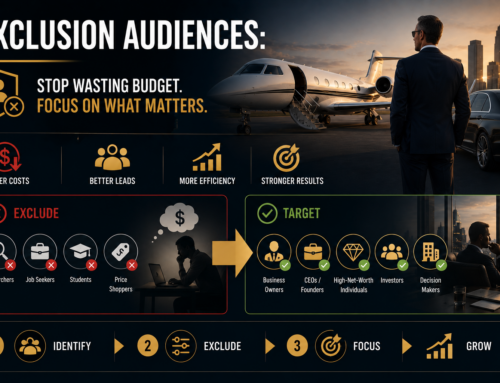
- Exclusion audiences for unqualified leads, employees, vendors, or job applicants
Meta says customer list custom audiences help advertisers find existing audiences across Meta technologies. Therefore, qualified CRM data can become a strong input when it is collected and used lawfully. Meta explains customer list custom audiences.
Action Step: Build separate audiences for aircraft-page visitors, route-page visitors, and pricing-page visitors. Then tailor retargeting messages to each intent level.
Step 2: Use Creative That Filters Out Low Intent
Direct Answer: Private aviation creative should attract qualified buyers while discouraging casual clickers.
Beautiful jet imagery can generate cheap engagement. However, it can also attract unqualified users. Therefore, the creative should include signals that clarify the offer, mission, and buyer type.
Creative Qualifiers That Improve Lead Quality
- Route-specific messaging
- Aircraft-class references
- Executive travel framing
- Family office language when appropriate
- Time-sensitive availability context
- Mission planning angles
- Premium service positioning
- Clear next-step expectations
For example, “Private Jet Available” may attract curiosity. However, “Plan a Heavy Jet Mission From Palm Beach to London” speaks to a more specific buyer. Therefore, the second message filters harder before the click.
Action Step: Replace generic luxury language with route, mission, and aircraft intent in at least 50% of your ad tests.
Step 3: Frame Offers Around Mission Intent
Direct Answer: Mission-based offers outperform generic “request a quote” ads because they match how serious buyers think.
UHNWI buyers and their teams usually care about the trip outcome. Therefore, offers should focus on mission planning, route availability, aircraft fit, or time-sensitive travel needs.
Offer Examples
- Request heavy jet availability for your Europe mission
- Plan a Palm Beach to Aspen charter
- Compare aircraft options for your route
- Check empty leg opportunities from South Florida
- Get mission-specific pricing guidance
- Build a private flight plan for your next executive trip
Additionally, each offer should connect to a matching landing page. As a result, the user sees continuity from ad to page to form.
Step 4: Design Lead Forms That Qualify, Not Inflate
Direct Answer: Lead forms should add enough friction to identify real charter intent without making serious buyers work too hard.
Instant forms can produce volume quickly. However, low-friction forms can also create low-quality leads. Therefore, private aviation campaigns should use qualification questions that separate serious buyers from casual users.
Useful Form Questions
- What departure city or airport are you considering?
- What destination are you considering?
- When are you looking to travel?
- How many passengers?
- Are you looking for one-way, round trip, or flexible options?
- Do you need help choosing an aircraft class?
- What is the best way to reach you quickly?
However, do not over-ask. Instead, ask the questions needed to qualify the mission. Therefore, the form creates useful sales context without damaging completion rates.
Action Step: Use a higher-intent form type or landing page form for premium campaigns. Then compare booked-call quality, not only cost per lead.
Step 5: Retarget Based on Intent Signals
Direct Answer: Retargeting should match the page category, not just the fact that someone visited the site.
A visitor who read a Citation Longitude article needs a different follow-up than someone who viewed a Palm Beach to London page. Therefore, segment retargeting by behavior.
Retargeting Segments
- Aircraft model viewers
- Route-pair viewers
- Airport page viewers
- Pricing guide viewers
- Empty leg page viewers
- Video viewers
- Lead form openers who did not submit
- Submitted leads who did not book a call
Meta explains that website custom audiences can reach people who already showed interest in a business. Therefore, route and aircraft retargeting can create a sharper follow-up system. Meta explains website custom audiences.
Step 6: Feed CRM Quality Back Into Strategy
Direct Answer: The best Meta strategy improves when CRM data shows which leads become real opportunities.
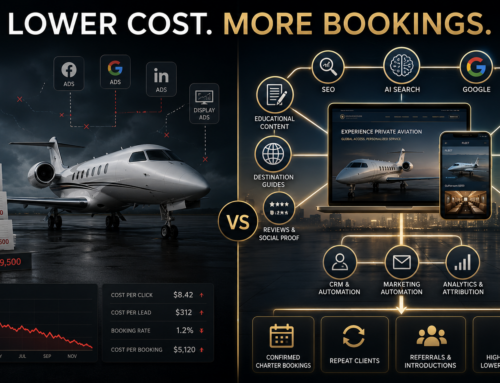
Cost per lead can mislead private aviation advertisers. For example, a campaign with a $40 lead cost may produce no serious opportunities. Meanwhile, a campaign with a $250 lead cost may produce real charter conversations. Therefore, CRM quality matters more than front-end CPL.
Track These CRM Fields
- Campaign source
- Ad set
- Creative angle
- Landing page
- Aircraft interest
- Route interest
- Travel timeframe
- Passenger count
- Qualified or unqualified status
- Booked call status
- Closed revenue or estimated opportunity value
Additionally, upload offline conversion events when appropriate and compliant. As a result, the platform can receive better signals about lead quality.
Step 7: Keep UHNWI Privacy at the Center
Direct Answer: UHNWI Meta targeting must respect privacy because discretion is part of the value proposition.
Do not write ads that feel invasive. For example, avoid copy that implies you know someone’s wealth, location, habits, or personal life. Instead, write from the mission perspective: route, aircraft need, timing, and service expectations.
Privacy-Safe Messaging Principles
- Speak to the mission, not personal identity.
- Use professional language, not creepy personalization.
- Avoid implying sensitive knowledge about the user.
- Use first-party data responsibly.
- Keep privacy policies clear.
- Train sales teams to handle inquiries discreetly.
Additionally, Meta has continued moving toward more privacy-focused ad systems, and regulation varies by region. Therefore, campaigns should be reviewed regularly for compliance, especially when targeting international audiences.
The Private Aviation Meta Funnel Map
Direct Answer: The UHNWI Filter works best when each funnel stage has a different job.
| Funnel Stage | Goal | Example Strategy |
|---|---|---|
| Cold Prospecting | Find qualified attention | Mission-based creative with broad or relevant audience signals |
| Engagement | Build intent pools | Video views, aircraft content, route content, airport content |
| Retargeting | Match follow-up to behavior | Route-specific ads after route-page visits |
| Lead Capture | Qualify mission intent | Form questions about route, date, passengers, and aircraft class |
| Speed-to-Lead | Convert urgency | AI caller, SMS, phone call, or advisor follow-up |
| CRM Feedback | Improve optimization | Qualified lead and booked-call reporting |
Campaign Examples
Direct Answer: The strongest campaigns combine mission-specific creative with behavior-based retargeting.
Campaign 1: South Florida Heavy Jet Mission
Use creative around Palm Beach, Opa-locka, and Fort Lauderdale heavy jet travel. Then send clicks to a South Florida heavy jet landing page. Additionally, retarget visitors with Palm Beach to London, Miami to Paris, and Fort Lauderdale to Aspen angles.
Campaign 2: Empty Leg Retargeting
Build an audience of route-page visitors and empty leg guide readers. Then run ads inviting them to receive route-specific empty leg alerts. Therefore, the offer feels useful instead of generic.
Campaign 3: Aircraft Comparison Funnel
Promote a G650ER vs Global 7500 comparison guide. Then retarget engaged readers with long-range mission planning CTAs. As a result, the campaign filters for aircraft-aware buyers.
Campaign 4: Executive Travel Lead Filter
Use creative around time-sensitive executive missions. Then qualify leads by route, timeframe, passenger count, and trip type. Consequently, your sales team receives better context before outreach.
Metrics That Matter
Direct Answer: Private aviation Meta campaigns should measure qualified opportunities, not just cost per lead.
Cheap CPL can destroy sales productivity. Therefore, measure the full funnel.
Track These Metrics
- Cost per qualified lead
- Cost per booked call
- Lead-to-call rate
- Call-to-opportunity rate
- Route quality
- Aircraft quality
- Travel timeframe quality
- Unqualified lead percentage
- Sales response time
- Estimated pipeline value
- Closed revenue
Additionally, track creative quality by opportunity value. As a result, you can scale ads that create real business, not only cheap forms.
Common Meta Targeting Mistakes
Direct Answer: Most private aviation Meta campaigns fail because they optimize for attention instead of qualified demand.
- Using generic jet photos with no mission filter
- Targeting broad luxury interests without enough qualification
- Using forms that are too easy for casual users
- Tracking CPL instead of qualified pipeline
- Retargeting all visitors with the same message
- Ignoring CRM feedback
- Using invasive or creepy personalization
- Failing to exclude unqualified audiences
- Sending all traffic to generic landing pages
- Not using route, aircraft, or airport context
Instead, build the filter across the entire journey. Therefore, every click teaches you more about intent.
Frequently Asked Questions
Can Meta Ads reach UHNWI private aviation buyers?
Yes. However, the campaign must filter for mission intent and lead quality because many users engage with jet content without real charter demand.
What is the UHNWI Filter?
The UHNWI Filter is a layered Meta ads system that uses audience signals, creative qualifiers, mission-based offers, lead form questions, retargeting, and CRM feedback to improve lead quality.
Should private aviation campaigns use broad targeting?
Sometimes. However, broad targeting needs strong creative, landing pages, forms, and CRM feedback so Meta optimizes toward quality rather than cheap conversions.
What should private jet lead forms ask?
They should ask about departure location, destination, travel timeframe, passenger count, trip type, aircraft needs, and contact preference.
How do you avoid wasting budget on plane spotters?
Use mission-specific creative, route-based offers, qualifying form questions, CRM exclusions, and retargeting based on high-intent content behavior.
External Sources
Conclusion
Direct Answer: The UHNWI Filter helps private aviation brands use Meta Ads to attract serious prospects while reducing wasted budget from low-intent engagement.
Meta can work for private aviation. However, it should not chase cheap leads. Therefore, the strongest strategy uses compliant audience layers, mission-specific creative, qualified forms, behavior-based retargeting, CRM feedback, and privacy-safe messaging.
Final Insight: In private aviation, the goal is not more leads. Instead, the goal is fewer bad leads, more serious conversations, and better high-value opportunities.
About the author : Anthony Paulino