Integrating Your Charter CRM with Your Ad Pixels for Full-Funnel Attribution
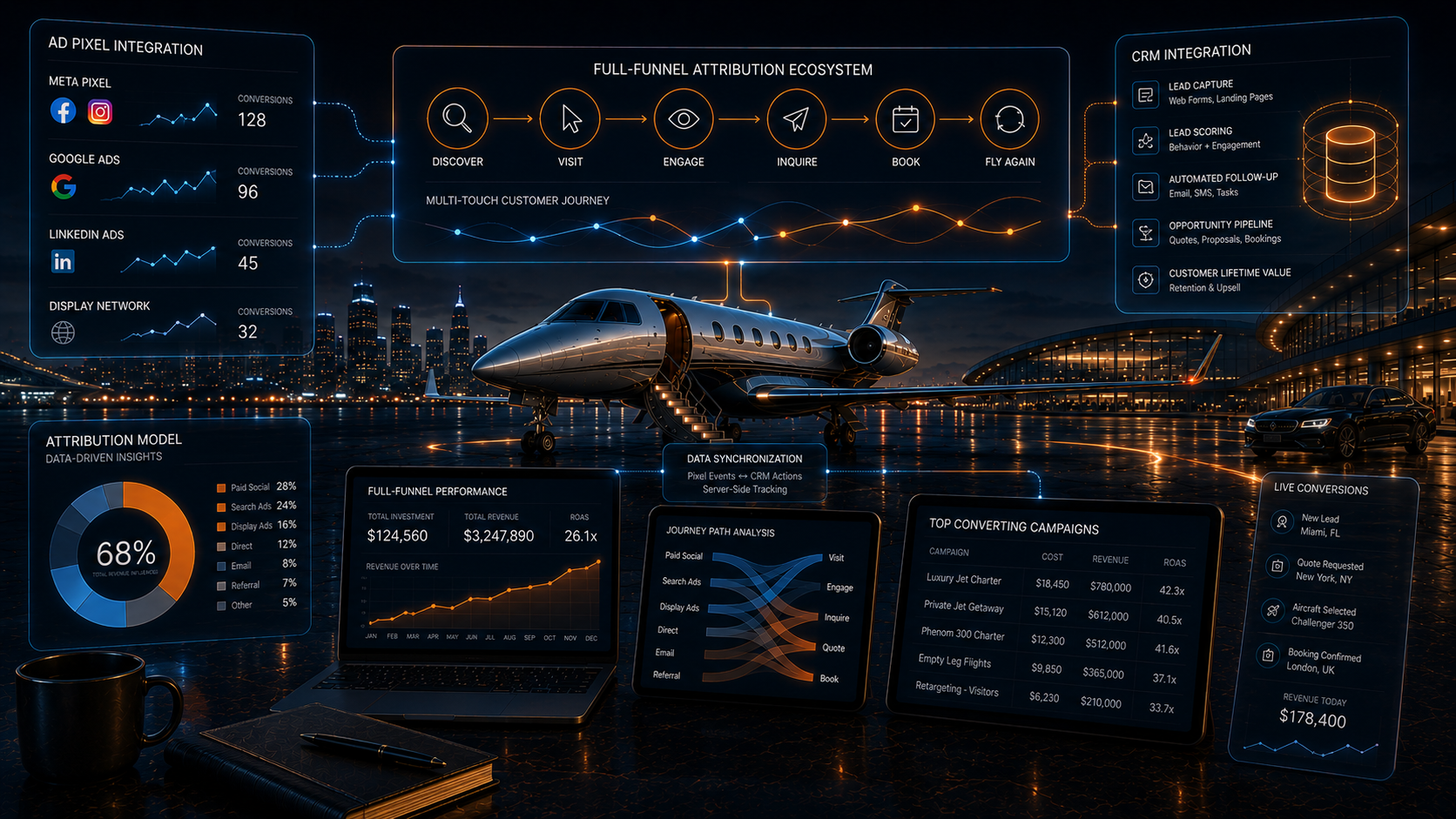
Direct Answer: Charter CRM ad pixel attribution connects your website, Meta Pixel, Google Ads tag, offline conversion events, CRM stages, and booked charter revenue so you can see which ads generate real private aviation opportunities instead of raw form fills. Therefore, charter operators should track each lead from click to consultation, quote, route fit, aircraft fit, closed charter, repeat booking, and gross profit.
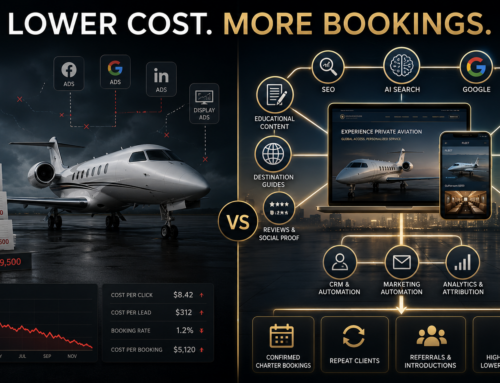
Most aviation marketing reports stop too early. They show cost per lead, form submissions, impressions, and clicks. However, those numbers do not prove whether the campaign attracted real travelers, plane spotters, assistants, family offices, or unqualified browsers.
Therefore, charter companies need full-funnel attribution. The CRM must send meaningful lead outcomes back to Meta, Google, analytics platforms, and reporting dashboards. As a result, the ad platforms can optimize toward better opportunities, not cheaper junk leads.
Google explains that conversion tracking helps measure valuable customer actions, while Meta supports CRM and offline event integrations through the Conversions API and offline event workflows. Therefore, aviation brands should connect form data, CRM stages, and revenue outcomes wherever privacy rules and platform policies allow. Google explains conversion tracking, Google explains offline conversion imports, and Meta explains the Conversions API.
Key Takeaways
- Charter companies should not optimize only for form fills.
- However, many ad accounts still treat every lead as equal.
- Therefore, CRM stages must feed qualified outcomes back into ad reporting.
- Additionally, route fit, aircraft fit, quote value, and closed revenue should shape optimization.
- Ultimately, full-funnel attribution turns aviation ads from lead volume campaigns into profit systems.
What Is Charter CRM Ad Pixel Attribution?
Direct Answer: Charter CRM ad pixel attribution connects marketing source data to CRM outcomes so you can see which campaigns produce real charter revenue.
A pixel records web activity. A CRM records sales activity. However, the real power comes when both systems communicate. Therefore, you can identify which ads create serious route inquiries, booked advisor calls, quotes, and closed flights.
Attribution Should Connect
- ad campaign
- ad set or audience
- creative
- landing page
- form submission
- CRM lead record
- qualified lead status
- route and aircraft fit
- quote value
- booked consultation
- closed charter revenue
- gross profit estimate
As a result, marketing decisions become revenue-based instead of CPL-based.
Why Aviation Attribution Usually Breaks
Direct Answer: Aviation attribution breaks because ad platforms see the lead, but they often cannot see what happened after sales follow-up.
For example, Meta may know that a lead form was submitted. However, Meta may not know whether the person requested a real route, had budget, answered the phone, booked a quote call, or converted into a charter.
Common Attribution Gaps
- no CRM connection
- no offline conversion upload
- no lead quality scoring
- no booked-call tracking
- no quote-stage tracking
- no revenue attribution
- no gross profit tracking
- no source field cleanup
- no UTM standards
- no feedback loop to ad platforms
Therefore, campaigns optimize toward cheap leads instead of profitable opportunities.
The Events Every Charter Company Should Track
Direct Answer: Charter companies should track events that represent buyer intent and sales value.
Core Website Events
- page view
- route page view
- aircraft page view
- airport page view
- CTA click
- form start
- lead submit
- phone click
- calendar booking
Core CRM Events
- new lead
- qualified lead
- route fit confirmed
- aircraft fit confirmed
- advisor call booked
- quote requested
- quote sent
- closed won
- closed lost
- repeat booking
Additionally, each event should have a clear definition so reporting stays clean.
CRM Stages That Matter for Charter Attribution
Direct Answer: The best CRM stages separate raw leads from real charter opportunities.
Every form fill should not count as a win. Therefore, your CRM should identify lead quality early.
Recommended CRM Pipeline
- New Lead
- Contact Attempted
- Connected
- Qualified Route
- Aircraft Fit Reviewed
- Advisor Call Booked
- Quote Requested
- Quote Sent
- Negotiation
- Closed Won
- Closed Lost
- Repeat Opportunity
Consequently, you can optimize ads for deeper pipeline movement instead of surface-level inquiries.
Meta Pixel and Conversions API Setup
Direct Answer: Meta attribution improves when the Pixel and Conversions API work together to send browser and server-side events.
The Meta Pixel tracks browser-based actions. However, browser tracking can lose data because of cookies, browsers, and privacy settings. Therefore, the Conversions API can improve event reliability by sending server-side events from your website or CRM.
Meta Events to Send
- Lead
- CompleteRegistration
- Schedule
- QualifiedLead
- QuoteRequested
- Purchase or ClosedWon
Additionally, send event values when appropriate. For example, a closed charter may pass revenue or estimated gross profit into reporting.
Google Ads and Offline Conversion Setup
Direct Answer: Google Ads offline conversions help connect click IDs to downstream CRM outcomes.
When someone clicks a Google ad, the click can include a Google Click ID. If that lead later becomes qualified or closed, the CRM can send the outcome back to Google Ads. Therefore, Google can optimize toward better leads.
Google Offline Events to Import
- qualified lead
- advisor call booked
- quote requested
- quote sent
- closed charter
- repeat booking
Additionally, offline imports should use consistent timestamps, conversion names, click IDs, and values.
HubSpot and Charter CRM Tracking
Direct Answer: HubSpot can centralize source tracking, CRM stages, lifecycle events, and sales outcomes for charter attribution.
HubSpot forms, tracking codes, workflows, lifecycle stages, and ad integrations can help connect traffic sources to sales activity. Therefore, it works well for charter companies that need one place to manage leads, calls, and pipeline.
HubSpot Fields to Track
- original source
- UTM source
- UTM medium
- UTM campaign
- UTM content
- landing page
- departure airport
- destination airport
- travel window
- passenger count
- aircraft preference
- lead quality score
- deal value
- gross profit estimate
As a result, sales and marketing can work from the same truth.
How to Track Qualified Charter Leads
Direct Answer: A qualified charter lead should meet route, timing, contact, and buying-intent standards.
Qualified Lead Criteria
- real departure location
- real destination
- reasonable travel window
- accurate contact details
- passenger count
- aircraft class fit
- buyer or assistant engagement
- realistic trip value
Additionally, create a CRM property called “Qualified Charter Lead.” Then send that event back to Meta and Google. Therefore, platforms learn which leads matter.
How to Attribute Revenue and Gross Profit
Direct Answer: Revenue attribution connects closed charters back to the campaign, while gross profit attribution shows true campaign economics.
Total charter value can be misleading. Therefore, tracking gross profit creates better decision-making.
Track These Values
- total charter price
- operator cost
- gross profit
- ad source
- deal stage
- closed-won date
- repeat booking value
- referral value
Consequently, the business can scale campaigns based on actual profit, not lead volume.
Privacy-Safe Attribution Rules
Direct Answer: Attribution must respect privacy laws, platform rules, and user consent requirements.
Private aviation clients value discretion. Therefore, tracking must remain careful, compliant, and professional.
Privacy-Safe Practices
- use clear privacy disclosures
- avoid unnecessary sensitive data sharing
- hash customer information when required
- follow platform event policies
- limit access to CRM records
- use consent tools where needed
- send only necessary event data
- keep private travel details out of ad platforms when unnecessary
Additionally, consult legal guidance for privacy requirements in your markets.
The Full-Funnel Attribution Dashboard
Direct Answer: A full-funnel dashboard should show the path from ad spend to closed charter value.
Dashboard Sections
- spend by campaign
- cost per raw lead
- cost per qualified lead
- cost per booked call
- cost per quote request
- cost per closed charter
- gross profit by source
- lead quality by campaign
- route demand by source
- aircraft demand by source
- closed-won revenue
Therefore, leadership can see which campaigns deserve more budget.
How Attribution Improves Ad Optimization
Direct Answer: Attribution improves ads by teaching platforms and marketers which leads actually turn into valuable opportunities.
If Meta only sees raw leads, it may find more cheap leads. However, if Meta receives qualified lead and closed-won signals, it can optimize more intelligently.
Attribution Helps Improve
- audience quality
- creative direction
- landing page strategy
- budget allocation
- retargeting logic
- lookalike seed quality
- campaign scaling
- sales follow-up quality
As a result, higher CPL can become acceptable when opportunity quality improves.
Attribution Event Map
Direct Answer: Every meaningful sales stage should map to a trackable marketing event.
| Funnel Stage | System | Event Name | Optimization Value |
|---|---|---|---|
| Visitor views route page | Website Pixel | RoutePageView | Retargeting audience |
| Visitor starts form | Website Pixel | FormStart | Intent signal |
| Visitor submits form | Website + CRM | Lead | Raw lead tracking |
| Sales confirms route fit | CRM | QualifiedLead | Quality optimization |
| Advisor call booked | CRM | Schedule | Sales intent |
| Quote requested | CRM | QuoteRequested | Opportunity signal |
| Charter closes | CRM | ClosedWon | Revenue optimization |
Common Attribution Mistakes
Direct Answer: Attribution fails when businesses track leads but ignore sales outcomes.
- optimizing only for CPL
- not using UTMs
- not storing click IDs
- not connecting CRM stages
- not sending offline conversions
- not defining qualified leads
- not tracking gross profit
- not separating route intent from casual inquiries
- not using privacy-safe data practices
- not reviewing campaign quality weekly
Instead, build attribution around qualified charter economics.
Frequently Asked Questions
What is full-funnel attribution for charter companies?
Full-funnel attribution connects ad clicks, website actions, CRM stages, qualified leads, quotes, closed charters, and revenue in one tracking system.
Why is cost per lead not enough?
Cost per lead does not show whether the lead had real route intent, buying ability, aircraft fit, or closed revenue potential.
Should charter companies send CRM events back to Meta and Google?
Yes, when privacy rules and platform policies allow it. Qualified lead and closed-won events help platforms optimize toward better outcomes.
What CRM events matter most?
Qualified lead, advisor call booked, quote requested, quote sent, closed won, and repeat booking events matter most.
How does attribution improve aviation ad performance?
Attribution helps teams shift budget toward campaigns, creatives, audiences, and landing pages that produce real charter opportunities.
External Sources
Conclusion
Direct Answer: Charter CRM ad pixel attribution gives operators the ability to measure which ads generate real aviation revenue instead of surface-level leads.
Raw CPL can mislead the entire business. However, full-funnel tracking reveals the real picture. Therefore, charter operators should connect pixels, UTMs, CRM stages, offline conversions, qualified lead scoring, quotes, closed revenue, and gross profit into one attribution system.
Final Insight: The best aviation ads do not win because they create the cheapest leads. They win because they create the most profitable charter opportunities.
About the author : Anthony Paulino