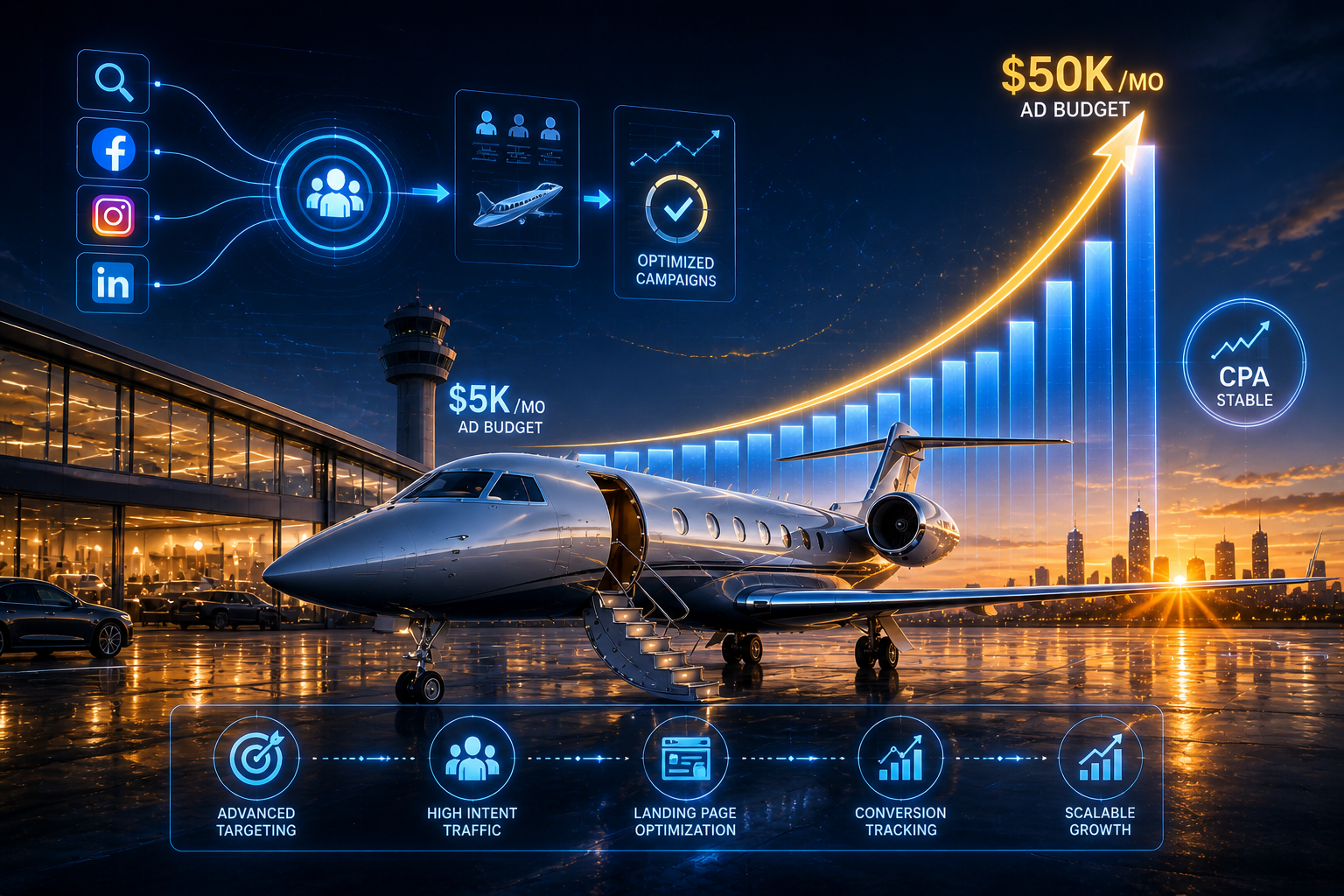
How to Scale an Aviation Ad Budget from $5k to $50k/mo Without CPA Bloat
Direct Answer: To scale an aviation ad budget from $5k to $50k per month without CPA bloat, increase spend in stages while improving tracking, creative volume, audience quality, CRM feedback, landing page conversion, and sales response speed. Therefore, the goal is not simply to spend more. Instead, the goal is to give Meta, Google, and your sales team better signals before each budget jump.
Most aviation campaigns fail during scaling because they treat budget as the growth lever. However, budget only amplifies the system that already exists. If the funnel has weak tracking, generic creative, poor qualification, slow follow-up, and unclear source data, scaling makes those problems more expensive. Therefore, the first rule is simple: fix signal quality before raising spend aggressively.
Additionally, private aviation has a different math model than low-ticket ecommerce. A campaign can look expensive at the lead level but profitable at the deal level. Meanwhile, a campaign can show a cheap CPL while filling the CRM with low-intent leads. As a result, aviation brands must scale around qualified opportunities, booked calls, and revenue potential instead of raw lead cost alone.
Meta explains that Advantage+ campaign budget automatically manages budget across ad sets to pursue better results, while Meta’s Conversions API creates a direct connection between marketing data and Meta’s optimization systems. Therefore, scalable aviation campaigns need both smart budget allocation and better conversion data. Meta explains Advantage+ campaign budget and Meta explains Conversions API.
Key Takeaways
- Scaling from $5k to $50k per month requires stronger systems, not only more budget.
- However, CPA bloat usually starts when spend rises faster than creative, tracking, and sales quality.
- Therefore, scale in controlled stages with clear performance gates.
- Additionally, use CRM feedback, offline conversion signals, and qualified-lead reporting to guide spend.
- Ultimately, the best aviation ad scaling plan protects cost per qualified opportunity, not just cost per lead.
What Is CPA Bloat?
Direct Answer: CPA bloat happens when cost per acquisition rises as budget increases because the campaign exhausts easy demand, weakens targeting quality, or sends poor signals to the ad platform.
At $5k per month, a campaign may survive on a few strong creatives and a narrow audience. However, at $50k per month, the platform needs more qualified signals, more creative variety, more landing page depth, and more conversion data. Therefore, scaling exposes every weak part of the funnel.
In aviation, CPA bloat can also appear when campaigns optimize for the wrong action. For example, Meta may find people likely to fill out a form if that is the main signal. However, those people may not be likely to book a real private flight. Therefore, the campaign should optimize toward deeper quality signals whenever possible.
Why Aviation Campaigns Break When They Scale
Direct Answer: Aviation campaigns break during scaling because the market is narrow, the buyer is selective, and the conversion path requires trust.
Private aviation is not a mass-market purchase. Therefore, more spend does not automatically create more qualified buyers. Instead, more spend often reaches colder audiences, broader placements, and weaker intent pools. Additionally, creative fatigue can increase quickly when the same aircraft image runs too long.
Common Scaling Pressure Points
- Creative fatigue increases.
- Audience quality drops.
- Retargeting pools get saturated.
- Lead forms attract lower-intent users.
- Landing pages fail to qualify traffic.
- Sales response cannot keep up.
- CRM feedback does not reach the ad platform.
- Reporting focuses on CPL instead of opportunity value.
Consequently, the fix is not always to reduce budget. Instead, fix the weak scaling layer and then continue expanding.
The $5k to $50k Scaling Framework
Direct Answer: The safest way to scale aviation ad spend is to move through staged budget levels with performance gates.
Use this formula:
Scalable Spend = Qualified Signal Quality × Creative Supply × Funnel Conversion × Sales Speed × Budget Discipline
First, qualified signal quality tells the platform what matters. Next, creative supply prevents fatigue. Additionally, funnel conversion protects CPA as traffic volume grows. Meanwhile, sales speed protects ROI because aviation leads decay quickly. Finally, budget discipline prevents emotional scaling.
Therefore, scaling should happen only when the previous stage proves stable.
Stage 1: Stabilize the $5k Foundation
Direct Answer: At $5k per month, your goal is to prove the offer, tracking, creative angle, and lead quality before scaling.
This stage should not chase volume. Instead, it should identify which message creates real conversations. Therefore, keep the campaign simple enough to read the data clearly.
What to Build at $5k/mo
- One core offer
- Two to three audience concepts
- Five to eight creative variations
- One high-intent landing page
- Clear CRM source tracking
- Lead quality scoring
- Sales response process
Additionally, define what counts as a qualified aviation lead. For example, route, travel timing, passenger count, aircraft class, and ability to communicate quickly may matter more than form volume.
Action Step: Do not scale beyond $5k until you know which creative and offer produce qualified conversations.
Stage 2: Scale to $10k With Creative Testing
Direct Answer: The jump from $5k to $10k should be driven by more creative testing, not only higher daily budgets.
If you double spend without adding creative, the audience may see the same message too often. Therefore, build more angles before raising budget.
Creative Angles to Test
- Route-specific mission ads
- Aircraft comparison ads
- Empty leg urgency ads
- Private airport convenience ads
- Executive travel problem ads
- Family office decision ads
- Trust and process ads
- Pricing education ads
Additionally, test video, static images, carousels, and talking head ads. As a result, the platform gets more chances to find qualified buyers without overusing one creative style.
Action Step: Add at least 10 new creative assets before moving from $5k to $10k.
Stage 3: Scale to $20k With Audience Expansion
Direct Answer: The jump to $20k requires audience expansion supported by stronger signal quality.
At this point, narrow audiences may cap out. Therefore, expand carefully. However, do not expand into broad luxury traffic without qualification. Instead, use creative and offers to maintain lead quality.
Audience Expansion Paths
- Broader geography around serviceable airports
- Lookalike-style seed audiences where appropriate
- Website retargeting from high-intent pages
- Video engagement audiences
- Customer list custom audiences when permitted
- Advantage+ audience guided by controls and suggestions
- Exclusion lists for unqualified lead patterns
Meta’s Advantage+ campaign budget can allocate budget across ad sets to pursue better overall results. Therefore, it can help once you have enough conversion signal and clear ad set logic. However, it should not replace strategy. Meta explains Advantage+ campaign budget.
Action Step: Expand one variable at a time. If you expand geography, do not also change offer, creative, and landing page all at once.
Stage 4: Scale to $35k With Funnel Segmentation
Direct Answer: At $35k per month, you need segmented funnels for cold prospecting, warm retargeting, and high-intent conversion.
One campaign cannot do every job well. Therefore, separate the funnel by intent level.
Recommended Funnel Segments
- Cold prospecting: Introduce mission-aware offers.
- Content engagement: Promote route, aircraft, and pricing education.
- Warm retargeting: Re-engage page viewers and video viewers.
- High-intent retargeting: Target form openers, pricing readers, and route-page visitors.
- Lead nurture: Follow up with CRM, email, SMS, and sales calls.
Additionally, each segment should have a different success metric. Cold campaigns may need qualified traffic and video engagement. Meanwhile, high-intent campaigns should produce form submits, calls, and booked conversations.
Action Step: Build separate landing pages for route, aircraft, airport, empty leg, and pricing intent.
Stage 5: Scale to $50k With CRM Feedback Loops
Direct Answer: The final jump to $50k requires CRM feedback, better conversion signals, and revenue-based optimization.
At this level, CPL alone becomes dangerous. Therefore, you need to know which campaigns produce actual qualified opportunities. Additionally, the ad platform needs stronger data about valuable downstream outcomes.
CRM Feedback Fields to Track
- Campaign source
- Ad creative angle
- Landing page
- Route interest
- Aircraft interest
- Travel timeframe
- Passenger count
- Lead quality score
- Booked call status
- Opportunity value
- Closed-won or closed-lost status
- Reason unqualified
Meta’s Conversions API can connect marketing data directly to Meta’s systems, and Conversions API for CRM partners can connect lead data to Meta Business Suite to help improve ad performance. Therefore, better CRM-to-platform feedback can support stronger optimization. Meta explains Conversions API and Meta explains Conversions API for CRM.
Action Step: Before reaching $50k per month, create a qualified-lead feedback event and compare every campaign by cost per qualified opportunity.
Creative Volume Rules for Scaling
Direct Answer: Creative volume protects CPA because it prevents fatigue and gives the platform more ways to find qualified buyers.
As spend rises, creative fatigue can happen faster. Therefore, you need a predictable creative pipeline.
Monthly Creative Targets by Spend Level
- $5k/mo: 5–8 active creatives
- $10k/mo: 10–15 active creatives
- $20k/mo: 20–30 active creatives
- $35k/mo: 35–50 active creatives
- $50k/mo: 50+ creative variations across angles and formats
Additionally, rotate concepts, not just colors. For example, test route, aircraft, pricing, empty leg, trust, video, and talking head concepts. As a result, the system learns which intent angle attracts better buyers.
Tracking and Conversion Signal Rules
Direct Answer: Scaling requires clean tracking because the platform cannot optimize toward outcomes it cannot see.
At minimum, track page views, landing page views, form starts, form submits, phone clicks, booked calls, qualified leads, and closed revenue when possible. Additionally, use server-side or CRM-based feedback where appropriate.
Recommended Events
- Landing page view
- Form start
- Lead submitted
- Qualified lead
- Booked call
- Opportunity created
- Closed-won revenue
- Phone click
- SMS click
- Pricing guide view
Google Analytics 4 supports conversion measurement from events, and GA4 recommended events include lead generation use cases. Therefore, analytics should capture full-funnel behavior, not only final submissions. Google Analytics explains conversions and Google Analytics lists recommended events.
Landing Page Rules That Protect CPA
Direct Answer: Landing pages protect CPA by qualifying traffic before the form and improving conversion rate after the click.
As budget grows, generic landing pages start to leak money. Therefore, each major campaign angle should have a matching page.
Landing Pages to Build
- Private aviation consultation page
- Route-specific landing pages
- Aircraft comparison landing pages
- Empty leg availability pages
- Airport authority pages
- Pricing education pages
- Family office advisory pages
Additionally, every page should include direct answers, proof, FAQs, a clear CTA, and a simple form. As a result, buyers get clarity before submitting.
Action Step: If CPA rises after scaling, check landing page match before blaming the audience.
Sales Response Rules That Protect ROI
Direct Answer: Sales response speed protects ROI because high-intent aviation leads decay quickly.
If a prospect asks about a charter, route, or aircraft, they may also contact competitors. Therefore, slow response can make a good campaign look bad. Additionally, high-ticket buyers expect professionalism.
Sales Response Standards
- Respond to high-intent leads within 5 minutes when possible.
- Use phone, SMS, and email together.
- Reference the exact route, aircraft, or offer.
- Ask qualifying questions early.
- Track outcome inside the CRM.
- Mark unqualified reasons clearly.
- Feed qualified outcomes back into reporting.
Consequently, scaling is not only a media buying problem. It is also a sales operations problem.
Budget Scaling Table
Direct Answer: Each budget level needs a different scaling priority.
| Monthly Spend | Main Goal | Primary Risk | Required Fix |
|---|---|---|---|
| $5k | Prove offer and signal quality | Not enough data | Simple tests and CRM lead scoring |
| $10k | Expand creative testing | Creative fatigue | More angles and formats |
| $20k | Expand audiences | Lower lead quality | Better segmentation and exclusions |
| $35k | Segment the funnel | One campaign doing too much | Separate cold, warm, and high-intent campaigns |
| $50k | Optimize by revenue signals | CPL hiding poor quality | CRM feedback and qualified-event optimization |
Metrics That Matter
Direct Answer: The most important scaling metric is cost per qualified opportunity, not cost per lead.
Track These Metrics
- Cost per qualified lead
- Cost per booked call
- Lead-to-call rate
- Call-to-opportunity rate
- Opportunity value
- Cost per opportunity
- Close rate by source
- Creative angle by qualification rate
- Landing page conversion rate
- Sales response time
- Unqualified lead percentage
- CPA by funnel stage
Additionally, track blended ROI across paid, organic, retargeting, and CRM follow-up. Therefore, you can see the full revenue impact rather than judging every campaign in isolation.
Common Scaling Mistakes
Direct Answer: Aviation ad scaling fails when spend grows faster than the funnel can support.
- Doubling budget too quickly
- Scaling before lead quality is proven
- Using the same creative too long
- Optimizing for CPL instead of qualified opportunity
- Ignoring CRM feedback
- Sending all traffic to one generic page
- Expanding audiences without exclusions
- Not using Conversions API or CRM data where appropriate
- Letting sales response lag behind spend
- Changing too many variables at once
Instead, scale in stages. Therefore, every budget increase should have a reason, a gate, and a measurement plan.
Frequently Asked Questions
How fast should I scale an aviation ad budget?
Scale only after the previous budget level produces stable qualified leads, booked calls, or opportunities. Usually, staged increases work better than sudden jumps.
Why does CPA rise when budget increases?
CPA rises because campaigns exhaust the easiest demand, creative fatigue increases, audience quality drops, or the platform receives weak conversion signals.
Should I optimize for leads or booked calls?
Optimize toward the deepest reliable signal available. If booked-call data is consistent, it is usually better than raw lead volume.
How many creatives do I need at $50k per month?
You should plan for 50 or more creative variations across angles, formats, hooks, and funnel stages to prevent fatigue and improve learning.
What is the biggest mistake when scaling aviation ads?
The biggest mistake is scaling spend before tracking, creative, landing pages, CRM feedback, and sales response are ready.
External Sources
Conclusion
Direct Answer: Scaling an aviation ad budget from $5k to $50k per month without CPA bloat requires staged budget growth, better creative, stronger tracking, tighter landing pages, faster sales response, and CRM-based optimization.
More spend does not fix a weak funnel. Instead, it exposes it. Therefore, aviation brands should scale only when each stage proves stable. Build the $5k foundation, expand creative at $10k, broaden intelligently at $20k, segment the funnel at $35k, and optimize by revenue signals at $50k.
Final Insight: In aviation advertising, scale is not a budget decision. Instead, scale is a systems decision. Build the system first, and the budget can follow without destroying CPA.
About the author : Anthony Paulino