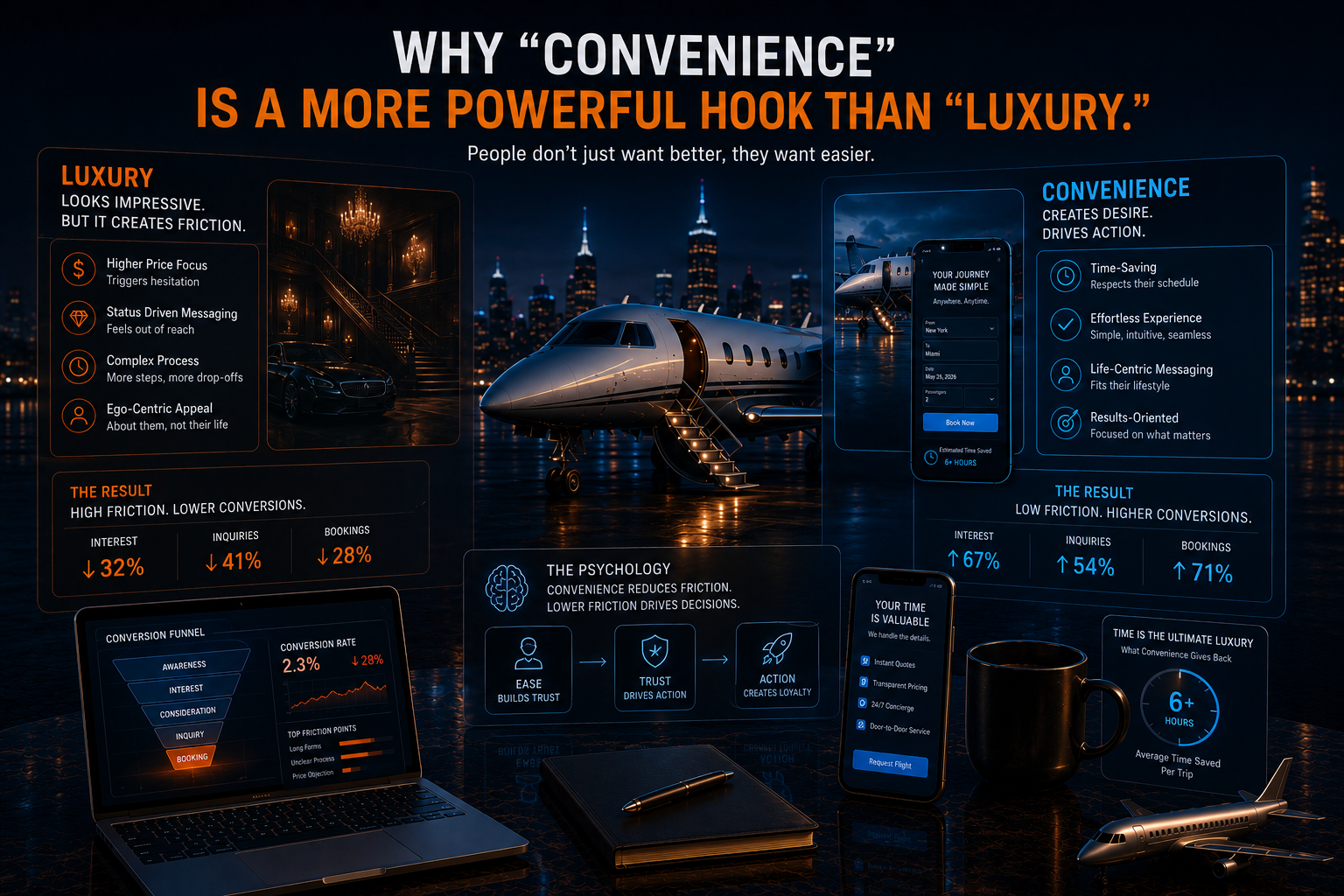
Why “Convenience” Is a More Powerful Hook Than “Luxury”
Direct Answer: Convenience is usually a stronger marketing hook than luxury because high-value buyers care more about saving time, reducing friction, avoiding stress, increasing control, and simplifying decisions than they care about status alone. Therefore, businesses that market convenience often convert better than businesses that only market prestige.
Luxury still matters. However, luxury without convenience often feels impractical. Meanwhile, convenience creates immediate emotional value. A buyer instantly understands why saving time, avoiding hassle, reducing uncertainty, skipping delays, simplifying logistics, or getting faster answers improves their life.
Additionally, affluent buyers often value time more than money. Therefore, the strongest high-ticket offers usually sell simplicity, access, efficiency, speed, and predictability first. Luxury then becomes the reinforcement layer, not the primary hook.
Research from consumer behavior studies consistently shows that convenience strongly influences purchasing decisions across industries. Additionally, modern customer experience expectations increasingly prioritize ease, speed, and reduced effort. Therefore, businesses that remove friction often outperform businesses that only emphasize image. Harvard Business Review discusses reducing customer effort, while Think with Google explains modern convenience expectations.
Key Takeaways
- Luxury attracts attention, but convenience drives action.
- However, many brands market status while ignoring friction reduction.
- Therefore, buyers often choose the simpler and easier option.
- Additionally, affluent buyers value time, certainty, and flexibility.
- Ultimately, convenience creates emotional relief, which increases conversions.
What Convenience Really Means
Direct Answer: Convenience means reducing effort, uncertainty, delay, confusion, and wasted time for the customer.
Many businesses misunderstand convenience. They assume convenience only means speed. However, convenience also means reducing cognitive load, simplifying decisions, improving flexibility, and removing unnecessary steps.
Convenience Can Mean
- faster response times
- fewer decisions
- less travel
- simpler onboarding
- predictable outcomes
- better communication
- easier scheduling
- less waiting
- clearer pricing
- reduced uncertainty
Therefore, convenience improves the entire buying experience instead of only improving appearance.
Why Convenience Converts Better Than Luxury
Direct Answer: Convenience converts better because buyers feel the value immediately.
Luxury often feels aspirational. However, convenience feels practical and emotionally relieving. Therefore, convenience creates faster decision-making.
For example, “Skip TSA and save four hours” often converts better than “Experience luxury private aviation.” The first message solves a pain point. Meanwhile, the second message describes a category.
Convenience Creates
- stress reduction
- time savings
- predictability
- emotional relief
- greater control
- simpler decisions
- higher urgency
- clearer value
Consequently, convenience-focused messaging often produces stronger response rates.
The Psychology Behind Convenience
Direct Answer: Convenience works because humans naturally avoid friction, uncertainty, and wasted effort.
The brain constantly looks for easier paths. Therefore, marketing that reduces complexity often feels safer and more attractive.
Additionally, people value certainty during buying decisions. If a product or service appears easier, faster, or more reliable, the perceived risk decreases.
Convenience Psychology Triggers
- lower stress
- reduced decision fatigue
- faster gratification
- less uncertainty
- greater confidence
- feeling of control
- time protection
As a result, convenience often feels emotionally stronger than prestige alone.
Why Time Is the Real Luxury
Direct Answer: High-net-worth buyers often value time more than money because time cannot be replaced.
This is why convenience sells so well in high-ticket markets. Affluent buyers may already have access to luxury. However, they still cannot create more time.
What High-Value Buyers Want
- less waiting
- fewer delays
- faster access
- simpler logistics
- better scheduling flexibility
- reduced hassle
- greater efficiency
- more control over their day
Therefore, businesses that protect the customer’s time often create stronger emotional positioning.
Private Aviation Example: Convenience Beats Prestige
Direct Answer: Most private aviation buyers choose charters for convenience long before they choose them for luxury.
Luxury matters in private aviation. However, the strongest trigger is usually convenience.
Convenience-Focused Aviation Hooks
- Skip TSA entirely
- Leave closer to your actual departure time
- Fly directly into smaller airports
- Avoid overnight layovers
- Control your schedule
- Reduce travel fatigue
- Save hours on every trip
- Handle multi-city travel more efficiently
Meanwhile, “luxury seating” or “premium interiors” often become secondary benefits. Therefore, convenience usually drives the initial inquiry.
Why Most Luxury Marketing Misses the Point
Direct Answer: Many luxury brands focus too heavily on appearance instead of practical value.
Expensive visuals alone do not create urgency. However, solving real friction does.
For example, a luxury kitchen remodel campaign may show beautiful finishes. However, a stronger hook may explain how the new layout saves time during cooking, hosting, and cleanup.
Weak Luxury Messaging
- exclusive experience
- premium lifestyle
- elevated luxury
- elite craftsmanship
- high-end sophistication
Stronger Convenience Messaging
- faster scheduling
- simpler ownership
- less maintenance stress
- better organization
- streamlined travel
- easier planning
- time savings
Therefore, the strongest campaigns combine aspiration with practical ease.
How Friction Kills High-Ticket Conversions
Direct Answer: Friction increases hesitation, delays decisions, and lowers conversion rates.
Every unnecessary step creates risk. Therefore, businesses should reduce friction across the entire buying journey.
Common Friction Points
- slow response times
- unclear pricing
- complex forms
- poor scheduling systems
- confusing offers
- weak communication
- unclear next steps
- too many choices
- long onboarding processes
Additionally, affluent buyers often abandon offers quickly when the process feels inefficient.
High-Converting Convenience Hooks
Direct Answer: Convenience hooks focus on reducing pain, time, effort, or uncertainty.
Examples
- Save 5+ Hours on Every Flight
- Get Answers Without Waiting Days
- Skip the Airport Chaos Entirely
- Launch Faster Without Managing Multiple Vendors
- Reduce Scheduling Friction Across Your Team
- Handle Everything From One Dashboard
- Book in Minutes Instead of Weeks
- Avoid Delays, Transfers, and Layovers
Consequently, the offer feels easier and more valuable immediately.
How to Position Offers Around Convenience
Direct Answer: Position offers around speed, simplicity, flexibility, certainty, and reduced effort.
Do not only describe the product. Instead, describe the easier future the customer experiences after buying.
Better Positioning Angles
- less time managing vendors
- faster implementation
- simpler workflows
- clearer communication
- more predictable results
- easier coordination
- reduced operational stress
- fewer moving parts
Additionally, convenience positioning works across both luxury and non-luxury industries.
Landing Pages That Sell Convenience
Direct Answer: Landing pages should explain how the service removes friction before discussing premium features.
Strong Landing Page Sections
- time-saving headline
- direct-answer summary
- friction-removal bullets
- simplified process explanation
- proof of reliability
- clear CTA
- expectation-setting
- FAQ section
For example, a charter page should explain how the traveler avoids airport delays, simplifies logistics, and gains scheduling flexibility before emphasizing luxury interiors.
Ad Angles That Outperform Pure Luxury
Direct Answer: Ads focused on ease and efficiency often outperform ads focused only on prestige.
Weaker Ad Angles
- exclusive luxury lifestyle
- elite elegance
- premium sophistication
- high-end prestige
Stronger Ad Angles
- avoid airport delays
- save hours every trip
- reduce travel stress
- simplify scheduling
- get faster answers
- launch quicker
- manage everything in one place
Therefore, convenience messaging usually creates stronger urgency and clearer emotional value.
Luxury Messaging vs Convenience Messaging
Direct Answer: Luxury messaging sells image, while convenience messaging sells relief and efficiency.
| Category | Luxury Messaging | Convenience Messaging |
|---|---|---|
| Core Emotion | Status | Relief |
| Main Value | Prestige | Efficiency |
| Primary Trigger | Aspiration | Friction reduction |
| Decision Speed | Often slower | Often faster |
| Buyer Focus | Identity | Practical outcome |
| Best Use | Brand reinforcement | Conversion and urgency |
Industries Where Convenience Wins
Direct Answer: Convenience-driven marketing performs strongly in nearly every high-ticket industry.
Industries
- private aviation
- luxury travel
- digital marketing
- healthcare
- real estate
- wealth management
- home services
- software
- automotive
- construction
Additionally, the higher the buyer’s income or responsibility level, the more valuable convenience often becomes.
Metrics That Matter
Direct Answer: Measure whether convenience-focused messaging improves speed, quality, and conversion performance.
Track These Metrics
- landing page conversion rate
- click-through rate
- qualified lead rate
- time to conversion
- cost per qualified lead
- booked call rate
- CTA click rate
- bounce rate
- sales cycle length
- close rate
Additionally, compare convenience-focused campaigns against prestige-focused campaigns directly. Therefore, you can see which emotional trigger drives stronger results.
Common Marketing Mistakes
Direct Answer: Businesses lose conversions when they focus too heavily on image instead of reducing friction.
- overusing luxury buzzwords
- not explaining practical value
- ignoring time savings
- creating complicated buying processes
- making scheduling difficult
- slow follow-up times
- using vague prestige messaging
- not showing operational simplicity
- focusing only on aesthetics
- creating too many decision points
Instead, show how the service makes life easier, faster, and less stressful.
Frequently Asked Questions
Why does convenience convert better than luxury?
Convenience reduces friction, saves time, lowers stress, and creates immediate practical value. Therefore, buyers often respond faster.
Does luxury still matter?
Yes. Luxury still reinforces quality and status. However, convenience usually creates the stronger conversion trigger.
What is the strongest convenience trigger?
Saving time is often the strongest convenience trigger because affluent buyers value time highly.
Can convenience marketing work in luxury industries?
Yes. In many luxury industries, convenience is actually the primary reason buyers choose premium services.
Should ads focus more on convenience or luxury?
Most high-performing campaigns lead with convenience and reinforce the offer with luxury positioning afterward.
External Sources
Conclusion
Direct Answer: Convenience is usually more powerful than luxury because buyers feel the emotional value immediately.
Luxury creates aspiration. However, convenience creates relief, control, speed, and simplicity. Therefore, businesses that reduce friction often outperform businesses that only market prestige.
Final Insight: The most successful luxury brands do not merely sell status. Instead, they sell a smoother, easier, faster life.
About the author : Anthony Paulino