Why Your “Contact Us” Page Is Killing Your Conversion Rate
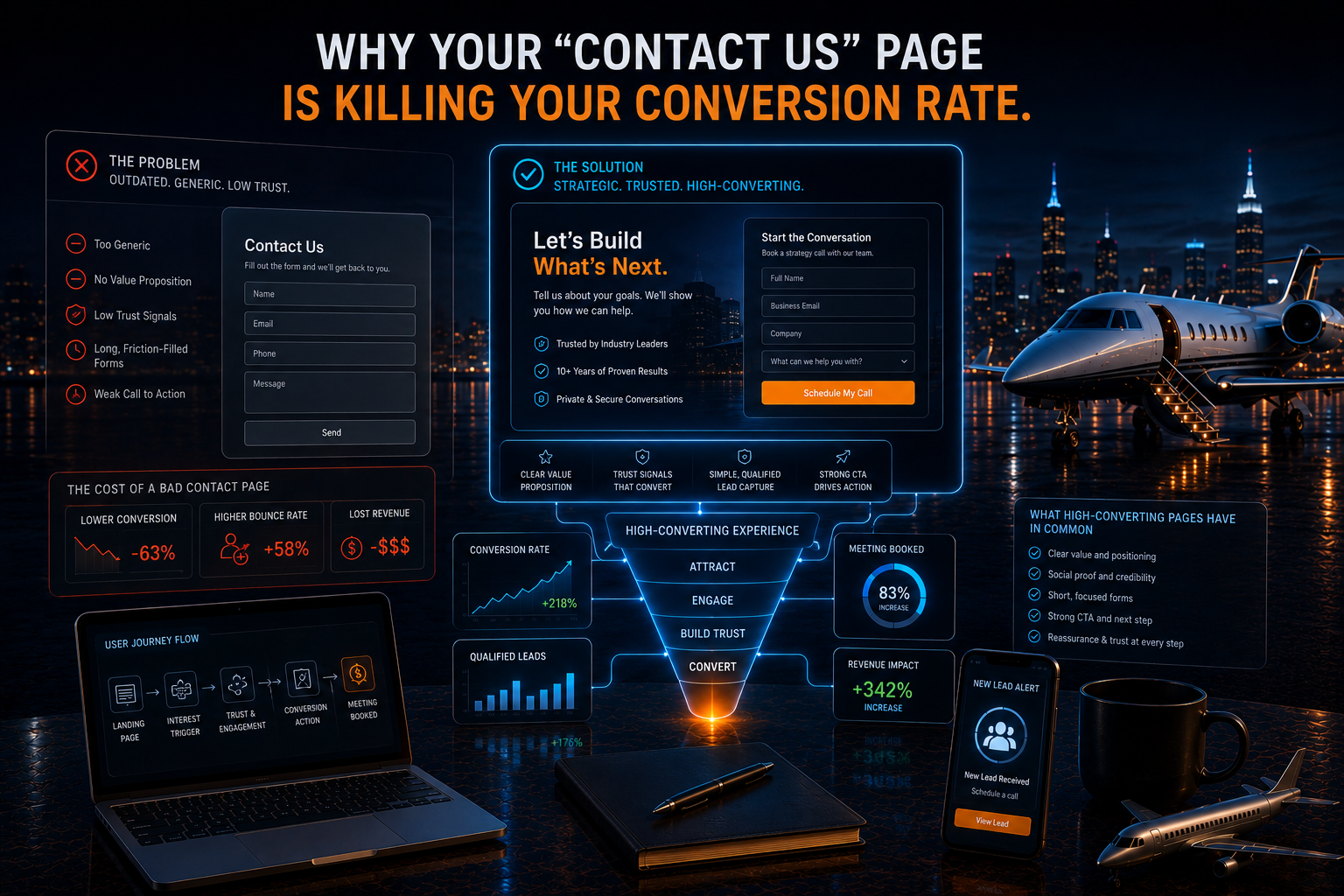
Direct Answer: A generic Contact Us page kills conversion rates because it gives visitors no clear outcome, no urgency, no proof, no offer, no expectation, and no reason to act now. Therefore, high-ticket businesses should replace vague contact pages with intent-specific conversion pages that guide visitors toward audits, consultations, quote reviews, route reviews, strategy calls, or service-specific next steps.
Most Contact Us pages look harmless. However, they often create friction at the exact moment a buyer needs certainty. The page usually says “Get in touch,” shows a basic form, lists a phone number, and gives no compelling reason to submit. As a result, serious visitors hesitate, compare competitors, or leave.
Additionally, paid traffic makes this problem worse. If someone clicks an ad for a specific offer and lands on a generic contact page, the message breaks. Therefore, the page wastes ad spend and lowers lead quality.
Google explains that landing page experience should match user expectations after the click. Additionally, Meta recommends choosing campaign objectives that match your business goal. Therefore, your conversion page should continue the exact promise that made the visitor click. Google explains landing page experience, and Meta explains campaign objectives.
Key Takeaways
- A Contact Us page usually asks for action without creating enough certainty.
- However, high-ticket buyers need a clear reason to submit their information.
- Therefore, each campaign should lead to a specific conversion page, not a generic form.
- Additionally, the page should explain the outcome, process, proof, risk reduction, and next step.
- Ultimately, conversion pages should sell the next conversation, not merely collect contact details.
Why Contact Us Pages Fail
Direct Answer: Contact pages fail because they ask for trust before creating value.
A visitor does not want to “contact you.” Instead, they want a result. They may want more leads, a better ad funnel, a private route review, a quote, a strategy, a diagnosis, or a clear next step. Therefore, the page should speak to that outcome immediately.
However, a standard Contact Us page usually forces every visitor into the same generic path. As a result, it treats a high-intent buyer the same as a vendor, job applicant, spammer, or casual browser.
What Most Contact Pages Lack
- specific offer
- clear buyer outcome
- proof
- risk reversal
- response-time expectation
- qualification questions
- service-specific context
- strong CTA
Therefore, the page loses people who were already close to taking action.
The Psychology Behind Low Contact Page Conversions
Direct Answer: Buyers avoid vague contact pages because uncertainty increases perceived risk.
Before someone submits a form, they ask quiet questions:
- What happens after I submit?
- Will someone pressure me?
- Is this worth my time?
- Can this company actually help?
- Will I get a useful answer?
- Am I in the right place?
Therefore, your page must answer those questions before the form. Additionally, high-ticket buyers need even more certainty because the decision carries more cost, risk, and time.
Consequently, the goal is not to make the page longer for no reason. Instead, the goal is to remove doubt in the right order.
Problem 1: No Message Match
Direct Answer: Message match means the page continues the exact promise from the ad, search result, email, or CTA.
If an ad says “Get a Free Lead Quality Audit,” the landing page should say “Get a Free Lead Quality Audit.” However, many businesses send that click to a generic Contact Us page. Therefore, the visitor feels a break in trust.
Weak Flow
Ad: “Get a Private Route Review” → Page: “Contact Us”
Better Flow
Ad: “Get a Private Route Review” → Page: “Request Your Private Route Review”
Additionally, message match improves visitor confidence because the page confirms they clicked the right thing.
Problem 2: No Clear Offer
Direct Answer: A Contact Us page fails when it offers communication instead of a valuable next step.
“Contact us” is not an offer. It is an administrative action. Therefore, replace it with a specific conversion offer.
Better Offer Examples
- Get a Free Lead Quality Audit
- Request a Private Route Review
- Book a Strategy Session
- Compare Your Options
- Get a Project Scope Review
- Check Availability
- Review Your Ad Funnel
- Request Mission-Specific Pricing Guidance
As a result, the visitor knows what they receive for submitting the form.
Problem 3: No Proof Before the Form
Direct Answer: Proof should appear before the form because visitors need trust before they share information.
A form without proof feels risky. Therefore, add proof near the top of the page.
Proof Options
- case study result
- testimonial
- client logo row
- years in business
- industry specialization
- process explanation
- review snippet
- media mention
- before-and-after example
However, never fabricate proof. If you do not have case studies yet, use process proof. Explain how the review works, what you check, and what the visitor receives.
Problem 4: Forms Ask Too Much or Too Little
Direct Answer: A form should ask enough to qualify the lead without creating unnecessary friction.
Many forms only ask name, email, and message. However, this gives your sales team little context. Meanwhile, other forms ask too many questions and reduce completion. Therefore, match the form length to the offer value.
Low-Friction Form
- Name
- Phone
- What do you need help with?
Higher-Intent Form
- Name
- Phone
- Service needed
- Timeline
- Current challenge
- Best contact method
Additionally, high-ticket offers can ask more questions when the page explains why the questions matter.
Problem 5: No Clear Expectations
Direct Answer: Visitors convert more confidently when they know what happens next.
After the form, will someone call? Will they email? How fast? Will they review the request first? Will they pressure the visitor? If the page does not explain this, the visitor may hesitate.
Expectation Copy Examples
- After you submit, our team reviews your details and follows up with next steps.
- No pressure. We will simply show you where the biggest opportunity sits.
- A strategist will review your request before the call.
- Most qualified requests receive a response within one business day.
- Your information stays private and only supports this consultation.
Therefore, expectation-setting reduces uncertainty and increases form completion quality.
How to Replace a Contact Us Page
Direct Answer: Replace your Contact Us page with service-specific conversion pages that match visitor intent.
You can still keep a simple Contact page for general inquiries. However, paid ads, SEO service pages, emails, and high-intent CTAs should send traffic to dedicated conversion pages.
Better Page Types
- Free Strategy Session page
- Lead Quality Audit page
- Private Route Review page
- Project Scope Review page
- Quote Request page
- Availability Check page
- Consultation Booking page
- Comparison Review page
Additionally, each page should match one buyer intent. As a result, the page feels more relevant and easier to act on.
High-Converting Page Templates
Direct Answer: A conversion page should lead with outcome, proof, process, and a clear CTA.
Template 1: Lead Quality Audit
Headline: Find Out Why Your Ads Are Producing Low-Quality Leads
Subheadline: We review your offer, creative, landing page, form, and follow-up so you can see where the funnel leaks.
CTA: Get My Lead Quality Audit
Template 2: Private Aviation Route Review
Headline: Request a Private Route Review Before You Charter
Subheadline: Compare aircraft fit, airport options, timing, passenger needs, and pricing variables before choosing your next flight.
CTA: Request My Route Review
Template 3: High-Ticket Strategy Session
Headline: Build a Clear Plan to Generate Better Qualified Leads
Subheadline: We review your current traffic, offers, conversion path, and CRM follow-up to find the fastest growth opportunities.
CTA: Book My Strategy Session
Better Form Questions
Direct Answer: Better form questions qualify the lead and prepare the sales team for a useful conversation.
For Marketing Services
- What service are you interested in?
- What is your biggest growth challenge?
- Are you currently running ads or SEO?
- What monthly budget range are you considering?
- How soon do you want to start?
For Private Aviation
- Where are you departing from?
- Where are you flying to?
- When are you considering travel?
- How many passengers?
- Do you need aircraft guidance?
For Home Services
- What project do you need help with?
- What is the property ZIP code?
- What timeline are you considering?
- Do you need financing information?
- What is the best way to reach you?
Therefore, the form becomes part of the conversion strategy, not just a data collection tool.
Better CTA Examples
Direct Answer: The CTA should name the outcome or next step, not the administrative action.
Weak CTAs
- Submit
- Contact Us
- Learn More
- Send Message
Better CTAs
- Book My Strategy Session
- Get My Free Audit
- Request My Route Review
- Compare My Options
- Check Availability
- Review My Lead System
- Get My Project Review
Additionally, add microcopy below the CTA. For example, “No pressure. Just clear next steps.”
Contact Page vs Conversion Page
Direct Answer: A Contact page collects messages, while a conversion page creates qualified action.
| Category | Generic Contact Page | Conversion Page |
|---|---|---|
| Primary Goal | Collect general messages | Create qualified leads |
| Headline | Contact Us | Specific outcome or offer |
| Proof | Often missing | Visible before the form |
| Form | Generic fields | Intent-specific questions |
| CTA | Submit | Book, request, compare, review |
| Expectation | Unclear | Clear next step |
| Best Use | General inquiries | Paid traffic, SEO pages, high-intent offers |
Metrics That Matter
Direct Answer: Measure conversion pages by lead quality and sales outcomes, not only form submissions.
Track These Metrics
- landing page conversion rate
- form start rate
- form completion rate
- cost per qualified lead
- lead-to-call rate
- booked call rate
- sales response time
- opportunity creation rate
- close rate
- unqualified lead percentage
- CTA click rate
- mobile conversion rate
Additionally, compare generic Contact Us traffic against intent-specific page traffic. Therefore, you can prove which page creates better pipeline.
Common Mistakes
Direct Answer: Businesses kill conversions when they send high-intent traffic to generic pages.
- sending paid ad traffic to Contact Us
- using “Submit” as the CTA
- not showing proof before the form
- not explaining what happens next
- asking irrelevant form questions
- using one form for every service
- not matching the page to the ad
- hiding the phone number
- not tracking lead quality
- not following up quickly
Instead, build conversion pages around the visitor’s exact intent.
Frequently Asked Questions
Is a Contact Us page bad?
No. A Contact Us page can handle general inquiries. However, it should not be the main destination for paid ads, service CTAs, or high-intent campaigns.
What should I use instead of Contact Us?
Use specific offers like Book a Strategy Session, Request a Quote, Get a Free Audit, Compare Options, or Check Availability.
Why does “Submit” hurt conversions?
Submit focuses on the form action instead of the visitor’s desired outcome. Therefore, outcome-based CTA text usually feels more compelling.
Should I ask more questions on my form?
Ask enough questions to qualify the lead, but only when each question supports a better follow-up experience.
What is the best page for paid traffic?
The best page matches the ad promise exactly and includes a clear offer, proof, risk reduction, form, and next-step explanation.
External Sources
Conclusion
Direct Answer: Your Contact Us page kills conversions when it gives high-intent visitors a vague form instead of a clear reason to act.
Keep a simple Contact Us page for general inquiries. However, send serious traffic to focused conversion pages with a specific offer, proof, process, CTA, and next-step expectation. Therefore, your website can convert more visitors into qualified calls, audits, quotes, reviews, and opportunities.
Final Insight: Buyers do not want to contact you. They want confidence that the next step will solve their problem.
About the author : Anthony Paulino