Using Scarcity and Urgency in High-Ticket Aviation Landing Pages
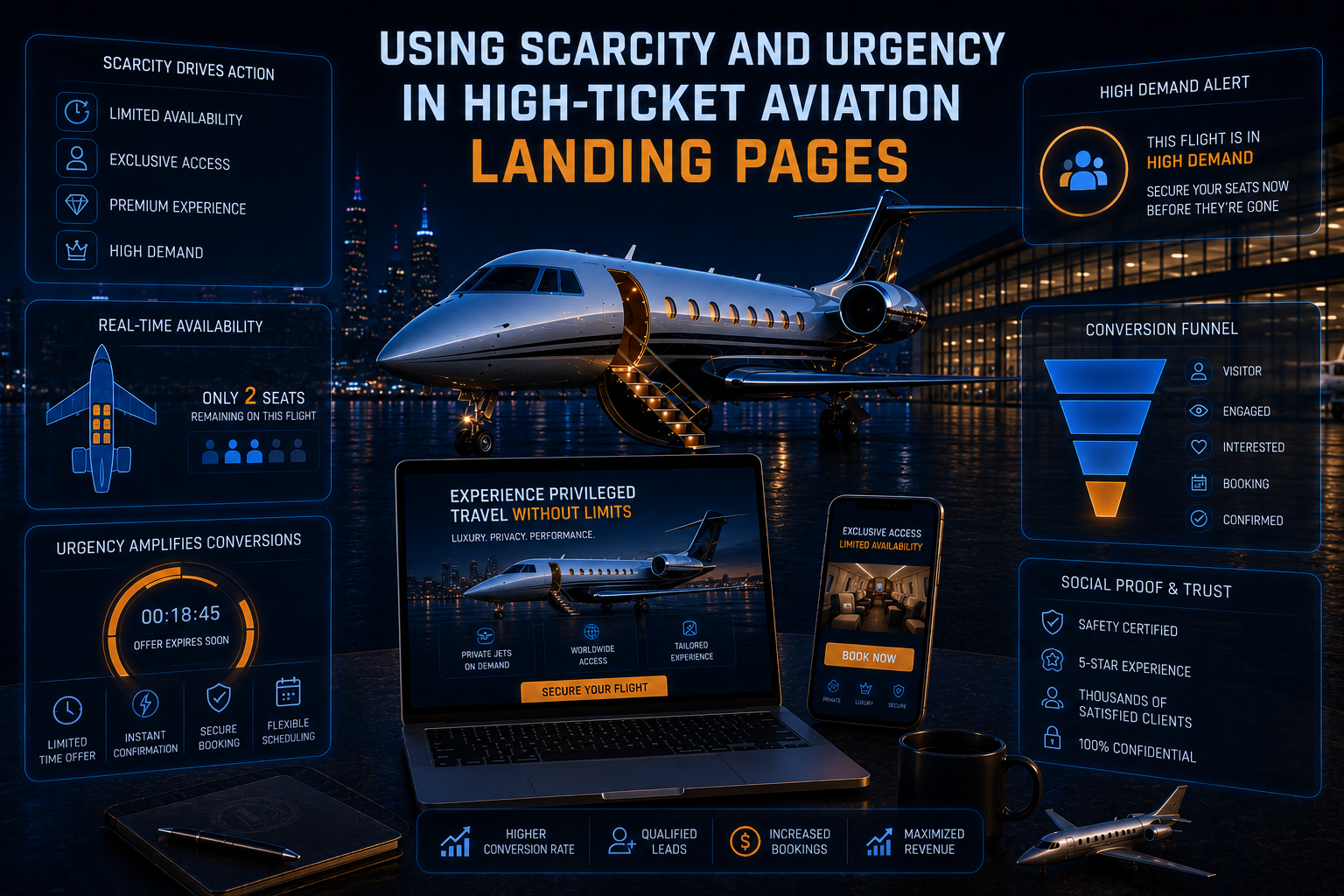
Direct Answer: Scarcity and urgency work on high-ticket aviation landing pages when they reflect real constraints like aircraft availability, route windows, empty leg timing, peak travel demand, crew scheduling, airport access, or advisor capacity. Therefore, private aviation brands should never fake urgency. Instead, they should explain why timing matters, what may change, and what the prospect should do next.
High-ticket aviation buyers do not respond well to cheap countdown timers or aggressive pressure. However, they do respond to relevant timing risk. Aircraft availability changes. Empty legs expire. Peak event demand tightens. Airport slots can become harder to coordinate. Therefore, urgency should feel like helpful guidance, not sales pressure.
Additionally, scarcity can improve lead quality when the landing page explains a real limitation. For example, “Only one aircraft available” is strong when true. However, “Act now before it’s gone forever” can damage trust. Therefore, the best aviation landing pages use calm, factual urgency that helps buyers make better decisions.
Google emphasizes helpful, people-first content, while Google Ads defines landing page experience around relevance, usefulness, and meeting expectations after the click. Therefore, scarcity should support clarity and relevance, not manipulate the visitor. Google explains helpful content, and Google explains landing page experience.
Key Takeaways
- Scarcity works best when it reflects real aviation constraints.
- However, fake urgency weakens trust with high-ticket buyers.
- Therefore, use aircraft availability, route timing, empty legs, seasonal demand, and advisor capacity honestly.
- Additionally, urgency should guide the buyer toward clarity, not pressure them into a rushed decision.
- Ultimately, premium urgency creates action while protecting brand trust.
What Scarcity Means in Aviation Marketing
Direct Answer: Scarcity in aviation marketing means a real limitation affects availability, timing, access, or service capacity.
Scarcity does not mean pressure. Instead, it means the buyer should understand why waiting may reduce options. Therefore, the page should explain the constraint clearly.
Real Aviation Scarcity Examples
- limited aircraft availability
- limited empty leg windows
- peak holiday demand
- event-driven travel pressure
- airport slot constraints
- crew scheduling limits
- weather and routing complexity
- advisor review capacity
As a result, the landing page creates urgency through truth, not hype.
Why Scarcity Works for High-Ticket Buyers
Direct Answer: Scarcity works because high-ticket buyers value certainty, control, and timing.
Private aviation buyers often act when they understand what could change. Therefore, the page should explain the cost of waiting in practical terms. For example, the buyer may lose a specific aircraft, pay more for repositioning, or need a less convenient airport.
However, the tone matters. A premium buyer does not want to feel pushed. Instead, they want to feel informed. Therefore, urgency should sound advisory.
Proof Breadcrumb: real constraint → clear explanation → reduced uncertainty → faster qualified action.
The Ethical Scarcity Framework
Direct Answer: Ethical scarcity explains what is limited, why it is limited, and what action protects the buyer’s options.
Use this formula:
Ethical Scarcity = Real Constraint + Clear Reason + Calm Guidance + Low-Risk Next Step
First, state the constraint. Next, explain why it exists. Additionally, guide the buyer toward the next step. Finally, reduce risk by making the action informational, not forceful.
Example
Weak: “Book now before prices explode.”
Better: “Aircraft availability can tighten during peak travel weeks. Request a route review early so an advisor can compare options before your preferred window narrows.”
Therefore, the copy creates urgency while protecting trust.
Scarcity Type 1: Aircraft Availability
Direct Answer: Aircraft availability is the strongest scarcity angle because it directly affects the buyer’s options.
Private aircraft availability changes quickly. Therefore, landing pages should make that clear without overpromising.
How to Use It
- Explain that availability changes by route, date, and aircraft class.
- Invite the buyer to review options early.
- Use specific aircraft class language when possible.
- Avoid claiming aircraft availability unless confirmed.
Copy Example
“Heavy jet availability can change quickly for long-range routes. Therefore, request a private route review early so an advisor can compare aircraft options before your preferred window tightens.”
Scarcity Type 2: Empty Leg Timing
Direct Answer: Empty legs create natural urgency because route, date, and timing flexibility are limited.
Empty leg opportunities usually exist because an aircraft needs to reposition. Therefore, the buyer must match the route and timing. This makes the scarcity real.
Landing Page Elements
- route window
- flexibility notes
- aircraft class
- passenger fit
- luggage considerations
- fast inquiry CTA
Copy Example
“This one-way opportunity may only fit travelers with flexible timing. Share your route and schedule so an advisor can confirm whether the aircraft window works.”
Scarcity Type 3: Peak Travel Demand
Direct Answer: Peak travel demand creates urgency because preferred aircraft and departure times become harder to secure.
Major events, holidays, ski season, summer travel, and international business periods can tighten availability. Therefore, the page should help prospects plan sooner.
Peak Demand Examples
- Super Bowl travel
- Art Basel Miami
- Masters week
- holiday travel
- ski season
- summer Europe travel
- major business conferences
Copy Example
“Peak event weeks can reduce aircraft options quickly. Therefore, early route planning gives your team more flexibility before preferred departure windows narrow.”
Scarcity Type 4: Airport and Slot Constraints
Direct Answer: Airport access can create urgency when timing, congestion, event demand, or operational limits affect planning.
Airport choice matters in private aviation. Therefore, a landing page can explain why early planning helps compare better departure and arrival options.
Useful Airport Urgency Angles
- preferred airport availability
- nearby alternate airports
- event congestion
- ground transfer planning
- FBO selection
- timing coordination
Copy Example
“The nearest airport is not always the best option during high-demand travel periods. Request an airport review before your preferred timing becomes harder to coordinate.”
Scarcity Type 5: Advisor Capacity
Direct Answer: Advisor capacity can create ethical urgency when the business provides a real consultative review.
If the offer includes a route review, aircraft comparison, or pricing analysis, team capacity may be limited. Therefore, the page can say so honestly.
How to Use Advisor Scarcity
- Use it only when capacity is real.
- Frame it around service quality.
- Do not fake calendar scarcity.
- Offer a low-pressure next step.
Copy Example
“We keep route reviews limited so each request receives advisor attention. Submit your details early if you want a proper aircraft and airport comparison.”
Where to Place Scarcity on the Landing Page
Direct Answer: Scarcity should appear near the hero, offer section, CTA, FAQ, and final close.
However, do not overuse it. Too much urgency can feel cheap. Therefore, use scarcity at key decision points.
Best Placement Areas
- Hero section: one calm timing note
- Offer section: explain what may change
- CTA area: add risk-reduction microcopy
- FAQ section: answer timing objections
- Final CTA: remind the buyer to review options early
As a result, urgency supports the decision without overwhelming the page.
Scarcity and Urgency Copy Examples
Direct Answer: Premium scarcity copy should sound factual, calm, and advisor-led.
Aircraft Availability
“Aircraft availability can change quickly by date, route, and aircraft class. Request a route review early so you can compare options before your preferred window tightens.”
Empty Leg
“Empty leg opportunities depend on route match and timing flexibility. Therefore, the sooner you confirm details, the easier it is to see whether the mission fits.”
Peak Travel
“Peak travel weeks can reduce aircraft options and increase planning complexity. Early review gives your team more flexibility.”
Advisor Review
“Advisor-led route reviews are limited so each request receives proper attention. Submit your details now to start the review process.”
Airport Options
“Airport choice can affect timing, convenience, and aircraft availability. Review options early before your preferred departure window narrows.”
CTA Examples That Preserve Premium Trust
Direct Answer: Premium CTAs should guide buyers toward clarity instead of pressuring them to buy immediately.
Strong CTA Examples
- Request a Private Route Review
- Check Aircraft Availability
- Compare My Route Options
- Review Empty Leg Fit
- Get Mission-Specific Pricing Guidance
- Speak With a Charter Advisor
Risk-Reduction Lines
- No pressure. Just clear route guidance.
- Private review. Advisor-led follow-up.
- Get clarity before you choose.
- Availability changes quickly, but your first review is simple.
Therefore, the CTA creates action without sounding desperate.
How to Pair Scarcity With Proof
Direct Answer: Scarcity becomes stronger when paired with proof, process, or transparency.
If you only say “limited availability,” the claim may feel weak. However, if you explain the process, the claim feels more credible.
Proof Pairings
- availability note + route review process
- empty leg timing + flexibility checklist
- peak demand note + event travel planning guide
- advisor capacity + consultation process
- airport timing note + alternate airport comparison
Additionally, proof can come from testimonials, process steps, response-time expectations, or clear operational explanations. Therefore, scarcity feels grounded.
Mobile Scarcity Rules
Direct Answer: Mobile scarcity must be short, scannable, and placed near the CTA.
Mobile visitors do not read long urgency paragraphs. Therefore, use short lines and bullets.
Mobile-Friendly Examples
- Aircraft availability changes quickly.
- Review options before your window narrows.
- Empty legs require route and timing fit.
- Peak travel weeks reduce flexibility.
- Private review. No pressure.
Additionally, keep the CTA visible. As a result, urgency can turn into action immediately.
Metrics That Matter
Direct Answer: Measure scarcity by qualified action quality, not only higher form volume.
Track These Metrics
- CTA click rate
- form start rate
- form completion rate
- qualified lead rate
- route match rate
- aircraft fit rate
- booked call rate
- sales response rate
- unqualified lead percentage
- landing page conversion rate
- cost per qualified opportunity
Additionally, test scarcity language against trust language. Therefore, you can increase urgency without reducing lead quality.
Common Scarcity Mistakes
Direct Answer: Scarcity fails when it feels fake, aggressive, vague, or disconnected from real aviation constraints.
- using fake countdown timers
- claiming limited aircraft without confirmation
- using cheap discount language
- overusing urgency throughout the page
- creating pressure without explaining the reason
- ignoring premium buyer psychology
- not pairing scarcity with proof
- making unrealistic promises
- using panic-based CTAs
- tracking more leads instead of better leads
Instead, use real constraints and calm guidance. Therefore, urgency increases action while protecting trust.
Frequently Asked Questions
Does scarcity work for private aviation landing pages?
Yes. Scarcity works when it reflects real constraints like aircraft availability, empty leg windows, peak demand, airport timing, or advisor capacity.
Should aviation landing pages use countdown timers?
Usually, no. Countdown timers can feel cheap unless they reflect a real deadline, such as a confirmed empty leg window or event-specific offer.
What is the best urgency message for aviation?
The best urgency message explains that aircraft availability can change quickly and encourages the buyer to review options early.
How do you use urgency without sounding pushy?
Use calm advisory language, explain the real reason timing matters, and offer a low-pressure next step like a route review.
Where should scarcity appear on a landing page?
Place it in the hero, offer section, CTA area, FAQ, and final close. However, use it sparingly so the page stays premium.
External Sources
Conclusion
Direct Answer: Scarcity and urgency improve high-ticket aviation landing pages when they reflect real timing constraints and guide buyers toward a helpful next step.
Private aviation buyers do not need pressure. Instead, they need clarity. Therefore, use aircraft availability, empty leg timing, peak travel demand, airport planning, and advisor capacity as honest reasons to act sooner.
Final Insight: Premium scarcity does not say, “Buy now.” Instead, it says, “Review your options before fewer good options remain.”
About the author : Anthony Paulino