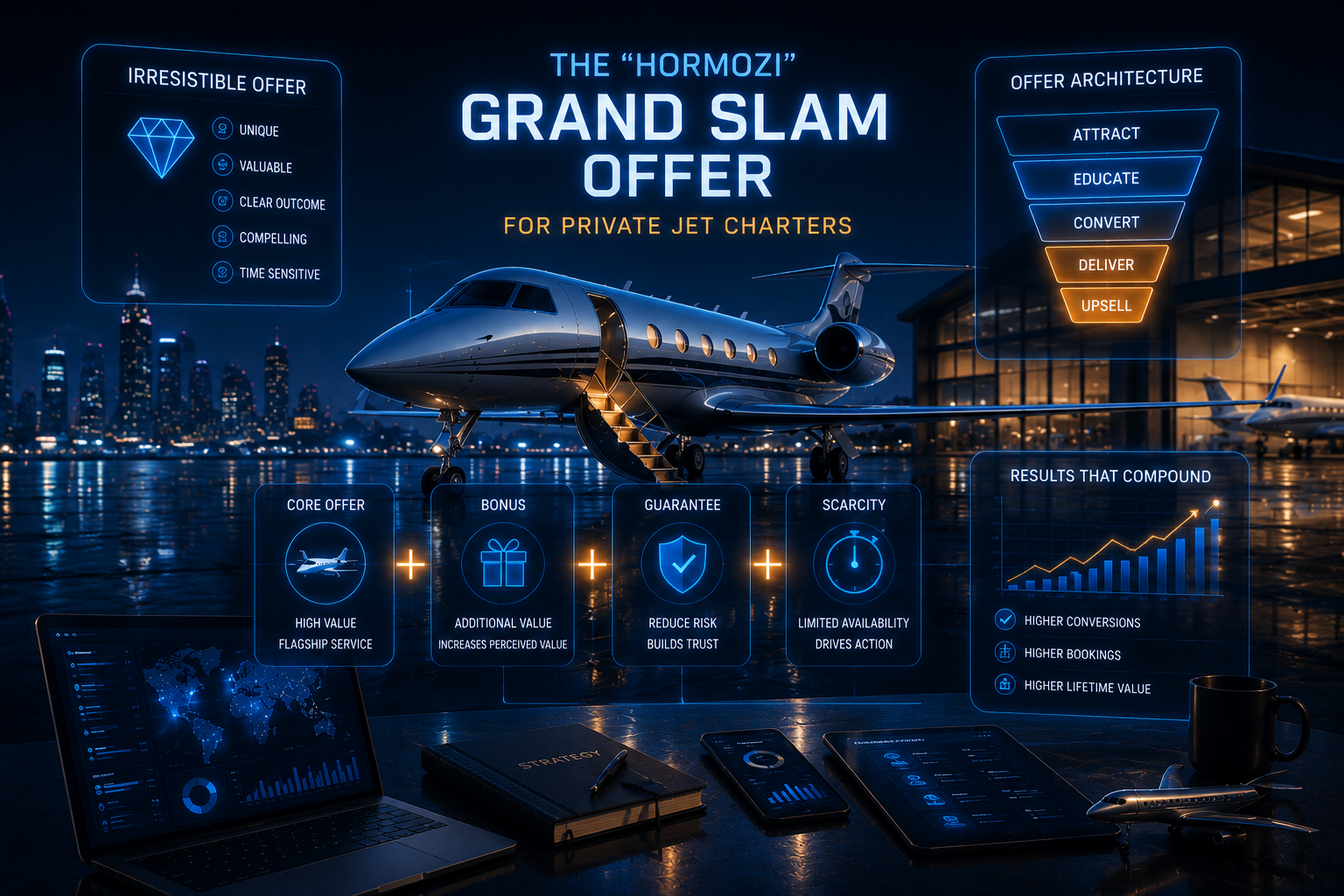
The “Hormozi” Grand Slam Offer for Private Jet Charters
Direct Answer: A Grand Slam Offer for private jet charters packages aircraft access, route planning, concierge guidance, speed, discretion, flexible options, and risk reduction into one high-value buying experience. Therefore, instead of selling “private jet charter,” the offer sells certainty, time saved, mission fit, and white-glove execution for serious travelers.
Most charter ads fail because they sell the same thing everyone else sells: “book a private jet.” However, high-net-worth buyers do not only buy the aircraft. Instead, they buy confidence that the trip will work, the aircraft will fit, the timing will hold, and the process will feel private and professional.
Therefore, the offer must create more value before the sales call. It should answer the buyer’s biggest questions, reduce friction, and make the next step feel safe. Additionally, it should filter casual browsers from serious prospects.
This is where the Grand Slam Offer concept becomes powerful. Instead of discounting, you increase perceived value. Instead of chasing cheap leads, you build a premium offer that makes qualified buyers think, “This feels like the safest next step.”
Key Takeaways
- A strong charter offer sells certainty, not only aircraft access.
- However, the offer must stay premium and avoid cheap discount positioning.
- Therefore, stack value around route planning, aircraft fit, speed, discretion, and support.
- Additionally, use risk reversal carefully because aviation still has operational limits.
- Ultimately, the best offer creates qualified conversations, not low-quality leads.
What Is a Grand Slam Offer for Private Jet Charters?
Direct Answer: A private jet charter Grand Slam Offer is a premium package that makes the buyer’s next step feel more valuable, easier, faster, safer, and more certain.
It does not mean adding gimmicks. Instead, it means packaging the real value that already exists inside a premium charter experience. Therefore, the offer should make the invisible value visible.
A strong charter offer may include:
- private route review
- aircraft fit analysis
- airport and FBO guidance
- same-day availability review
- empty leg monitoring
- concierge coordination
- pricing variable breakdown
- discreet advisor follow-up
- backup aircraft or alternate route planning when available
As a result, the offer feels more valuable than “request a quote.”
Why Normal Charter Offers Fail
Direct Answer: Normal charter offers fail because they sound interchangeable.
Most operators and brokers say the same things: luxury, convenience, safety, and service. However, those words no longer differentiate the offer. Therefore, serious buyers still feel uncertainty.
Weak Offer Examples
- Book a private jet today
- Luxury private flights available
- Request a quote
- Fly private with us
- Premium charter services
These offers may generate clicks. However, they do not explain why the buyer should act now or trust this provider. Therefore, they often attract casual users and weak leads.
Better Angle: “Get a private route review that compares aircraft, airport options, timing, and pricing variables before you choose.”
The Private Aviation Grand Slam Offer Formula
Direct Answer: The strongest charter offer increases desired outcome, increases certainty, reduces time, and reduces effort.
Use this formula:
Offer Value = Dream Outcome × Perceived Likelihood of Success ÷ Time Delay × Effort
Therefore, your offer should make the desired outcome bigger, the path more certain, the result faster, and the process easier. Additionally, the offer should do this without cheapening the brand.
Private Aviation Translation
- Dream Outcome: a smooth, private, perfectly matched flight
- Likelihood: expert aircraft and route guidance
- Time Delay: fast availability review
- Effort: concierge-style planning and simple next step
As a result, the offer becomes more compelling without needing a discount.
Step 1: Sell the Dream Outcome
Direct Answer: The dream outcome is not “a private jet.” It is the stress-free completion of a high-value mission.
For a private aviation buyer, the real outcome may include privacy, time saved, convenience, control, safety confidence, prestige, or family comfort. Therefore, the offer should speak to the mission outcome.
Dream Outcome Examples
- Arrive privately without wasting a full travel day.
- Move an executive team on one controlled schedule.
- Fly a family comfortably with luggage, pets, and support.
- Choose the right aircraft before committing.
- Use the best airport instead of the nearest airport.
- Secure a flexible one-way opportunity when timing fits.
Therefore, the ad and landing page should not only describe the aircraft. Instead, they should describe the successful mission.
Step 2: Increase the Perceived Likelihood of Success
Direct Answer: Buyers respond when the offer makes success feel more likely.
In private aviation, success means the aircraft fits, the schedule works, the quote makes sense, and the provider responds professionally. Therefore, the offer should show how your team reduces mistakes.
Certainty Builders
- route review before aircraft recommendation
- aircraft class comparison
- airport and FBO guidance
- passenger and luggage planning
- timing and flexibility review
- pricing variable explanation
- advisor-led consultation
Additionally, use proof where available. For example, show process steps, testimonials, service standards, or response-time expectations. As a result, the buyer feels safer taking action.
Step 3: Reduce Time Delay
Direct Answer: The offer becomes stronger when the buyer can get clarity quickly.
Private aviation often involves urgency. Therefore, slow follow-up weakens the offer. If the buyer has to wait days for basic availability, the value drops.
Time-Reducing Offer Elements
- same-day availability review
- 15-minute route consultation
- rapid aircraft shortlist
- fast airport option review
- immediate lead routing to an advisor
- SMS and phone follow-up
However, do not promise impossible timelines. Instead, promise a fast first step. Therefore, the offer remains credible.
Step 4: Reduce Effort and Sacrifice
Direct Answer: A strong offer makes the next step feel easy for a busy buyer.
High-net-worth buyers and their teams value convenience. Therefore, the offer should remove mental work. Instead of making the prospect figure out aircraft, airports, routing, and timing alone, the offer should guide them.
Effort Reducers
- short inquiry form
- advisor-led route review
- aircraft comparison summary
- airport recommendation
- pricing variables explained clearly
- concierge-style follow-up
- one point of contact
Additionally, use clear next steps. As a result, the buyer does not need to wonder what happens after the form.
Step 5: Build the Charter Value Stack
Direct Answer: The value stack makes the full offer feel bigger than a simple quote request.
Do not invent fake bonuses. Instead, package real advisory value into named components. Therefore, the buyer understands what they get when they inquire.
Example Value Stack
- Private Route Review: departure, destination, timing, and airport options
- Aircraft Fit Analysis: passenger count, luggage, range, and cabin needs
- Airport and FBO Guidance: convenience, access, and ground transfer context
- Pricing Variable Breakdown: aircraft class, repositioning, fees, and timing
- Empty Leg Check: available one-way opportunities when relevant
- Discreet Advisor Follow-Up: private phone, SMS, or email support
- Mission Shortlist: best-fit options summarized clearly
As a result, the offer becomes more valuable before the buyer even sees a quote.
Step 6: Add a Premium Risk Reversal
Direct Answer: Risk reversal should reduce buyer hesitation without making operational promises the provider cannot control.
In aviation, you must avoid reckless guarantees. Aircraft availability, weather, crew, airport operations, and timing can change. Therefore, risk reversal should focus on the advisory process, not impossible outcomes.
Premium Risk Reversal Examples
- No-pressure route review before you commit.
- We will compare aircraft fit before recommending an option.
- You will receive clear pricing variables before moving forward.
- If one aircraft does not fit, we will review alternate options when available.
- Your inquiry stays private and advisor-led.
Therefore, the buyer feels protected without the brand making unrealistic claims.
Step 7: Use Real Scarcity Without Looking Desperate
Direct Answer: Private aviation scarcity should come from actual aircraft availability, route windows, seasonal demand, or advisor capacity.
Fake scarcity damages trust. However, real scarcity can improve response because aircraft availability changes quickly.
Real Scarcity Examples
- limited aircraft availability for a route
- specific empty leg window
- peak season demand
- holiday or event travel pressure
- same-day advisor capacity
- limited repositioning opportunity
Additionally, keep scarcity professional. Instead of “Act now before it’s gone,” say, “Availability can change quickly, so we recommend reviewing options early.”
Step 8: Create the Right CTA
Direct Answer: The CTA should ask for a qualified next step, not a vague click.
For private jet charters, “learn more” is too weak. Instead, the CTA should align with the buyer’s mission.
Strong CTA Examples
- Request a Private Route Review
- Compare Aircraft for Your Mission
- Check Heavy Jet Availability
- Review Empty Leg Options
- Get Mission-Specific Pricing Guidance
- Plan Your Private Charter With an Advisor
Therefore, the CTA filters for people who have real intent.
Grand Slam Offer Examples
Direct Answer: The best offers package certainty, speed, support, and discretion around a specific charter mission.
Offer 1: Private Route Review
Headline: Get a Private Route Review Before You Charter
Offer: Compare aircraft class, airport options, passenger fit, luggage needs, timing, and pricing variables before you choose.
CTA: Request Route Review
Offer 2: Empty Leg Opportunity Check
Headline: See If an Empty Leg Fits Your Route
Offer: Review available one-way opportunities, flexibility windows, aircraft fit, and route limitations with an advisor.
CTA: Check Empty Leg Options
Offer 3: Heavy Jet Mission Shortlist
Headline: Compare Heavy Jet Options for Your Long-Range Mission
Offer: Get a shortlist of aircraft classes and route considerations based on passengers, timing, luggage, and airport access.
CTA: Compare Heavy Jet Options
Landing Page Structure
Direct Answer: The landing page should explain the offer, stack the value, reduce risk, and ask for mission details.
Use This Layout
- H1 with specific offer
- Direct answer summary
- Mission problem section
- Value stack section
- How the process works
- Aircraft or route examples
- Risk reversal section
- Short form
- FAQs
- Final CTA
Additionally, the form should ask about departure, destination, timing, passengers, and contact preference. As a result, sales can respond with context.
Ad Copy Examples
Direct Answer: The ad copy should make the offer feel specific, premium, and easy to act on.
Ad Example 1
Hook: “Before you request a private jet quote, make sure the aircraft actually fits the mission.”
Body: “Get a private route review that compares aircraft class, airport options, timing, passenger count, luggage needs, and pricing variables before you choose.”
CTA: Request Route Review
Ad Example 2
Hook: “The nearest private airport is not always the smartest departure choice.”
Body: “Review route, FBO access, ground transfer, aircraft availability, and timing before planning your next private flight.”
CTA: Review Airport Options
Ad Example 3
Hook: “A heavy jet is not always the right answer.”
Body: “Compare aircraft class, route distance, cabin needs, passenger count, and luggage requirements before paying for more aircraft than your mission needs.”
CTA: Compare Aircraft
Metrics That Matter
Direct Answer: Measure the offer by qualified conversations and opportunity value, not only lead volume.
Track These Metrics
- landing page conversion rate
- form completion rate
- qualified lead rate
- route match rate
- aircraft fit rate
- booked call rate
- advisor response speed
- cost per qualified opportunity
- opportunity value
- closed revenue
- unqualified lead percentage
Additionally, track which value-stack component creates the most qualified inquiries. Therefore, you can improve the offer over time.
Common Offer Mistakes
Direct Answer: Charter offers fail when they rely on generic luxury language instead of clear buyer value.
- Using “request a quote” as the only offer
- Selling aircraft access instead of mission certainty
- Discounting too quickly
- Using fake scarcity
- Making unrealistic guarantees
- Ignoring airport and route context
- Not explaining aircraft fit
- Using weak CTAs
- Asking too few qualifying questions
- Tracking leads instead of opportunities
Instead, build the offer around certainty, speed, support, and discretion.
Frequently Asked Questions
What is a Grand Slam Offer for private jet charters?
It is a premium charter offer that increases perceived value by packaging route review, aircraft fit, airport guidance, pricing clarity, speed, discretion, and advisor support into one clear next step.
Should private jet charter companies discount their offers?
Usually, no. Discounting can weaken premium positioning. Instead, increase value through better planning, better guidance, better speed, and clearer support.
What is the best CTA for charter ads?
The best CTA depends on intent. Strong options include Request a Private Route Review, Compare Aircraft, Check Availability, and Get Mission-Specific Pricing Guidance.
How do you add risk reversal in aviation?
Use process-based risk reversal, such as no-pressure route reviews, aircraft fit comparisons, transparent pricing variables, and alternate option reviews when available.
Why does offer structure matter more than ad creative?
Creative gets attention, but the offer converts attention into action. Therefore, a weak offer can waste even strong creative.
External Sources
Conclusion
Direct Answer: The best Grand Slam Offer for private jet charters sells certainty, speed, discretion, and expert mission planning before it sells the aircraft.
Private aviation buyers do not need another generic quote button. Instead, they need confidence. Therefore, package the offer around route review, aircraft fit, airport guidance, pricing clarity, speed, advisor support, and privacy-safe follow-up.
Final Insight: The aircraft may create desire. However, the offer creates action.
About the author : Anthony Paulino