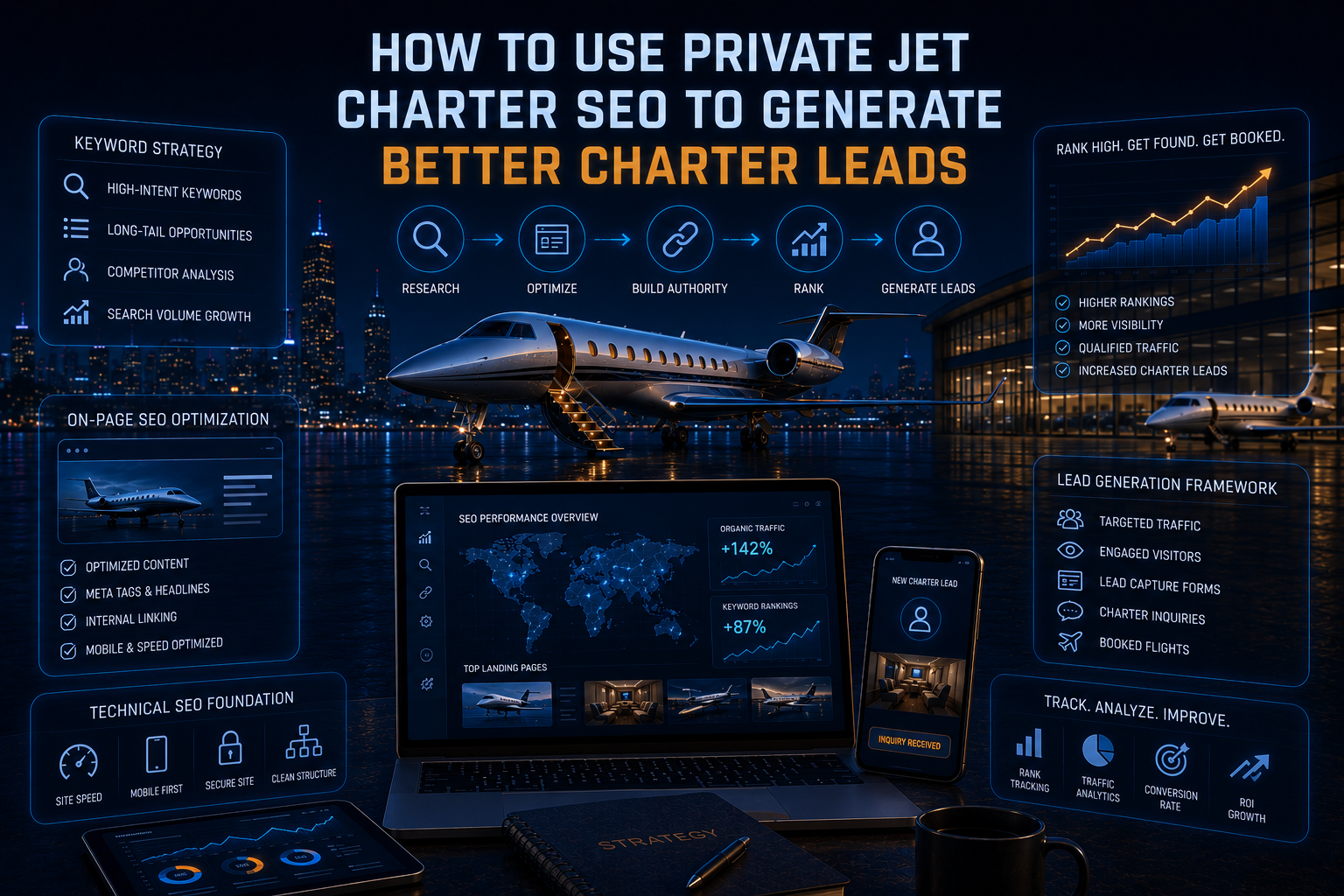
How to Use Private Jet Charter SEO to Generate Better Charter Leads
Direct Answer: Private jet charter SEO generates better charter leads by targeting high-intent searches related to routes, aircraft models, airports, FBOs, pricing questions, and travel scenarios instead of broad luxury keywords alone. Therefore, the strongest aviation SEO strategy builds route-specific pages, aircraft-specific content, airport authority pages, AI-search optimization, and conversion-focused landing pages that attract serious buyers instead of casual traffic.
Many private aviation companies still treat SEO like a branding exercise. However, high-performing private jet SEO works more like a lead qualification system. Instead of chasing broad traffic, it captures people searching for exact missions, exact aircraft, exact airports, and exact travel outcomes.
Additionally, search behavior is changing quickly. Buyers increasingly use conversational searches, voice search, AI search systems, and detailed comparison queries before contacting a charter company. Therefore, SEO must evolve beyond generic “private jet charter” pages.
Google recommends creating helpful, people-first content that answers user needs clearly. Additionally, structured data helps search engines understand page content. Therefore, private aviation websites should combine helpful content with strong schema markup and AI-readable structure. Google explains helpful content, while Google explains structured data.
Key Takeaways
- Private jet SEO should focus on buyer intent instead of vanity traffic.
- However, broad “luxury travel” keywords usually attract weaker leads.
- Therefore, route pages, airport pages, aircraft pages, and GEO content perform better.
- Additionally, AI-search optimization is becoming essential for aviation visibility.
- Ultimately, the best private jet SEO systems generate qualified charter conversations instead of random clicks.
What Is Private Jet Charter SEO?
Direct Answer: Private jet charter SEO is the process of optimizing aviation content, landing pages, route pages, aircraft pages, and airport pages to attract high-intent charter traffic from search engines and AI-search systems.
However, aviation SEO should not focus only on rankings. Instead, it should focus on lead quality. Therefore, every SEO page should help qualify the visitor before they contact sales.
Private Jet SEO Goals
- generate qualified charter inquiries
- rank for mission-specific searches
- increase AI-search visibility
- capture airport-related searches
- attract aircraft-specific traffic
- build authority around routes and travel planning
- support retargeting audiences
- improve conversion quality
Consequently, the best aviation SEO systems function as digital infrastructure, not isolated blog posts.
Why Most Aviation SEO Fails
Direct Answer: Most aviation SEO fails because websites target broad keywords without targeting real charter intent.
Many companies optimize for terms like “private jet” or “luxury travel.” However, those terms often attract curiosity instead of buying intent. Therefore, traffic volume may increase while lead quality stays weak.
Common Weak SEO Approaches
- generic service pages
- shallow websites with few pages
- no route-specific content
- no airport or FBO pages
- no aircraft comparison content
- weak internal linking
- no AI-search optimization
- no conversion strategy
Additionally, AI search systems prefer detailed authority sources. Therefore, shallow aviation websites struggle to become trusted recommendation sources.
Understanding High-Intent Charter Searches
Direct Answer: High-intent charter searches reveal specific travel goals, not general aviation curiosity.
For example, someone searching “private jet” may simply be researching. However, someone searching “G650ER charter from Teterboro to Nice” is much closer to booking.
Examples of High-Intent Searches
- private jet from Palm Beach to Aspen
- heavy jet charter near KTEB
- Global 7500 charter rates
- empty leg flights from Miami
- best airport for private jet near Los Angeles
- same-day private jet charter
- private jet for 12 passengers with pets
Therefore, SEO should align with real charter behavior instead of broad lifestyle branding.
Strategy 1: Build Route-Specific SEO Pages
Direct Answer: Route-specific pages attract better charter leads because they match real mission searches.
Route pages target specific city pairs, airports, or travel corridors. Therefore, they capture users with much stronger booking intent.
What Route Pages Should Include
- departure airport options
- arrival airport options
- best aircraft for the route
- flight duration guidance
- passenger considerations
- luggage guidance
- pricing variables
- seasonal travel considerations
- route-specific FAQs
- private route review CTA
Additionally, route pages create highly valuable retargeting audiences for Meta and Google campaigns.
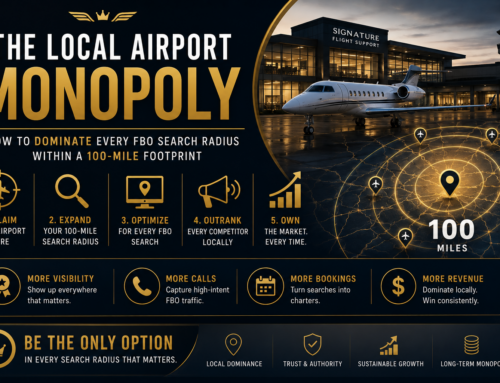
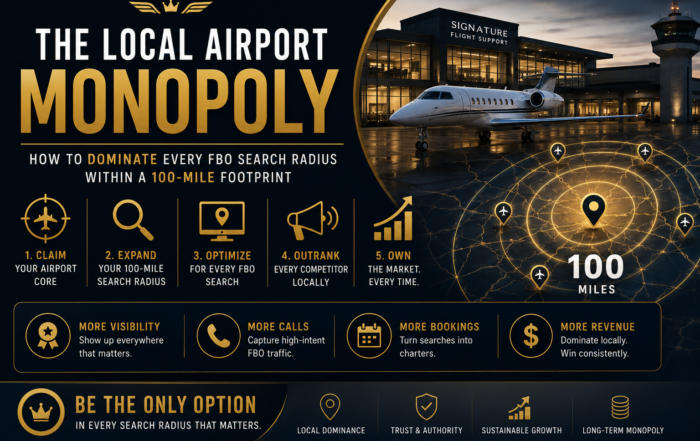
Strategy 2: Create Airport and FBO Authority Pages
Direct Answer: Airport authority pages help aviation brands rank for local private aviation demand.
Many charter buyers search around airports instead of company names. Therefore, airport-specific pages can attract strong local intent.
Important Aviation Airport Topics
- KTEB private jet charter
- KVNY private aviation
- KPBI charter flights
- private aviation near Scottsdale
- best FBO near Aspen
- private jet airport near Miami
Additionally, airport pages strengthen geographic authority. As a result, the website gains more topical depth for search engines and AI systems.
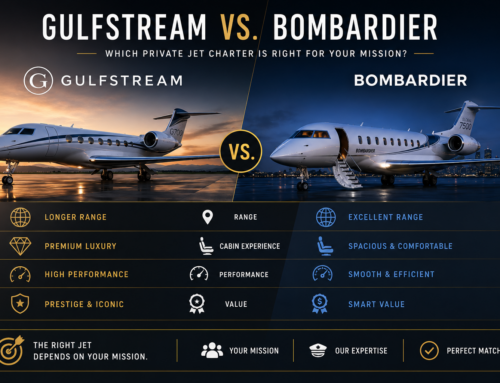
Strategy 3: Build Aircraft Model SEO Pages
Direct Answer: Aircraft-specific SEO pages attract highly educated buyers searching for exact aircraft capabilities.
Aircraft searches often indicate stronger buying intent. Therefore, pages for aircraft models can generate better leads than generic charter pages.
Aircraft SEO Topics
- Gulfstream G650ER charter
- Global 7500 charter
- Citation Longitude charter
- heavy jet comparisons
- super midsize jet comparisons
- best aircraft for international routes
What Aircraft Pages Should Explain
- range and route fit
- passenger capacity
- cabin layout
- speed and comfort
- luggage capacity
- best mission profiles
- comparison options
- availability guidance
Consequently, aircraft pages help qualify buyers before they ever contact sales.
Strategy 4: Optimize for AI Search and GEO
Direct Answer: Generative Engine Optimization helps private jet brands appear in AI-generated recommendations and conversational search results.
Search is changing rapidly. Users increasingly ask AI systems questions directly. Therefore, aviation websites should answer those questions clearly and structurally.
AI Search Questions to Target
- What is the best private jet charter company near Palm Beach?
- Which aircraft is best for a New York to London flight?
- What is the difference between a Global 7500 and G650ER?
- What airport should I use for private aviation near Los Angeles?
- How much does a heavy jet charter cost?
Additionally, schema markup helps AI systems interpret content relationships. Therefore, aviation pages should include FAQPage, Article, WebPage, BreadcrumbList, HowTo, and SpeakableSpecification schema. Google explains structured data.
Strategy 5: Build Aviation Topic Clusters
Direct Answer: Topic clusters improve SEO authority by connecting related aviation pages together.
Instead of isolated articles, aviation websites should build connected content ecosystems. Therefore, related pages should link naturally together.
Example Aviation Topic Clusters
- airport authority cluster
- aircraft comparison cluster
- route-pair cluster
- empty-leg cluster
- heavy jet cluster
- international travel cluster
- private aviation pricing cluster
Additionally, topic clusters improve internal linking structure. Consequently, search engines better understand the site’s authority.
Strategy 6: Use Keyword Research to Find Intent
Direct Answer: Keyword research helps aviation marketers discover the exact phrases serious charter buyers search for.
Tools like Semrush can help identify route searches, airport searches, aircraft model demand, pricing questions, and comparison terms. Therefore, keyword research should guide content planning and landing page creation. Explore Semrush keyword research tools.
Keyword Categories to Research
- route-pair searches
- airport searches
- aircraft model searches
- pricing searches
- comparison searches
- empty-leg searches
- AI-search question searches
- urgent charter searches
As a result, the SEO strategy becomes aligned with real buyer demand.
Strategy 7: Use Conversion-Focused Landing Pages
Direct Answer: SEO traffic only becomes valuable when the landing page creates certainty and drives action.
Many aviation websites generate traffic but fail to convert it. Therefore, every SEO page should include clear next steps.
Better Aviation CTAs
- Request a Private Route Review
- Compare Aircraft Options
- Check Empty Leg Availability
- Review Airport Options
- Get Mission-Specific Pricing Guidance
- Speak With a Charter Advisor
Additionally, landing pages should include proof, FAQs, route clarity, aircraft guidance, and low-friction forms.
Strategy 8: Use Aviation Schema Markup
Direct Answer: Schema markup helps search engines and AI systems understand aviation content more clearly.
Structured data provides context about pages, services, FAQs, organizations, and articles. Therefore, it improves interpretability for both search engines and AI systems.
Important Aviation Schema Types
- Organization
- WebSite
- WebPage
- Article
- FAQPage
- HowTo
- BreadcrumbList
- SpeakableSpecification
Additionally, schema can support richer search results and clearer AI extraction.
Strategy 9: Build Strong Internal Linking
Direct Answer: Internal linking helps search engines understand relationships between aviation topics.
Every route page, aircraft page, airport page, and blog should connect naturally to related resources. Therefore, the site becomes easier to crawl and understand.
Strong Internal Link Examples
- route page → aircraft page
- aircraft page → comparison guide
- airport page → route page
- pricing page → aircraft page
- empty-leg guide → route pages
Consequently, authority flows through the site more effectively.
Strategy 10: Retarget SEO Visitors
Direct Answer: Retargeting SEO visitors helps aviation brands stay visible during the decision process.
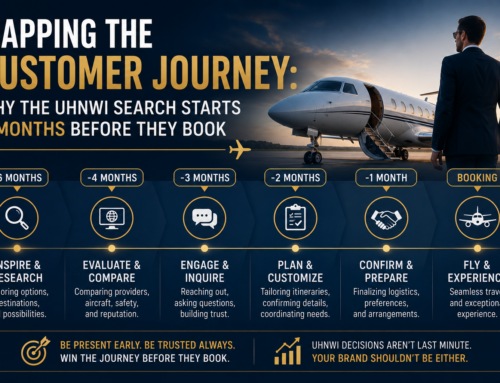
Most buyers will not convert immediately. Therefore, retargeting should continue the conversation after the first visit.
Retargeting Audiences
- route-page visitors
- airport-page visitors
- aircraft-page visitors
- pricing-page visitors
- video viewers
- form openers
Additionally, retargeting ads should match the original interest category. As a result, the follow-up feels more relevant.
SEO Metrics That Matter
Direct Answer: Private jet SEO success should be measured by qualified lead quality and revenue impact.
Important SEO Metrics
- qualified lead rate
- booked consultation rate
- route-page conversions
- aircraft-page engagement
- airport-page traffic
- AI-search visibility
- cost per acquisition reduction
- organic conversion rate
- retargeting audience growth
- organic opportunity value
Therefore, SEO reporting should connect traffic to pipeline and revenue.
Common Private Jet SEO Mistakes
Direct Answer: Aviation SEO fails when websites stay too shallow and generic.
- targeting only broad keywords
- ignoring route-specific intent
- not building airport pages
- not building aircraft pages
- weak internal linking
- ignoring AI-search optimization
- not using schema markup
- using weak CTAs
- creating thin content
- tracking traffic instead of lead quality
Instead, build SEO infrastructure around how real buyers search for private aviation services.
Frequently Asked Questions
What is private jet charter SEO?
Private jet charter SEO is the process of optimizing aviation pages, route pages, aircraft pages, and airport pages to attract qualified charter traffic from search engines and AI-search systems.
Why do route pages generate better charter leads?
Route pages match real mission intent, which means the visitor is usually closer to booking than someone searching broad aviation terms.
Should private aviation websites optimize for AI search?
Yes. AI-search systems increasingly recommend providers directly, so structured aviation content improves visibility in conversational search.
Why are aircraft model pages important?
Aircraft model pages attract educated buyers searching for specific aircraft capabilities, route fit, and passenger requirements.
What metrics matter most for aviation SEO?
The most important metrics include qualified lead rate, booked consultations, opportunity value, AI-search visibility, and organic conversion quality.
External Sources
Conclusion
Direct Answer: Private jet charter SEO generates better charter leads when the strategy focuses on real buyer intent instead of broad luxury traffic.
The strongest aviation SEO systems combine route pages, airport pages, aircraft content, AI-search optimization, schema markup, strong internal linking, conversion-focused landing pages, and retargeting audiences. Therefore, SEO becomes more than a ranking tactic. Instead, it becomes a scalable lead-generation infrastructure.
Final Insight: The best private jet SEO strategy does not chase more traffic. Instead, it attracts the right travelers before competitors even enter the conversation.
About the author : Anthony Paulino