Private Aviation Aircraft Guide
Private Jet Aircraft Guide: Compare Range, Cabin, Performance & Mission Fit
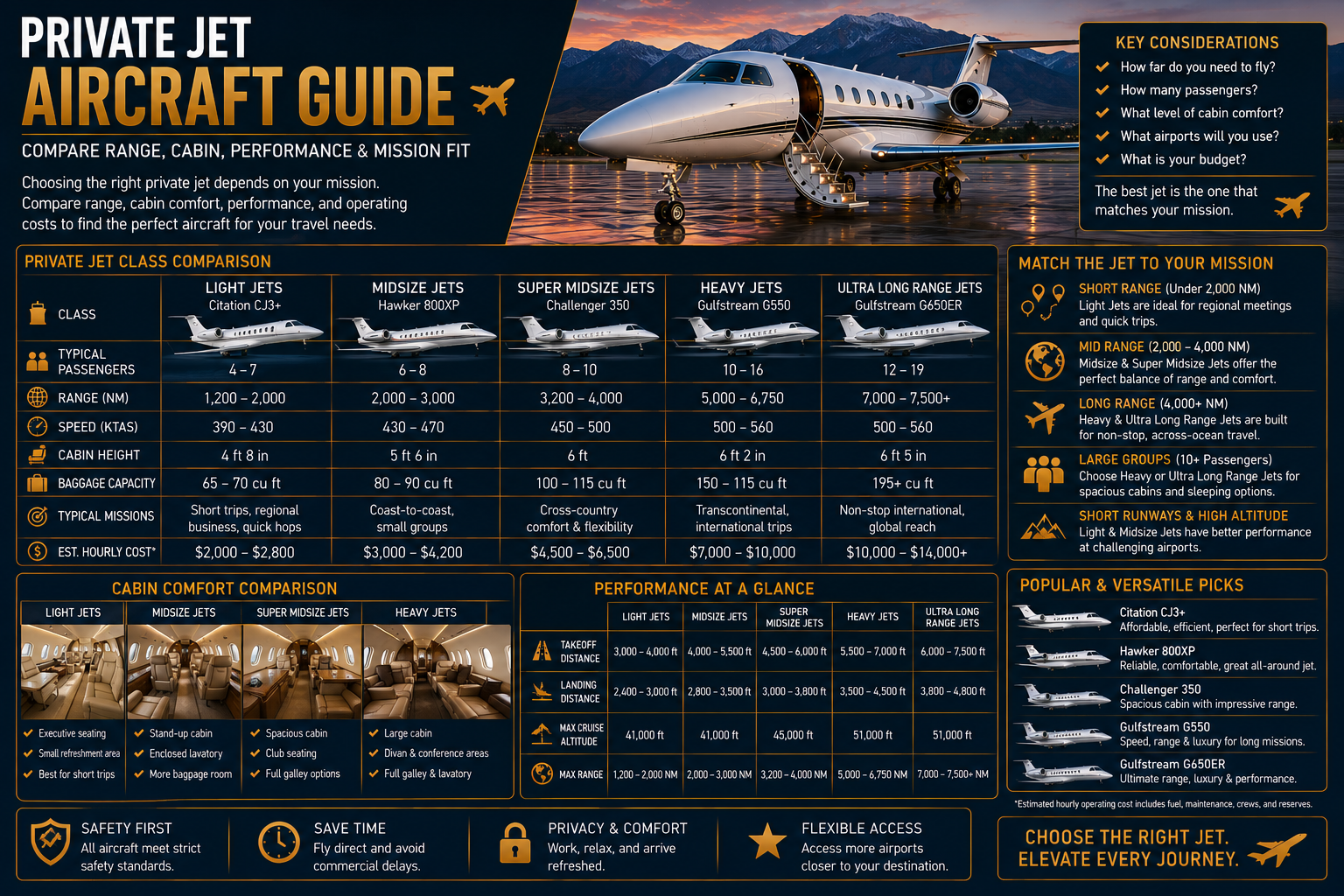
The best private jet is not simply the largest, newest or longest-range aircraft. The right aircraft matches passenger count, baggage, route distance, cabin expectations, airport performance and operating conditions. This guide compares private jet categories and leading aircraft so travelers, executives, family offices and aviation buyers can choose around the complete mission.
Private aviation offers an enormous aircraft range.
A four-passenger regional business trip can use one type of aircraft.
A family flying nonstop across the Atlantic can require another.
Meanwhile, a CEO traveling between continents with staff, sleeping space and multiple cabin zones can require an entirely different platform.
Therefore, aircraft selection should begin with the mission rather than the aircraft name.
That principle matters because larger does not automatically mean better.
A large-cabin aircraft provides extraordinary space.
However, it also brings greater operating weight and cost.
A light jet may provide less cabin volume.
However, it can efficiently solve a short regional mission while accessing airports that may create a better door-to-door itinerary.
Consequently, the best aircraft is the one that solves the passenger’s real travel problem with the least unnecessary compromise.
Range matters.
However, advertised maximum range does not equal guaranteed real-world range.
Passenger count matters.
Baggage matters.
Weather matters.
Airport elevation matters.
Runway length matters.
Wind matters.
Additionally, required fuel reserves and air traffic routing can affect practical mission capability.
Therefore, aircraft specifications should be treated as decision inputs rather than promises.
Cabin size matters for a different reason.
A one-hour flight and a twelve-hour flight do not create the same passenger needs.
A compact cabin can work extremely well for a short business trip.
However, longer missions increase the value of standing room, sleeping capability, multiple living zones, additional lavatories and dedicated crew space.
Consequently, cabin value rises with both flight duration and passenger requirements.
Airport capability matters just as much.
A jet can have enough range for the route while still being poorly suited to one of the airports.
Short runways can change the aircraft decision.
High-elevation airports can change it again.
Hot-weather departures can increase required runway.
Mountain destinations introduce additional terrain and weather considerations.
Therefore, aircraft selection should always consider the airport pair rather than only the distance between two cities.
This becomes especially important in private aviation because airport choice creates much of the industry’s time advantage.
A smaller aircraft capable of using the airport closest to the passenger can sometimes produce a faster complete trip than a larger aircraft using a more distant airport.
Therefore, aircraft performance and passenger geography belong in the same decision.
Private jet categories help organize those choices.
Turboprops can solve short regional and runway-sensitive missions.
Very light and light jets add jet speed while remaining efficient for smaller groups.
Midsize jets provide more cabin and range.
Super-midsize aircraft can add stand-up cabins and substantial domestic or transcontinental capability.
Large-cabin aircraft provide greater passenger space and long-range capability.
Ultra-long-range jets can connect distant global city pairs while providing multiple cabin zones for work, dining and rest.
However, category labels only provide a starting point.
Aircraft within the same category can differ significantly.
One super-midsize jet may emphasize runway performance.
Another may emphasize cabin volume.
One large-cabin aircraft may provide greater payload.
Another may provide more range.
Therefore, individual aircraft pages are necessary after the category comparison.
This aircraft authority hub is designed around that decision process.
It begins with the passenger mission.
Then, it explains the aircraft categories.
Next, it compares range, cabin, speed, baggage, runway considerations and practical use cases.
Finally, it connects those concepts with individual aircraft including Gulfstream, Bombardier, Dassault, Cessna Citation, Embraer, Pilatus, Textron King Air and HondaJet models.
The planned aircraft library includes the Gulfstream G650.
It includes the Gulfstream G700.
It includes the Gulfstream G550.
Additionally, it includes the Bombardier Global 7500 and Global 6500.
The Challenger 350 and Challenger 650 provide additional large and super-midsize comparison points.
Citation aircraft include the Citation X, Latitude, Longitude and XLS.
Embraer aircraft include the Phenom 300, Legacy 500, Praetor 500 and Praetor 600.
Dassault representation includes the Falcon 7X and Falcon 8X.
The Pilatus PC-24 adds a unique utility-focused business jet.
The King Air 350 represents high-capability turboprop travel.
Finally, the HondaJet represents the light end of the business jet spectrum.
Therefore, the library is not designed as a ranking of prestige.
Instead, it is designed as a mission-selection system.
The Gulfstream G650 provides a useful example.
The original G650 offers approximately 7,000 nautical miles of theoretical NBAA IFR range at Mach 0.85 under Gulfstream’s published reference conditions.
The G650ER increased that capability to approximately 7,500 nautical miles.
Both use Rolls-Royce BR725 engines.
Additionally, the family has a maximum operating Mach number of 0.925.
However, production of the G650 family has now ended.
The final G650-family aircraft completed production in 2025 as Gulfstream transitioned toward its next-generation ultra-long-range fleet.
Therefore, a 2026 buyer should understand the G650 differently from a current factory-production aircraft.
It remains highly relevant for charter, ownership, aircraft management and the pre-owned market.
However, it should not be presented as though a new production slot remains equivalent to current Gulfstream models.
That distinction matters throughout this guide.
Aircraft markets evolve.
Production lines change.
New models replace older models.
However, discontinued production does not make a business jet operationally irrelevant.
Many highly capable private aircraft remain in service for decades.
Therefore, this hub separates production status from mission capability.
The Gulfstream G700 creates another example.
It belongs to Gulfstream’s current next-generation fleet and provides up to 7,750 nautical miles of published maximum range at Mach 0.85 under the manufacturer’s reference conditions.
It can seat up to 19 passengers.
Additionally, Gulfstream offers up to five living areas depending on configuration.
Therefore, a G700 mission can emphasize both global range and substantial cabin flexibility.
However, it is not automatically the best aircraft for every traveler.
A four-person New York-to-Florida trip does not need five living areas.
Consequently, aircraft capability should only be purchased or chartered when it creates usable mission value.
The Bombardier Global 7500 provides another ultra-long-range reference point.
Meanwhile, the Falcon 8X offers a different blend of long-range capability and airport flexibility.
Therefore, aircraft comparisons become more useful when the buyer evaluates what each design prioritizes.
Speed introduces another layer.
A private jet’s maximum operating Mach number can look impressive.
However, normal cruise strategy may use a lower speed.
Long-range cruise often prioritizes range efficiency.
High-speed cruise prioritizes time.
Therefore, buyers should understand whether they value absolute range, faster block time or some balance between the two.
That distinction becomes meaningful on long missions.
Saving several minutes on a short flight may provide limited value.
Saving substantial time on repeated transcontinental or intercontinental missions can compound throughout a year.
Consequently, speed becomes more economically meaningful as stage length and annual utilization increase.
Cabin altitude also matters.
Long-duration passengers spend many hours inside the pressure vessel.
Therefore, lower cabin altitude can contribute to passenger comfort.
Humidity, sound levels, lighting and window area can also influence the experience.
Consequently, comparing aircraft only by physical dimensions misses important cabin differences.
Baggage creates another frequently overlooked issue.
An aircraft may provide enough seats while lacking ideal luggage capacity for the mission.
Golf clubs create additional volume.
Ski equipment creates another challenge.
Large family groups can carry substantial luggage.
Entertainment travelers can bring wardrobe or production equipment.
Therefore, baggage requirements should be disclosed before aircraft selection rather than after booking.
Passenger count also needs more nuance than the maximum certified seating number.
An aircraft may technically seat a certain number of people.
However, that does not mean the cabin is ideal for that many passengers on a long mission.
Therefore, buyers should distinguish maximum seating from comfortable mission seating.
Sleeping capacity introduces another distinction.
A cabin can seat more passengers than it can comfortably sleep.
Consequently, an overnight intercontinental flight can create different aircraft requirements from a daytime mission carrying the same number of people.
Crew requirements also scale with the mission.
Longer flights can require additional pilots.
International missions can increase planning complexity.
Very long missions can make dedicated crew rest more valuable.
Therefore, the passenger cabin cannot always be evaluated independently from crew requirements.
Aircraft age also deserves careful interpretation.
A newer aircraft can provide newer systems and cabin features.
However, an older aircraft with strong maintenance history and a high-quality refurbishment can still provide an excellent passenger experience.
Consequently, charter buyers should evaluate operator quality and aircraft condition rather than assuming model year alone determines trip quality.
Ownership decisions go even deeper.
Acquisition price matters.
However, maintenance exposure matters.
Engine programs matter.
Scheduled inspections matter.
Hangar requirements matter.
Crew costs matter.
Insurance matters.
Depreciation matters.
Additionally, annual utilization changes the economics.
Therefore, the best aircraft to charter is not automatically the best aircraft to own.
The same principle applies to fractional ownership and jet cards.
A traveler may prefer access to multiple aircraft categories rather than committing to one airplane.
Therefore, mission variability can influence the best private aviation model before the aircraft model is even selected.
This hub addresses those decisions from the traveler’s perspective.
It does not assume that every reader should buy an aircraft.
It does not assume that charter is always better.
Instead, it explains what each aircraft can solve.
Consequently, travelers can compare aircraft around real operating requirements rather than marketing labels.
Most importantly, the guide treats aircraft selection as one component of the complete private aviation system.
The aircraft must fit the passengers.
It must fit the baggage.
It must fit the route.
It must fit the airports.
Additionally, it must fit the operating conditions.
When those variables align, aircraft selection becomes much easier.
Direct Aircraft Answer
How Do You Choose the Right Private Jet?
Direct Answer: Choose a private jet by matching passenger count, baggage, route distance, cabin expectations and airport performance to the mission. The best aircraft provides enough range and comfort with appropriate runway margin without forcing travelers to pay for unnecessary size or capability. Airport choice should be evaluated at both ends before the aircraft is finalized.
Aircraft selection becomes easier when the variables are considered in the correct order.
Start with the passenger.
Then evaluate the route.
Next, evaluate the airports.
Finally, compare aircraft capable of solving all three.
1
How Many Passengers?
Passenger count establishes the minimum cabin requirement, although comfortable seating can matter more than maximum certified seating.
2
How Much Baggage?
Luggage, golf clubs, skis, equipment and extended-stay bags can materially change which aircraft fits.
3
How Far Is the Flight?
Route length determines the basic range requirement while reserves, weather and routing affect practical capability.
4
Which Airports?
Runway length, elevation, temperature, terrain and local operating requirements can remove otherwise capable aircraft from consideration.
5
What Cabin Experience?
Stand-up height, sleeping space, work areas, lavatories and cabin zones become more valuable as flight duration increases.
6
What Is Actually Necessary?
The strongest aircraft provides the needed capability without forcing the mission to carry unnecessary cost, weight or complexity.
What Is the Most Common Aircraft-Selection Mistake?
Starting with aircraft prestige.
A well-known ultra-long-range jet may be impressive.
However, a smaller aircraft can produce a better trip when the route is short and the destination airport rewards additional runway flexibility.
Therefore, aircraft reputation should follow mission suitability rather than replace it.
Should Price Be the First Filter?
No.
First determine which aircraft can safely and comfortably perform the mission.
Then compare economics among the suitable options.
Otherwise, the least expensive aircraft may create a fuel stop, baggage limitation or airport compromise that reduces the value of the trip.
Consequently, mission qualification should come before price comparison.
Does the Same Traveler Always Need the Same Aircraft?
Usually not.
A family office may use a light jet for a short regional trip.
The same family may use a super-midsize aircraft for a longer domestic mission.
Meanwhile, an international trip may justify an ultra-long-range cabin.
Therefore, access to multiple aircraft categories can be more valuable than treating one airplane as the answer to every mission.
The right private jet is the smallest aircraft that comfortably solves the complete mission without creating unwanted range, baggage, cabin or airport compromises.
That mission-first rule provides a better starting point than aircraft prestige or category alone.
Private Jet Categories
What Are the Main Types of Private Jet Aircraft?
Direct Answer: Private aircraft generally progress from turboprops and very light jets through light, midsize, super-midsize, large-cabin and ultra-long-range jets. As category size increases, travelers generally gain cabin space, baggage capacity and range, while acquisition cost, charter cost, operating weight and runway requirements can also increase.
Aircraft categories simplify comparison.
However, category boundaries are not perfectly standardized.
Therefore, travelers should use them as broad mission groups rather than rigid technical definitions.
| Aircraft Category | Typical Mission Strength | Primary Buyer Consideration |
|---|---|---|
| Turboprop | Short regional travel and airport flexibility | Efficiency, runway capability and shorter stage lengths |
| Very Light / Entry Jet | Small groups on short private missions | Low trip complexity and efficient jet travel |
| Light Jet | Regional and shorter domestic missions | Speed, efficiency and smaller-group comfort |
| Midsize Jet | Longer domestic missions | More cabin and baggage without large-aircraft economics |
| Super-Midsize Jet | Transcontinental and premium domestic missions | Stand-up cabin, range and baggage capability |
| Large-Cabin Jet | Long-range executive and family travel | Cabin zones, passenger comfort and substantial range |
| Ultra-Long-Range Jet | Intercontinental and global nonstop missions | Maximum range, sleeping capability and extended-flight comfort |
Does Moving Up a Category Always Improve the Trip?
No.
Larger aircraft can provide more capability.
However, capability only creates value when the passenger uses it.
Therefore, a larger cabin can become unnecessary cost on a short mission.
Additionally, heavier aircraft can face more demanding runway requirements.
Consequently, moving up a category should solve a specific passenger or route limitation.
Why Can Two Aircraft in the Same Category Feel Very Different?
Manufacturers make different design choices.
One aircraft may emphasize cabin width.
Another may emphasize runway performance.
A third may emphasize range.
Additionally, interior configuration can vary significantly between individual aircraft.
Therefore, category should narrow the search rather than determine the final selection.
Aircraft categories organize the market, but the exact aircraft solves the mission.
Compare individual range, cabin, baggage and airport capability after identifying the correct category.
Aircraft Decision Framework
What Should You Compare Before Choosing a Private Jet?
Direct Answer: Compare private jets across six core mission variables: passengers, baggage, practical range, cabin experience, airport performance and total trip economics. Then evaluate secondary factors such as speed, sleeping capacity, cabin altitude, crew requirements, aircraft age and operating model. No single specification should determine the aircraft by itself.
Aircraft comparisons often begin with range.
However, range tells only part of the story.
A useful comparison evaluates the whole mission.
Passenger Fit
Compare comfortable seating and cabin layout rather than relying only on maximum passenger certification.
Baggage Fit
Confirm the actual luggage, sports equipment and specialty items the passengers intend to carry.
Practical Range
Evaluate the real route with passengers, reserves, weather and likely operating conditions.
Airport Performance
Make sure the aircraft works comfortably at the departure and destination airports.
Cabin Experience
Match cabin height, width, zones and sleeping capability to flight duration.
Mission Economics
Compare total trip value after suitable aircraft have been identified.
Which Variable Should Eliminate an Aircraft First?
Any hard mission limitation.
If the luggage does not fit, the aircraft is not a good choice.
If practical range creates an unwanted fuel stop, another aircraft may be stronger.
If runway performance is unsuitable, the aircraft should be removed from consideration.
Therefore, hard operating requirements should eliminate options before softer preferences are compared.
Which Variables Should Be Optimized After That?
Cabin preference can come next.
Speed can come next.
Price can come next.
Additionally, operator availability can determine which suitable aircraft are actually accessible for the requested date.
Consequently, aircraft selection works best as a filtering process.
First eliminate aircraft that cannot solve the mission. Then compare the aircraft that can.
That process produces a cleaner decision than ranking every jet on one universal scale.
Private Jet Range
How Much Private Jet Range Do You Actually Need?
Direct Answer: You need enough practical range to complete the desired route with the expected passengers, baggage, fuel reserves and operating conditions. Buying or chartering thousands of miles of unused range can add unnecessary cost, while selecting an aircraft too close to its limit can create fuel stops or payload restrictions.
Maximum range attracts attention.
However, most missions do not need maximum range.
Therefore, the better question is how much range creates useful value.
A regional flight may require only a fraction of a light jet’s capability.
A coast-to-coast mission requires substantially more.
An intercontinental mission can justify an ultra-long-range aircraft.
Consequently, route distance should determine the range category.
Should You Choose an Aircraft Whose Published Range Barely Covers the Route?
Generally, a comfortable performance margin is more useful.
Published range can depend on idealized reference conditions.
Real flights include weather.
They include routing.
They include required reserves.
Additionally, passenger and baggage loads vary.
Therefore, selecting an aircraft right at the theoretical limit can increase the chance of an unwanted technical stop.
When Is Extra Range Valuable?
Extra range creates value when it preserves nonstop capability.
It can also provide more flexibility around winds or routing.
Additionally, frequent international travelers may prefer an aircraft capable of several different long missions rather than only one specific city pair.
Therefore, useful reserve capability can be valuable even when it is not used on every flight.
Buy or charter enough range to protect the mission—not range simply for the sake of owning a larger number.
Practical nonstop capability matters more than the brochure headline.
Published vs. Practical Range
Why Is Real-World Private Jet Range Different From Published Range?
Direct Answer: Published private jet range is normally calculated under defined reference assumptions. Actual range can change with passengers, baggage, winds, temperature, airport elevation, air traffic routing, cruise speed, aircraft configuration and required reserves. Therefore, a published maximum range should be used for comparison rather than treated as a guaranteed nonstop distance.
Manufacturers need standardized assumptions to compare aircraft.
Therefore, published specifications remain useful.
However, real-world missions do not occur under identical conditions.
A strong headwind can increase fuel burn.
Additional passengers increase weight.
A high-elevation departure can change aircraft performance.
Additionally, faster cruise can trade fuel efficiency for time.
Wind
Headwinds can reduce practical range while favorable winds can improve the mission.
Passengers
Additional passenger weight can affect payload and fuel planning.
Baggage
Heavy luggage adds payload that must be included in the aircraft’s operating calculation.
Routing
ATC routes rarely match the straight-line distance perfectly.
Cruise Speed
Flying faster can increase fuel consumption and reduce maximum-range capability.
Reserves
Required fuel reserves remain part of professional flight planning.
Why Is Aircraft Range Usually Listed With Specific Passenger Assumptions?
Payload changes the aircraft.
Therefore, manufacturers need a standard passenger and crew assumption for theoretical comparisons.
However, an individual charter may carry a different number of people.
Consequently, the operator calculates the real mission before departure.
Who Decides Whether the Aircraft Can Fly Nonstop?
The aircraft operator and flight crew determine operational feasibility.
Therefore, passengers should treat a range number as planning guidance rather than authority to demand a nonstop flight.
Conditions on the actual day determine the final operating plan.
Published range answers, “What can this aircraft do under defined assumptions?” Real flight planning answers, “What can this aircraft do on this mission today?”
Both numbers matter, but they answer different questions.
Private Jet Cabin Comparison
How Should You Compare Private Jet Cabin Size?
Direct Answer: Compare private jet cabins by usable height, width, length, seating layout, living zones, sleeping capability and baggage access rather than cabin volume alone. Flight duration matters because features that provide little value on a one-hour trip can become major quality-of-life differences on an eight- or twelve-hour mission.
Cabin dimensions influence how the flight feels.
However, no single dimension tells the entire story.
Width affects seating and aisle space.
Height affects the ability to stand.
Length determines how many functional areas can fit.
Additionally, interior configuration determines how effectively that space is used.
What Is a Living Area on a Large Private Jet?
A living area is a distinct cabin zone designed around a different passenger purpose.
One area can support meetings.
Another can support dining.
Another can support relaxation.
Additionally, a rear area can become sleeping space.
Therefore, multiple living zones become particularly valuable on long flights.
Does More Cabin Volume Always Mean a Better Cabin?
No.
Layout matters.
Window placement matters.
Furniture configuration matters.
Sound level matters.
Additionally, cabin altitude and lighting can influence passenger comfort.
Therefore, the strongest cabin is the one designed around how the passengers actually use the aircraft.
When Does Stand-Up Cabin Height Matter Most?
Its value rises with flight duration.
Passengers may tolerate a compact cabin on a short trip.
However, the ability to stand and move more naturally becomes increasingly valuable on longer missions.
Consequently, super-midsize and larger cabins can become worthwhile before their additional range is strictly necessary.
Cabin size should be measured in usable passenger experience, not simply cubic feet.
The longer the flight, the more important cabin layout and movement become.
Passenger Capacity
How Many Passengers Can a Private Jet Carry?
Direct Answer: Private jet passenger capacity ranges from small aircraft carrying only a few travelers to large-cabin jets configured for approximately 19 passengers. However, maximum certified seating does not equal ideal mission seating. Flight duration, interior layout, luggage, sleeping requirements and passenger expectations should determine how many people the aircraft carries comfortably.
Maximum seating can be misleading.
An aircraft might legally carry a larger group.
However, using every available seat can make a long flight less comfortable.
Therefore, travelers should distinguish maximum seats from practical passenger capacity.
Why Can Two Identical Aircraft Carry Different Numbers of Passengers?
Interior configurations vary.
One owner can prioritize individual seats.
Another can install divans.
A third can create larger lounge areas with fewer total seats.
Therefore, the aircraft model alone does not always reveal the exact passenger capacity of an individual tail number.
Should Charter Travelers Confirm the Exact Interior?
Yes, especially when cabin layout matters.
Passengers should confirm seating.
They should confirm sleeping arrangements when relevant.
Additionally, they should confirm baggage capability.
Consequently, the specific aircraft offered for charter matters—not simply the model name.
The relevant passenger number is not “How many seats exist?” It is “How many people can travel comfortably on this specific mission?”
Mission duration and interior configuration determine the better answer.
Private Jet Baggage Planning
How Much Baggage Can a Private Jet Carry?
Direct Answer: Private jet baggage capacity varies dramatically by aircraft and should be evaluated by both compartment volume and allowable weight. Passenger bags, golf clubs, skis, strollers, pet equipment and oversized items can change aircraft selection even when the passenger count fits comfortably.
Baggage can eliminate an aircraft faster than passenger seating.
Therefore, luggage should be discussed early.
A four-person business trip may involve only small bags.
A four-person ski trip can involve dramatically more volume.
Consequently, identical passenger counts can require different aircraft.
Business Bags
Short executive travel often creates relatively modest luggage requirements.
Golf Clubs
Golf bags create long, bulky items that should be confirmed against compartment dimensions.
Ski Equipment
Skis and winter luggage can materially increase the space required for mountain travel.
Family Luggage
Multiple suitcases, strollers and child equipment can increase volume quickly.
Pet Equipment
Crates, beds and other pet items can become part of the baggage calculation.
Production Equipment
Entertainment and media travel can require unusually large or specialized baggage loads.
Why Is Baggage Volume Not the Only Limit?
Aircraft also have weight limits.
Therefore, a compartment can have physical space remaining while aircraft payload becomes constrained.
Fuel adds another major weight variable.
Consequently, the operator must consider both size and weight.
Can Baggage Be Accessible During Flight?
Some aircraft provide in-flight access to baggage compartments.
Others may not provide the same access.
Therefore, passengers who need specific items during the flight should confirm the aircraft configuration before departure.
Tell the operator what you are bringing before choosing the aircraft.
Baggage requirements can change the correct private jet even when passenger count and route stay exactly the same.
Airport + Aircraft Compatibility
Why Does Runway Performance Matter When Choosing a Private Jet?
Direct Answer: Runway performance determines whether a private jet can safely use the airports that create the best passenger itinerary. Aircraft weight, runway length, elevation, temperature, wind, runway condition and obstacles all influence takeoff and landing requirements. Therefore, the largest aircraft can sometimes produce a worse door-to-door mission than a smaller jet with greater airport flexibility.
Aircraft range answers one question.
Runway performance answers another.
A jet can easily have enough range between two cities while lacking ideal performance for one airport.
Therefore, aircraft and airport selection cannot be separated.
Why Can a Smaller Aircraft Produce a Better Trip?
It may access a closer airport.
Therefore, passengers can save ground time.
Additionally, lighter aircraft can offer more operating flexibility at certain airports.
Consequently, a slightly slower or smaller aircraft can produce a faster total journey.
Why Does Takeoff Often Require More Attention Than Landing?
An aircraft can arrive after burning substantial fuel.
Therefore, landing weight may be much lower.
However, departing on a long mission can require a large fuel load.
Consequently, the same aircraft can land comfortably yet face a more restrictive takeoff calculation.
Should Travelers Use Published Takeoff Distance as a Guarantee?
No.
Published figures use defined conditions.
Actual operations depend on the real airport and mission.
Therefore, flight crews and operators perform aircraft-specific calculations.
Aircraft selection should protect airport choice, not destroy it.
A jet that reaches more destinations in theory can create less passenger value if it cannot efficiently use the airports closest to the traveler.
Global Private Aviation
What Is an Ultra-Long-Range Private Jet?
Direct Answer: An ultra-long-range private jet is designed for extended intercontinental missions while providing a large cabin suitable for working, dining, relaxing and sleeping. Aircraft in this class can connect many global city pairs nonstop, although practical range still depends on payload, weather, routing, speed and airport conditions.
Ultra-long-range aircraft exist to solve time.
Their primary value is not simply luxury.
It is the ability to connect distant markets without an intermediate fuel stop while keeping passengers productive and comfortable for many hours.
Therefore, the category can be particularly valuable for global executives and family offices.
Global Range
Ultra-long-range aircraft can connect intercontinental city pairs that smaller jets cannot comfortably fly nonstop.
Multiple Living Areas
Large cabins can separate work, dining, relaxation and sleeping functions.
Sleeping Capability
Overnight missions increase the value of lie-flat sleeping arrangements and private cabin zones.
Crew Support
Very long missions can make dedicated crew areas more important.
Large Baggage Capacity
Extended international travel can require substantial luggage volume.
Higher Mission Cost
The capability carries greater acquisition, charter and operating economics than smaller categories.
Which Planned Aircraft Fit the Ultra-Long-Range Discussion?
The Gulfstream G650 family provides an important benchmark.
The Gulfstream G700 represents Gulfstream’s newer generation.
The Bombardier Global 7500 also belongs near the top of the global range category.
Additionally, the Dassault Falcon 8X provides another long-range large-cabin option with a different mission profile.
Therefore, the strongest comparison depends on more than maximum nautical miles.
Is Ultra-Long-Range Always Better for International Travel?
No.
A shorter international route may fit a super-midsize or other large-cabin aircraft comfortably.
Therefore, paying for the largest possible range can create unnecessary expense.
Ultra-long-range aircraft become most valuable when long nonstop capability or extensive cabin functionality creates real passenger value.
Ultra-long-range jets are time machines for missions that genuinely need their capability.
Their value comes from eliminating stops and supporting passengers through very long flights—not simply from having the biggest range number.
Large-Cabin Private Jets
What Is a Large-Cabin Private Jet?
Direct Answer: A large-cabin private jet provides substantially more standing room, passenger space, baggage capacity and long-range capability than smaller jet categories. These aircraft can support executive teams, families and international travel with multiple seating zones, sleeping arrangements and premium cabin features, although they also require greater operating budgets and more runway consideration.
Large-cabin aircraft serve missions where passenger experience becomes a major part of the decision.
Therefore, their value grows with flight duration.
Several hours in a larger cabin can provide more room to work.
Passengers can move between zones.
Additionally, overnight missions can use sleeping configurations.
When Does Large-Cabin Space Create Real Value?
Long flights create one clear use case.
Larger passenger groups create another.
Entertainment and executive teams can also benefit.
Additionally, travelers carrying significant luggage may value the larger aircraft.
Therefore, large-cabin capability should solve a real passenger requirement.
What Is the Tradeoff?
Aircraft weight increases.
Operating cost generally increases.
Additionally, some smaller airports can become less practical.
Therefore, the passenger gains cabin capability while potentially sacrificing some airport flexibility.
Which Planned Aircraft Belong in the Large-Cabin Comparison?
The Gulfstream G550 remains an important large-cabin reference.
The Bombardier Global 6500 adds long-range capability.
The Challenger 650 occupies another segment of the large-cabin market.
Additionally, the Falcon 7X and Falcon 8X provide Dassault alternatives with distinctive operating characteristics.
Consequently, buyers should compare both the cabin and the mission profile.
Large-cabin aircraft make the most sense when passengers actually use the additional space, range or baggage capability.
Otherwise, a smaller aircraft can often solve the mission more efficiently.
Aircraft Specification Accuracy
Why Should Current Private Jet Specifications Be Verified?
Aircraft specifications, production status and manufacturer lineups can change.
Therefore, this guide uses aircraft data as a mission-comparison tool while exact operating capability should always be confirmed for the specific aircraft.
The Gulfstream G650 family provides an important example.
The G650 and G650ER remain significant operating aircraft.
However, Gulfstream completed production of the family in 2025 as its next-generation aircraft lineup expanded.
Therefore, current buyers should distinguish between active aircraft in the charter or pre-owned fleet and aircraft available as new-production models.
For current Gulfstream fleet information, review the official Gulfstream aircraft lineup.
For current Gulfstream owner and operator support, review Gulfstream Customer Support.
Additionally, the G650 family uses Rolls-Royce BR725 engines, and current engine support information can be reviewed through Rolls-Royce Business Aviation.
Operational range, runway requirements, payload and airport compatibility should always be confirmed by the aircraft operator for the exact flight.
Super-Midsize Private Jets
What Is a Super-Midsize Private Jet?
Direct Answer: A super-midsize private jet combines much of the cabin comfort of a larger aircraft with greater operating efficiency and airport flexibility. These jets commonly provide stand-up cabins, substantial baggage capacity and transcontinental range, making them strong choices for executives, families and longer domestic missions that do not require ultra-long-range capability.
Super-midsize jets occupy one of private aviation’s most useful mission categories.
They provide more cabin than traditional midsize aircraft.
However, they avoid much of the size and operating expense associated with large-cabin jets.
Therefore, the category can create an attractive balance.
A traveler flying from New York to Los Angeles provides a useful example.
The mission is long enough for cabin comfort to matter.
However, it does not necessarily require an ultra-long-range aircraft.
Consequently, a capable super-midsize jet can provide the necessary range while preserving more efficient economics.
The same logic can apply to routes such as Miami to Aspen.
Dallas to New York can fit the category well.
Additionally, Scottsdale to the East Coast can create a strong super-midsize mission.
Stand-Up Cabin
Many aircraft in the category allow passengers to stand and move more naturally during longer flights.
Transcontinental Range
The category can solve many nonstop coast-to-coast missions when conditions and payload support the flight.
More Baggage
Greater baggage capability can make the category useful for families, executives, golfers and ski travelers.
Cabin Productivity
Larger cabins can provide stronger work environments for executive teams.
Airport Flexibility
Some super-midsize aircraft can preserve access to airports that become less attractive for heavier large-cabin jets.
Mission Efficiency
Travelers can gain substantial range and cabin capability without automatically moving into the largest aircraft categories.
Which Planned Aircraft Fit the Super-Midsize Category?
The Challenger 350 provides an important reference.
The Citation Longitude provides another.
The Praetor 600 also competes strongly in this mission range.
Additionally, aircraft classification can vary slightly between sources because category boundaries are not formally universal.
Therefore, the aircraft should be compared by actual mission capability rather than category label alone.
When Is a Super-Midsize Jet Better Than a Large-Cabin Jet?
A super-midsize aircraft can be stronger when the passengers do not need multiple large living zones or extreme range.
Therefore, the smaller aircraft can provide enough cabin and range without carrying unnecessary capability.
Airport performance can also influence the decision.
Consequently, a super-midsize aircraft can outperform a larger jet in total mission value even when the larger aircraft provides more impressive specifications.
When Should Travelers Move Up to a Large-Cabin Aircraft?
Larger passenger groups can justify the move.
Longer international missions can justify it.
Sleeping requirements can also justify it.
Additionally, passengers who need multiple distinct cabin zones may benefit from the larger platform.
Therefore, moving up should solve a clear limitation rather than simply increase aircraft size.
Super-midsize jets often sit near the private aviation sweet spot for long domestic travel.
They can provide meaningful cabin comfort and range without automatically requiring large-cabin economics.
Midsize Private Jets
What Is a Midsize Private Jet?
Direct Answer: A midsize private jet provides more cabin room, baggage capacity and range than most light jets while remaining smaller and generally more economical than super-midsize or large-cabin aircraft. Midsize jets can be particularly effective for medium-length domestic trips where passengers want greater comfort without paying for unused long-range capability.
Midsize aircraft extend the private aviation mission.
A light jet can work extremely well regionally.
However, longer trips increase the value of additional cabin space.
Therefore, midsize aircraft can provide the next logical step.
Passenger comfort improves.
Baggage capability can improve.
Range generally increases.
Additionally, some aircraft provide better lavatory and cabin arrangements for longer flights.
When Does a Midsize Jet Make the Most Sense?
Consider a midsize aircraft when a light jet begins creating compromises.
The route may approach the smaller aircraft’s practical range.
The passenger group may need more baggage space.
Additionally, travelers may simply want more cabin comfort for a multi-hour flight.
Therefore, midsize aircraft become valuable when those improvements are actually used.
Is a Midsize Jet Necessary for Every Three-Hour Flight?
No.
Passenger count matters.
Baggage matters.
The specific light jet matters.
Additionally, airport requirements can change the decision.
Therefore, flight duration should influence aircraft choice without determining it by itself.
Can Midsize Jets Fly Coast to Coast?
Some missions may be possible with certain aircraft and favorable conditions.
However, travelers who repeatedly need reliable transcontinental capability may find a super-midsize aircraft more suitable.
Therefore, practical range margin matters more than whether a route is theoretically possible.
Midsize jets become attractive when light-jet efficiency is no longer worth the cabin, baggage or range compromise.
They provide a middle ground before the mission requires a super-midsize aircraft.
Light Private Jets
What Is a Light Private Jet?
Direct Answer: A light private jet is designed primarily for smaller passenger groups traveling on regional and shorter domestic missions. Light jets can provide jet speed, private terminals and schedule flexibility while using less aircraft than a midsize or large-cabin mission requires. Their strongest advantages are efficiency, speed and access to a broad airport network.
Light jets can produce exceptional private aviation value.
The passenger receives a private aircraft.
The passenger receives schedule control.
Additionally, the aircraft can use business aviation airports close to the actual destination.
However, the traveler avoids paying for thousands of miles of unused range.
Therefore, light jets can be extremely efficient when the mission fits.
Small Groups
Light jets work particularly well when only a few passengers need to travel.
Regional Routes
Shorter domestic trips can use the aircraft’s capability efficiently.
Jet Speed
Travelers gain the speed advantage of turbine jet propulsion without moving into a larger aircraft.
Airport Access
Smaller aircraft can make a broad network of business aviation airports practical.
Lower Trip Cost
When the mission fits, using less aircraft can reduce charter expense compared with larger categories.
Simpler Mission
Smaller groups with modest baggage can avoid paying for cabin capability they will not use.
Which Planned Aircraft Fit the Light-Jet Discussion?
The Phenom 300 provides one of the most important modern light-jet references.
The Citation XLS family occupies the upper end of light-jet and entry-midsize discussions depending on classification.
The HondaJet represents a smaller light business jet solution.
Therefore, travelers can find meaningful differences even within the smaller jet market.
What Is the Biggest Limitation of a Light Jet?
The smaller cabin creates the most obvious tradeoff.
Baggage can also become restrictive.
Additionally, longer routes can require a fuel stop.
Therefore, travelers should not force a light aircraft onto a mission simply because it produces the lowest quote.
When Can a Light Jet Beat a Larger Aircraft?
Airport geography can create the advantage.
If the smaller jet can use an airport substantially closer to the passenger, it may reduce ground travel.
Additionally, a smaller group may receive no meaningful benefit from a large cabin on a short trip.
Consequently, the light jet can produce the better complete itinerary.
Light jets are not lesser private jets. They are purpose-built tools for missions that do not need larger-aircraft capability.
When passenger count, baggage and distance fit, the category can be one of private aviation’s most efficient choices.
Turboprop Private Aircraft
When Is a Turboprop Better Than a Private Jet?
Direct Answer: A turboprop can be better than a jet when the mission is relatively short, airport or runway flexibility matters and maximum cruise speed provides limited additional value. High-capability turboprops can offer substantial cabin utility, strong regional efficiency and access to airports that may create a better door-to-door trip than a larger jet.
Private aviation does not begin with jets.
Turboprops solve important missions.
Therefore, travelers should not automatically eliminate them because they use propellers.
A short regional flight provides a strong example.
The jet may fly faster.
However, the total airborne distance may be too short for that speed advantage to create a major difference.
Meanwhile, the turboprop can provide excellent airport flexibility.
Consequently, total travel time can remain highly competitive.
Why Can Turboprops Be Strong for Short Airports?
Many turboprops are designed around strong runway performance.
Therefore, they can access airports that may not work as comfortably for larger jets.
That can place passengers closer to their final destination.
Consequently, slower cruise speed does not automatically mean a slower door-to-door trip.
What Is the Main Tradeoff?
Cruise speed.
Jets generally fly faster.
Therefore, the time difference becomes more meaningful as route length increases.
Cabin expectations can also differ.
Consequently, turboprops tend to become most attractive on shorter missions.
Where Does the King Air 350 Fit?
The King Air 350 represents the high-capability end of business turboprop travel.
It combines a substantial cabin with regional mission flexibility.
Therefore, it provides an important comparison against smaller jets when runway access, passenger utility or shorter stage lengths matter.
A turboprop can beat a jet when airport access saves more time than additional cruise speed.
Private aviation should optimize the complete trip rather than the aircraft’s maximum speed.
High-Elevation Aircraft Performance
How Do High-Elevation Airports Affect Private Jet Choice?
Direct Answer: High-elevation airports can reduce aircraft takeoff and climb performance because air density decreases as elevation rises. Therefore, aircraft selection for airports such as Aspen, Centennial and other mountain destinations must consider elevation together with temperature, runway length, aircraft weight, terrain and weather rather than relying only on published range.
Elevation changes aircraft performance.
The air becomes less dense.
Therefore, engines and wings operate in a different environment than they do near sea level.
Higher temperature can intensify the effect.
Consequently, aircraft weight becomes especially important.
A jet carrying a small passenger load and moderate fuel may have substantial flexibility.
The same aircraft departing heavily loaded for a long-range mission can create a very different calculation.
Therefore, aircraft capability should always be evaluated around the exact mission.
Why Does Aspen Require Specialized Aircraft Planning?
Aspen combines high elevation with mountainous terrain and a specialized operating environment.
Therefore, aircraft selection cannot focus only on runway length.
Weather matters.
Aircraft performance matters.
Additionally, operator procedures and airport requirements matter.
Travelers can review the Aspen Airport Private Jet Guide for airport-specific planning.
Why Does Centennial Matter in Aircraft Comparisons?
Centennial provides a long primary runway.
However, its high field elevation still affects aircraft performance.
Therefore, a long runway does not make density altitude irrelevant.
Travelers can review the Centennial Airport Private Jet Guide for APA-specific planning.
Can Aircraft Size Become a Disadvantage at Elevation?
Yes.
Larger aircraft generally bring more operating weight.
Therefore, a smaller aircraft with strong high-altitude performance can sometimes provide greater mission flexibility.
Consequently, cabin size should not be used as a substitute for airport-performance analysis.
At high-elevation airports, the strongest aircraft is the one that preserves enough performance margin for the real payload, weather and runway—not necessarily the largest jet available.
Elevation should be considered before the aircraft is booked.
Hot-Weather Aircraft Performance
How Does Hot Weather Affect Private Jet Performance?
Direct Answer: Hot weather reduces air density and can increase the runway required for takeoff while reducing aircraft climb performance. The effect becomes particularly important when heat combines with high airport elevation, heavy passenger loads or substantial fuel. Therefore, summer conditions can change which aircraft or fuel strategy works best for a mission.
Temperature is not simply a passenger-comfort issue.
It changes aircraft performance.
Therefore, the same aircraft can have different capabilities at the same airport on different days.
A cool morning can create one performance profile.
A hot afternoon can create another.
Consequently, departure timing can sometimes become part of mission planning.
Why Can Early-Morning Departures Help?
Morning temperatures can be cooler.
Therefore, air density may provide a more favorable performance environment.
However, weather and operational conditions still vary.
Consequently, flight crews determine whether timing provides a meaningful advantage for the actual mission.
Can Hot Weather Force a Fuel Stop?
Potentially.
A heavily fueled aircraft can require more runway.
Therefore, an operator may reduce departure fuel when performance demands it.
The aircraft can then stop later for additional fuel.
Consequently, a mission that is theoretically within the aircraft’s range may not always operate nonstop under every condition.
Which Destinations Make Heat Especially Relevant?
Desert and high-elevation markets deserve additional attention.
Scottsdale can experience extreme summer temperatures.
Las Vegas can as well.
Meanwhile, Centennial combines elevation with warm summer conditions.
Therefore, the same aircraft can face different constraints across the private aviation network.
Aircraft capability changes with the atmosphere.
The right aircraft in cool conditions may require a different payload, departure time or fuel strategy when heat and elevation increase density altitude.
Private Jet Speed
How Fast Do Private Jets Fly?
Direct Answer: Private jet cruise speeds vary by aircraft category and mission, while many modern business jets operate at high subsonic speeds. Maximum operating Mach number, high-speed cruise and long-range cruise are different specifications. Therefore, travelers should compare expected block time and mission efficiency rather than assuming the aircraft with the highest maximum speed always produces the best trip.
Speed sells aircraft.
However, maximum speed does not tell passengers how the aircraft will normally operate.
An aircraft may have an impressive maximum Mach number.
However, long-range missions can use a more efficient cruise setting.
Therefore, maximum speed and practical trip speed should be separated.
What Does Mach Mean?
Mach compares aircraft speed with the local speed of sound.
Therefore, Mach 0.90 means the aircraft is traveling at approximately 90% of the local speed of sound.
However, the actual speed represented by a Mach number varies with atmospheric conditions.
Consequently, Mach provides a useful high-altitude aviation comparison rather than a fixed miles-per-hour conversion.
When Does Private Jet Speed Create the Most Value?
Long missions and repeated travel increase its value.
Saving a modest amount of time once may not materially change the economics.
However, executives completing hundreds of flight hours each year can accumulate substantial time savings.
Therefore, annual utilization should influence how much value a buyer places on cruise speed.
Can a Slower Aircraft Still Produce the Faster Trip?
Yes.
Airport access can outweigh cruise speed.
A slower aircraft that lands 30 minutes closer to the passenger’s destination can beat a faster aircraft that requires more ground travel.
Therefore, block time and door-to-door time matter more than cruise speed alone.
Private aviation should optimize door-to-door speed—not bragging rights at maximum Mach.
Aircraft speed becomes valuable when it materially reduces the passenger’s complete travel time.
Long-Flight Cabin Comfort
Why Does Cabin Altitude Matter on a Private Jet?
Direct Answer: Cabin altitude describes the pressure environment passengers experience while the aircraft flies at a much higher physical altitude. Lower cabin-altitude capability can contribute to passenger comfort on long flights, although cabin pressure is only one part of the experience. Noise, humidity, seating, lighting, movement and sleep quality also matter.
Private jets cruise high above the ground.
However, the cabin is pressurized.
Therefore, passengers experience an environment equivalent to a much lower altitude than the aircraft’s actual flight level.
Aircraft manufacturers increasingly emphasize this part of cabin design.
That makes sense.
Passengers can spend ten hours or more inside an ultra-long-range aircraft.
Consequently, small improvements in cabin environment can become more meaningful as flight duration increases.
Should Cabin Altitude Determine the Aircraft by Itself?
No.
The aircraft still needs to solve the route.
It needs enough baggage space.
It needs the correct passenger configuration.
Additionally, it needs appropriate airport performance.
Therefore, cabin altitude belongs inside a larger comfort and mission comparison.
What Other Cabin Factors Matter?
Sound levels matter.
Lighting matters.
Window size can matter.
Humidity can matter.
Additionally, seat design and sleeping arrangements can have a major effect on long-flight comfort.
Consequently, premium aircraft should be evaluated as complete cabin environments.
Cabin altitude becomes more meaningful as flight time increases, but the best long-range cabin combines pressure, sound, lighting, space and sleeping comfort.
No single cabin specification determines the complete passenger experience.
Gulfstream Aircraft Guide
Which Gulfstream Private Jets Should Travelers Compare?
Direct Answer: Travelers researching Gulfstream aircraft should compare the G650 family, G700 and G550 across range, cabin size, production generation, airport performance and mission economics. The G650 remains a major ultra-long-range operating aircraft, the G700 represents Gulfstream’s newer large-cabin generation, and the G550 remains relevant throughout the pre-owned and operating fleet.
Gulfstream has become one of the most recognizable names in long-range business aviation.
However, the aircraft do not solve identical missions.
Therefore, travelers should understand where each model fits.
Ultra-Long-Range
Gulfstream G650
The G650 family established a major benchmark for high-speed, ultra-long-range private aviation and remains important throughout the operating and charter fleet.
New Generation
Gulfstream G700
The G700 expands Gulfstream’s large-cabin concept with substantial range and up to five living areas depending on configuration.
Large Cabin
Gulfstream G550
The G550 remains an important long-range large-cabin aircraft despite production having ended, with substantial representation in business aviation fleets.
Why Does the G650 Still Matter After Production Ended?
Production status and operational relevance are different.
Existing G650 and G650ER aircraft remain capable long-range business jets.
Therefore, they remain relevant for charter, ownership and pre-owned acquisition.
Additionally, their established operating history makes them important comparison aircraft.
Consequently, the G650 deserves its own aircraft guide even though buyers are no longer comparing new factory production slots in the same way.
Why Is the G700 Different?
The G700 belongs to Gulfstream’s newer aircraft generation.
It provides a larger cabin concept.
Additionally, it offers very long published range and multiple living areas.
Therefore, it can better serve travelers who place high value on both global range and extensive cabin zoning.
Why Does the G550 Still Matter?
A successful aircraft does not stop being useful when production ends.
The G550 remains in active service around the world.
Therefore, charter travelers and pre-owned buyers can still encounter it frequently.
Its economics can also differ materially from newer aircraft.
Consequently, it remains an important large-cabin comparison.
Compare Gulfstreams by mission generation—not simply by model number.
The G550, G650 and G700 represent different eras and different combinations of range, cabin capability and economics.
Bombardier Aircraft Guide
Which Bombardier Private Jets Should Travelers Compare?
Direct Answer: Travelers should compare Bombardier’s Global and Challenger families around mission length and cabin requirements. The Global 7500 and Global 6500 target long-range large-cabin travel, while the Challenger 350 and Challenger 650 solve shorter missions with different cabin, range and operating profiles.
Bombardier covers several important private aviation categories.
Therefore, travelers can remain within the manufacturer family while moving substantially between mission profiles.
Global 7500
Designed around ultra-long-range travel, a large cabin and global executive missions.
Global 6500
Provides long-range large-cabin capability for demanding international and domestic missions.
Challenger 350
Represents a strong super-midsize mission profile for premium domestic and transcontinental travel.
Challenger 650
Provides a larger cabin and longer-range mission profile within the Challenger family.
Global 7500 or Challenger 350?
These aircraft solve very different problems.
The Global 7500 can support major intercontinental missions.
The Challenger 350 targets a smaller mission class.
Therefore, comparing them only on specifications misses the point.
The better comparison begins with the route and passenger requirements.
Why Compare the Global 7500 With the Gulfstream G700?
Both aircraft target the top end of modern business aviation.
Therefore, buyers and charter travelers can compare range, cabin design, living zones, speed and operator availability.
However, the best aircraft still depends on the exact mission.
Consequently, the later aircraft comparison should focus on practical passenger use rather than declaring a universal winner.
Bombardier’s Global and Challenger families solve different layers of private aviation demand.
Choose the mission class first, then compare aircraft within that class.
Cessna Citation Aircraft Guide
Which Citation Private Jets Should Travelers Compare?
Direct Answer: Citation buyers and charter travelers should compare the Citation X, Latitude, Longitude and XLS according to route length, cabin requirements, speed, baggage and airport performance. The family spans multiple mission profiles, from efficient shorter trips to longer super-midsize missions, so the best Citation depends heavily on how the aircraft will actually be used.
Citation is not one aircraft category.
The family spans different mission classes.
Therefore, travelers should avoid treating the Citation name as a single cabin or range standard.
Citation X
Known for high-speed business aviation and remains an important aircraft in the operating fleet.
Citation Latitude
Provides a midsize cabin and domestic mission capability with a strong balance of comfort and efficiency.
Citation Longitude
Moves farther into the super-midsize mission with additional range and cabin capability.
Citation XLS
Provides an efficient smaller-cabin solution for regional and shorter domestic business aviation.
Latitude or Longitude?
Start with mission length.
Then consider passenger expectations.
The Longitude provides more capability.
However, the Latitude may solve a shorter mission without requiring the larger aircraft.
Therefore, the better aircraft depends on whether the additional capability creates usable value.
Why Does the Citation X Still Matter?
Speed made the Citation X an important business aviation aircraft.
Although newer aircraft have changed the market, existing Citation X aircraft remain in service.
Therefore, charter travelers can still encounter the model.
Consequently, its high-speed mission profile deserves comparison with newer aircraft rather than being ignored because of production status.
The Citation family demonstrates why aircraft names should never replace category analysis.
Different Citation models solve substantially different passenger and route requirements.
Embraer Executive Jets
Which Embraer Private Jets Should Travelers Compare?
Direct Answer: Embraer’s planned aircraft in this guide span the Phenom 300, Legacy 500, Praetor 500 and Praetor 600. Together, they cover light through super-midsize mission requirements, allowing travelers to compare efficient regional jet travel with larger cabins and longer-range capability within the same manufacturer family.
Embraer provides useful progression through several aircraft categories.
Therefore, its aircraft demonstrate how passenger requirements change the correct jet.
Phenom 300
A major light-jet platform designed around efficient private and business aviation missions.
Legacy 500
A larger-cabin aircraft that remains relevant in the operating and pre-owned fleet.
Praetor 500
Provides a modern midsize mission profile with substantial range for its class.
Praetor 600
Extends the family into longer super-midsize missions with additional range capability.
Phenom 300 or Praetor?
The passenger should begin with the mission.
A short regional trip with a small group may strongly favor the Phenom.
However, a longer mission can justify the Praetor family’s larger cabin and additional range.
Therefore, moving up the family should solve an actual limitation.
Praetor 500 or Praetor 600?
Range creates a major distinction.
Therefore, travelers who repeatedly fly longer missions can gain meaningful value from the Praetor 600.
However, the Praetor 500 can provide a strong solution when the extra range is unnecessary.
Consequently, the route network should drive the comparison.
Embraer’s lineup allows travelers to move from efficient light-jet missions into longer-range cabins without assuming every trip requires the largest aircraft.
The correct model changes with the mission.
Dassault Falcon Aircraft
How Do the Falcon 7X and Falcon 8X Fit Into Private Aviation?
Direct Answer: The Dassault Falcon 7X and Falcon 8X are long-range, large-cabin business jets designed for demanding international and executive missions. Both use three-engine configurations and emphasize a combination of range, cabin capability and airport performance. The Falcon 8X extends the platform with additional range and cabin capability compared with the 7X.
Dassault approaches business aviation with a distinct design philosophy.
Therefore, Falcon aircraft deserve comparison beyond range alone.
The three-engine configuration is unusual among modern business jets.
Additionally, airport-performance capability can become valuable for travelers using demanding destinations.
Why Can Airport Performance Matter for a Long-Range Aircraft?
Long-range passengers do not always travel between major international airports.
A global traveler may want to land close to a resort.
Another may need access to a regional business airport.
Therefore, long range creates more value when the aircraft also preserves useful airport access.
Falcon 7X or Falcon 8X?
The 8X provides greater capability.
However, the 7X remains a highly capable long-range aircraft.
Therefore, charter availability, cabin configuration, route length and economics should influence the decision.
Consequently, the newer or larger aircraft does not automatically become necessary for every mission.
Why Compare the Falcon 8X With Gulfstream and Global Aircraft?
All compete for demanding long-range travelers.
However, they emphasize different combinations of cabin, range, speed and airport capability.
Therefore, a mission-specific comparison provides more useful information than a simple specification ranking.
Falcon aircraft demonstrate that global range and airport flexibility do not need to be evaluated separately.
The strongest long-range aircraft should solve both the distance and the airports.
Specialized Mission Aircraft
Where Do the PC-24, King Air 350 and HondaJet Fit?
Direct Answer: The Pilatus PC-24, King Air 350 and HondaJet demonstrate three different approaches to efficient private aviation. The PC-24 emphasizes utility and airport flexibility, the King Air 350 provides high-capability turboprop transportation, and the HondaJet provides efficient light-jet travel for smaller passenger groups and shorter missions.
Not every useful private aircraft fits neatly into a prestige hierarchy.
These aircraft prove why.
Each solves a specific mission extremely well.
Therefore, travelers should evaluate what the aircraft can do rather than where it sits in a size ranking.
Utility Jet
Pilatus PC-24
The PC-24 combines jet performance with an unusual emphasis on airport versatility and mission utility.
Turboprop
King Air 350
The King Air 350 provides substantial regional capability while preserving the operating strengths of a business turboprop.
Light Jet
HondaJet
The HondaJet provides an efficient small-jet solution for shorter private missions and smaller passenger groups.
Why Is the PC-24 Different From a Conventional Business Jet?
Mission versatility plays a central role in its design.
Therefore, travelers considering airports with unusual runway or access requirements may find the aircraft particularly interesting.
Its large cargo door also creates a different utility profile from many conventional business jets.
Consequently, the PC-24 can solve missions where passenger count alone does not tell the full story.
Why Choose a King Air 350 Instead of a Jet?
Shorter regional missions can favor the turboprop.
Airport access can favor it as well.
Additionally, cabin and payload utility can provide value for certain groups.
Therefore, the King Air should be compared with the complete trip rather than rejected because its cruise speed is lower than a jet.
When Does a HondaJet Make Sense?
Small passenger groups create the strongest use case.
Shorter missions create another.
Therefore, travelers can receive private jet speed and convenience without chartering substantially more aircraft than the mission needs.
Specialized aircraft often win by solving a specific mission better—not by having the largest cabin or longest range.
Utility belongs beside luxury when comparing private aircraft.
Aircraft Family Decision
Should You Choose the Manufacturer or the Mission First?
Direct Answer: Choose the mission first. Gulfstream, Bombardier, Citation, Embraer, Dassault, Pilatus, Beechcraft and Honda Aircraft each produce or have produced capable business aircraft, but brand preference should come after passenger, route, baggage, cabin and airport requirements. The best manufacturer is the one whose aircraft best solves the specific trip.
Brand loyalty exists throughout private aviation.
That is understandable.
Passengers can prefer a particular cabin.
Pilots can have platform preferences.
Owners can also value manufacturer support relationships.
However, mission fit should remain the first filter.
A Gulfstream can be exceptional for one trip.
A Citation can be stronger for another.
A Phenom can solve a smaller regional mission more efficiently.
Meanwhile, a PC-24 can provide airport utility that changes the entire itinerary.
Therefore, aircraft families should not be ranked as universally better or worse.
What Should Charter Travelers Prioritize Beyond the Aircraft?
Operator quality matters.
Aircraft condition matters.
Crew experience matters.
Safety standards matter.
Additionally, the specific cabin configuration matters.
Therefore, the model name should never become the only charter-selection criterion.
What Should Aircraft Buyers Prioritize?
The analysis becomes even broader.
Acquisition price matters.
Maintenance programs matter.
Engine coverage matters.
Crew requirements matter.
Hangar availability matters.
Additionally, resale and annual utilization matter.
Therefore, an ownership decision requires economics that a one-time charter comparison does not.
What Comes Next in the Aircraft Comparison?
The next step is direct aircraft-to-aircraft analysis.
The G650 can be compared with the G700.
The G700 can be compared with the Global 7500.
The Challenger family can be compared across mission classes.
Citation aircraft can be separated by cabin and range.
Additionally, the Praetor and Falcon families can be compared directly.
Therefore, the next section moves from aircraft categories and families into the specific decisions private travelers actually face.
Mission first. Aircraft category second. Manufacturer third. Exact aircraft fourth.
That order prevents brand preference from creating a worse private aviation itinerary.
Direct Private Jet Comparison
How Should Leading Private Jets Be Compared?
Direct Answer: Leading private jets should be compared by mission fit rather than prestige. Start with practical range, passenger count, baggage, cabin configuration, runway performance and airport access. Then compare speed, sleeping capability, operating economics, production status and availability. The strongest aircraft is the one that solves the real trip with the fewest compromises.
Aircraft comparison becomes useful when the models solve similar problems.
Therefore, comparing a HondaJet directly with a Global 7500 creates little decision value.
The more useful comparison begins inside the correct mission class.
A long-range buyer can compare the G700 and Global 7500.
A super-midsize traveler can compare the Challenger 350 and Praetor 600.
A shorter domestic traveler can compare the Citation XLS, Phenom 300 and other smaller platforms.
Consequently, the aircraft should first be grouped by mission.
| Comparison Question | Why It Matters | What to Look For |
|---|---|---|
| Can It Fly the Route Nonstop? | Fuel stops can add time and complexity | Practical range with passengers, baggage, winds and reserves |
| Does the Cabin Fit the Trip? | Longer flights increase the value of cabin space | Height, width, length, living zones and sleeping capability |
| Will the Baggage Fit? | Sports and family travel can exceed smaller compartments quickly | Volume, weight and oversized-item capability |
| Can It Use the Best Airports? | Airport geography can save more time than cruise speed | Runway performance, elevation and destination restrictions |
| How Fast Is the Mission? | Speed compounds on long or frequent flights | Expected cruise strategy and real block time |
| What Does the Aircraft Cost to Use? | Unused capability can create unnecessary expense | Charter pricing, ownership economics and mission efficiency |
| Is the Aircraft Still in Production? | Production status can affect acquisition and support strategy | New-production availability versus operating or pre-owned relevance |
Should the Aircraft With the Best Specifications Always Win?
No.
A specification only creates value when the passenger uses it.
Therefore, 1,000 additional nautical miles of range may provide no benefit on a short domestic mission.
A larger cabin may create little value for two passengers flying one hour.
Additionally, a heavier aircraft can reduce airport flexibility.
Consequently, the aircraft with the strongest overall specifications can still be the weaker mission choice.
What Should Break a Tie Between Two Suitable Aircraft?
The exact cabin can break the tie.
Operator quality can break it.
Airport capability can break it.
Additionally, availability and total trip price can break it.
Therefore, once two aircraft both solve the hard mission requirements, softer preferences become more important.
Compare aircraft only after defining the mission they are being asked to solve.
Mission fit creates a useful comparison. Specification ranking alone does not.
Gulfstream Comparison
Gulfstream G650 vs. G700: Which Private Jet Fits the Mission Better?
Direct Answer: The G650 remains an elite ultra-long-range aircraft with substantial speed, range and global operating relevance, while the G700 adds a newer-generation cabin with more living-area flexibility and greater published range. The G700 can be stronger when maximum cabin functionality matters, while the G650 can remain highly compelling in charter and pre-owned markets.
This comparison requires more than asking which aircraft is newer.
Both belong near the top of business aviation.
However, they represent different Gulfstream generations.
The G650 family established a modern ultra-long-range benchmark.
The G700 expands the concept with a larger cabin and more interior zoning.
Therefore, the strongest aircraft depends on what the passenger values most.
| Decision Factor | Gulfstream G650 | Gulfstream G700 |
|---|---|---|
| Mission Class | Ultra-long-range | Ultra-long-range |
| Production Position | Production completed; active operating and pre-owned fleet | Newer-generation current Gulfstream platform |
| Cabin Concept | Large long-range cabin | Larger cabin with up to five living areas depending on configuration |
| Range Position | Long-range global capability | Greater published maximum range than the original G650 |
| Speed | Very high-speed business aviation capability | Very high-speed business aviation capability |
| Best Use Case | Global charter, ownership and pre-owned acquisition | Buyers prioritizing next-generation cabin and global capability |
When Can the G650 Still Be the Better Choice?
Charter availability can favor it.
Pre-owned acquisition economics can favor it.
Additionally, the passenger may simply not need the G700’s larger interior concept.
Therefore, older production generation does not automatically mean weaker mission value.
When Does the G700 Pull Ahead?
Passengers who value extensive cabin zoning can benefit.
New-production ownership strategy can also favor it.
Additionally, the aircraft provides greater published range than the original G650.
Therefore, the G700 can become stronger when the traveler actually uses those advantages.
Should Charter Passengers Pay More Just for the G700?
Only when the difference creates real value.
If the route, passengers and cabin needs fit both aircraft comfortably, the G650 can remain an exceptional mission platform.
Therefore, the premium should be justified by cabin, availability or mission requirements rather than model-year prestige.
The G700 extends the Gulfstream ultra-long-range formula, but the G650 remains highly relevant because capability and production status are not the same thing.
Choose the cabin and mission fit rather than the newest badge.
Top-Tier Ultra-Long-Range Comparison
Gulfstream G700 vs. Global 7500: Which Is Better?
Direct Answer: The Gulfstream G700 and Bombardier Global 7500 both target ultra-long-range executive and family-office travel with large multi-zone cabins and global nonstop capability. The better aircraft depends on cabin preference, route requirements, operator availability, airport performance and acquisition or charter economics rather than a universal specification winner.
These aircraft compete at the top of modern business aviation.
Therefore, both can solve demanding global missions.
Both provide multiple passenger zones.
Both target long intercontinental travel.
Consequently, the comparison becomes more nuanced than simply asking which jet can fly farther.
What Should Passengers Compare First?
Cabin layout.
The aircraft may both provide enough range.
Therefore, passenger use of the interior can become more important.
One traveler may value sleeping arrangements.
Another may value a conference area.
Additionally, galley and crew-zone configuration can influence the experience.
Does Maximum Published Range Decide the Winner?
No.
Real missions include passengers, baggage, winds and routing.
Therefore, both aircraft should be evaluated on the actual city pair.
If both can fly the mission nonstop, additional theoretical range may provide little immediate passenger value.
Consequently, cabin and airport suitability can become more important.
Why Does Operator Availability Matter for Charter?
A charter traveler does not choose from every aircraft in existence.
They choose from available aircraft in the operating market.
Therefore, repositioning cost and operator location can materially affect pricing.
Consequently, a slightly less preferred model can become the stronger charter choice when it is positioned efficiently.
G700 vs. Global 7500 is a mission and cabin decision, not a scoreboard.
Once both aircraft comfortably solve the route, passenger preference and operating reality matter more than bragging rights.
Bombardier Challenger Comparison
Challenger 350 vs. Challenger 650: Which Aircraft Makes More Sense?
Direct Answer: The Challenger 350 is generally better suited to super-midsize domestic and transcontinental missions, while the Challenger 650 provides a larger cabin and longer-range mission profile. Travelers should choose the Challenger 350 when its range and cabin fully solve the trip, then move to the 650 when additional space, passengers or mission length create real value.
These aircraft share the Challenger name.
However, they do not occupy the same mission position.
Therefore, comparing them as direct substitutes can be misleading.
The Challenger 350 emphasizes super-midsize efficiency.
The Challenger 650 moves into a larger-cabin mission.
Consequently, the route should determine which aircraft enters the comparison.
| Mission Factor | Challenger 350 | Challenger 650 |
|---|---|---|
| Category Position | Super-midsize | Large cabin |
| Primary Strength | Premium domestic and transcontinental missions | Larger cabin and longer-range travel |
| Best Passenger Group | Smaller executive or family groups | Larger groups or passengers needing more cabin |
| Economics | Can be more efficient when extra size is unnecessary | Greater aircraft capability with corresponding operating economics |
| Best Decision Rule | Use when it fully solves the mission | Move up when cabin or range requirements justify it |
Why Can the Challenger 350 Be the Better Aircraft Even When the 650 Is Larger?
Unused size does not improve the mission.
Therefore, the 350 can be stronger when the group fits comfortably and the route remains inside its practical capability.
Airport flexibility can also improve.
Consequently, using less aircraft can create better total mission value.
When Does the Challenger 650 Become Worth It?
More passengers can justify it.
Longer range can justify it.
Additional baggage and cabin needs can justify it.
Therefore, the aircraft should be selected when those benefits become useful rather than merely available.
Choose the Challenger 350 until the mission actually needs the Challenger 650.
That rule prevents paying for unused aircraft capability.
Citation Mission Comparison
Citation Latitude vs. Longitude vs. XLS: Which One Fits Best?
Direct Answer: The Citation XLS works well for shorter regional and domestic missions, the Latitude adds more cabin comfort and midsize capability, and the Longitude extends the family toward longer super-midsize missions. Travelers should move up the Citation range only when additional cabin, baggage or nonstop capability solves a real limitation.
The three aircraft create a useful progression.
The XLS solves one mission class.
The Latitude expands the cabin.
The Longitude extends range and capability further.
Therefore, travelers can use the route and cabin requirement to identify the correct step.
| Decision Factor | Citation XLS | Citation Latitude | Citation Longitude |
|---|---|---|---|
| Mission Position | Shorter regional and domestic travel | Midsize domestic travel | Longer super-midsize missions |
| Cabin | Efficient smaller cabin | More substantial stand-up cabin environment | Greater long-flight cabin capability |
| Range Need | Lower | Moderate | Higher |
| Best Use | Small groups and efficient shorter trips | Longer domestic comfort | Premium transcontinental and longer-range missions |
When Should Travelers Stay With the XLS?
When the route is short enough.
When baggage fits.
When the cabin is comfortable for the passenger group.
Therefore, there is little reason to move up purely for prestige.
When Does the Latitude Make Sense?
When passengers want more cabin comfort without moving into a super-midsize aircraft.
Therefore, the Latitude can become a strong middle-ground choice.
When Does the Longitude Become Worth It?
Longer missions increase its value.
Greater cabin and range requirements can also justify it.
Consequently, the Longitude should solve a mission the smaller Citation aircraft would compromise.
Citation aircraft should be chosen like steps on a ladder.
Move up only when the next model solves a range, cabin or baggage limitation the smaller aircraft cannot.
Embraer Praetor Comparison
Praetor 500 vs. Praetor 600: Which Private Jet Is Better?
Direct Answer: The Praetor 500 can be the stronger choice for midsize missions that do not need the Praetor 600’s additional range, while the Praetor 600 becomes more attractive for longer domestic and transcontinental trips. Their similar design language makes route length and range margin especially important when deciding between them.
The Praetor comparison illustrates an important aircraft-selection principle.
The larger capability should be purchased only when the mission needs it.
Therefore, the Praetor 500 can remain the better aircraft for many trips even though the 600 extends range.
Why Choose the Praetor 500?
The route may fit comfortably.
The passenger group may fit comfortably.
Additionally, the aircraft can provide the required cabin without carrying unused range.
Therefore, the 500 can create a more efficient mission.
Why Choose the Praetor 600?
Longer routes can justify it.
Headwind-sensitive missions can benefit from additional range margin.
Additionally, travelers who frequently push the 500 near its practical limit can gain more consistency.
Consequently, repeated mission patterns should influence the decision.
Should Charter Travelers Care About the Difference?
Yes, when the route is near the range boundary.
However, on shorter trips both aircraft may solve the mission comfortably.
Therefore, pricing and availability can become more important than the extra capability.
Praetor 500 vs. 600 is mainly a question of whether additional range creates useful mission margin.
If the 500 solves the route comfortably, extra capability may provide little value.
Dassault Falcon Comparison
Falcon 7X vs. Falcon 8X: Which Long-Range Jet Fits Better?
Direct Answer: The Falcon 8X extends the Falcon 7X concept with greater range and cabin capability, while the 7X remains a highly capable long-range business jet. The 8X can be stronger for passengers who need additional range or cabin flexibility, while the 7X can remain compelling when its existing capability fully solves the mission.
These aircraft share a common design philosophy.
Therefore, the comparison becomes one of mission margin rather than completely different aircraft roles.
The 8X adds capability.
However, the 7X remains relevant.
Consequently, travelers should identify which additional capability they actually need.
Why Can the 7X Still Be Enough?
Many long-range missions remain comfortably inside its capability.
Therefore, the passenger may not need the additional 8X range.
Charter availability and economics can also favor the 7X.
Consequently, older generation does not automatically create inferior mission value.
When Does the 8X Make More Sense?
Longer missions can benefit.
Additional cabin flexibility can benefit.
Additionally, a buyer may prefer the newer and more capable platform for repeated long-range use.
Therefore, the 8X becomes stronger when those advantages align with the mission.
The Falcon 8X adds capability, but the Falcon 7X remains powerful when the route does not need the extra margin.
Long-range aircraft should be compared by what the passenger actually uses.
Aircraft Charter Strategy
Which Private Jet Is Best for Charter?
Direct Answer: The best charter aircraft is the smallest available jet that comfortably meets passenger, baggage, route and airport requirements without creating unwanted fuel stops or cabin compromises. Charter travelers should also evaluate operator quality, aircraft condition, exact interior, positioning cost and availability rather than selecting by model name alone.
Charter differs from ownership.
The passenger does not need one aircraft to solve every future mission.
Therefore, charter creates category flexibility.
A light jet can be used today.
A super-midsize aircraft can be used next month.
An ultra-long-range jet can be used for an international trip.
Consequently, charter travelers can optimize the aircraft on every mission.
Why Is the Cheapest Quote Not Automatically the Best?
The aircraft may require a fuel stop.
It may create baggage restrictions.
The operator may also position the aircraft from far away.
Therefore, a low initial price can create other compromises.
Consequently, the complete itinerary should be compared.
Why Does Operator Quality Matter as Much as Aircraft Model?
A jet does not operate itself.
Crew experience matters.
Maintenance standards matter.
Operational discipline matters.
Additionally, the specific aircraft condition affects the passenger experience.
Therefore, aircraft model should never replace operator due diligence.
Should Charter Travelers Request a Specific Tail Number?
When the exact interior matters, yes.
Different aircraft of the same model can have different seating, refurbishment, connectivity and sleeping arrangements.
Therefore, long or high-value missions can justify reviewing the exact aircraft offered.
Charter gives travelers a major advantage: the aircraft can change when the mission changes.
Use that flexibility instead of forcing every trip into one preferred model.
Private Aircraft Ownership
Which Private Jet Is Best to Own?
Direct Answer: The best private jet to own is the aircraft that fits the owner’s recurring mission profile while producing acceptable acquisition, maintenance, crew, hangar, insurance and operating economics. Ownership should be based on annual utilization and repeated route needs, because buying an aircraft around a rare maximum-range trip can create unnecessary cost on every ordinary mission.
Ownership changes the decision framework.
A charter traveler can select a new aircraft every trip.
An owner cannot.
Therefore, the owned aircraft should solve the majority of recurring missions efficiently.
Rare missions can be handled differently.
The owner can charter a larger aircraft.
They can stop for fuel.
Additionally, they can use another aviation structure.
Consequently, ownership should optimize around the normal mission rather than the rarest edge case.
Acquisition
Purchase price determines only the beginning of ownership economics.
Maintenance
Scheduled inspections, parts and maintenance programs can materially affect long-term cost.
Engines
Engine programs and future overhaul exposure belong in the ownership analysis.
Crew
Pilot staffing, training and scheduling requirements vary by aircraft and mission.
Hangar
Aircraft dimensions and home-airport availability can affect operating logistics.
Utilization
Annual flight hours strongly influence whether ownership economics make sense.
Should Owners Buy Enough Range for the Longest Trip They Might Ever Fly?
Not automatically.
That strategy can force the owner to operate more aircraft than necessary on almost every other mission.
Therefore, the better analysis looks at mission frequency.
If one annual trip requires substantially more aircraft than the other 100 flights, solving that trip separately may create better economics.
Why Does Home Airport Matter Before Buying?
The aircraft needs to fit operationally and physically.
Runway performance matters.
Hangar dimensions matter.
Additionally, maintenance and crew logistics matter.
Therefore, the owner should evaluate the home airport before finalizing the aircraft.
Own the aircraft that solves the recurring mission—not the rarest imaginable mission.
Ownership economics improve when aircraft capability matches how the airplane is actually used.
Family Office Aircraft Strategy
Which Private Jet Works Best for Family Offices?
Direct Answer: Family offices should choose aircraft around the household’s real mission mix rather than one prestige category. Regional travel can favor light or midsize jets, domestic family trips can favor super-midsize aircraft, and frequent international travel can justify large-cabin or ultra-long-range jets. Baggage, pets, security and schedule flexibility should also influence the choice.
Family-office aviation can involve unusually diverse missions.
One trip may carry two principals.
Another may carry children and staff.
A third may include pets.
A ski trip adds equipment.
International travel adds range and customs complexity.
Therefore, no single aircraft category automatically solves every family-office mission.
Why Can Fleet Access Be Better Than One Aircraft?
Mission diversity creates the answer.
A family can use smaller aircraft for short trips.
It can use a larger jet when cabin or range requires it.
Therefore, charter, fractional or managed access to multiple categories can sometimes outperform sole reliance on one aircraft.
When Does Owning a Large-Cabin Aircraft Make Sense?
Frequent long-range travel can justify it.
Larger recurring passenger groups can justify it.
Additionally, scheduling control and privacy can create value.
Therefore, the decision should be tied to repeated usage rather than occasional preference.
Why Does Baggage Matter More for Family Travel?
Families can bring more luggage than business travelers.
Strollers can add volume.
Sports equipment can add more.
Additionally, pet equipment may need space.
Consequently, baggage capability can become a primary aircraft-selection variable.
Family offices should optimize around mission diversity.
The strongest aircraft strategy may be access to the right category for each trip rather than forcing one jet to do everything.
Executive Aircraft Strategy
Which Private Jet Works Best for Executive Travel?
Direct Answer: The best executive aircraft is the jet that preserves productive time across the full business itinerary. Light and midsize jets can be ideal for regional trips, super-midsize aircraft can support long domestic missions, and large-cabin aircraft can enable intercontinental work and rest. Airport access can matter more than maximum range on many executive missions.
Executive aviation creates value through time.
Therefore, aircraft selection should be measured in productivity rather than prestige.
A smaller jet can leave from an airport closer to headquarters.
That may save more time than a faster aircraft leaving from a distant airport.
Consequently, door-to-door optimization matters.
When Does a Light Jet Work for a CEO?
Regional same-day business travel creates a strong use case.
A small team can move quickly.
The aircraft can use convenient executive airports.
Additionally, schedule control can allow multiple meetings in one day.
Therefore, light aircraft can create exceptional executive value.
When Does a Super-Midsize Aircraft Become Better?
Longer domestic missions increase the value of stand-up cabin space and work areas.
Therefore, the passenger can remain productive for several hours.
Additionally, nonstop range can preserve the schedule.
When Does an Ultra-Long-Range Aircraft Become a Business Tool?
Repeated global travel can justify it.
The aircraft can eliminate fuel stops.
Passengers can work, dine and sleep onboard.
Therefore, the cabin becomes part of the executive’s working environment.
The best executive aircraft is the one that creates the most productive door-to-door business day.
Sometimes that is a light jet. Sometimes it is an ultra-long-range cabin.
International Private Jet Strategy
Which Private Jet Is Best for International Travel?
Direct Answer: The best international private jet depends on route length, passenger count, baggage, destination-airport performance and whether nonstop capability materially improves the itinerary. Super-midsize jets can solve many shorter international missions, while large-cabin and ultra-long-range aircraft become more valuable as flight duration, distance and sleeping requirements increase.
International does not automatically mean ultra-long-range.
Miami to the Caribbean creates one mission.
New York to London creates another.
Los Angeles to Europe creates another.
Therefore, aircraft category should follow the actual international route.
When Can a Super-Midsize Jet Handle International Travel?
Shorter international missions can fit comfortably.
Some transatlantic missions may also fit certain aircraft under suitable conditions.
However, passengers should value range margin.
Therefore, repeated longer routes can justify moving to a large-cabin aircraft.
When Does Ultra-Long-Range Become Valuable?
Very long nonstop city pairs create the clearest case.
Sleeping capability becomes more valuable.
Crew requirements also become more important.
Therefore, the entire cabin is designed around extended occupancy.
Why Does the Destination Airport Still Matter?
A globally capable aircraft still needs to land at the destination.
Therefore, runway length, elevation and airport restrictions remain important.
Consequently, maximum global range should never be evaluated separately from airport access.
International aircraft selection starts with the actual city pair—not the word “international.”
Use only as much range and cabin as the mission genuinely requires.
Private Jet Pet Travel
Which Private Jet Is Best for Traveling With Pets?
Direct Answer: The best aircraft for pet travel depends on the animal’s size, passenger group, route length, cabin layout and operator policy. Private aviation can allow pets to remain in the cabin on many missions, but travelers should disclose every animal before booking so the operator can confirm acceptance, cabin suitability and destination requirements.
Pets change the passenger profile.
Therefore, they should be included before aircraft selection.
A small dog may require little additional space.
A large dog can change cabin movement.
Multiple animals can create another problem.
Additionally, crates and pet equipment can affect baggage.
Consequently, aircraft selection should consider the pet as part of the mission.
Does a Larger Cabin Always Help?
It can.
More floor area provides greater movement.
However, a short regional flight with one small pet may not require a large aircraft.
Therefore, aircraft size should remain proportional to the mission.
Why Must the Operator Know Before Booking?
Policies vary.
Aircraft owners can also impose restrictions.
Additionally, international destinations can have animal-entry requirements.
Therefore, the pet should never be introduced as a surprise at departure.
Treat pets as passengers when selecting the aircraft.
Their size, equipment and destination requirements belong in the mission profile before booking.
Golf Travel Aircraft Selection
Which Private Jet Is Best for Traveling With Golf Clubs?
Direct Answer: The best private jet for golf travel is the smallest aircraft that can comfortably carry the passengers and every golf bag without compromising practical range or payload. Golf clubs create long, bulky baggage, so compartment dimensions can matter as much as published baggage volume.
Golf travel exposes one of the weaknesses in generic baggage numbers.
A compartment may have enough total cubic volume.
However, the bag shape can still create a problem.
Therefore, travelers should disclose the number of golf bags before aircraft selection.
Can a Light Jet Carry Golf Clubs?
Some can, depending on aircraft and passenger load.
However, several golfers carrying full-size bags can exceed practical baggage space quickly.
Therefore, the exact aircraft should be confirmed.
When Does a Larger Aircraft Become Worth It?
More golfers create the obvious case.
Longer trips can add conventional luggage on top of golf equipment.
Therefore, baggage volume can drive the mission into a larger category even when the passenger count remains modest.
Golf equipment can determine the aircraft before passenger seating does.
Confirm the number and size of golf bags before accepting a charter aircraft.
Ski Travel Aircraft Selection
Which Private Jet Is Best for Ski Travel?
Direct Answer: Ski travel requires an aircraft that can handle passengers, winter luggage and long ski equipment while also performing comfortably at mountain or high-elevation airports. The best aircraft may be smaller than the largest available jet because runway, elevation, terrain and weather can make airport performance more important than cabin size.
Ski missions combine baggage and airport complexity.
Therefore, they deserve special aircraft planning.
Skis create long baggage.
Winter clothing adds volume.
Boots add more.
Additionally, mountain airports introduce high-elevation performance.
Consequently, the mission should be evaluated as one integrated problem.
Why Can a Large Jet Be the Wrong Ski Aircraft?
Cabin space can be attractive.
However, aircraft weight can reduce flexibility at demanding mountain airports.
Therefore, a smaller aircraft with strong airport performance can produce the better itinerary.
Why Does Aspen Make Aircraft Selection More Important?
Aspen introduces high elevation, terrain and weather.
Therefore, aircraft and operator capability matter significantly.
Travelers can review the Aspen Airport Private Jet Guide when planning ASE missions.
Should Ski Bags Be Disclosed Before Booking?
Yes.
Operators need the number and size of ski bags.
They also need conventional luggage information.
Therefore, baggage planning should happen before the aircraft is finalized.
The best ski aircraft fits both the equipment and the mountain airport.
Cabin size, baggage capacity and high-elevation performance should be evaluated together.
Complete Aircraft Decision
How Should You Make the Final Private Jet Aircraft Decision?
Direct Answer: Make the final aircraft decision by eliminating jets that cannot comfortably satisfy the route, passengers, baggage or airport requirements. Then compare the remaining aircraft by cabin experience, nonstop capability, speed, availability and total mission economics. The strongest choice solves the complete trip without forcing passengers to pay for capability they do not need.
The final aircraft decision should become easier as the analysis progresses.
First, eliminate aircraft that cannot solve the mission.
Then compare the aircraft that remain.
Therefore, the decision does not need to begin with dozens of models.
It should narrow naturally.
| Decision Step | Question | What It Can Eliminate |
|---|---|---|
| 1. Passenger Count | How many people will actually travel? | Aircraft without enough practical seating or cabin space |
| 2. Baggage | What luggage, golf clubs, skis, pet equipment or specialty items are coming? | Aircraft with insufficient baggage volume, dimensions or payload |
| 3. Route | How far does the aircraft need to fly? | Aircraft without comfortable practical range |
| 4. Airports | Can the aircraft use the best departure and destination airports? | Aircraft with unsuitable runway or airport performance |
| 5. Cabin | What level of space and comfort does the flight duration justify? | Aircraft that create unwanted passenger compromises |
| 6. Sleeping | Will passengers need to sleep during the mission? | Cabins without suitable sleeping arrangements |
| 7. Availability | Which suitable aircraft can actually perform the trip? | Aircraft that are unavailable or inefficiently positioned |
| 8. Economics | Which qualified aircraft creates the strongest total trip value? | Aircraft carrying unnecessary cost or capability |
What Should Be Treated as a Hard Requirement?
Passenger capacity is a hard requirement.
Baggage fit can become one.
Range can become one.
Airport performance can become one.
Therefore, these factors belong near the beginning of the decision.
Cabin preferences are important.
However, they should not override fundamental operating requirements.
What Should Be Compared After the Hard Requirements Are Met?
Cabin layout becomes more important.
Speed can become more important.
Aircraft age can matter.
Connectivity can matter.
Additionally, price and operator availability become meaningful comparison points.
Consequently, the aircraft-selection process should move from necessity toward preference.
What If Two Aircraft Solve the Mission Equally Well?
Then compare the exact aircraft.
One may have a newer interior.
Another may have a stronger seating arrangement.
One may be positioned nearby.
Another may require expensive repositioning.
Additionally, one operator may provide a stronger overall trip solution.
Therefore, the model-level comparison should eventually become an aircraft-level and operator-level comparison.
Aircraft selection should become more specific as the decision progresses.
Start with category. Narrow to model. Then evaluate the exact aircraft and operator that will perform the mission.
Aircraft + Airport Strategy
Why Should the Private Jet and Airport Be Selected Together?
Direct Answer: The private jet and airport should be selected together because runway length, elevation, temperature, terrain and airport restrictions can change aircraft suitability. Meanwhile, airport geography determines ground travel. A smaller aircraft using a closer executive airport can sometimes produce a faster and more valuable trip than a larger aircraft using a more distant airport.
Aircraft selection does not happen in isolation.
Private aviation creates much of its value through airport access.
Therefore, selecting an aircraft that unnecessarily restricts airport choice can reduce the advantage the passenger is paying to receive.
Consider New York.
A traveler may value access through Teterboro because of the final destination.
Consider Los Angeles.
Van Nuys may provide stronger geography for a particular passenger.
South Florida creates another example.
Opa-locka, Palm Beach, Boca Raton and Naples each solve different destination patterns.
Therefore, aircraft selection should protect access to the airports that make the itinerary work.
Runway Length
Aircraft takeoff and landing requirements must fit the available runway under actual operating conditions.
Elevation
High-elevation airports can reduce aircraft performance and increase required runway.
Temperature
Hot conditions can further reduce aircraft performance.
Terrain
Mountain environments can create specialized operating considerations.
Passenger Geography
The airport closest to the final destination can materially reduce total travel time.
Ground Transportation
The complete trip continues after the aircraft reaches the ramp.
Should Travelers Choose the Airport Before the Aircraft?
Sometimes.
If one airport creates a substantial passenger advantage, the aircraft can be selected around that airport.
However, some missions require enough aircraft capability that airport options narrow naturally.
Therefore, the two decisions should influence each other.
Why Is This Especially Important for Mountain Destinations?
Mountain airports can combine elevation, terrain and changing weather.
Therefore, aircraft performance becomes especially important.
Aspen provides a clear example.
The best aircraft is not simply the one with the largest cabin.
It is the aircraft and operator combination capable of solving the mountain mission appropriately.
Why Does This Matter for Long-Range Jets?
Large fuel loads increase departure weight.
Therefore, a long-range aircraft departing for an intercontinental mission can require substantially more runway than the same aircraft arriving after burning fuel.
Consequently, airport suitability must be evaluated separately for each leg.
The aircraft should preserve the airport advantage that makes private aviation valuable.
Range, cabin and prestige provide little benefit if the aircraft forces passengers away from the airport that best serves the trip.
Route + Aircraft Strategy
Why Should Private Jet Aircraft Be Compared Around Specific Routes?
Direct Answer: Aircraft become easier to compare when they are evaluated around a specific route because distance, winds, fuel, passengers, baggage and airport conditions create measurable mission requirements. A jet that is ideal for Teterboro to Miami may not be ideal for New York to London, while an aircraft designed for global travel can be excessive for a short regional flight.
Route analysis turns aircraft specifications into useful decisions.
A maximum-range number provides context.
However, a real city pair creates the actual problem.
Therefore, route and aircraft authority should work together.
A Teterboro-to-Miami mission can favor efficient midsize or super-midsize aircraft depending on passengers and preferences.
A New York-to-London mission creates a different range and cabin requirement.
Los Angeles-to-Cabo creates another.
Dallas-to-Aspen adds mountain-airport performance.
Consequently, the same traveler can need several aircraft categories across one year.
Why Do Winds Matter More on Certain Routes?
Longer flights magnify wind effects.
Direction also matters.
Therefore, an aircraft that comfortably completes one direction nonstop may have less range margin on the return.
Consequently, route planning should evaluate both legs rather than assuming they are identical.
Why Can a Fuel Stop Change the Aircraft Decision?
A stop adds time.
It adds another takeoff and landing.
Additionally, it interrupts the passenger’s trip.
Therefore, moving to a larger-range aircraft can become worthwhile when it reliably removes a stop.
However, if both aircraft already complete the route nonstop, additional range can provide little immediate benefit.
Should Travelers Always Avoid Fuel Stops?
No.
A larger aircraft can cost substantially more.
Therefore, a technical stop may occasionally create better economics when time sensitivity is lower.
Consequently, nonstop capability has value, but that value should be measured against the passenger’s actual priorities.
Aircraft range becomes meaningful when attached to a route.
Ask whether the aircraft can solve the real city pair comfortably—not how far it can fly under idealized maximum-range conditions.
Private Jet Aircraft Library
Which Private Jet Aircraft Guides Are Included in This Research Hub?
Direct Answer: The aircraft research library covers 20 major private aircraft across Gulfstream, Bombardier, Cessna Citation, Embraer, Dassault Falcon, Pilatus, Beechcraft and Honda Aircraft. Each individual guide examines range, cabin, passengers, baggage, performance, mission fit and the travel situations where that aircraft can provide the strongest value.
The hub establishes the aircraft-selection framework.
The individual aircraft guides provide the deeper analysis.
Therefore, each aircraft becomes its own research node.
| Manufacturer | Aircraft | Primary Research Angle |
|---|---|---|
| Gulfstream | G650 | Ultra-long-range performance, cabin and global mission fit |
| Gulfstream | G700 | Next-generation ultra-long-range cabin and global capability |
| Gulfstream | G550 | Large-cabin long-range operating and pre-owned relevance |
| Bombardier | Global 7500 | Ultra-long-range global travel and cabin capability |
| Bombardier | Global 6500 | Long-range large-cabin mission fit |
| Bombardier | Challenger 350 | Super-midsize domestic and transcontinental missions |
| Bombardier | Challenger 650 | Large-cabin Challenger mission capability |
| Cessna Citation | Citation X | High-speed business aviation |
| Cessna Citation | Citation Latitude | Midsize cabin and domestic mission balance |
| Cessna Citation | Citation Longitude | Super-midsize range and cabin capability |
| Cessna Citation | Citation XLS | Efficient regional and shorter domestic travel |
| Embraer | Phenom 300 | Light-jet efficiency and regional missions |
| Embraer | Legacy 500 | Midsize cabin and operating-fleet relevance |
| Embraer | Praetor 500 | Midsize range and mission efficiency |
| Embraer | Praetor 600 | Super-midsize range and transcontinental capability |
| Dassault | Falcon 7X | Long-range cabin and airport flexibility |
| Dassault | Falcon 8X | Extended long-range capability and cabin flexibility |
| Pilatus | PC-24 | Utility, cargo capability and airport versatility |
| Beechcraft | King Air 350 | Turboprop efficiency and regional airport access |
| Honda Aircraft | HondaJet | Efficient light-jet travel for smaller groups |
Which Aircraft Guide Comes Next?
The Gulfstream G650 begins the individual aircraft build.
Therefore, the next page moves from broad aircraft selection into one specific ultra-long-range platform.
The guide will examine the G650’s range.
It will examine its cabin.
It will examine passenger and baggage capability.
Additionally, it will examine runway performance, route fit, charter considerations and how the aircraft compares with alternatives.
After that, the library continues through the G700, G550, Global 7500 and the rest of the planned aircraft sequence.
This hub answers, “Which aircraft category and model should I consider?” Each aircraft guide answers, “Is this specific aircraft right for my mission?”
Together, the pages create a connected aircraft decision system.
Aircraft Booking Checklist
What Information Should You Provide Before Choosing a Private Jet?
Direct Answer: Before choosing a private jet, provide the departure and destination, travel dates, passenger count, baggage, pets, sports equipment, cabin preferences and schedule requirements. International travelers should also identify passport and customs needs. Accurate mission information allows the operator to recommend aircraft that can actually perform the trip without unnecessary compromises.
Better information creates better aircraft selection.
Therefore, travelers should disclose mission details before requesting the final aircraft recommendation.
| Information | Why It Matters |
|---|---|
| Departure | Determines airport options, positioning and aircraft performance requirements |
| Destination | Determines range, airport suitability and ground geography |
| Date and Time | Affects aircraft availability, positioning and operating conditions |
| Passenger Count | Determines seating, payload and cabin requirements |
| Baggage | Can materially change aircraft size and payload requirements |
| Golf Clubs or Skis | Oversized equipment requires compartment-specific planning |
| Pets | Operator policies and cabin requirements vary |
| Children | Seating, equipment and cabin preferences can change |
| Cabin Preference | Determines whether additional space or living zones create value |
| Sleeping Requirement | Can materially affect long-range aircraft selection |
| Schedule Flexibility | Can influence aircraft availability and charter economics |
| International Requirements | Customs, immigration and documentation must be coordinated |
Why Should Travelers Mention Golf Clubs and Skis Specifically?
Shape matters.
Therefore, standard luggage counts may not reveal the real baggage requirement.
Long sports equipment can exceed compartment dimensions even when total baggage volume appears sufficient.
Consequently, oversized items should be identified individually.
Why Should Pets Be Disclosed Early?
Operator policies differ.
Aircraft-owner policies can differ as well.
Additionally, international animal-entry requirements can create additional planning.
Therefore, pets belong in the initial mission profile.
Why Does Schedule Flexibility Matter?
Aircraft positioning affects charter availability.
Therefore, changing departure time or airport slightly can sometimes improve the aircraft options.
Consequently, passengers with flexibility may gain access to stronger pricing or better aircraft positioning.
The aircraft recommendation is only as good as the mission information behind it.
Passengers should disclose the real trip before comparing jets.
Final Aircraft Decision
What Is the Most Important Rule When Choosing a Private Jet?
Direct Answer: Choose the aircraft around the mission rather than choosing the mission around the aircraft. Passenger count, baggage, route, airports and cabin requirements should determine the category. Then compare suitable aircraft by performance, comfort, availability and economics. The largest, newest or longest-range private jet is not automatically the best one.
Private aviation works because it can adapt.
Therefore, aircraft selection should preserve that advantage.
A light jet can be the correct aircraft.
A super-midsize jet can be the correct aircraft.
A turboprop can be the correct aircraft.
Additionally, an ultra-long-range jet can be the correct aircraft.
The mission determines which answer is right.
That means travelers should resist aircraft prestige as the starting point.
Instead, begin with where the passengers are going.
Determine how many people are traveling.
Identify the luggage.
Consider the airports.
Then determine the range and cabin required.
Consequently, aircraft selection becomes a rational filtering process.
This approach also protects the passenger from unnecessary cost.
A larger aircraft can provide more capability.
However, unused capability does not improve the trip.
Therefore, the strongest aircraft is often the smallest platform that comfortably solves every important requirement.
The same rule applies to ownership.
The aircraft should solve the recurring mission.
Rare missions can be handled separately.
Therefore, buyers should avoid purchasing substantially more aircraft solely to cover an unusual trip that occurs once or twice each year.
The rule also applies to charter.
Because charter travelers can change aircraft between trips, they should take advantage of that flexibility.
Use a smaller aircraft when the mission is small.
Move up when the route, passengers, baggage or cabin requirement demands it.
Most importantly, connect the aircraft with the airport.
A jet that forces passengers away from the best airport can reduce private aviation’s greatest advantage.
Therefore, runway performance and passenger geography belong beside cabin and range in every serious aircraft comparison.
Mission first. Airport second. Aircraft category third. Exact aircraft fourth.
That sequence keeps private aviation focused on what matters most: the passenger’s complete trip.
Continue Your Private Aviation Research
Connect Aircraft Selection With Airport Planning
The aircraft represents only one part of a private aviation mission.
Therefore, travelers should also research the airports that support the itinerary.
Runway capability can affect aircraft selection.
Airport geography can affect ground travel.
Customs can affect international arrivals.
Additionally, FBO selection can affect passenger and crew logistics.
The Private Aviation Airport Guide connects those airport variables with the aircraft-selection process.
Together, the aircraft and airport hubs allow travelers to evaluate both sides of the mission before moving into specific route planning.
Frequently Asked Questions
Private Jet Aircraft FAQs
What are the main types of private jets?
Direct Answer: Private aircraft generally progress from turboprops and very light jets through light, midsize, super-midsize, large-cabin and ultra-long-range jets. Each category provides a different balance of cabin size, range, airport capability and operating economics.
How do I choose the right private jet?
Direct Answer: Start with passenger count, baggage, route distance and the departure and destination airports. Then compare aircraft that meet those requirements by cabin comfort, practical range, speed, availability and total mission economics.
What is the best private jet?
Direct Answer: There is no universally best private jet. The strongest aircraft is the one that comfortably solves the passenger, baggage, route, airport and cabin requirements of the specific mission without adding unnecessary capability or cost.
Is a bigger private jet always better?
Direct Answer: No. Larger jets can provide more range and cabin space, but they can also cost more and require greater runway consideration. A smaller aircraft can create better value when it comfortably solves the mission and preserves access to a more convenient airport.
What is an ultra-long-range private jet?
Direct Answer: An ultra-long-range jet combines intercontinental nonstop capability with a large cabin designed for extended travel. These aircraft can provide multiple living areas, sleeping arrangements and substantial baggage capacity for demanding global missions.
What is a super-midsize private jet?
Direct Answer: A super-midsize jet combines a stand-up cabin and substantial range with greater efficiency than many large-cabin aircraft. The category is particularly useful for premium domestic and transcontinental missions.
What is a light private jet?
Direct Answer: A light jet is designed primarily for smaller groups and shorter regional or domestic trips. Light jets can provide jet speed and broad airport access without requiring the cost or size of a larger aircraft.
Is a turboprop better than a private jet?
Direct Answer: A turboprop can be better for shorter missions when runway access, airport geography and efficiency matter more than maximum cruise speed. The better aircraft depends on the complete door-to-door itinerary.
How far can a private jet fly?
Direct Answer: Private jet range varies dramatically by category, from shorter regional missions to ultra-long-range aircraft capable of major intercontinental flights. Actual nonstop capability depends on passengers, baggage, winds, routing, reserves and airport conditions.
Why is real private jet range different from published range?
Direct Answer: Published range uses defined reference assumptions, while actual missions include real passengers, baggage, weather, winds, routing, cruise strategy and fuel reserves. Therefore, operators calculate practical range for each flight.
How fast do private jets fly?
Direct Answer: Private jet speeds vary by aircraft, while many modern business jets cruise at high subsonic speeds. Maximum Mach, high-speed cruise and long-range cruise are different specifications, so expected block time provides a more useful passenger comparison.
How many passengers can a private jet carry?
Direct Answer: Capacity ranges from a few passengers in smaller aircraft to approximately 19 passengers in selected large business jets. However, comfortable mission seating can be lower than maximum certified seating, especially on long flights.
How much baggage can a private jet carry?
Direct Answer: Baggage capacity varies significantly by aircraft. Travelers should consider both compartment volume and allowable payload while specifically disclosing golf clubs, skis, strollers, pet equipment and other oversized items before booking.
Can private jets carry golf clubs?
Direct Answer: Many private jets can carry golf clubs, although the number of bags depends on compartment dimensions, passenger luggage and aircraft payload. Golf equipment should be disclosed before the aircraft is selected.
Can private jets carry skis?
Direct Answer: Many private aircraft can accommodate skis, but long equipment requires aircraft-specific baggage planning. Ski travelers should disclose ski bags, boots and winter luggage before accepting an aircraft.
Can pets fly in the cabin on a private jet?
Direct Answer: Many private aviation operators allow pets in the passenger cabin, although operator and aircraft-owner policies vary. Travelers should disclose pets before booking and confirm any destination-specific animal-entry requirements.
Why does runway length matter when choosing a private jet?
Direct Answer: Aircraft require different takeoff and landing distances depending on weight, weather, elevation, runway condition and other factors. Therefore, runway performance can determine whether an aircraft can efficiently use the airport closest to the passenger.
Why does airport elevation matter for private jets?
Direct Answer: Higher elevation reduces air density and can decrease aircraft takeoff and climb performance. The effect becomes especially important when elevation combines with high temperatures, heavy fuel loads or demanding terrain.
Does hot weather affect private jet performance?
Direct Answer: Yes. Higher temperatures reduce air density and can increase required takeoff distance while reducing climb performance. Hot-weather effects become especially important at high-elevation airports and with heavily loaded aircraft.
What is cabin altitude on a private jet?
Direct Answer: Cabin altitude describes the pressure environment experienced inside the aircraft while it flies at a much higher physical altitude. Lower cabin-altitude capability can contribute to comfort, particularly on long-duration flights.
Gulfstream G650 or G700: which is better?
Direct Answer: The G700 provides a newer-generation cabin and additional capability, while the G650 remains an exceptional ultra-long-range aircraft throughout the operating, charter and pre-owned fleet. The stronger choice depends on route, cabin requirements, availability and economics.
Gulfstream G700 or Global 7500: which is better?
Direct Answer: Both aircraft solve demanding ultra-long-range missions. Travelers should compare the exact cabin, route, passenger requirements, airport performance, operator availability and economics rather than choosing a universal winner from maximum specifications alone.
Should I charter or own a private jet?
Direct Answer: Charter provides aircraft flexibility between missions, while ownership can provide greater control for travelers with sufficient recurring utilization. The better structure depends on annual flight hours, route patterns, schedule requirements and total economics.
Should I choose the aircraft or airport first?
Direct Answer: Aircraft and airport selection should happen together. Passenger geography determines which airports create the strongest itinerary, while runway, elevation and operating conditions determine which aircraft can use those airports effectively.
What is the biggest mistake when choosing a private jet?
Direct Answer: The biggest mistake is selecting the aircraft by prestige, size or maximum range before defining the mission. Passenger count, baggage, route and airport requirements should determine the aircraft category first.