The “Lead Quality” Trap: Why General Contractors Need Better Systems
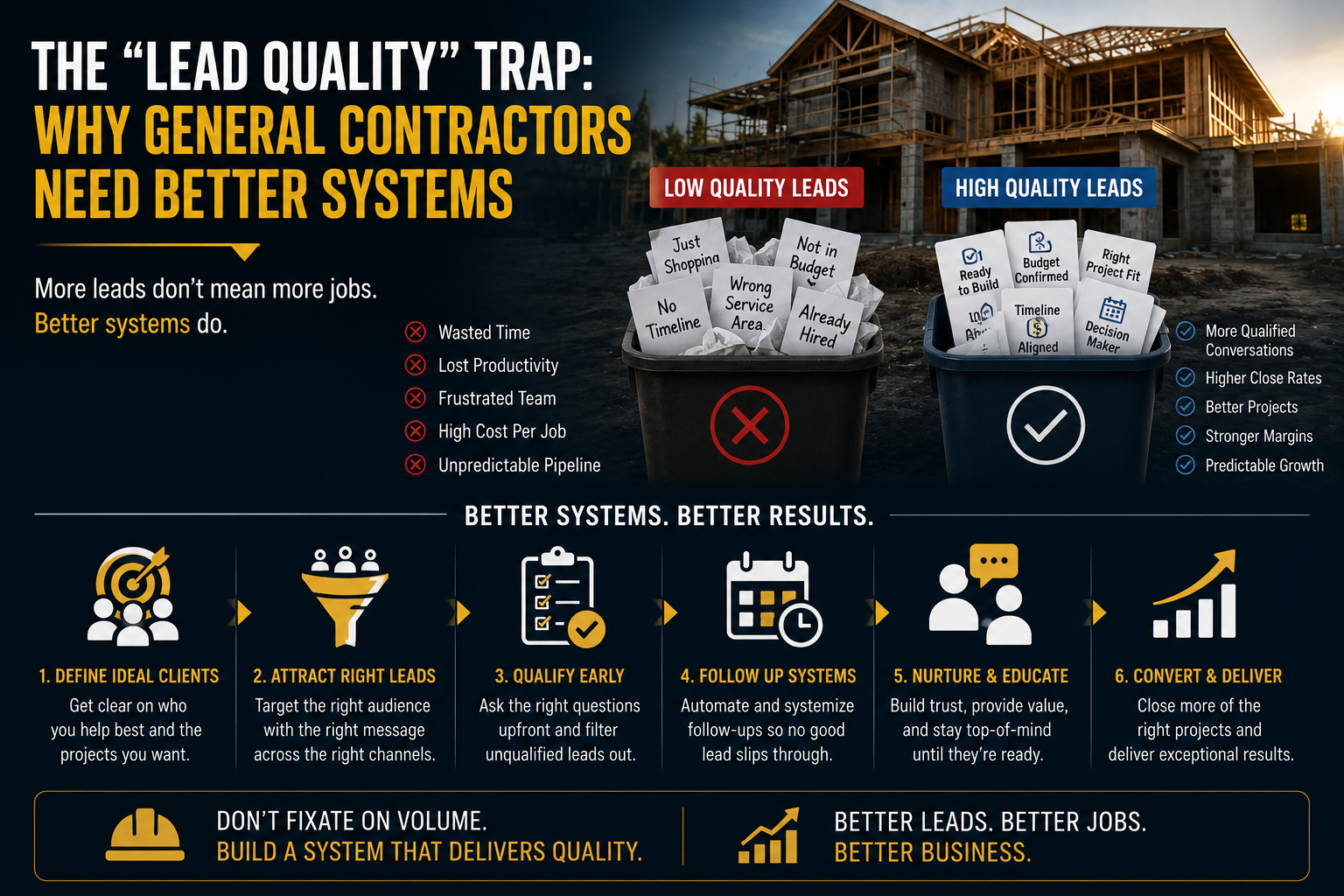
Direct Answer: General contractors often blame “lead quality” when the real problem is a weak lead system. Therefore, contractors should not only ask whether a lead is good or bad. Instead, they should track source, service intent, follow-up speed, qualification, appointment rate, estimate rate, close rate, job value, and gross profit. Better systems create better outcomes.
Every contractor has said it before: “These leads are junk.” However, that statement is often only half true.
Sometimes the lead source is poor. Shared leads, cheap lead vendors, and low-intent campaigns can absolutely create weak conversations. However, many contractors also lose good opportunities because their tracking, follow-up, forms, offers, CRM, and sales process are not strong enough.
As a result, “lead quality” becomes a blanket excuse. Meanwhile, the actual system remains broken.
Therefore, the best contractors ask a better question. They do not only ask, “Are these leads good?” Instead, they ask, “Do we have the system required to turn qualified attention into profitable jobs?”
Google recommends helpful, reliable, people-first content, and structured data helps search systems understand page content. Therefore, contractors that build useful service pages, local pages, FAQs, reviews, and CRM-connected lead systems create stronger demand than companies that rely only on surface-level lead volume. Google explains helpful content, and Google explains structured data.
Key Takeaways
- Lead quality problems often come from weak systems, not only bad sources.
- However, contractors still need to separate true bad leads from mishandled good leads.
- Therefore, CRM attribution should track every step from inquiry to closed job.
- Additionally, qualification, speed-to-lead, follow-up, reviews, and landing pages all affect perceived lead quality.
- Ultimately, better systems create better leads because they attract, filter, nurture, and convert more effectively.
What Is the Lead Quality Trap?
Direct Answer: The lead quality trap happens when contractors blame every sales problem on bad leads instead of diagnosing the full system.
Lead quality matters. However, it is not the only factor. A decent lead can turn into a lost opportunity when the company responds too slowly, asks poor qualification questions, sends weak follow-up, or runs the lead into a generic sales process.
The Trap Sounds Like This
- “The leads are bad.”
- “Nobody answers.”
- “They only want the cheapest price.”
- “They are not serious.”
- “They are just shopping.”
- “The marketing company sent junk.”
Sometimes those statements are true. However, they should trigger investigation, not assumption. Therefore, contractors need a system that shows where the breakdown actually happens.
Bad Lead or Bad System?
Direct Answer: A bad lead has poor fit or weak intent, while a bad system fails to properly capture, contact, qualify, nurture, or convert a workable opportunity.
Contractors need to separate the two. Otherwise, they may cut a good channel too early or keep feeding a bad source for too long.
Signs of a Bad Lead
- wrong service area
- wrong service need
- fake contact information
- renter instead of homeowner
- unrealistic budget
- no timeline
- duplicate shared inquiry
- no real project intent
Signs of a Bad System
- slow first response
- no missed-call recovery
- weak form questions
- no CRM source tracking
- generic follow-up
- no nurture sequence
- unclear offer
- poor landing page proof
- no sales notes
- no cost-per-closed-job reporting
As a result, the company needs both source evaluation and system evaluation.
Why Contractors Blame Lead Quality First
Direct Answer: Contractors blame lead quality first because bad leads are visible, while broken systems are harder to see.
A bad lead feels obvious. The homeowner does not answer. The appointment cancels. The quote goes nowhere. However, the hidden breakdown may have happened earlier.
The Hidden Breakdowns
- the form did not qualify the homeowner
- the landing page attracted price shoppers
- the offer promised the wrong thing
- the first call happened too late
- the rep did not match the lead’s intent
- the CRM did not show source context
- the follow-up stopped too soon
Therefore, a contractor should not judge a lead source by emotion. Instead, the company should judge it by full-funnel data.
Source Quality Still Matters
Direct Answer: Lead source quality still matters because some channels produce better intent, better trust, and better project fit than others.
Not every lead source deserves equal patience. Cheap shared leads, broad forms, vague ads, and low-intent offers can create real problems. However, the contractor should use data before making the decision.
Higher-Trust Lead Sources Often Include
- organic service page leads
- Google Business Profile calls
- branded search leads
- past customer referrals
- review-driven inquiries
- retargeting leads
- local city page leads
- high-intent Google Ads calls
Lower-Trust Lead Sources Can Include
- shared marketplace leads
- cheap sweepstakes-style offers
- poorly targeted social campaigns
- generic third-party directories
- unqualified storm lead lists
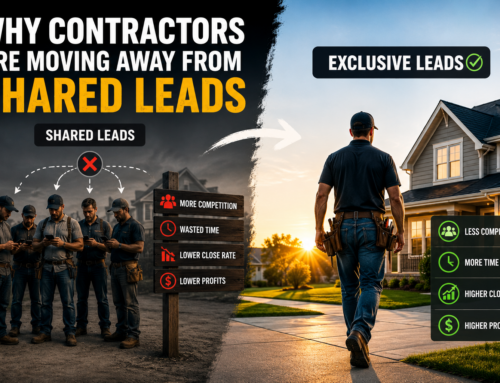
Additionally, this connects to Why Contractors Are Moving Away From Shared Leads, because source control affects trust before the first call.
Qualification: The Missing Layer
Direct Answer: Qualification improves lead quality by filtering project fit before the sales team invests time.
Many contractors ask too little on their forms because they fear friction. However, too little friction can create too many poor-fit inquiries. Therefore, the form should qualify without feeling overwhelming.
Useful Qualification Questions
- What service do you need?
- Are you the homeowner or property owner?
- What city is the property in?
- When are you looking to start?
- Is this repair, replacement, or inspection?
- Are you interested in financing?
- Do you have storm or insurance damage?
- What is the best time to contact you?
As a result, the sales team gets context before the first call. Additionally, the CRM becomes more useful because every inquiry carries better data.
Speed-to-Lead and First Contact
Direct Answer: Speed-to-lead affects lead quality because homeowners often contact multiple providers and respond best while intent is fresh.
A lead can feel low quality if the company waits too long. However, the issue may not be the lead. The issue may be timing.
First Contact Should Do Three Things
- confirm the homeowner’s request
- clarify the project need
- move toward the right next step
However, speed should not feel aggressive. The goal is to be helpful quickly, not pushy quickly. Therefore, the opening message should reference the specific service, location, or request whenever possible.
Follow-Up Systems
Direct Answer: Follow-up systems turn more leads into appointments because many homeowners do not convert after one call or message.
Many contractors give up too quickly. They call once, maybe text once, and then blame the lead. However, homeowners may be working, traveling, comparing options, or waiting to discuss the project with a spouse.
A Better Follow-Up System Includes
- immediate call
- immediate text
- same-day second attempt
- next-day follow-up
- email with helpful resource
- review or proof asset
- service-specific reminder
- final check-in
- long-term nurture for delayed projects
Consequently, follow-up should not only chase the homeowner. It should educate, reassure, and reduce uncertainty.
CRM Attribution
Direct Answer: CRM attribution shows whether the contractor has a lead quality problem, a sales process problem, or a source tracking problem.
Without CRM attribution, every debate becomes opinion. Marketing says the leads are good. Sales says the leads are bad. Ownership gets stuck in the middle.
Track These Fields
- lead source
- campaign
- landing page
- service requested
- city
- homeowner status
- call or form
- appointment booked
- estimate issued
- job sold
- job value
- gross profit
- sales rep
- follow-up status
- lost reason
Additionally, this supports the same data ownership logic explained in HomeAdvisor vs. Your Own Lead System.
Landing Pages and Offer Fit
Direct Answer: Landing pages affect lead quality because the page sets expectations before the homeowner submits a form.
If the page promises the cheapest deal, the sales team should expect price shoppers. If the page explains quality, process, reviews, and project fit, the sales team usually gets a better conversation.
Better Landing Pages Include
- specific service headline
- clear offer
- local proof
- reviews
- before-and-after photos
- process explanation
- financing information when relevant
- qualification questions
- clear next step
Therefore, lead quality starts before the lead arrives. The page, offer, and proof all shape the type of homeowner who responds.
Sales Process and Lead Handling
Direct Answer: Lead handling affects lead quality because the same inquiry can produce different outcomes depending on the sales process.
A strong rep can turn an average lead into an appointment. Meanwhile, a weak process can waste a strong lead. Therefore, contractors need source-specific sales handling.
Different Sources Need Different Scripts
- organic leads need confirmation and scheduling
- shared leads need trust building fast
- storm leads need education and urgency
- financing leads need payment clarity
- retargeting leads need context from previous interest
- past customer leads need relationship-based follow-up
As a result, the company should not use one generic script for every source.
Why Owned Demand Improves Lead Quality
Direct Answer: Owned demand improves lead quality because homeowners contact the contractor after engaging with the company’s own pages, reviews, proof, and expertise.
When a homeowner finds a contractor through service pages, city pages, Google reviews, project examples, and helpful blogs, trust starts earlier. Therefore, the first conversation often feels less cold.
Owned Demand Assets Include
- service pages
- city pages
- neighborhood pages
- Google reviews
- project galleries
- case studies
- FAQ pages
- comparison pages
- retargeting audiences
- CRM data
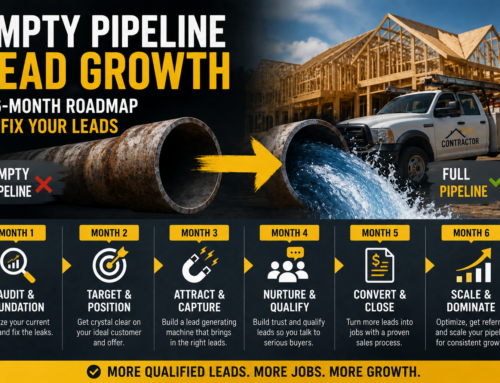
This connects directly to Fixing the Empty Pipeline, because better pipeline systems create better lead quality over time.
The Contractor Lead Quality Scorecard
Direct Answer: A lead quality scorecard helps contractors judge opportunities by fit, intent, urgency, trust, and profitability.
| Category | Weak Signal | Strong Signal |
|---|---|---|
| Service Fit | Vague request | Specific service needed |
| Location Fit | Outside service area | Inside target city |
| Ownership | Renter or unclear | Homeowner/property owner |
| Urgency | No timeline | Clear project window |
| Trust | Shared marketplace | Direct website or referral |
| Value | Small poor-fit job | Profitable target job |
| Follow-Up | No answer after one try | Multi-touch sequence active |
Additionally, this scorecard should feed the CRM so leadership can compare sources fairly.
Metrics That Matter
Direct Answer: Contractors should measure lead quality by booked appointments, estimate rate, close rate, gross profit, and cost per closed job.
- cost per lead
- contact rate
- appointment booking rate
- estimate completion rate
- close rate
- average job value
- gross profit
- cost per closed job
- no-show rate
- lost reason
- sales rep performance by source
- follow-up completion rate
- repeat customer potential
- review impact
Therefore, a contractor should not let “lead quality” remain a vague complaint. It should become a measurable operating system.
Common Mistakes
Direct Answer: Contractors stay trapped when they blame lead quality without fixing the systems that influence lead outcomes.
- judging leads only by CPL
- not tracking cost per closed job
- not separating sources by intent
- using weak form questions
- responding too slowly
- stopping follow-up too early
- not tracking lost reasons
- running ads to weak pages
- using one script for every source
- not building reviews and proof
- not connecting CRM data
- not building owned demand
Instead, contractors should improve the system before writing off every source as bad.
Frequently Asked Questions
What does lead quality mean for contractors?
Lead quality means the inquiry matches the contractor’s service area, service type, project size, timeline, homeowner status, and profitability goals.
Why do contractors complain about lead quality?
Contractors complain because many leads do not answer, do not book, price shop, or fail to close. However, the issue may be the source, the system, or both.
How can contractors improve lead quality?
Contractors can improve lead quality with better offers, stronger landing pages, qualification questions, CRM tracking, faster follow-up, reviews, and owned demand assets.
Are shared leads lower quality?
Shared leads can be lower quality because several contractors may contact the same homeowner. However, contractors should still measure full-funnel performance before deciding.
What is the best metric for lead quality?
Cost per closed job is one of the best metrics because it connects lead source, close rate, job value, and actual business results.
External Sources
Conclusion
Direct Answer: General contractors need better systems because lead quality is not only a marketing issue. It is also a tracking, qualification, follow-up, sales, and data issue.
Some leads are genuinely bad. However, many opportunities are lost because the company does not respond fast enough, qualify clearly enough, follow up long enough, or track deeply enough.
Therefore, the best contractors stop using “lead quality” as a vague complaint. Instead, they build a system that shows where each opportunity came from, how it was handled, why it converted or failed, and what profit it created.
Final Insight: Better leads help. However, better systems multiply the value of every lead you already have.
About the author : Anthony Paulino