Fixing the “Empty Pipeline”: A 6-Month Roadmap for Sustainable Lead Growth
Direct Answer: Contractors fix an empty pipeline by combining immediate lead flow with long-term owned demand. Therefore, roofing, siding, window, gutter, remodeling, and exterior companies need a 6-month system that includes paid campaigns, CRM tracking, service pages, city pages, reviews, retargeting, speed-to-lead, follow-up automation, and helpful content that keeps producing opportunities after the first campaign ends.
An empty pipeline creates pressure fast. Crews need work. Sales reps need appointments. Cash flow needs movement. However, panic usually leads to poor marketing decisions.
Some contractors start buying cheap shared leads. Others discount too aggressively. Meanwhile, some boost random posts, restart old campaigns, or hire another vendor without fixing the system underneath.
As a result, they may create activity, yet the pipeline stays unstable.
Therefore, the real solution has two parts. First, the company needs short-term demand to stop the bleeding. Then, it needs long-term infrastructure so the same problem does not return again in 90 days.
Google recommends creating helpful, reliable, people-first content, and structured data helps search systems understand page content. Therefore, contractors should build useful service pages, city pages, FAQs, reviews, and local assets that homeowners can trust before they request an estimate. Google explains helpful content, while Google explains structured data.
Key Takeaways
- An empty pipeline usually points to a broken lead system, not just a slow week.
- However, paid ads can create short-term demand while owned lead assets compound.
- Therefore, contractors should build a 6-month roadmap instead of panic-buying random leads.
- Additionally, CRM attribution must track booked appointments, estimates, closed jobs, and gross profit.
- Ultimately, sustainable lead growth comes from owning the demand path, not renting every opportunity.
Why Home Improvement Pipelines Go Empty
Direct Answer: Home improvement pipelines go empty when companies depend on inconsistent referrals, weak follow-up, seasonal demand, shared leads, thin websites, poor tracking, and paid campaigns that stop producing once spend slows down.
The Warning Signs Usually Show Up Early
A pipeline rarely collapses without warning. Usually, calls slow down first. Then, estimate volume drops. After that, sales reps start complaining about lead quality. Meanwhile, crews start waiting for the next project, and leadership begins reacting instead of planning.
Common Causes
- referral volume slows down
- shared leads become less profitable
- Google Ads stop converting efficiently
- Meta campaigns fatigue
- Google Business Profile activity drops
- reviews stop growing
- service pages are too thin
- city pages do not rank
- old leads are not nurtured
- sales follow-up is inconsistent
- CRM tracking is incomplete
- storm demand dries up
Therefore, the first step is diagnosis. A contractor should not buy more leads before understanding why the existing system stopped working.
Why Most Quick Fixes Fail
Direct Answer: Most quick fixes fail because they create temporary activity without improving lead quality, follow-up speed, conversion pages, reviews, CRM tracking, or long-term owned demand.
Cheap Leads Can Create False Confidence
A contractor may buy cheap leads and see form fills quickly. However, if those leads do not answer, book, or close profitably, the pipeline is not fixed. It is only busier.
Discounting Can Attract the Wrong Buyer
Discounts can help when they support a clear offer. However, aggressive discounting can also attract price shoppers. As a result, the company may fill the calendar while weakening margins.
Boosted Posts Are Not a Lead System
Social posts can help build awareness. However, random boosted posts rarely create predictable pipeline growth by themselves. Instead, paid traffic needs an offer, landing page, tracking system, retargeting audience, and CRM workflow.
Consequently, quick fixes only work when they plug into a stronger foundation.
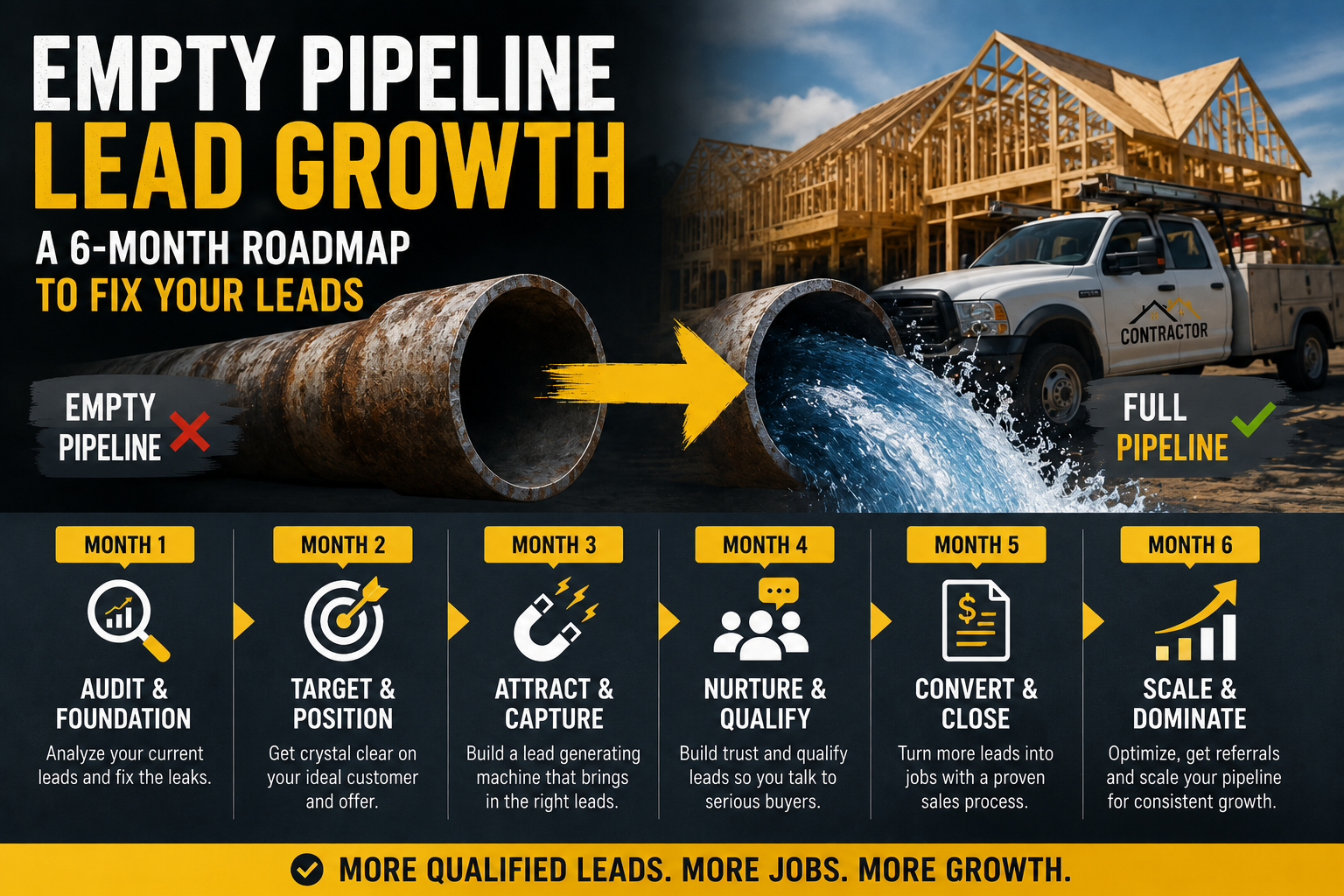
The 6-Month Roadmap
Direct Answer: A 6-month lead growth roadmap should stabilize short-term demand while building the owned assets that create predictable opportunities over time.
The Two-Track Strategy
First, contractors need immediate lead flow. Therefore, paid search, Meta lead forms, old-lead reactivation, missed-call recovery, and review-based campaigns can create fast activity.
Meanwhile, contractors also need infrastructure. Therefore, service pages, city pages, neighborhood pages, Google Business Profile improvements, reviews, CRM attribution, retargeting, and GEO-ready content must build underneath the short-term campaigns.
The Goal by Month Six
By the end of month six, the company should have better tracking, stronger pages, better audiences, more proof, stronger follow-up, and clearer forecasting. As a result, pipeline growth becomes more manageable and less panic-driven.
Month 1: Stop the Bleeding
Direct Answer: Month 1 should stabilize lead flow while fixing tracking, CRM attribution, landing pages, offers, speed-to-lead, and missed-call recovery.
Launch Immediate Demand Campaigns
First, activate the fastest lead channels. For many contractors, that means Google Search for urgent intent, Meta lead forms for offer-driven campaigns, Google Business Profile updates, old-lead reactivation, and past-customer outreach.
Fix Tracking Before Scaling
However, do not scale spend blindly. Otherwise, the company may create more leads without knowing which ones become booked appointments, estimates, or sold jobs.
Month 1 Priorities
- audit all current lead sources
- install call tracking
- install form tracking
- set CRM source fields
- fix broken forms
- review landing page CTAs
- reactivate old leads
- launch urgent paid campaigns
- create missed-call follow-up
- improve speed-to-lead
Good Quick Campaigns
- roof inspection offer
- storm damage inspection
- free siding estimate
- window replacement consultation
- gutter guard promotion
- emergency roof repair campaign
Additionally, every campaign should push source data into the CRM. Therefore, the contractor can judge campaigns by booked estimates, not surface-level lead counts.
Month 2: Build Core Lead Assets
Direct Answer: Month 2 should focus on building or rebuilding the core service pages that generate high-intent demand.
Service Pages Must Carry More Weight
Many contractor websites list services but do not sell them well. They may mention roofing, siding, windows, or gutters, yet they do not answer the homeowner’s real questions. Therefore, those pages struggle to rank and convert.
Core Pages to Build
- roof replacement
- roof repair
- storm damage roof repair
- siding installation
- window replacement
- gutter installation
- gutter guards
- commercial roofing
- emergency roof repair
- insurance restoration
Each Page Should Include
- a direct answer summary
- common problem signs
- service process
- material or product options
- local proof
- reviews
- FAQs
- financing information
- clear CTA
- schema markup
Furthermore, these pages should connect to your broader owned-demand strategy. As explained in Stop Buying Cheap Leads, stronger service pages reduce long-term dependence on rented lead flow.
Month 3: Build Local Authority
Direct Answer: Month 3 should build city and neighborhood pages that capture local homeowner intent before competitors and lead vendors do.
Local Pages Create Market Coverage
Home improvement is local. Therefore, a contractor should not rely only on broad service pages. City and neighborhood pages help the company appear when homeowners search for services near them.
Build City Pages For
- primary revenue cities
- nearby suburbs
- storm-prone areas
- high-income neighborhoods
- commercial service areas
- markets with strong past jobs
Make Every City Page Useful
However, city pages cannot simply swap place names. Instead, each page should include local home types, weather issues, common service demand, nearby neighborhoods, project examples, reviews, and local FAQs.
Add Neighborhood Pages After Priority Cities
After city pages launch, neighborhood pages can capture micro-local searches that larger competitors often ignore. As a result, the site can build authority in profitable pockets of the market.
Month 4: Add GEO and Problem-Solving Content
Direct Answer: Month 4 should focus on GEO-ready blogs, FAQs, and educational pages that answer homeowner questions before they contact a contractor.
AI Search Rewards Clear Answers
Homeowners increasingly ask specific questions through Google, ChatGPT, Gemini, and other AI systems. Therefore, contractors need answer-ready content that explains problems clearly and builds trust quickly.
Problem-Solving Topics
- How do I know if my roof has hail damage?
- Should I repair or replace my roof?
- Are gutter guards worth it?
- What siding is best for cold weather?
- How long do replacement windows last?
- What should I do after storm damage?
- How does the insurance claim process work?
- Why is my roof leaking around the chimney?
- What causes gutters to overflow?
- How much attic ventilation do I need?
Use Direct Answers and Helpful Next Steps
Each page should open with a clear answer. Then, it should expand with examples, warning signs, next steps, FAQs, and internal links. Additionally, schema should support the visible content.
This approach connects directly to The 1,000-Page Advantage, because deeper content ecosystems create more ways for buyers to find and trust the business.
Month 5: Scale Paid Media and Retargeting
Direct Answer: Month 5 should scale paid media only after tracking, pages, offers, retargeting audiences, and CRM workflows are working.
Paid Media Should Support the System
Paid ads should not replace owned infrastructure. Instead, they should accelerate it. Therefore, Meta Ads and Google Ads should send traffic to strong pages, collect first-party data, build audiences, and create measurable pipeline.
Scale These Campaigns
- Google Search for emergency intent
- Google Search for roof replacement intent
- Meta lead forms for seasonal offers
- Meta retargeting for service page visitors
- review-based ads
- before-and-after creative
- city-specific campaigns
- storm response campaigns
Build Retargeting Audiences
- roofing page visitors
- siding page visitors
- window page visitors
- gutter page visitors
- storm damage page visitors
- form starters
- estimate page visitors
- past customers
Additionally, paid media becomes stronger when CRM data shows which campaigns produce closed jobs. Therefore, month five is about controlled scaling, not random spending.
Month 6: Optimize, Expand, and Forecast
Direct Answer: Month 6 should focus on optimizing what works, cutting what does not, expanding local authority, and forecasting demand by service and season.
Review the Full Funnel
By month six, the company should have enough data to identify patterns. Therefore, leadership should review lead sources, booked appointments, estimates, closed jobs, average ticket, gross profit, sales rep performance, and follow-up quality.
Optimize These Areas
- top-performing service pages
- city pages with impressions but low clicks
- landing pages with traffic but low conversions
- campaigns with leads but weak close rates
- sales scripts by lead source
- review request workflows
- retargeting audiences
- old-lead reactivation sequences
Build the Next 6-Month Plan
Finally, use the data to plan the next build cycle. Expand into more cities, more neighborhoods, more service pages, more problem-solving content, and more proof assets. As a result, the pipeline becomes more predictable.
Service Strategy by Trade
Direct Answer: Each home improvement service needs a different pipeline strategy because homeowner intent changes by urgency, project size, seasonality, and budget.
Roofing
Roofing pages should focus on leaks, storm damage, replacement signs, insurance support, ventilation, warranties, and emergency response. Additionally, paid media should separate urgent repair intent from replacement intent.
Siding
Siding pages should focus on curb appeal, energy performance, storm damage, maintenance, material comparisons, and long-term home value. Therefore, visual proof matters heavily.
Windows
Window pages should focus on drafts, energy efficiency, condensation, age, financing, and room-by-room replacement options. Additionally, homeowners often need education before they request an estimate.
Gutters
Gutter pages should focus on water damage prevention, overflow, foundation risk, gutter guards, seasonal maintenance, and roofline protection. Therefore, bundles with roofing or siding can improve average ticket.
Storm Restoration
Storm pages should focus on inspection, documentation, insurance process, emergency tarping, and fast response. However, messaging should stay helpful and ethical, not fear-based.
CRM Attribution and Follow-Up
Direct Answer: CRM attribution and follow-up determine whether leads become revenue or disappear.
Speed Matters, But Context Matters Too
Homeowners often contact multiple companies. Therefore, speed-to-lead can make or break appointment rates. However, speed alone is not enough. The follow-up must match the lead source, service need, and urgency level.
CRM Fields to Track
- lead source
- campaign
- landing page
- service requested
- city
- neighborhood
- call or form
- appointment booked
- estimate issued
- job sold
- job value
- gross profit
- sales rep
- follow-up status
Additionally, CRM tracking supports the data ownership strategy explained in HomeAdvisor vs. Your Own Lead System. The contractor that owns the data owns more of the pipeline.
Reviews and Proof Assets
Direct Answer: Reviews and proof assets make every lead source work better because homeowners trust contractors faster when they see real local results.
Proof Reduces Price Pressure
When homeowners see reviews, project photos, warranties, certifications, and before-and-after examples, they feel more confident. Therefore, the conversation becomes less price-focused and more trust-focused.
Build These Proof Assets
- Google reviews
- before-and-after galleries
- city-specific project examples
- video testimonials
- roof inspection photos
- siding transformation photos
- window replacement examples
- storm documentation examples
- warranty explanations
- financing examples
Additionally, proof should appear across service pages, city pages, landing pages, ads, and follow-up messages.
Panic Lead Buying vs. Sustainable Pipeline Building
Direct Answer: Panic lead buying creates temporary activity, while sustainable pipeline building creates long-term owned demand.
| Category | Panic Lead Buying | Sustainable Pipeline Building |
|---|---|---|
| Goal | Get leads fast | Create predictable demand |
| Data Ownership | Weak | Strong |
| Lead Quality | Often inconsistent | Improves over time |
| SEO Value | Little or none | Compounding |
| Retargeting | Limited | Owned audiences |
| CRM Learning | Often missing | Core part of the system |
| Long-Term Value | Resets monthly | Builds business equity |
Metrics That Matter
Direct Answer: Sustainable lead growth should be measured by booked appointments, estimate volume, close rate, job value, gross profit, and owned demand growth.
Pipeline Metrics
- lead volume
- contact rate
- appointment booking rate
- estimate completion rate
- close rate
- average job value
- gross profit per job
- cost per closed job
- sales cycle length
- follow-up completion rate
Owned Demand Metrics
- organic impressions
- city page clicks
- service page conversions
- Google Business Profile actions
- review growth
- retargeting audience growth
- branded search growth
- AI-search visibility
Therefore, pipeline health should be measured across the full funnel, not only at the lead stage.
Common Pipeline Mistakes
Direct Answer: Contractors keep empty pipelines when they chase short-term leads without fixing tracking, pages, offers, follow-up, reviews, and owned demand.
- buying leads without tracking close rate
- running ads to weak pages
- not building service pages
- not building city pages
- not asking for reviews consistently
- not tracking calls
- not using CRM attribution
- not retargeting site visitors
- not following up with old leads
- not separating repair, replacement, and storm intent
- not building AI-search content
- not reviewing gross profit by source
Instead, fix the system first. Then, scale the channels that produce profitable jobs.
Frequently Asked Questions
How can a home improvement company fix an empty pipeline quickly?
Start with paid search, Meta lead forms, Google Business Profile updates, old-lead reactivation, missed-call follow-up, and better speed-to-lead. However, also fix tracking immediately.
How long does sustainable lead growth take?
Paid media can create demand quickly. However, SEO, GEO, reviews, and local authority usually compound over several months.
What pages should contractors build first?
Start with core service pages, then build city pages, neighborhood pages, storm pages, and problem-solving blogs.
Why is CRM attribution important?
CRM attribution shows which sources create booked appointments, estimates, closed jobs, and profit, so the company stops judging marketing by lead volume alone.
Should contractors use paid ads while building SEO?
Yes. Paid ads can create short-term demand while SEO and owned lead infrastructure build long-term demand.
External Sources
Conclusion
Direct Answer: A contractor fixes an empty pipeline by combining short-term demand generation with long-term owned lead infrastructure.
Paid ads, old-lead reactivation, and urgent offers can create immediate activity. However, they should not replace the real work. Service pages, city pages, reviews, CRM attribution, retargeting, GEO content, and proof assets create the foundation for sustainable lead growth.
Therefore, the goal is not to avoid slow seasons forever. Instead, the goal is to build a system strong enough to forecast, prepare, and recover without panic.
Final Insight: An empty pipeline is not solved by buying more noise. It is solved by building the machine that turns attention into trusted appointments and profitable jobs.
About the author : Anthony Paulino