The Hidden Cost of “Cheap” Lead Gen Services: Are They Killing Your Brand Reputation?
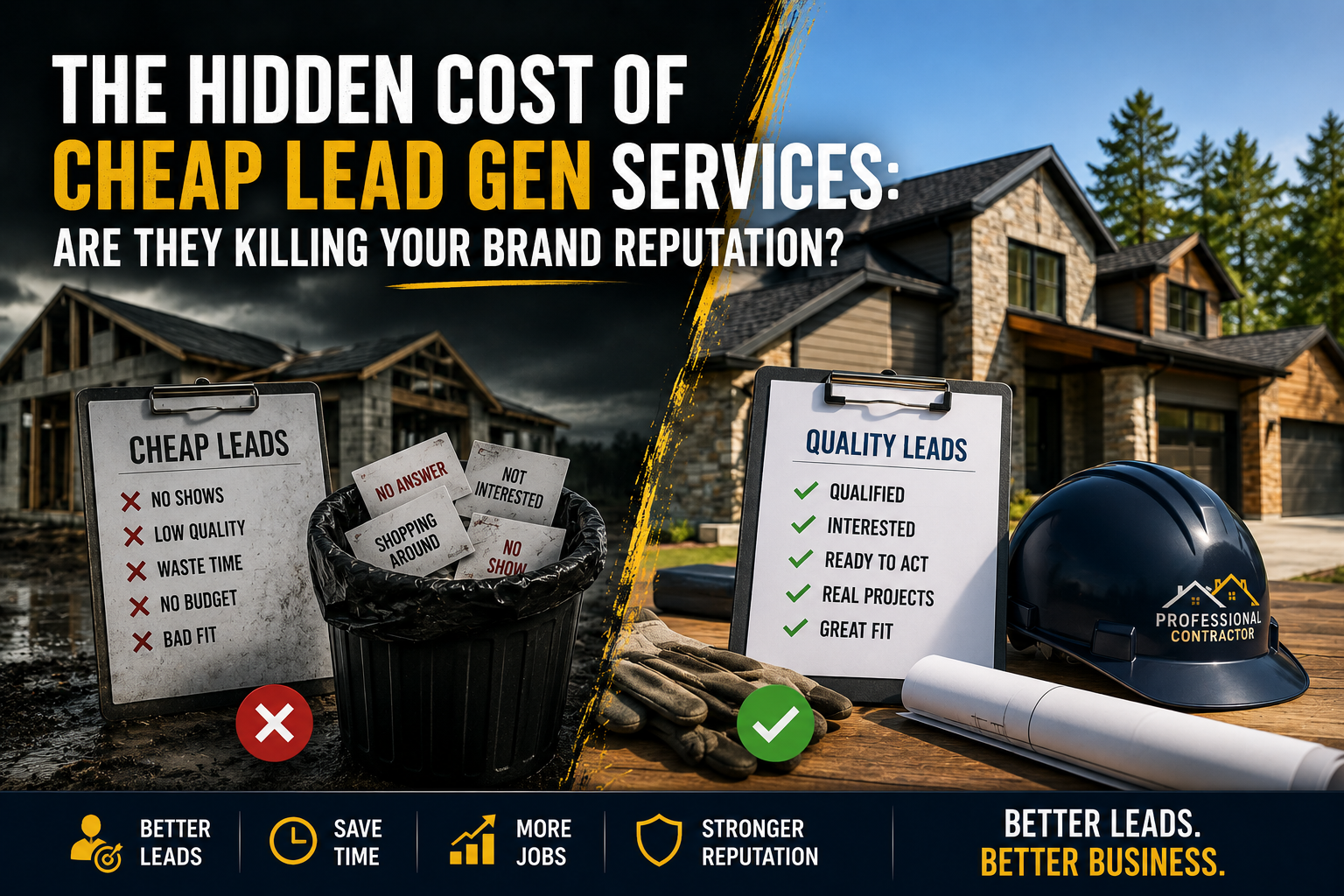
Direct Answer: Cheap lead gen services can damage a contractor’s brand reputation when they create low-intent inquiries, shared leads, spammy follow-up, price-shopping behavior, poor customer experiences, and weak data ownership. Therefore, roofing, siding, window, gutter, remodeling, and home improvement companies should judge lead vendors by appointment quality, close rate, gross profit, customer trust, and long-term brand impact—not only cost per lead.
Cheap leads look attractive when the pipeline feels light. However, cheap lead generation can become expensive once the sales team starts chasing homeowners who do not answer, do not remember requesting help, or already received calls from several other contractors.
As a result, the brand starts to feel pushy before it ever gets a real chance to build trust.
Therefore, the problem is not only lead cost. Instead, the deeper problem is what cheap lead sources can do to your reputation, your sales process, your margins, and your long-term market position.
Google recommends creating helpful, reliable, people-first content, while structured data helps search systems understand pages and entities. Therefore, contractors that build trusted, owned lead systems usually create stronger long-term growth than companies that depend only on rented, low-quality lead flow. Google explains helpful content, while Google explains structured data.
Key Takeaways
- Cheap leads often cost more than they appear because low contact rates and weak close rates create hidden waste.
- However, the bigger risk is brand damage when homeowners feel spammed, confused, or pressured.
- Therefore, contractors should measure cost per closed job, not cost per lead alone.
- Additionally, owned lead systems protect customer data, follow-up quality, reviews, and brand trust.
- Ultimately, cheap lead gen services can hurt reputation when they make your company look like one more desperate bidder.
Why Cheap Leads Feel So Tempting
Direct Answer: Cheap leads feel tempting because they promise fast activity when a contractor needs appointments, crews need work, and cash flow feels tight.
When the pipeline slows down, urgency takes over. A contractor may not want a long-term strategy in that moment. Instead, they want phone calls, forms, and booked estimates as quickly as possible.
The Promise Sounds Simple
Cheap lead vendors usually sell speed, volume, and low cost. That can sound attractive, especially when referrals slow down or paid ads stop working. However, fast volume does not always create profitable demand.
The Real Question
Therefore, the real question is not, “Can this vendor generate leads?” The better question is, “Will these leads create trusted conversations, profitable jobs, and a stronger brand?”
How Cheap Lead Sources Damage Brand Reputation
Direct Answer: Cheap lead sources damage brand reputation when homeowners experience your company as another unwanted call instead of a trusted local provider.
Brand reputation starts before the appointment. In fact, it can start the moment your team calls the homeowner. If the homeowner does not remember requesting a quote, received too many calls, or feels pressured, your brand may begin with friction.
Reputation Problems Start Early
- the homeowner feels spammed
- the homeowner receives too many contractor calls
- the homeowner does not know your company
- the homeowner thinks the inquiry was sold
- the homeowner compares everyone by price
- the homeowner avoids future follow-up
Therefore, even if your company is professional, the lead source can shape the first impression before your team can prove value.
The Spam Factor: When Follow-Up Feels Aggressive
Direct Answer: Cheap lead systems can make normal follow-up feel aggressive because the homeowner may be contacted by several companies at once.
Speed-to-lead matters. However, speed can feel intrusive when the homeowner is not expecting multiple calls. Therefore, even a professional sales team can appear pushy if the lead source creates confusion.
Where Follow-Up Goes Wrong
- calling too many times too quickly
- texting before trust exists
- using generic scripts
- not referencing the homeowner’s actual need
- not explaining why your company is calling
- pushing for an appointment before building context
Instead, follow-up should feel helpful. The goal is to clarify the homeowner’s problem, not chase them like a transaction.
How Low-Quality Leads Burn Out Sales Teams
Direct Answer: Low-quality leads burn out sales teams because reps spend too much time chasing people who are not ready, not interested, not qualified, or already overwhelmed.
Sales teams can handle rejection. However, constant low-quality follow-up creates frustration. Over time, reps may stop trusting the lead source. Additionally, they may start treating every lead with less enthusiasm.
Sales Burnout Shows Up As
- slower follow-up
- weaker call energy
- less consistent CRM notes
- more lead blaming
- lower appointment rates
- poor sales morale
- higher turnover risk
Consequently, cheap leads can damage more than marketing. They can weaken the entire sales culture.
How Bad Lead Experiences Can Affect Reviews
Direct Answer: Bad lead experiences can affect reviews when homeowners feel misled, pressured, over-contacted, or frustrated before they even become customers.
Not every bad lead turns into a bad review. However, reputation risk increases when the first interaction feels confusing. A homeowner who believes they were spammed may blame the contractor, even when the lead vendor created the issue.
Reputation Risks Include
- negative call experience
- complaints about repeated contact
- confusion about how the contractor got their information
- frustration with appointment pressure
- loss of trust before the estimate
Therefore, contractors should protect their brand by choosing lead sources carefully and controlling the follow-up experience.
Why Data Ownership Matters
Direct Answer: Data ownership matters because contractors need to understand which sources create real appointments, closed jobs, profit, and long-term customers.
When a contractor owns the lead system, it can track every important step. However, cheap lead vendors often provide limited insight. As a result, the contractor may see form fills without understanding the full customer journey.
Owned Data Helps Track
- lead source
- service requested
- city or neighborhood
- campaign
- landing page
- call recording
- appointment status
- estimate value
- closed job value
- gross profit
- future retargeting potential
Additionally, first-party data helps improve paid media, retargeting, and CRM attribution. Google’s business resources explain that first-party data can help businesses power ads and generate actionable insights from their own customer interactions. Google Business discusses first-party data strategy.
The Real Math: Cost Per Closed Job
Direct Answer: Contractors should judge cheap lead services by cost per closed job and gross profit, not cost per lead.
Cost per lead is easy to understand. However, it can mislead the business. A $60 lead with a 5% close rate may cost more than a $250 lead with a 35% close rate.
Simple Comparison
| Lead Source | Cost Per Lead | Close Rate | Cost Per Closed Job | Brand Value |
|---|---|---|---|---|
| Cheap Shared Leads | $60 | 5% | $1,200 | Weak |
| Owned Lead System | $220 | 30% | $733 | Strong |
Although the owned lead costs more upfront, it can produce a lower acquisition cost after close rate is included. Additionally, it builds data, trust, and retargeting value.
Therefore, cheap is not cheap unless it closes profitably.
What a Better Lead System Looks Like
Direct Answer: A better lead system creates direct homeowner demand through service pages, local SEO, reviews, paid media, retargeting, CRM attribution, and helpful content.
A strong lead system does not depend on one channel. Instead, it creates several connected ways for homeowners to find, trust, and contact the company.
Better Lead System Assets
- high-converting service pages
- city and neighborhood pages
- Google Business Profile optimization
- review generation
- Meta Ads
- Google Ads
- retargeting audiences
- CRM workflows
- call tracking
- before-and-after proof
- FAQ pages
- comparison pages
- problem-solving blogs
Furthermore, this system improves over time because every page, review, audience, and CRM insight strengthens the next campaign.
Why Digital Fortress Architecture Protects Your Brand
Direct Answer: Digital Fortress architecture protects your brand by replacing rented, low-trust lead flow with owned assets that build authority before the first call.
Instead of appearing as one more contractor in a shared lead race, your company becomes the source homeowners find directly. Therefore, the relationship starts with education, proof, and trust.
Digital Fortress Assets Include
- service hubs
- city pages
- neighborhood pages
- review pages
- project galleries
- case studies
- FAQ libraries
- retargeting audiences
- CRM attribution
- AI-search-ready content
This is the same strategy explained in Stop Buying Cheap Leads. The goal is not just to get more leads. Instead, the goal is to own more of the demand path.
The Cheap Lead Vendor Scorecard
Direct Answer: Contractors should evaluate lead vendors with a scorecard that measures quality, exclusivity, transparency, brand impact, and profitability.
Questions to Ask Before Buying Cheap Leads
- Are the leads exclusive or shared?
- How was the homeowner acquired?
- Did the homeowner ask for my company specifically?
- How many contractors receive the same inquiry?
- Can I track source, campaign, and close rate?
- What is the average contact rate?
- What is the average appointment rate?
- What is the average cost per closed job?
- Does the source build my brand or only the vendor’s brand?
- Can I retarget these leads through my own system?
If a vendor cannot answer these questions clearly, the lead source may create more risk than value.
Metrics That Matter
Direct Answer: The right metrics reveal whether a cheap lead source creates profitable growth or simply creates noise.
Track These Metrics
- cost per lead
- contact rate
- appointment booking rate
- estimate completion rate
- close rate
- average job value
- gross profit per job
- cost per closed job
- no-show rate
- discount rate
- review impact
- sales team time
- repeat customer potential
- retargeting audience growth
Additionally, compare cheap lead vendors against direct organic, paid search, Meta, referral, and repeat-customer sources. As a result, leadership can see which channels actually strengthen the business.
Common Mistakes
Direct Answer: Contractors get hurt by cheap lead gen services when they chase volume before protecting trust, tracking quality, and measuring profit.
- judging leads only by low CPL
- not tracking cost per closed job
- buying shared leads without knowing how many competitors receive them
- using aggressive follow-up scripts
- not asking how the homeowner was acquired
- not tracking review risk
- not owning retargeting audiences
- not connecting leads to CRM attribution
- not building direct lead assets
- not measuring gross profit by source
- not training reps differently by lead type
- not building long-term brand authority
Instead, contractors should treat cheap lead sources as temporary supplements, not the foundation of the business.
Frequently Asked Questions
Are cheap lead gen services always bad?
No. Some low-cost lead sources can work when they are transparent, trackable, and profitable. However, contractors should judge them by cost per closed job and brand impact, not cost per lead alone.
Can cheap leads hurt my brand reputation?
Yes. Cheap leads can hurt reputation when homeowners feel spammed, confused, pressured, or contacted by too many contractors after one inquiry.
What is better than buying cheap shared leads?
An owned lead system with service pages, city pages, reviews, paid media, retargeting, CRM attribution, and helpful content usually creates stronger long-term control.
How should contractors measure lead quality?
Contractors should track contact rate, appointment rate, estimate rate, close rate, average job value, gross profit, cost per closed job, and customer experience.
Should contractors stop using lead vendors completely?
Not necessarily. However, lead vendors should supplement a contractor-owned system rather than replace owned demand, reviews, SEO, CRM data, and direct brand trust.
External Sources
Conclusion
Direct Answer: Cheap lead gen services can hurt a contractor’s brand reputation when they create poor first impressions, low-trust sales conversations, shared competition, weak data ownership, and unprofitable jobs.
Cheap leads can create activity. However, activity does not always create growth. If the lead source makes homeowners feel spammed, confused, or pressured, the contractor may pay twice: once for the lead and again through lost trust.
Therefore, the better strategy is to build an owned lead system that protects the brand, captures first-party data, improves follow-up, supports retargeting, and creates direct demand.
Final Insight: A lead is not cheap if it weakens your reputation. The strongest contractors do not chase the lowest CPL. They build the highest-trust path to profitable jobs.
About the author : Anthony Paulino