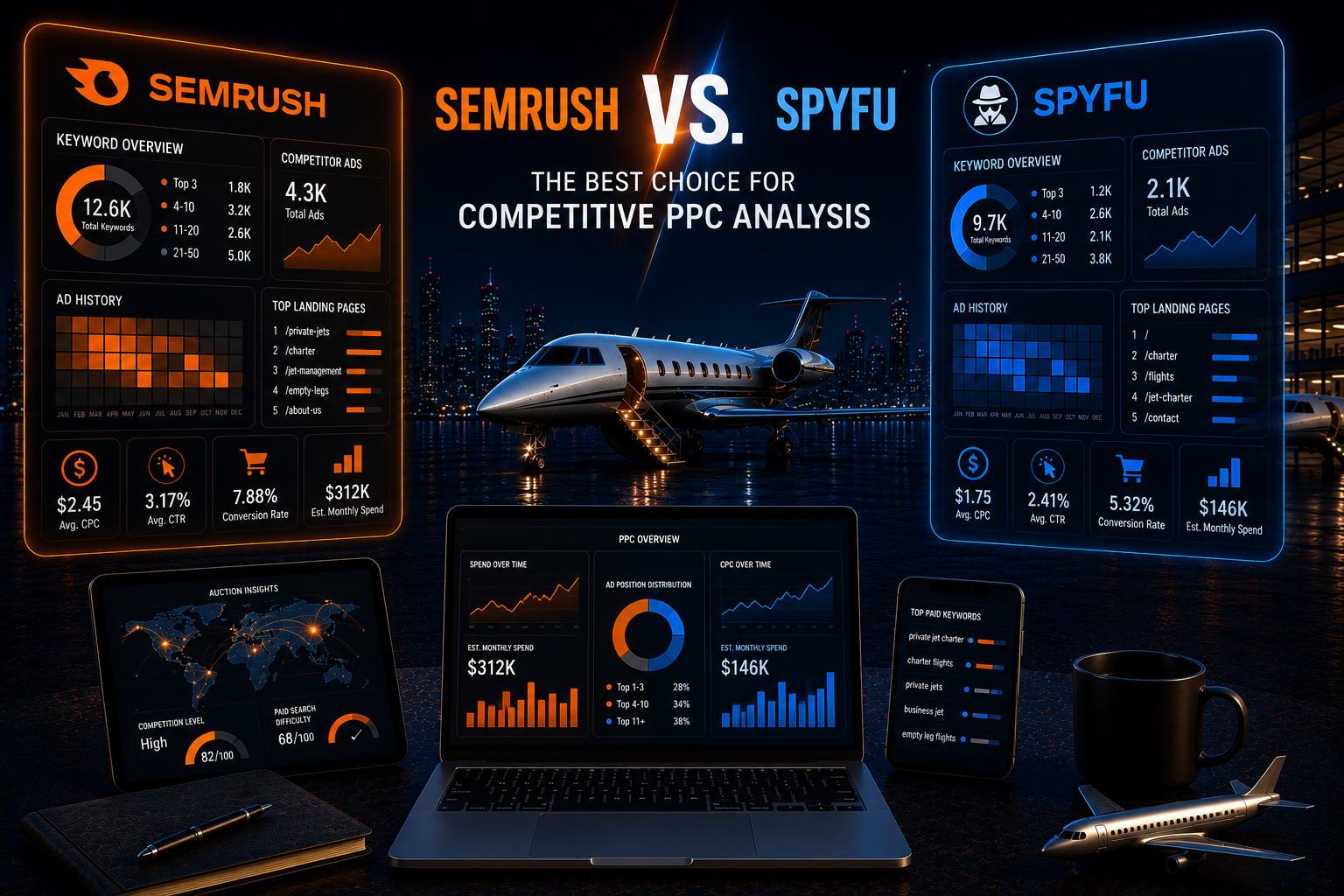
Semrush vs. SpyFu: The Best Choice for Competitive PPC Analysis
Definition: Competitive PPC analysis is the process of studying competitors’ paid search keywords, ad copy, estimated spend, landing pages, budget trends, and Google Ads positioning so you can build smarter campaigns.
Direct Answer: Semrush is the better choice for competitive PPC analysis when you want PPC data connected to SEO, keyword research, content strategy, technical audits, and broader digital marketing workflows. However, SpyFu is a strong, affordable PPC competitor intelligence tool for teams that mainly want to research competitor keywords, ads, budgets, clicks, and historical Google Ads activity.
Semrush and SpyFu both help marketers understand what competitors are doing in paid search. However, they are not built for the exact same user. Semrush works like a full digital marketing platform with PPC intelligence as one major feature. SpyFu works more like a focused competitor research platform built around SEO and PPC spying.
Therefore, the best choice depends on your workflow. If you only want to see competitor Google Ads keywords and ad history at a lower cost, SpyFu can be very useful. However, if you want PPC research connected to SEO, content, landing pages, keyword strategy, technical SEO, reporting, and AI search visibility, Semrush is usually the stronger long-term platform.
Ultimately, PPC competitor analysis should not be about copying ads. Instead, it should help you find market gaps, understand buyer intent, improve landing pages, sharpen ad copy, and avoid wasted spend.
Key Takeaways
- Semrush is stronger for all-in-one PPC, SEO, content, and competitor workflows.
- SpyFu is strong for affordable Google Ads competitor keyword and ad research.
- Semrush Advertising Research can show competitor paid keywords, ad examples, estimated paid traffic, and estimated ad spend.
- SpyFu focuses heavily on competitor PPC keywords, estimated spend, clicks, ad history, and domain comparisons.
- SpyFu may be easier for smaller teams that only need PPC competitor intelligence.
- Semrush is usually better for agencies managing SEO, PPC, content, and reporting together.
- Therefore, SpyFu is focused and budget-friendly, while Semrush is broader and more scalable.
Quick Verdict
Semrush is the stronger platform if competitive PPC analysis is part of a larger marketing system. Its Advertising Research tools are designed to analyze competitors’ PPC campaigns, Google Ads ad samples, paid keyword positions, budget estimates, paid traffic, competitors, ad copy, and landing-page direction. Semrush also connects PPC research to SEO, keyword research, content planning, and reporting workflows. Semrush Advertising Research
SpyFu is the stronger focused option if you want straightforward Google Ads competitor research. SpyFu says users can search a competitor, download PPC keywords, see estimated clicks, see what competitors pay per keyword, monitor PPC competitors, compare multiple websites, and track budget, clicks, and ads over time. SpyFu competitor keyword research SpyFu PPC overview
Therefore, the simple recommendation is:
- Choose Semrush if you want PPC competitor analysis plus SEO, content, technical SEO, reporting, and full digital marketing strategy.
- Choose SpyFu if you mainly want affordable competitor PPC keyword, ad, and spend research.
If you want the broader platform for PPC plus SEO workflows, start here: Try Semrush.
What Competitive PPC Analysis Actually Needs
Competitive PPC analysis should answer one central question: what is already working in the market, and how can we build a better campaign without wasting money?
However, many marketers use competitor tools incorrectly. They copy competitor ads, copy competitor keywords, and assume the competitor knows what they are doing. That is risky. A competitor may be wasting money. They may have poor tracking. They may bid on broad terms for brand awareness. Additionally, their economics may not match yours.
Therefore, competitive PPC research should review:
- Which keywords competitors bid on consistently
- Which ads have appeared repeatedly over time
- Which calls to action competitors test
- Which landing pages they use
- Which offers appear most often
- Which competitors overlap your market
- Which keywords show commercial intent
- Which keywords may be overpriced
- Which SEO pages also support paid traffic
- Which gaps competitors ignore
Google Ads itself recommends relevance across keywords, ads, and landing pages because ad quality can influence performance. For official guidance, review Google Ads quality guidance.
Because of that, the best PPC tool is not only the one that shows more keywords. Instead, it is the tool that helps you convert competitor data into smarter campaigns.
What Semrush Does Well for PPC
Semrush is strong for PPC because it connects paid search research to the rest of your marketing strategy. Its Advertising Research feature helps users analyze competitors’ paid campaigns, monitor ad copy, find Google Ads competitors, review common paid keywords, and estimate paid traffic and spend. Semrush Advertising Research
Additionally, Semrush’s paid marketing tools include keyword research, competitor analysis, and ad copy workflows. Semrush highlights that its PPC tools help marketers analyze competitors, carry out keyword research, and create compelling ad copy. Semrush PPC marketing tools
Semrush PPC Strengths
- Competitor paid keyword research
- Google Ads competitor discovery
- Ad copy examples
- Estimated paid traffic
- Estimated ad spend
- PPC keyword research
- SEO and PPC keyword overlap
- Landing page research support
- Competitor domain analysis
- Reporting workflows
- Content and SEO integration
Therefore, Semrush works especially well for agencies and businesses that need PPC insights connected to organic search, landing-page strategy, and broader demand generation.
What SpyFu Does Well for PPC
SpyFu built its reputation around competitor intelligence. Its core promise is simple: search for a competitor and download their PPC keywords. SpyFu also highlights PPC competitor monitoring, estimated clicks, estimated keyword costs, and competitor changes over time. SpyFu competitor keyword research
SpyFu’s PPC overview says users can find any site’s paid keywords and estimated ad spend, compare two or more websites for shared keywords, track a site’s PPC budget, clicks, and number of ads over time, and find top PPC competitors. SpyFu PPC overview
SpyFu PPC Strengths
- Competitor paid keyword lists
- Estimated ad spend
- Estimated clicks
- Historical ad tracking
- Domain comparisons
- Shared keyword discovery
- Competitor monitoring
- PPC reports
- Affordable competitor research workflows
Additionally, SpyFu offers PPC reports through Recon, which provides deeper analysis into a domain’s strengths and opportunities against SEO or Google Ads competitors. SpyFu Recon reports
Consequently, SpyFu is especially useful when the main job is Google Ads competitor research at a focused price point.
PPC Keyword Research Comparison
PPC keyword research is not just about finding keywords. Instead, it is about identifying which keywords show commercial intent, which terms competitors consistently buy, and which terms deserve testing.
Semrush PPC Keyword Research
Semrush gives you paid keyword data inside a broader keyword ecosystem. That means you can research paid keywords, then compare them against SEO keywords, CPC, keyword difficulty, SERP features, and content opportunities.
This is useful because PPC and SEO should not operate in separate silos. For example, if a keyword converts in Google Ads, it may deserve an SEO page. Likewise, if an SEO page ranks but does not convert, it may not deserve paid spend.
SpyFu PPC Keyword Research
SpyFu is very direct. Search a competitor, then review the paid keywords they buy. Additionally, you can compare multiple domains and see shared keywords. That is useful when you want quick competitor keyword discovery without building a broader platform workflow.
Winner for PPC Keyword Research
Semrush wins for strategic PPC keyword research because it connects keyword data to SEO, content, competitor, and broader marketing analysis.
SpyFu wins for fast competitor PPC keyword spying because the workflow is simple and focused.
Ad Copy and Creative Intelligence
Ad copy research helps you understand how competitors position offers. However, the goal is not to copy them. Instead, the goal is to understand patterns, promises, objections, calls to action, and angles.
Semrush Advertising Research lets users monitor competitors’ ad copy, view live ad examples, review calls to action, emotional triggers, and brand mentions, and use those insights to improve their own ad text. Semrush Advertising Research
SpyFu also supports ad copy research and historical ad tracking. SpyFu’s own PPC competitor analysis content emphasizes tracking copy changes and learning from past messaging competitors dropped. SpyFu PPC competitor analysis
Ad Copy Research Checklist
- What benefit appears most often?
- What pain point do competitors lead with?
- What CTA repeats across ads?
- What discounts or guarantees appear?
- What claims do they avoid?
- Which ads seem to run the longest?
- What landing page does each ad use?
Therefore, use ad copy research to build a better test plan. Do not treat competitor ads as proven winners unless they ran consistently over time.
Budget and Spend Insights
Budget estimates help you understand how aggressively competitors invest in paid search. However, all third-party estimates should be treated as directional, not exact.
Semrush Advertising Research offers budget estimations, paid traffic estimates, and competitor ad spending insights. Semrush Advertising Research
SpyFu says users can see how many clicks competitors get, what they pay for each keyword, estimated ad spend, and budget changes over time. SpyFu competitor keyword research SpyFu PPC overview
How to Use Spend Estimates Correctly
- Use estimates to identify serious competitors.
- Look for spend patterns over time.
- Compare spend against keyword intent.
- Find keywords competitors keep buying.
- Avoid assuming estimated spend equals profit.
- Use your own conversion data before scaling.
Consequently, spend data should guide testing, not replace strategy.
Competitor Discovery
Many businesses know their obvious competitors. However, PPC tools often reveal search competitors they did not know existed.
Semrush’s Advertising Research Competitors report can show a domain’s rivals, common keywords, paid traffic estimates, and online competitors’ ad spending. Semrush Advertising Research
SpyFu also helps users find top PPC competitors and compare multiple websites to find shared keywords. SpyFu PPC overview
Actionable Competitor Discovery Workflow
- Enter your domain.
- Export paid competitors.
- Sort competitors by keyword overlap.
- Identify direct competitors and indirect competitors.
- Review ads for each competitor.
- Review keywords competitors buy repeatedly.
- Build a “do not copy blindly” notes column.
- Create a testing roadmap from gaps.
As a result, competitor discovery becomes a planning tool, not just a curiosity report.
Landing Page and Funnel Research
PPC analysis should always include landing pages. After all, the ad only earns the click. The landing page earns the lead or sale.
Semrush helps marketers monitor competitor ads and landing-page direction. Meanwhile, SpyFu helps uncover competitor ad and keyword patterns that can lead you to important paid search funnels.
Landing Page Research Checklist
- Does the landing page match the ad promise?
- Is the CTA clear?
- Does the page use proof?
- Does the page answer objections?
- Does the form ask too much?
- Does the offer feel specific?
- Is the page fast on mobile?
- Does the page have one goal?
Additionally, Google Ads quality guidance emphasizes relevance across ad, keyword, and landing page experience. Therefore, landing-page analysis should be part of every competitive PPC review. Google Ads quality guidance
For more funnel strategy, see The Straight Line Funnel.
SEO + PPC Strategy
This is where Semrush has a major advantage. PPC should not operate separately from SEO. Instead, paid search data should inform organic strategy, and organic data should inform paid testing.
How SEO and PPC Should Work Together
- Use PPC data to validate high-intent keywords.
- Build SEO pages for proven paid keywords.
- Use SEO pages as retargeting audiences.
- Use organic content to lower sales friction.
- Use paid search to test messaging quickly.
- Use keyword gaps to find content and ad opportunities.
Semrush is stronger here because it connects PPC research, keyword research, SEO data, content planning, and competitor analysis. SpyFu is strong for PPC spying, but it is less complete as a full SEO + PPC operating system.
For related strategy, review Google Ads Management Company and SEO Services for Businesses.
Agency Reporting and Workflow
Agencies need more than raw competitor data. They need repeatable workflows, client reporting, action plans, and cross-channel visibility.
Semrush Agency Advantages
- Broader reporting
- SEO and PPC integration
- Competitor research
- Technical SEO tools
- Content planning
- Keyword gap analysis
- Better fit for full-service teams
SpyFu Agency Advantages
- Fast competitor PPC research
- Clear competitor keyword downloads
- Useful PPC reports
- Budget-friendly competitor intelligence
- Simple workflow for paid search specialists
Therefore, Semrush is usually better for full-service agencies, while SpyFu can be excellent for PPC specialists who want focused competitor data.
Pricing and Value
Pricing changes often, so always check each provider directly before subscribing. However, the value pattern is consistent.
SpyFu is often attractive because it focuses on competitor intelligence and affordability. A 2026 TechRadar review described SpyFu as a strong value choice for marketers focused on competitor intelligence, SEO, and PPC, while noting that it does not offer the same broad variety of digital marketing tools as larger platforms like Semrush. TechRadar SpyFu review
Semrush usually costs more, but it can replace multiple tools because it includes broader SEO, PPC, content, competitor, technical SEO, and reporting workflows.
Choose SpyFu for Value If:
- You mainly need PPC competitor research.
- You want a focused tool.
- You are budget-sensitive.
- You do not need a large SEO/content platform.
Choose Semrush for Value If:
- You manage SEO and PPC together.
- You need competitor research across channels.
- You need technical SEO audits.
- You need content planning.
- You need client reporting.
- You need a platform that scales with your marketing strategy.
Consequently, SpyFu can be cheaper, but Semrush can be more valuable when it replaces several tools.
Best Competitive PPC Analysis Workflow
Use this workflow whether you choose Semrush or SpyFu.
Step 1: Identify True PPC Competitors
Start with competitors bidding on the same paid keywords, not only brands you already know.
Step 2: Export Competitor Paid Keywords
Look for recurring keywords, high-intent keywords, and keywords competitors keep buying.
Step 3: Group Keywords by Intent
Separate brand, competitor, problem, comparison, service, and transactional terms.
Step 4: Review Ad Copy Patterns
Document repeated hooks, offers, guarantees, CTAs, and pain points.
Step 5: Review Landing Pages
Study page structure, proof, form length, CTA wording, speed, and message match.
Step 6: Find Gaps
Look for high-intent keywords competitors ignore, weak landing pages, vague offers, and poor ad-message match.
Step 7: Build a Test Plan
Create ad groups around intent, write multiple ad angles, and send traffic to matching landing pages.
Step 8: Track Real Outcomes
Measure cost per qualified lead, booked call rate, close rate, and revenue. Do not optimize only for clicks.
If you want this workflow inside a broader marketing platform, use Semrush here.
Who Should Use Semrush?
Semrush is the better choice for marketers who need PPC analysis connected to broader growth strategy.
Choose Semrush If You Are:
- A full-service agency
- A Google Ads manager who also works with SEO
- A content team using PPC data for SEO topics
- A local SEO team running paid search
- A B2B agency managing multi-channel lead generation
- A business that needs reporting and competitive strategy
- A company investing in both paid and organic visibility
Additionally, Semrush is stronger if you want to turn PPC insights into SEO pages, landing pages, competitor gaps, and content strategy.
Who Should Use SpyFu?
SpyFu is the better choice for marketers who mainly want focused PPC competitor intelligence.
Choose SpyFu If You Are:
- A small team focused on Google Ads competitor research
- A budget-conscious marketer
- A PPC specialist who wants competitor keyword lists
- A freelancer doing paid search audits
- A business that does not need a full SEO platform
- A user who wants simple competitor spend and keyword insights
Additionally, SpyFu can be useful as a focused secondary tool even when a team already uses another SEO platform.
Common PPC Competitor Analysis Mistakes
- Copying competitor ads without context.
- Assuming competitor spend equals profitable spend.
- Ignoring landing pages.
- Only reviewing keywords once.
- Ignoring seasonal patterns.
- Not separating brand and non-brand terms.
- Not grouping keywords by intent.
- Using broad match without tight controls.
- Not connecting PPC data to SEO strategy.
- Optimizing for clicks instead of qualified leads or revenue.
Ultimately, competitor tools show clues. However, your own tracking data must decide what scales.
Frequently Asked Questions
Is Semrush better than SpyFu for PPC analysis?
Semrush is better if you want PPC competitor analysis connected to SEO, content, technical SEO, keyword research, and reporting. However, SpyFu is strong if you mainly want focused Google Ads competitor keyword, ad, click, and spend research.
Is SpyFu good for Google Ads competitor research?
Yes. SpyFu is designed around competitor keyword research and PPC intelligence. It can show competitor paid keywords, estimated clicks, estimated spend, ad history, and PPC competitors.
Which tool is better for agencies?
Semrush is usually better for full-service agencies because it supports PPC analysis, SEO, content planning, technical SEO audits, keyword gaps, and reporting. SpyFu can still work well for PPC-focused agencies.
Which tool is more affordable?
SpyFu is often more attractive for budget-conscious teams focused on competitor intelligence. Semrush usually costs more but provides a broader marketing platform.
Should I copy competitor Google Ads?
No. Use competitor ads for insight, not copying. Analyze their offers, CTAs, landing pages, and keyword patterns, then build a better test plan based on your own economics.
Can PPC competitor data help SEO?
Yes. Paid keyword data can reveal high-intent terms that deserve SEO pages, comparison content, landing pages, and retargeting campaigns.
Final Verdict
Semrush vs. SpyFu comes down to workflow.
SpyFu is excellent if you want focused, affordable PPC competitor intelligence. It helps you find competitor paid keywords, ads, estimated spend, clicks, and PPC competitors quickly.
However, Semrush is the better choice if you want PPC analysis connected to the bigger growth picture. It gives you competitive PPC data plus SEO, keyword research, content planning, technical audits, reporting, and broader digital visibility workflows.
Therefore, choose SpyFu if you only need competitor PPC spying. Choose Semrush if you want competitive PPC analysis that turns into a full marketing strategy.
About the author : Anthony Paulino