
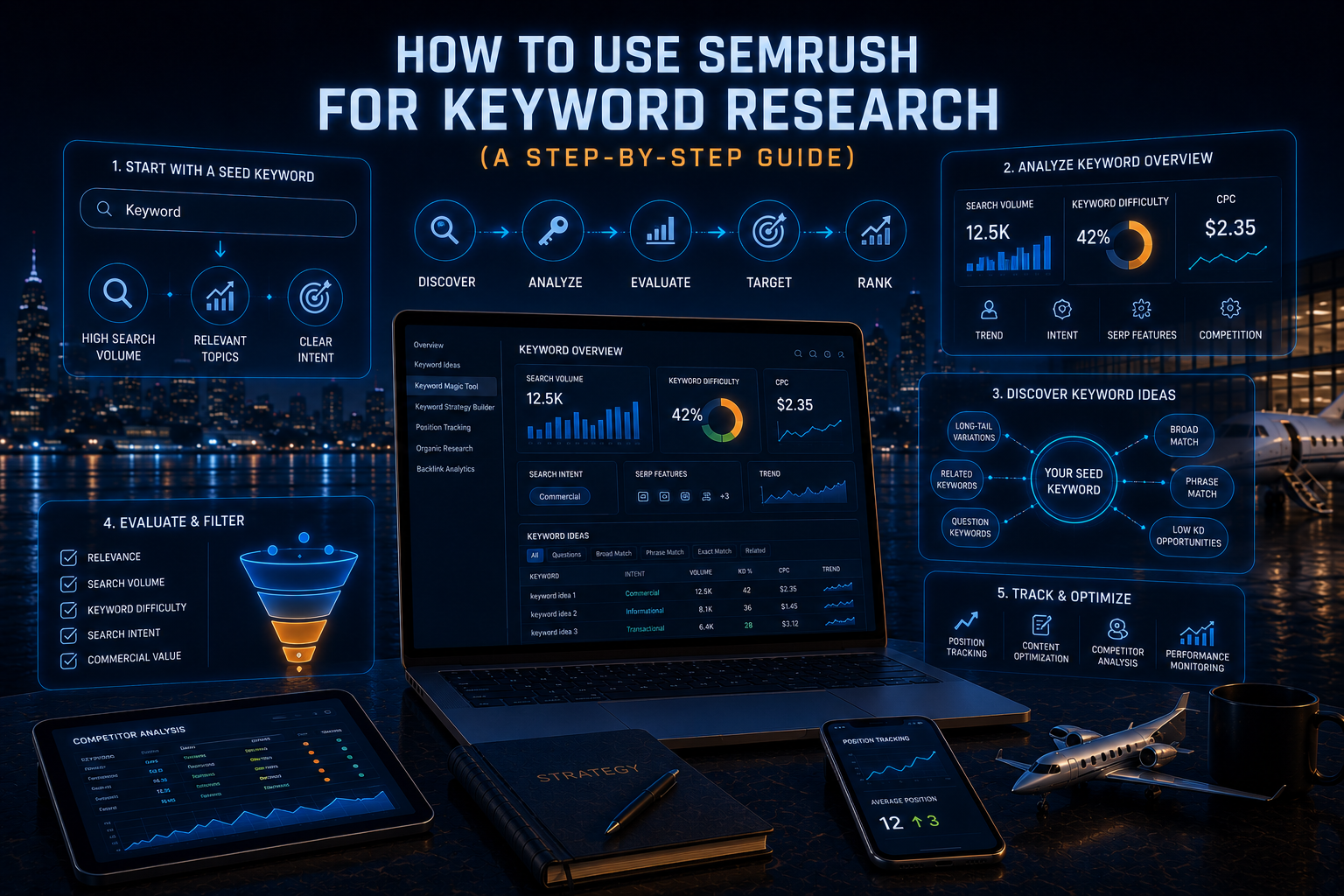
How to Use Semrush for Keyword Research: A Step-by-Step Guide
Definition: Semrush keyword research is the process of using Semrush tools to find search terms, analyze intent, review competition, uncover competitor gaps, and build content that can rank.
Direct Answer: To use Semrush for keyword research, start with Keyword Overview, then expand ideas with Keyword Magic Tool, filter by intent, check keyword difficulty, review CPC, analyze SERP features, compare competitors with Keyword Gap, and finally group your best terms into topic clusters.
Keyword research should never start with guessing. However, many businesses still choose keywords because they sound popular. As a result, they create content that gets traffic but does not create leads, sales, or affiliate revenue.
Therefore, Semrush helps because it turns keyword research into a measurable workflow. Instead of chasing random search volume, you can compare demand, difficulty, intent, competition, CPC, SERP features, and competitor rankings in one place.
Moreover, keyword research now matters beyond traditional rankings. Because AI search and answer engines rely on clear structure, strong topical coverage, and direct answers, your keyword strategy should also support GEO, AI Overviews, and entity clarity.
Ultimately, Semrush works best when you use it as a strategy system, not merely a keyword list generator.
Key Takeaways
- Start with a business goal before opening Semrush.
- Use Keyword Overview to validate search volume, difficulty, CPC, trends, and intent.
- Then use Keyword Magic Tool to find long-tail and question-based opportunities.
- Next, use Keyword Gap to find competitor keywords you missed.
- Additionally, use Organic Research to reverse-engineer pages already getting traffic.
- After that, group keywords by intent before writing content.
- Finally, prioritize keywords by business value, not only search volume.
- Therefore, the best Semrush workflow turns raw keywords into organized topic clusters.
Why Use Semrush for Keyword Research?
Semrush is useful because it connects keyword discovery with competitor research, content planning, PPC data, technical SEO, and rank tracking. Therefore, it helps you understand not only what people search, but also which keywords can actually support growth.
For example, a keyword may have high search volume. However, if the intent is weak, the competition is too strong, or the SERP gives users instant answers, that keyword may not be worth your time. Meanwhile, a lower-volume keyword with strong commercial intent may produce better leads.
Additionally, Semrush helps you identify keywords your competitors already rank for. Consequently, you can stop guessing and start building content around proven demand.
For broader SEO fundamentals, review Google’s SEO Starter Guide. Moreover, for structured data and machine-readable clarity, review Schema.org.
If you want to follow this workflow inside the platform, start here: Try Semrush.
What to Do Before Opening Semrush
Before using Semrush, define the business objective. Otherwise, you may collect hundreds of keywords without knowing which ones matter.
Start with these questions:
- What offer, product, or service are you trying to grow?
- Who is the target buyer?
- What problem are they trying to solve?
- Which searches happen before they buy?
- Which terms show trust-building intent?
- Which terms show commercial intent?
- Which terms can become service pages, blogs, reviews, or comparisons?
Then create a seed keyword list. A seed keyword is a broad starting term you can expand later.
Example Seed Keyword List
- keyword research
- SEO tools
- technical SEO audit
- content marketing strategy
- AI search optimization
- generative engine optimization
- local SEO services
- Semrush tutorial
After that, use Semrush to validate demand, difficulty, intent, and opportunity. Therefore, you avoid building content around assumptions.
Step 1: Start With Keyword Overview
First, open Semrush and enter one seed keyword into Keyword Overview. This gives you a quick snapshot of the keyword’s potential.
Review these metrics:
- Search Volume: How often people search the keyword.
- Keyword Difficulty: How hard it may be to rank.
- Intent: Why the user is searching.
- CPC: Whether advertisers pay for the term.
- Trend: Whether demand is rising or falling.
- SERP Features: What Google shows on the results page.
However, do not choose the keyword yet. Instead, use this page to decide whether the keyword deserves deeper research.
Actionable Example
If you enter “technical SEO audit,” you may find a keyword with strong commercial value and educational demand. Therefore, it could support a blog guide, a service page, a lead magnet, or a comparison article.
However, if the top search results are mostly beginner guides, then a hard sales page may not match intent. In that case, write a useful guide and place a soft CTA inside it.
Decision Rule
Choose a keyword only when it has search demand, clear intent, realistic competition, and business value. Otherwise, skip it or save it for later.
Step 2: Expand Ideas With Keyword Magic Tool
Next, open Keyword Magic Tool. This is where one seed keyword becomes a full list of related opportunities.
Use it this way:
- Enter your seed keyword.
- Review broad match keywords.
- Then review phrase match keywords.
- Next, check exact match keywords.
- After that, use question filters.
- Finally, filter by difficulty, intent, and word count.
For example, “keyword research” may expand into:
- how to do keyword research
- keyword research for SEO
- keyword research tools
- Semrush keyword research
- long-tail keyword research
- keyword research for affiliate marketing
- keyword research for local SEO
Therefore, one broad keyword can become a full content cluster.
Actionable Tip
Use the question filter to find direct-answer blog topics. Because question keywords often work well for featured snippets, AI search, and FAQ sections, they should become a major part of your content plan.
Step 3: Filter by Search Intent
After finding keyword ideas, filter them by intent. This step matters because different search intents need different page types.
The Four Main Search Intents
- Informational: The user wants to learn.
- Commercial: The user compares options.
- Transactional: The user is ready to act.
- Navigational: The user wants a specific brand or website.
Therefore, a keyword like “how to use Semrush for keyword research” needs a tutorial. Meanwhile, “Semrush vs Ahrefs” needs a comparison page. Additionally, “SEO audit service” likely needs a service page.
Intent-to-Page Mapping
| Intent | Example Keyword | Best Page Type |
|---|---|---|
| Informational | how to use Semrush for keyword research | Step-by-step guide |
| Commercial | Semrush vs KWFinder | Comparison article |
| Transactional | technical SEO audit service | Service page |
| Navigational | Semrush login | Usually not a target |
As a result, your content matches what the user actually wants.
Step 4: Check Keyword Difficulty the Right Way
Keyword difficulty helps you estimate ranking competition. However, it should not control your entire strategy.
Use difficulty scores as a starting filter. Then, manually inspect the search results.
Manual SERP Checklist
- Are the top pages deeply helpful?
- Are ranking domains too strong?
- Does the content match intent?
- Are the pages outdated?
- Are forums or weak pages ranking?
- Can you add original examples?
- Can you create better structure?
- Can you support the page with internal links?
Sometimes, a keyword with medium difficulty is still worth targeting because the current results are weak. However, sometimes a low-difficulty keyword is not worth targeting because it has no business value.
Therefore, use difficulty as one signal, not the final decision.
Step 5: Use CPC to Find Commercial Value
CPC shows whether advertisers pay for a keyword. Although CPC is not an SEO ranking factor, it often reveals business value.
For example, “what is SEO” may have high volume. However, “SEO audit service” may have stronger buying intent. Therefore, the second keyword may create more revenue even with fewer searches.
How to Interpret CPC
- High CPC + commercial intent = strong opportunity.
- Low CPC + vague intent = lower priority.
- Low volume + high CPC = possible hidden gem.
- High volume + no CPC = likely informational.
Additionally, CPC helps affiliate marketers identify buyer keywords. If advertisers pay for a term, there may be commercial value behind it.
Actionable Tip
Create a “money keyword” column in your keyword spreadsheet. Mark keywords that show high CPC, buying intent, comparison intent, or direct service demand.
Step 6: Analyze SERP Features
Next, review SERP features. A keyword may have search volume, yet the actual click opportunity may be limited if Google already answers the query directly.
Common SERP Features
- Featured snippets
- People Also Ask
- Local packs
- Images
- Videos
- Shopping results
- Reviews
- AI Overviews
Therefore, your page format should match the search result layout.
If the SERP shows People Also Ask, add FAQ sections. If it shows videos, consider adding video content. If it shows a local pack, build local signals. If it shows snippets, place a direct answer near the top.
Additionally, for page experience and performance support, review Web.dev Core Web Vitals guidance.
Step 7: Find Competitor Keyword Gaps
After researching seed terms, use Keyword Gap. This tool helps you find keywords competitors rank for that you do not.
How to Use Keyword Gap
- Enter your domain.
- Enter three to five competitors.
- Review missing keywords.
- Then review weak keywords.
- Filter by intent.
- Filter by difficulty.
- Export the best opportunities.
Because competitors already rank for those terms, you know the market has existing demand.
What to Look For
- Keywords competitors rank for but you do not.
- Commercial terms you missed.
- Comparison keywords you have not written.
- Service keywords competitors own.
- Question keywords that deserve blog posts.
- Topic clusters where competitors have more depth.
However, do not copy competitors. Instead, use the gap to build stronger pages with better structure, clearer answers, better proof, and stronger internal links.
Step 8: Reverse-Engineer Competitor Pages
Next, use Organic Research to study competitor pages already getting traffic. This helps you understand which page types work in your market.
Review These Details
- Top organic pages
- Keywords each page ranks for
- Traffic estimates
- Content format
- Search intent
- Internal links
- Backlink strength
- Freshness
For example, if a competitor ranks with a “Semrush vs Ahrefs” comparison, do not simply write the same article. Instead, create a more useful page with updated context, better comparison tables, stronger use cases, FAQs, and internal links.
Consequently, you compete with a better asset instead of a copied topic.
Step 9: Build Topic Clusters
After collecting keywords, group them into topic clusters. This step turns keywords into an SEO structure.
Example Cluster: Keyword Research
- How to Use Semrush for Keyword Research
- Semrush vs Ahrefs
- Semrush vs KWFinder
- Best Keyword Research Tools
- How to Find Long-Tail Keywords
- Technical SEO Audit Using Semrush
- Keyword Mapping for SEO
Each page supports the broader topic. Additionally, each supporting page should link back to the most important hub page.
Therefore, the site builds topical authority instead of isolated posts.
Actionable Tip
For every topic cluster, create one hub page, five to fifteen supporting pages, and a clear internal linking plan.
Step 10: Prioritize Your Keyword List
Finally, prioritize the list. Otherwise, you may end up with hundreds of keywords and no clear publishing plan.
Score Each Keyword From 1–5
- Business value
- Search intent fit
- Ranking difficulty
- Content opportunity
- Internal linking support
- Click potential
Then choose the highest scoring keywords first.
Priority Example
| Keyword | Intent | Business Value | Difficulty | Priority |
|---|---|---|---|---|
| technical SEO audit service | Transactional | High | Medium | High |
| what is SEO | Informational | Low | High | Low |
| Semrush vs Ahrefs | Commercial | High | Medium | High |
| how to use Semrush for keyword research | Informational / Commercial | Medium | Medium | High |
Because of this system, you publish content based on strategy instead of mood.
Complete Semrush Keyword Research Workflow
Use this checklist every time:
- Define the business goal.
- Create 10–20 seed keywords.
- Run each seed term through Keyword Overview.
- Review volume, difficulty, intent, CPC, trends, and SERP features.
- Open Keyword Magic Tool.
- Expand related, phrase match, exact match, and question keywords.
- Filter by intent and difficulty.
- Export promising terms.
- Run Keyword Gap against competitors.
- Find missing and weak keywords.
- Use Organic Research to inspect competitor pages.
- Group keywords by search intent.
- Build topic clusters.
- Prioritize by business value.
- Create a content calendar.
- Track rankings, traffic, leads, and conversions.
If you need the platform for this process, use Semrush here.
Examples by Business Type
Local Service Business
A roofing company should research service plus city keywords, financing keywords, storm damage keywords, repair keywords, and comparison terms. Therefore, the keyword map may include “roof repair Akron,” “metal roofing Medina,” and “roof replacement financing Ohio.”
Affiliate Website
An affiliate site should focus on reviews, comparisons, alternatives, best lists, and problem-solving guides. For example, “Semrush vs KWFinder,” “best SEO tools for bloggers,” and “how to find low competition keywords” all fit affiliate intent.
B2B Agency
A B2B agency should target service keywords, industry keywords, pain-point keywords, and comparison keywords. For example, “SEO agency for manufacturers,” “Google Ads for home services,” and “GEO services for AI search” all support high-intent demand.
Ecommerce Site
An ecommerce site should research product categories, buying guides, comparison keywords, and problem-based searches. Additionally, CPC can help reveal commercial value before content is created.
Common Semrush Keyword Research Mistakes
- Choosing keywords only by search volume.
- Ignoring search intent.
- Not checking the actual SERP.
- Exporting huge keyword lists without prioritizing.
- Creating separate pages for the same intent.
- Ignoring competitor gaps.
- Skipping internal linking.
- Ignoring CPC and commercial value.
- Not tracking conversions after publishing.
- Using keyword research without a content strategy.
Ultimately, Semrush gives you the data. However, strategy decides what to do with it.
Frequently Asked Questions
Is Semrush good for keyword research?
Yes. Semrush is strong for keyword research because it shows search volume, keyword difficulty, CPC, competition, intent, trends, SERP features, competitor gaps, and topic planning opportunities.
Which Semrush tool should I use first for keyword research?
Start with Keyword Overview to validate a seed keyword. Then use Keyword Magic Tool to expand ideas and Keyword Gap to find competitor opportunities.
How do I find long-tail keywords in Semrush?
Use Keyword Magic Tool, enter a seed keyword, then filter by word count, questions, lower keyword difficulty, and specific intent. As a result, you can uncover long-tail opportunities faster.
How do I know if a keyword is worth targeting?
A keyword is worth targeting when it has clear intent, business value, realistic difficulty, useful search demand, and a content opportunity you can satisfy better than current results.
Does Semrush help with competitor keyword research?
Yes. Semrush offers Keyword Gap and Organic Research tools that help identify competitor rankings, missing keywords, weak keywords, and top-performing pages.
Can Semrush help with AI search and GEO?
Yes. Keyword research supports GEO when pages use direct answers, structured headings, schema, strong topical authority, and clear internal links.
Final Verdict
Semrush is one of the most useful keyword research platforms because it connects keyword data with competitor research, PPC value, content strategy, technical SEO, and AI visibility.
Therefore, do not use it only to export keyword lists. Instead, use it to build a full search strategy. Validate demand, understand intent, find gaps, build clusters, publish better pages, and track revenue outcomes.
Ultimately, the best keyword research does not chase traffic alone. Instead, it finds the searches most likely to create business growth.
About the author : Anthony Paulino