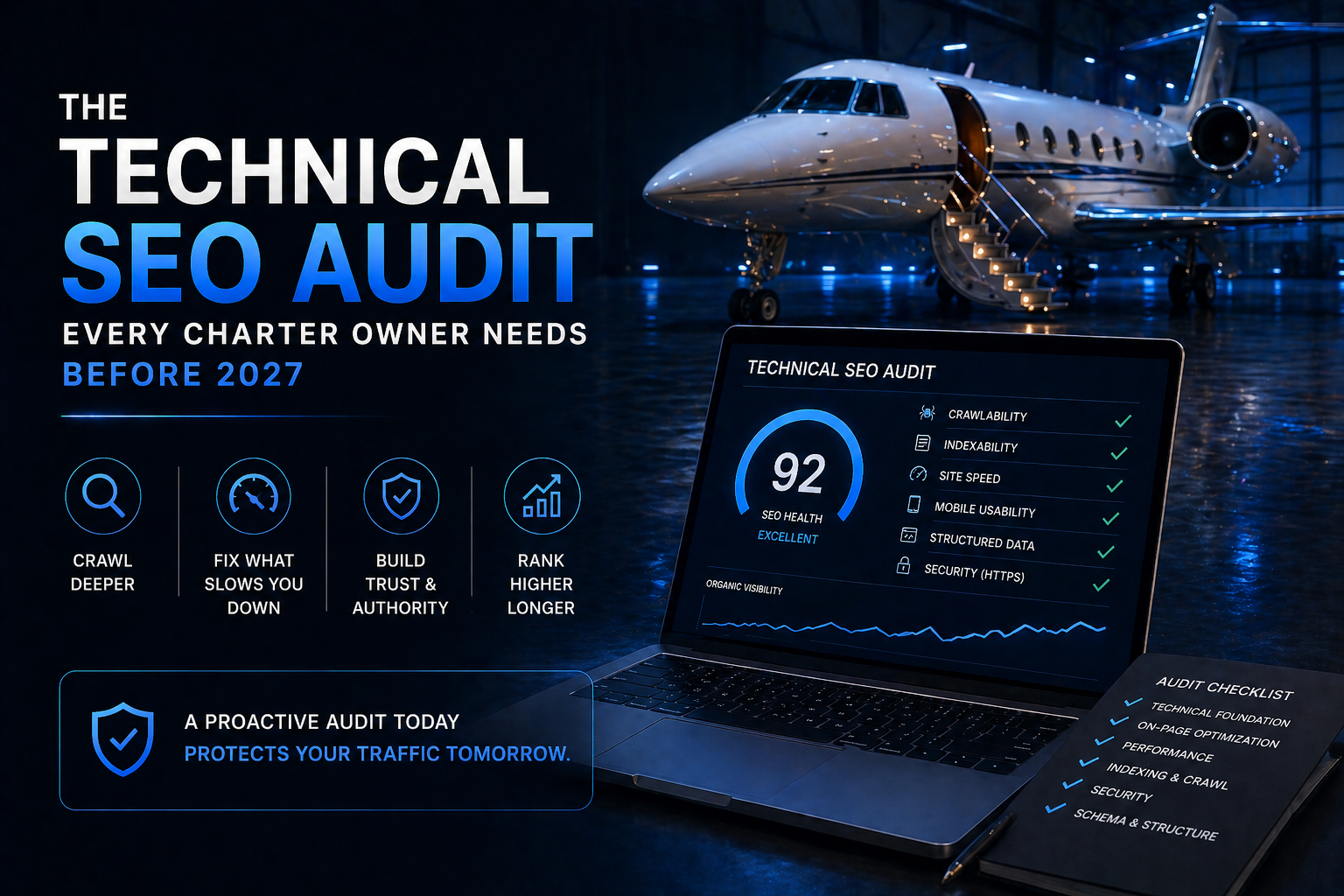
The Technical SEO Audit Every Charter Owner Needs Before 2027
Definition: A technical SEO audit is a full review of the hidden systems that control how search engines crawl, understand, trust, rank, and display your charter website.
Direct Answer: If your private aviation website has crawl errors, slow speed, weak schema, poor mobile usability, broken forms, or thin site architecture, you can lose rankings and qualified charter leads. Therefore, every charter owner should complete a serious technical SEO audit before 2027.
Many charter brands focus on aircraft quality, concierge service, visual branding, and relationships. Those factors matter. However, many still operate with weak digital infrastructure.
A website can look elite while underperforming badly. It may load slowly, confuse Google, waste authority, leak leads, or fail to support AI search systems. Consequently, brands with inferior fleets but stronger websites can capture demand first.
Because of that, technical SEO is no longer optional. It is part of commercial competitiveness.
Ultimately, if the engine under your website is weak, growth becomes harder than it should be.
Key Takeaways
- Technical SEO affects rankings, trust, conversions, and AI visibility.
- Luxury design does not replace technical strength.
- Fast websites often convert better.
- Indexing issues can hide valuable pages.
- Schema improves entity understanding.
- Internal linking increases authority flow.
- 2027 winners will combine SEO, GEO, and UX.
Why This Audit Matters Before 2027
Private aviation search is changing quickly. Traditional rankings still matter. However, AI-generated recommendations now influence discovery more each month.
At the same time, buyers expect flawless digital experiences. If a site feels slow, confusing, or dated, trust drops immediately.
Therefore, charter brands now need to win in three areas:
- Search visibility
- User experience
- AI discoverability
Because of that, brands that fix technical weaknesses now can build momentum before slower competitors react.
Crawlability and Indexing Audit
If Google cannot crawl your site efficiently, rankings suffer. Therefore, start here first.
Audit Checklist
- XML sitemap includes only live indexable pages
- Robots.txt does not block key sections
- No accidental noindex tags
- 404 errors redirected properly
- No redirect chains
- Canonical tags are correct
- HTTPS version is primary
- WWW/non-WWW consistency
- No duplicate city URLs
- No orphan pages
Use Google Search Central for crawl guidance.
Actionable Tip: Export all indexed URLs from Search Console. Then compare them against pages that actually matter for revenue.
Consequently, many brands discover useless pages indexed while money pages remain weak.
Speed and Core Web Vitals Audit
Affluent buyers expect instant performance. Therefore, speed is brand perception plus SEO.
Check These Metrics
- Largest Contentful Paint
- Interaction to Next Paint
- Cumulative Layout Shift
- Mobile page load time
- Server response time
- Heavy scripts
- Uncompressed hero images
- Unused plugins
Use PageSpeed Insights.
Actionable Tip: Compress large aircraft images and convert to next-gen formats first. That single step often creates major gains.
Mobile Experience Audit
Executives often browse on mobile. Therefore, mobile friction costs premium leads.
Check:
- Phone button visible immediately
- Tap targets large enough
- Forms easy to complete
- No popups blocking content
- Readable text size
- Fast mobile load time
- Calendars and quote tools work properly
Actionable Tip: Test your inquiry flow personally from an iPhone and Android device every month.
Schema and Entity Audit
Schema helps Google understand who you are, what you offer, and why pages matter.
Use These Types
- Organization
- WebSite
- WebPage
- Article
- FAQPage
- BreadcrumbList
- SpeakableSpecification
Review standards at Schema.org.
Actionable Tip: Keep business name, phone, and contact details identical everywhere.
Site Architecture Audit
Many charter sites have weak architecture. They rely on a homepage plus a few shallow pages.
Instead, structure should support search intent clusters:
- Aircraft model pages
- Route pages
- Airport pages
- City pages
- Comparison pages
- FAQ pages
- Safety pages
As a result, Google understands topical authority better.
For strategic support, review SEO Services for Businesses.
Fleet Page Technical Audit
Many fleet pages look beautiful yet rank poorly.
Common Problems
- Thin copy
- No internal links
- No route references
- No FAQs
- Duplicate aircraft descriptions
- Huge images slowing load speed
- No comparison guidance
Actionable Fixes
- Add mission-fit guidance
- Add route examples
- Add FAQs
- Add internal links to comparison pages
- Compress images
- Use schema
Consequently, fleet pages become traffic assets instead of galleries.
Route Page Indexing Strategy
Route pages can become major lead drivers when built correctly.
Examples:
- New York to London private jet
- Miami to Aspen private charter
- Teterboro to Van Nuys jet charter
However, thin duplicate route pages fail.
Actionable Tip: Every route page should include flight time ranges, aircraft fit, airport notes, seasonal demand, and FAQs.
Lead Capture System Audit
Traffic means little if inquiries leak.
Audit:
- Forms deliver correctly
- CRM captures every lead
- Call tracking works
- After-hours routing exists
- Thank-you pages track conversions
- Auto-response emails fire instantly
- No spam filter losses
Actionable Tip: Submit your own forms weekly from different devices.
AI Search Readiness Audit
AI tools answer questions directly. Therefore, pages need clear answers.
Add:
- Direct answer summaries
- Comparison tables
- Question-led pages
- Structured headings
- Entity clarity
- Consistent schema
For deeper strategy, review Generative Engine Optimization.
Best Tools to Run the Audit
- Google Search Console
- Google Analytics
- PageSpeed Insights
- Screaming Frog
- Ahrefs or Semrush
- Schema validators
- Mobile device testing
Use tools for facts. Then use judgment for priorities.
12-Month Roadmap
Quarter 1
Fix crawl issues, speed, forms, and schema.
Quarter 2
Build aircraft, route, and airport clusters.
Quarter 3
Expand city pages, comparisons, and FAQ hubs.
Quarter 4
Optimize AI search visibility and improve conversion systems.
Consequently, the website compounds authority over time.
Frequently Asked Questions
What is a technical SEO audit?
A review of hidden website systems that affect rankings and leads.
How often should charter brands run one?
Quarterly, with monthly spot checks.
Can a beautiful website still fail?
Yes. Design does not guarantee technical health.
Does technical SEO help AI search?
Yes. Structure and clarity help AI systems understand pages.
What creates fast wins?
Fixing indexing, speed, broken forms, and internal links.
Final Verdict
The charter owners who win before 2027 will not only own better aircraft. They will own stronger digital systems.
Therefore, run a real technical SEO audit now. Fix hidden leaks, improve trust, and prepare for future search behavior.
Ultimately, technical strength becomes commercial strength online.
About the author : Anthony Paulino