The ROI of Long-Tail Search in Private Aviation: Why “Gulfstream G700 Charter” Beats “Private Jet”
Definition: Long-tail search in private aviation means targeting specific buyer searches, such as “Gulfstream G700 charter NYC to London,” instead of broad phrases like “private jet.”
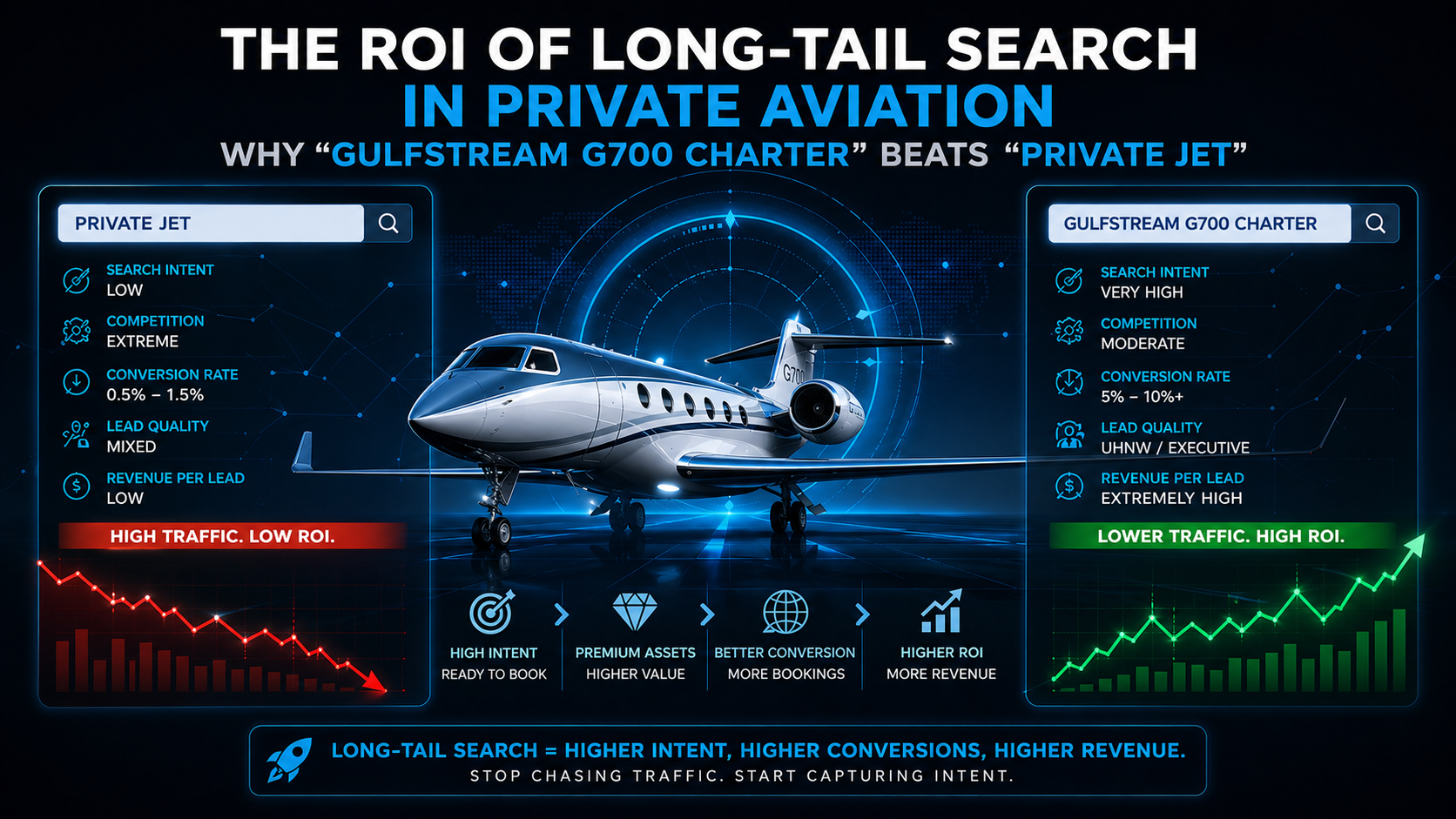
Direct Answer: Long-tail search creates stronger ROI in private aviation because it attracts buyers who already know the aircraft, route, mission, passenger need, or luxury outcome they want. Therefore, long-tail traffic usually converts better, costs less to win, and produces higher-value leads than broad search traffic.
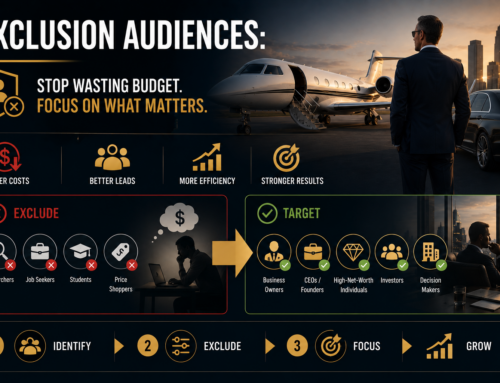
Many charter companies chase big keywords first. However, “private jet” is often a vanity keyword. It attracts researchers, dreamers, students, plane spotters, low-intent browsers, and early-stage shoppers. Meanwhile, a search like “Gulfstream G700 charter Teterboro to London” signals a much more serious buyer.
Because of that, private aviation SEO should not start with volume. Instead, it should start with intent. The goal is not to get the most visitors. The goal is to get the most qualified charter inquiries.
Ultimately, broad keywords may win attention. However, long-tail keywords win revenue.
Key Takeaways
- Broad keywords create visibility, yet long-tail keywords create qualified demand.
- Specific aircraft, route, airport, and mission searches often convert better.
- Long-tail pages usually face less competition than broad private aviation terms.
- AI search rewards clear, specific, answer-first content.
- Long-tail SEO works best when aircraft, route, city, and FAQ pages connect together.
- Private aviation companies should measure ROI by booked trips, not raw traffic.
- Therefore, “Gulfstream G700 charter” can be more valuable than “private jet.”
Why Broad Keywords Mislead Charter Companies
Broad keywords feel attractive because they show large search volume. However, volume does not equal value. A search like “private jet” can mean almost anything. The person may want photos, pricing curiosity, ownership information, charter options, celebrity travel news, or aviation career content.
Therefore, a charter company can rank for a big term and still generate weak leads. That creates an expensive SEO trap. The marketing team celebrates traffic growth, yet the sales team sees few qualified inquiries.
Additionally, broad terms attract massive competition. Large brokers, charter marketplaces, aviation media sites, directories, and established brands often dominate those rankings. Because of that, ranking for broad terms may require years of link building, content depth, technical SEO, and brand strength.
Long-tail search works differently. Instead of competing for one giant keyword, you compete across hundreds of precise searches. As a result, the total traffic may become large, yet the individual battles are easier to win.
For example, “private jet” is broad. However, these searches are much more useful:
- Gulfstream G700 charter from Teterboro to London
- Global 7500 charter Miami to Dubai
- Best private jet for large dogs in cabin
- Private jet charter Cleveland to Naples Florida
- Quietest private jet for overnight flights
- Heavy jet for 12 passengers New York to Europe
Consequently, long-tail keywords help charter companies stop fighting everyone and start serving specific buyers.
Why Intent Beats Search Volume
Search intent reveals what the buyer wants to accomplish. Therefore, intent matters more than traffic volume.
A person searching “private jet” may be at the awareness stage. However, a person searching “Gulfstream G700 charter NYC to London” has already narrowed the need. They know the aircraft class, route, and likely mission profile. That searcher is much closer to action.
Because of that, private aviation keyword research should separate searches into four intent groups:
1. Awareness Intent
These searches educate the user. Examples include “what is a private jet charter” or “how much does a private jet cost.” Although useful, these searches may convert slowly.
2. Comparison Intent
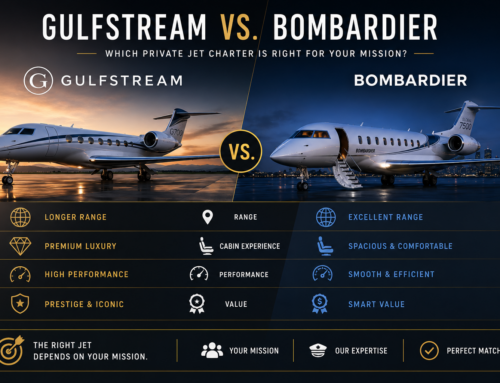
These searches show active evaluation. Examples include “Gulfstream G700 vs Global 7500” or “super midsize vs heavy jet.” Therefore, these pages can influence aircraft selection.
3. Mission Intent
These searches show a specific travel need. Examples include “best jet for NYC to London with 10 passengers” or “private jet for ski trip to Aspen.” Consequently, these searches can produce strong inquiries.
4. Transactional Intent
These searches show booking readiness. Examples include “Gulfstream G700 charter Teterboro” or “private jet charter Miami to Aspen.” These are usually the highest priority.
Actionable Tip: Build your content calendar around intent, not search volume. Start with transactional and mission-intent pages. Then expand into comparison and awareness pages.
Google’s own helpful content guidance emphasizes creating content for people first and satisfying user needs clearly. Therefore, content that directly answers high-intent searchers usually creates a stronger user experience than generic keyword pages. See Google Search Central’s helpful content guidance.
The ROI Math Behind Long-Tail Search
Private aviation companies should not judge SEO only by sessions. Instead, they should judge SEO by qualified inquiries, booked flights, customer lifetime value, and acquisition cost.
Therefore, the ROI math often favors long-tail search even when traffic volume is lower.
Broad Keyword Scenario
- Keyword: private jet
- Monthly traffic potential: high
- Competition: extreme
- Buyer readiness: mixed
- Conversion rate: low
- Cost to rank: high
- Sales team quality: inconsistent
Long-Tail Keyword Scenario
- Keyword: Gulfstream G700 charter Teterboro to London
- Monthly traffic potential: lower
- Competition: lower
- Buyer readiness: high
- Conversion rate: higher
- Cost to rank: lower
- Sales team quality: stronger
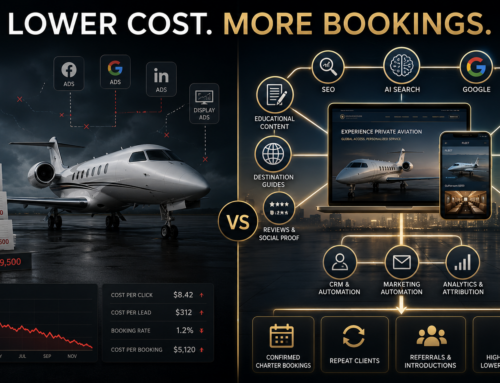
Now compare the economics.
| Metric | Broad Keyword | Long-Tail Keyword Cluster |
|---|---|---|
| Monthly Visitors | 10,000 | 2,000 |
| Lead Conversion Rate | 0.4% | 3% |
| Monthly Leads | 40 | 60 |
| Lead Quality | Mixed | High |
| Estimated Bookings | 2–3 | 5–8 |
| SEO Difficulty | Very High | Moderate |
Although this is a simplified model, it shows the core point. A smaller pool of qualified buyers can outperform a larger pool of unfocused visitors.
Moreover, private aviation has high transaction value. Therefore, even one additional booked charter can justify months of focused SEO investment.
Actionable Tip: Track long-tail SEO by inquiry quality. Add fields to your CRM that capture source page, aircraft interest, route interest, passenger count, trip timeline, and estimated charter value. As a result, you can see which long-tail pages produce real revenue.
How to Build a Private Aviation Long-Tail Keyword Map
A strong long-tail strategy starts with a keyword map. However, that map should not be random. Instead, it should reflect how private aviation buyers actually think.
Use this structure:
1. Aircraft Model Keywords
- Gulfstream G700 charter
- Global 7500 charter
- Falcon 8X charter
- Citation Latitude charter
- Challenger 350 charter
- Phenom 300 charter
2. Route Keywords
- New York to London private jet
- Miami to Aspen private jet charter
- Teterboro to Van Nuys private jet
- Los Angeles to Cabo private jet
- Palm Beach to Nantucket private charter
3. Airport Keywords
- Teterboro private jet charter
- Van Nuys private aviation
- Opa-locka private jet charter
- West Palm Beach private jet departures
- Aspen private jet airport guide
4. Mission Profile Keywords
- Best private jet for dogs in cabin
- Best jet for overnight international flights
- Quietest private jet cabin
- Best jet for mobile office setup
- Private jet with large baggage capacity
5. Comparison Keywords
- Gulfstream G700 vs Global 7500
- Falcon 8X vs Global 6500
- Super midsize vs heavy jet
- Jet card vs on-demand charter
- Teterboro vs Westchester private jet departure
After that, combine the categories. For example:
- Gulfstream G700 charter NYC to London
- Best jet for large dogs Teterboro to Palm Beach
- Global 7500 vs G700 for overnight Europe flights
- Private jet from Miami to Aspen with ski gear
Consequently, one keyword map can produce hundreds of valuable content opportunities.
Aircraft Model Pages That Capture Buyer Intent
Aircraft model pages should never read like basic spec sheets. Serious buyers need guidance, not just numbers.
Therefore, each aircraft page should answer:
- Who is this aircraft best for?
- Which routes fit this aircraft best?
- How many passengers fit comfortably?
- How much baggage can it handle?
- Is it good for pets?
- Is it good for overnight flights?
- Is it good for executive work?
- What comparable aircraft should buyers consider?
For example, a “Gulfstream G700 charter” page should discuss long-range missions, cabin zones, sleep configurations, business productivity, and comparable ultra-long-range aircraft. Additionally, it should link to route pages such as New York to London, Los Angeles to Tokyo, or Miami to Dubai when relevant.
Actionable Tip: Add a “Best For / Not Best For” section to every aircraft page. This builds trust because it shows honest guidance instead of generic promotion.
Route Pages That Turn Searches Into Inquiries
Route pages work because buyers often search around real travel plans. They may not care about abstract aviation content. Instead, they want to know the best way to complete a specific mission.
A strong route page should include:
- Typical flight time
- Best aircraft categories
- Departure airport options
- Arrival airport options
- Seasonal considerations
- Weather or baggage considerations
- Pet and passenger comfort notes
- Recommended booking timing
- CTA for route-specific quote
For example, a Miami to Aspen page should discuss winter demand, ski gear, runway considerations, passenger count, and aircraft category fit. Therefore, it becomes useful rather than generic.
Actionable Tip: Add route-specific CTAs. Instead of “Contact us,” use “Request aircraft options for Miami to Aspen.” As a result, the inquiry feels more relevant.
Mission Profile Pages for High-Value Buyers
Mission profile pages capture buyers who search by need instead of aircraft name. These pages are powerful because they match how affluent buyers often think.
They ask:
- Which jet works best for my family?
- Which aircraft allows my dog comfortably?
- Which cabin works best for overnight sleep?
- Which jet supports a mobile office?
- Which aircraft works best for ski trips?
Therefore, mission pages should translate buyer needs into aircraft recommendations.
For example, a page on “best private jet for large dogs in cabin” should discuss cabin floor space, boarding comfort, operator pet policies, cleaning considerations, and aircraft categories. Moreover, it should avoid pretending one answer fits every case.
Actionable Tip: Build mission pages from sales call questions. If prospects ask the same question more than twice, it likely deserves a page.
Comparison Pages That Catch Decision-Stage Searchers
Comparison pages are valuable because users who compare options are usually closer to buying. They are no longer asking if private aviation is possible. Instead, they are deciding which option fits best.
Strong comparison pages should include:
- Feature comparison table
- Best use case for each option
- Range differences
- Cabin differences
- Passenger comfort notes
- Baggage considerations
- Route suitability
- Decision recommendation
For example, “Gulfstream G700 vs Global 7500” should not simply compare specs. Instead, it should explain which aircraft may fit different travel styles, cabin preferences, route lengths, and passenger needs.
Consequently, the page becomes a decision tool, not just an SEO page.
Why Long-Tail SEO Wins in GEO and AI Search
AI search favors clear, specific answers. Therefore, long-tail content naturally supports Generative Engine Optimization.
When someone asks an AI tool, “What is the best aircraft for eight passengers from New York to London?” the system needs specific source content. A generic private jet page may not answer that question well. However, a detailed route and aircraft-fit page can.
Because of that, long-tail content can become AI-answer fuel.
To improve AI visibility, every long-tail page should include:
- A direct answer near the top
- Clear definitions
- Comparison tables
- FAQs
- Structured headings
- Schema markup
- Specific examples
- Internal links to related entities
Google has also published guidance around AI features in Search and how helpful content can appear across search experiences. Therefore, building clear, useful, people-first content remains essential. Review Google’s AI features guidance and Google’s helpful content guidance.
For IMR’s AI visibility strategy, review Generative Engine Optimization.
How to Convert Long-Tail Traffic Into Charter Leads
Long-tail traffic converts better only when the page matches the intent. Therefore, conversion strategy matters as much as keyword strategy.
Use these conversion elements:
- Direct answer at the top
- Route-specific or aircraft-specific CTA
- Trust signals near the form
- Simple mobile form
- Phone and text options
- Privacy reassurance
- Fast response promise
- Relevant aircraft recommendation
For example, a page about “Gulfstream G700 charter NYC to London” should not use a generic CTA. Instead, it should say, “Request G700 availability for NYC to London.”
Additionally, the form should ask only what matters:
- Departure city or airport
- Destination
- Passenger count
- Preferred date
- Aircraft preference
- Contact information
Actionable Tip: Use hidden form fields that capture the source page. Then your sales team knows exactly what aircraft or route the prospect cares about.
Internal Linking for Long-Tail Authority
Long-tail pages become more powerful when they connect. Therefore, internal linking is critical.
Use this structure:
- Aircraft pages link to route pages.
- Route pages link to aircraft pages.
- Comparison pages link to both aircraft pages.
- Mission pages link to relevant aircraft categories.
- Blog posts link to service pages.
- Service pages link to major strategy resources.
For example, a G700 page should link to G700 vs Global 7500, NYC to London, long-range jet charter, and overnight cabin comfort pages. As a result, Google sees a connected topic cluster.
For broader SEO architecture, see SEO Services for Businesses.
90-Day Long-Tail SEO Implementation Plan
Days 1–15: Build the Keyword Map
Start by collecting aircraft, route, airport, city, comparison, and mission-profile keywords. Additionally, review sales calls and inquiry forms for repeated buyer questions.
Days 16–30: Prioritize by Revenue Potential
Rank keywords by likely charter value, buyer readiness, and competition level. Therefore, “G700 charter NYC to London” should beat generic informational topics.
Days 31–45: Build Aircraft Pages
Create pages for the highest-value aircraft models first. Include mission fit, passenger comfort, route examples, FAQs, and comparison links.
Days 46–60: Build Route Pages
Create high-value route pages with flight time, aircraft fit, airport options, and route-specific CTAs.
Days 61–75: Build Comparison and Mission Pages
Add decision-stage content, such as aircraft comparisons and “best jet for” guides. Consequently, the site captures buyers who are narrowing options.
Days 76–90: Add Schema, Links, and CRO
Finish by adding schema, internal links, direct answers, FAQs, and conversion prompts. Then track inquiries by source page.
As a result, the website becomes a structured demand-capture system instead of a basic brochure.
Common Long-Tail SEO Mistakes
- Chasing search volume instead of buyer intent.
- Publishing thin aircraft pages with only specs.
- Creating duplicate route pages with swapped city names.
- Ignoring comparison content.
- Forgetting route-specific CTAs.
- Failing to link related pages together.
- Skipping schema and FAQs.
- Measuring success only by traffic instead of booked revenue.
- Writing generic luxury copy instead of useful guidance.
Ultimately, long-tail SEO fails when brands treat it as a keyword exercise. It wins when brands treat it as buyer-intent infrastructure.
Frequently Asked Questions
Are long-tail keywords better than broad keywords in private aviation?
Yes. Long-tail keywords often convert better because they show more specific buyer intent. Therefore, they usually produce stronger ROI than broad awareness terms.
Does “private jet” still matter as a keyword?
Yes, but it should not be the only focus. Broad keywords can build visibility. However, specific aircraft, route, and mission searches usually produce better leads.
How many long-tail pages should a charter company build?
It depends on market size, fleet focus, and growth goals. However, serious private aviation SEO often requires hundreds of pages across aircraft, routes, airports, cities, comparisons, and FAQs.
Do long-tail keywords help AI search visibility?
Yes. AI search often responds to specific questions. Therefore, detailed long-tail pages can support GEO and AI-answer visibility.
What is the best first long-tail page to build?
Start with your highest-value aircraft or route. For example, build a page around a premium aircraft model that matches your strongest charter demand.
How should charter companies measure long-tail ROI?
Track impressions, clicks, qualified leads, sales conversations, booked trips, and estimated charter value by landing page. Consequently, you can see which pages produce real revenue.
Final Verdict
In private aviation, broad keywords create visibility. However, long-tail keywords create qualified demand.
Therefore, a search like “Gulfstream G700 charter” can be more valuable than “private jet” because it reveals a buyer with clearer intent, stronger knowledge, and higher booking potential.
Ultimately, private aviation companies should stop chasing volume alone. Instead, they should build long-tail authority across aircraft, routes, airports, comparisons, and mission profiles.
Because of that, precision wins. Moreover, precision compounds.
About the author : Anthony Paulino