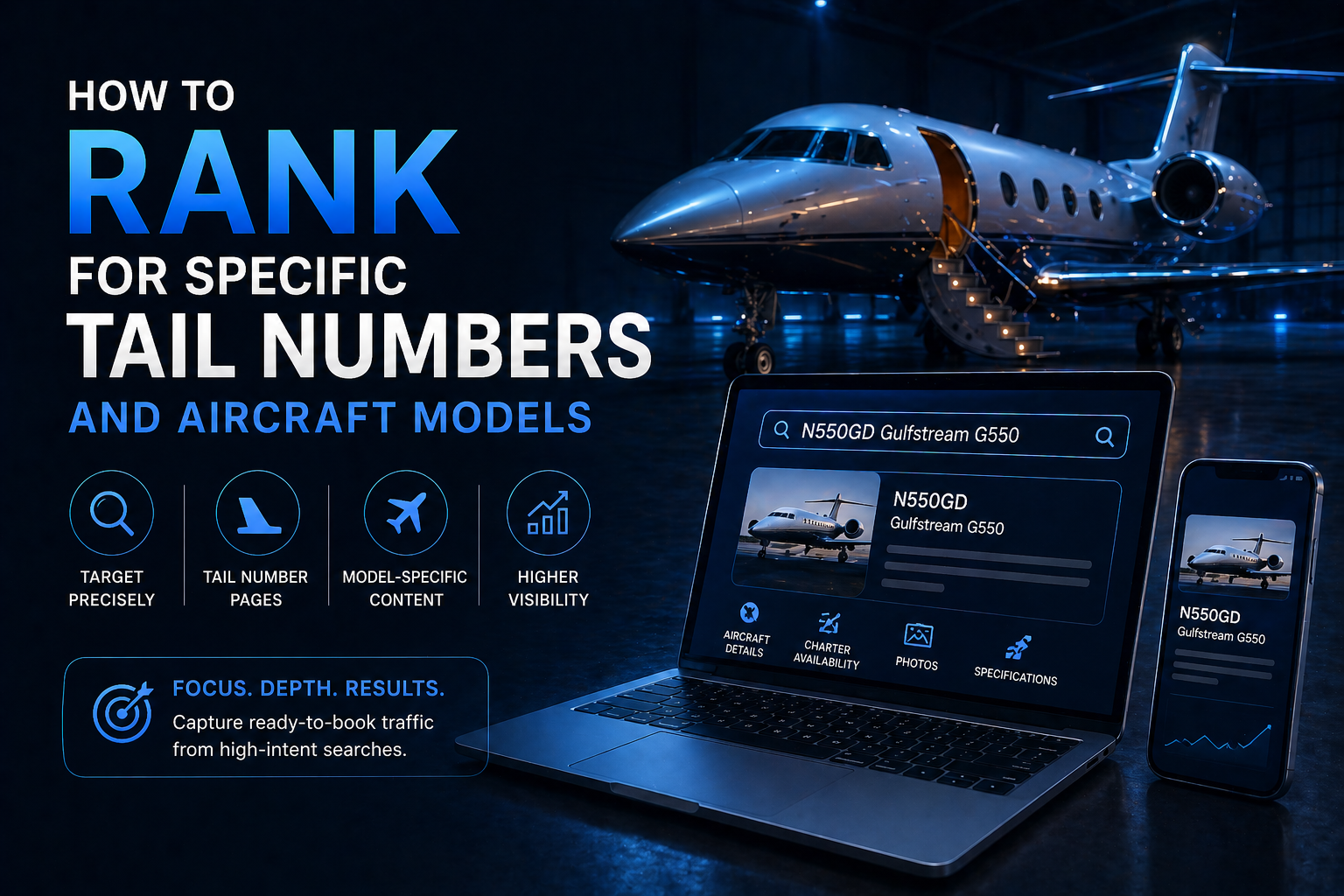
How to Rank for Specific Tail Numbers and Aircraft Models
Definition: Ranking for specific tail numbers and aircraft models means building optimized pages that help search engines and AI systems understand exact aircraft entities, ownership interest, charter relevance, and model-level buying intent.
Direct Answer: If a private aviation company wants to capture serious buyer traffic, ranking only for broad keywords like private jet charter is not enough. However, ranking for exact aircraft models and relevant tail-number searches can attract higher-intent users who already know what they want.
Many private aviation companies ignore some of the strongest long-tail search intent in the industry. They focus on generic keywords such as private jet rental, charter flights, or executive aviation. Although those phrases matter, they are broad and competitive.
Meanwhile, highly qualified users often search with precision. They search for Gulfstream G700 charter, Global 7500 range, Citation Latitude cabin size, or even specific tail numbers tied to aircraft they have seen, flown on, tracked, or researched.
Because of that, companies that build pages around aircraft entities can capture demand that others overlook. Therefore, ranking for tail numbers and aircraft models can become a powerful edge.
Key Takeaways
- Broad keywords are valuable, yet specific aircraft searches often convert better.
- Aircraft model pages can capture high-intent traffic.
- Tail number searches reveal curiosity, verification, or booking interest.
- Schema helps search engines understand aircraft entities.
- Comparison and route pages strengthen aircraft relevance.
- AI search rewards structured, authoritative answers.
- Internal links turn single pages into authority clusters.
Why This Strategy Matters
Searchers who know exact aircraft names are usually further along in the buying cycle. They may have flown privately before, compared fleets already, or narrowed their preferences.
Therefore, a person searching “Gulfstream G650ER charter” often has stronger intent than someone searching “private jet.”
Likewise, a person searching a tail number may be verifying ownership, checking availability history, researching a charter operator, or trying to identify a plane they noticed recently.
Because of that, these searches can bring qualified traffic with lower competition than broad aviation phrases.
Understanding Tail Number Search Intent
Tail number searches are unique because they often come with curiosity plus urgency. Users may want immediate answers.
Common reasons people search a tail number include:
- Identifying an aircraft seen at an airport
- Researching ownership history
- Checking aircraft type
- Looking for charter availability
- Verifying operator credibility
- Following celebrity or corporate travel rumors
- Comparing aircraft before booking
Consequently, a useful page can satisfy intent quickly while introducing charter options naturally.
Understanding Aircraft Model Search Intent
Aircraft model searches often signal stronger commercial intent than tail number searches. Buyers may compare comfort, range, image, speed, or mission fit.
Examples include:
- Global 7500 charter price
- Gulfstream G700 range
- Citation Latitude charter cost
- Falcon 8X cabin noise
- Challenger 350 for coast to coast flights
Because of that, model pages should not be thin spec sheets. Instead, they should guide a buying decision.
How to Build Tail Number Pages
Tail number pages should be informative, compliant, and useful. Avoid making unsupported claims or privacy-invasive content.
A strong page can include:
- Tail number
- Aircraft manufacturer
- Aircraft model
- Aircraft category
- Typical mission use
- Cabin highlights
- Comparable charter aircraft
- How to book a similar aircraft
- Related model pages
For example, if a user searches a Challenger tail number, your page can explain the Challenger platform and offer similar charter options.
Therefore, you meet curiosity intent while introducing commercial relevance subtly.
How to Build Aircraft Model Pages
Aircraft model pages are often the strongest asset in this strategy. However, many companies waste them with generic copy.
A stronger aircraft model page should answer:
- Who is this aircraft best for?
- How many passengers fit comfortably?
- Which routes fit best?
- Is it ideal for business use onboard?
- How does baggage space compare?
- How does cabin comfort compare?
- What similar jets should buyers consider?
Additionally, include direct answers near the top because Google and AI systems prefer clarity.
For wider visibility strategy, connect these pages to SEO Services for Businesses.
Use Schema and Entity Signals
Structured data helps search engines understand what the page is about. Therefore, use schema wherever appropriate.
Helpful schema may include:
- WebPage
- Article
- FAQPage
- BreadcrumbList
- Organization
- Product-like attributes when relevant
You can review standards at Schema.org.
Also keep naming consistent. If one page says G650ER and another uses different formatting, clarity can weaken.
Use Internal Linking for Authority
One aircraft page is useful. However, an aircraft cluster is stronger.
Link model pages to:
- Comparison pages
- Route pages
- Airport pages
- Buyer question pages
- Fleet overview pages
For example, a Gulfstream G700 page should link to New York to London route pages, Global 7500 comparison pages, and overnight cabin comfort guides.
As a result, the site builds deeper authority signals.
Use Non-Competitive External Sources
External authority links can improve trust when used naturally.
- FAA for aircraft registry and aviation guidance
- NBAA for business aviation resources
- Google Search Central for SEO guidance
- Schema.org for structured data standards
However, links should support the page naturally. Random links do not help.
90-Day Rollout Plan
Days 1–30
Audit existing fleet pages, map aircraft keywords, and identify priority models.
Days 31–60
Launch top aircraft model pages and first comparison pages.
Days 61–90
Launch tail-number opportunity pages, route links, FAQs, and schema upgrades.
Consequently, the site gains faster depth and broader ranking paths.
Frequently Asked Questions
Do tail number pages really rank?
Yes, especially when the search volume exists and intent is clear.
Are model pages better than fleet overview pages?
Usually yes. Dedicated model pages often capture stronger long-tail intent.
Should I create pages for every aircraft model?
Prioritize aircraft relevant to your charter market first, then expand.
Does schema guarantee rankings?
No. However, it can improve clarity and search understanding.
Can AI search use these pages?
Yes. Well-structured aircraft pages can help AI systems answer buyer questions.
Final Verdict
If you only chase broad private jet keywords, you miss many qualified buyers. However, if you rank for exact aircraft models and relevant tail-number searches, you capture precision demand.
Therefore, this strategy can create lower-competition traffic, stronger buyer intent, and better authority signals over time.
Ultimately, the future of private aviation SEO belongs to brands that understand entities, not just keywords.
About the author : Anthony Paulino