HomeAdvisor vs. Your Own Lead System: Who Owns Your Customer Data?
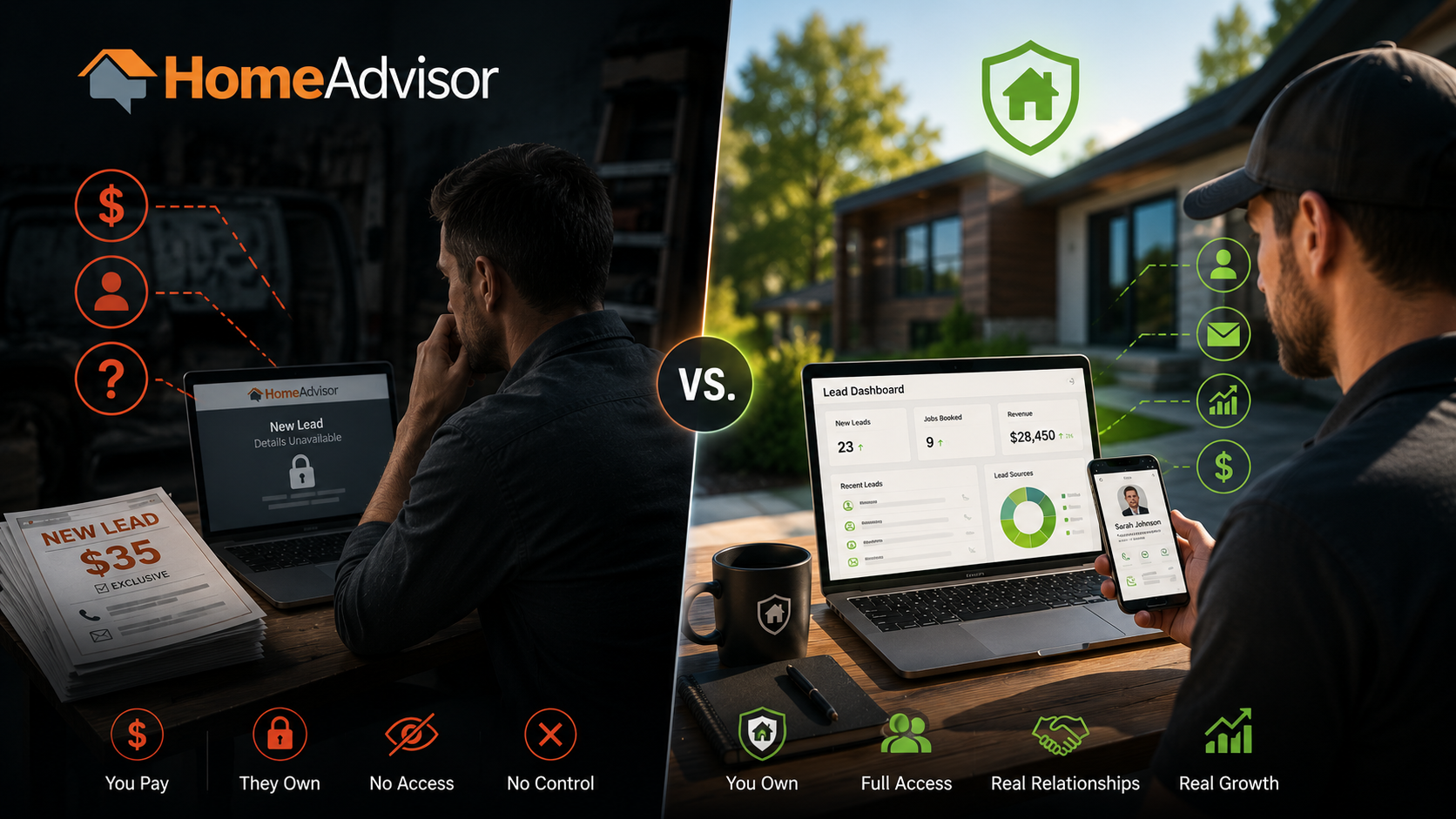
Direct Answer: Home improvement companies that depend on HomeAdvisor-style lead platforms often rent access to homeowners instead of owning the customer relationship, source data, retargeting audience, local search visibility, and long-term follow-up system. Therefore, contractors should build their own lead system with SEO infrastructure, first-party data, CRM attribution, paid media, reviews, and Digital Fortress architecture.
HomeAdvisor-style platforms can create activity. However, activity is not the same as ownership. A roofing, siding, window, gutter, or remodeling company may receive a lead, yet the platform often controls much of the discovery path before the contractor ever enters the conversation.
Meanwhile, an owned lead system gives the contractor more control. Instead of waiting for a third-party platform to send another homeowner, the company builds direct demand through service pages, city pages, neighborhood pages, Google Business Profile visibility, paid campaigns, retargeting audiences, reviews, and CRM follow-up.
As a result, the question is not only, “Where did the lead come from?” The better question is, “Who owns the customer relationship after the lead arrives?”
Additionally, Google recommends helpful, reliable, people-first content, and structured data can help search systems understand page content. Therefore, your own lead system should not be a single landing page. Instead, it should become a connected Digital Fortress built from useful content, local authority, conversion pages, tracking, and follow-up systems. Google explains helpful content, while Google explains structured data.
Key Takeaways
- HomeAdvisor-style platforms may create lead flow, but contractors do not fully own the demand source.
- However, an owned lead system gives contractors more control over data, follow-up, retargeting, and brand equity.
- Therefore, home improvement companies should compare lead platforms by cost per closed job, not cost per lead alone.
- Additionally, first-party data improves CRM attribution, paid media, SEO, GEO, and long-term marketing decisions.
- Ultimately, the contractor that owns the data owns more of the customer relationship.
The Core Question: Who Owns the Customer Data?
Direct Answer: The business that owns the customer data controls the follow-up, retargeting, attribution, brand relationship, and future marketing value.
A lead is not only a name and phone number. It also tells you what service the homeowner wants, where they live, what problem they have, what offer they responded to, and what follow-up path they need.
Therefore, when that data enters your system directly, you can improve sales, ads, SEO, email, remarketing, and operations. However, when most demand flows through a third-party platform, you may see the lead while missing the larger data picture.
Owned Customer Data Can Include
- service requested
- location
- landing page source
- ad campaign source
- keyword or page intent
- call recording
- form answers
- appointment status
- estimate value
- closed job value
- gross profit
- future service potential
As a result, owned data becomes a business asset, not just a marketing report.
How HomeAdvisor-Style Lead Platforms Work
Direct Answer: HomeAdvisor-style platforms connect contractors with homeowners through a third-party marketplace, which means the platform often controls much of the discovery experience before the contractor enters the conversation.
These platforms can help contractors access homeowners who are already looking for services. Therefore, they may create short-term opportunity. However, the homeowner may not have searched for your company specifically.
Instead, the homeowner may have searched inside a platform ecosystem. Consequently, the lead can begin with less brand trust than a homeowner who found your website, read your reviews, watched your proof, and requested your company directly.
Platform Lead Advantages
- fast lead flow
- marketplace visibility
- simple setup
- possible short-term appointment volume
- access to homeowners already requesting services
Platform Lead Tradeoffs
- less control over the demand source
- weaker brand ownership
- potential competition with other pros
- limited remarketing control
- less SEO value
- less first-party data value
- ongoing platform dependency
Consequently, the platform may help generate activity, but it may not build your long-term demand asset.
What Is Your Own Lead System?
Direct Answer: Your own lead system is a contractor-owned growth engine that captures homeowners through your website, local SEO, paid ads, retargeting, Google Business Profile, reviews, forms, phone calls, CRM workflows, and follow-up automation.
An owned lead system does not mean you must stop using every third-party platform immediately. Instead, it means you stop making rented demand the foundation of your business.
An Owned Lead System Includes
- service pages
- city pages
- neighborhood pages
- storm damage pages
- Google Business Profile optimization
- review generation
- Meta Ads and Google Ads
- call tracking
- form tracking
- CRM attribution
- email and SMS follow-up
- retargeting audiences
- before-and-after proof
- AI-search-ready content
Therefore, your own lead system becomes a Digital Fortress that compounds over time.
Why Customer Data Ownership Matters
Direct Answer: Customer data ownership matters because it helps contractors make smarter marketing, sales, hiring, production, and follow-up decisions.
When you own the system, you can see which neighborhoods produce the best jobs, which services close fastest, which ads create profitable projects, and which pages attract low-quality inquiries.
Customer Data Helps Answer
- Which services produce the highest gross profit?
- Which cities generate the best appointment rates?
- Which ads produce real jobs?
- Which pages create high-ticket estimates?
- Which sales reps close specific lead sources best?
- Which homeowners need long-term nurturing?
- Which offers create price shoppers?
- Which campaigns should receive more budget?
Additionally, data ownership helps the business improve every month. Without it, marketing decisions often become guesses.
First-Party Data Is the New Contractor Advantage
Direct Answer: First-party data gives contractors direct insight from their own website visitors, leads, customers, calls, forms, and CRM records.
First-party data comes from owned sources such as website forms, calls, customer records, and direct interactions. Therefore, it gives contractors more control than platform-only lead reports.
Moreover, first-party data supports better audience building, better campaign measurement, and better follow-up when collected responsibly and with proper consent where required.
First-Party Data Sources for Contractors
- website forms
- phone calls
- estimate requests
- chat conversations
- email subscribers
- review requests
- CRM records
- Google Business Profile interactions
- retargeting audiences
- past customer lists
As a result, first-party data becomes one of the most valuable assets a contractor can build.
Lead Quality vs. Lead Volume
Direct Answer: Lead quality matters more than lead volume because a smaller number of direct, high-trust leads can produce more profit than a larger number of low-intent platform leads.
Many contractors ask, “How many leads did we get?” However, the better question is, “How many profitable jobs did those leads create?” Therefore, every lead source should be judged by closed revenue and gross profit.
High-Quality Lead Indicators
- homeowner requested your company directly
- service need is specific
- location matches your service area
- timeline is clear
- contact information is accurate
- homeowner answers follow-up
- project fits your target ticket
- lead source shows strong intent
- homeowner has seen reviews or proof
Consequently, a more expensive direct lead can outperform a cheaper rented lead if it closes at a higher rate.
CRM Attribution: The Missing Layer
Direct Answer: CRM attribution shows which lead sources produce booked appointments, estimates, closed jobs, and profit.
Without CRM attribution, a lead source can look successful because it creates form fills. However, once the company tracks the full funnel, weak sources often become obvious.
CRM Fields Every Contractor Should Track
- lead source
- campaign
- landing page
- service requested
- city or neighborhood
- call vs form
- appointment booked
- estimate completed
- job sold
- contract value
- gross profit
- follow-up status
Additionally, CRM attribution helps compare platform leads against owned leads fairly. Therefore, the contractor can shift spend based on profit, not emotion.
SEO Infrastructure Creates Direct Demand
Direct Answer: SEO infrastructure creates direct demand by helping homeowners find the contractor’s own website when they search for services, locations, problems, and costs.
A strong home improvement website should not rely on one homepage and a few generic service pages. Instead, it should build a full local authority ecosystem.
SEO Infrastructure for Home Improvement Includes
- roof replacement pages
- roof repair pages
- siding installation pages
- window replacement pages
- gutter installation pages
- storm damage pages
- insurance claim guides
- city pages
- neighborhood pages
- cost guides
- comparison pages
- FAQ pages
Additionally, this connects directly to Stop Buying Cheap Leads, because owned SEO assets reduce long-term dependence on rented lead sources.
GEO and AI Search Change the Game
Direct Answer: GEO helps contractors appear in AI-generated answers when homeowners ask specific questions about roofing, siding, windows, gutters, storm damage, and local contractors.
Homeowners increasingly ask detailed questions before contacting anyone. For example, they may ask, “How do I know if my roof has hail damage?” or “Should I replace my gutters before winter?” Therefore, contractors need answer-ready content.
AI Search Questions to Target
- How do I know if I need roof repair?
- What does hail damage look like?
- Are gutter guards worth it?
- How long do replacement windows last?
- What siding is best for my climate?
- Should I repair or replace my roof?
- How does the insurance claim process work?
Furthermore, authority matters. As explained in Why You Are Either an Authority or a Commodity in 2026, companies that answer more buyer questions become harder to reduce to price.
Paid Media Works Better With Owned Data
Direct Answer: Paid media performs better when the contractor owns the website, pixel data, landing pages, CRM records, and follow-up system.
A Meta ad or Google ad can generate the first click. However, the owned system determines what happens next. Therefore, paid traffic should support the Digital Fortress instead of replacing it.
Owned Paid Media Advantages
- custom landing pages
- retargeting audiences
- lookalike audience creation
- conversion tracking
- call tracking
- CRM source attribution
- creative testing
- service-specific funnels
- city-specific campaigns
Additionally, first-party website and CRM data can improve campaign decisions over time. Therefore, the company builds learning, not just leads.
Retargeting Protects the Opportunity
Direct Answer: Retargeting is one of the biggest advantages of owning your lead system because homeowners rarely choose a contractor after one touch.
A homeowner may visit a roof replacement page, leave, read reviews later, compare financing, and then return days later. Therefore, if the contractor owns the site and pixel data, that homeowner can enter a retargeting sequence.
Retargeting Audiences for Contractors
- roofing page visitors
- siding page visitors
- window page visitors
- gutter page visitors
- storm damage page visitors
- form starters who did not submit
- estimate page visitors
- past customers
- review page visitors
Consequently, the company can keep educating and reminding homeowners instead of losing them after the first visit.
Reviews and Brand Trust Belong on Your Assets
Direct Answer: Reviews create the most long-term value when they strengthen the contractor’s own Google profile, website, landing pages, and sales process.
Third-party platforms may display reviews. However, contractors should also build review assets they can use across their own lead system.
Review Assets Should Support
- Google Business Profile
- service pages
- city pages
- landing pages
- ads
- email follow-up
- sales scripts
- before-and-after galleries
- case studies
Additionally, review content helps build trust before the sales call. Therefore, it reduces price pressure and improves close rates.
HomeAdvisor vs. Your Own Lead System
Direct Answer: HomeAdvisor-style platforms rent access to homeowner demand, while your own lead system builds direct demand and first-party data ownership.
| Category | HomeAdvisor-Style Lead Platform | Your Own Lead System |
|---|---|---|
| Demand Source | Third-party platform | Owned website, SEO, ads, reviews, CRM |
| Customer Data | Limited platform-dependent access | First-party website and CRM data |
| Brand Trust | Often starts inside platform | Built before direct contact |
| Retargeting | Limited control | Owned audiences |
| Long-Term Asset | Weak | Strong |
| Lead Quality Control | Platform-dependent | Page, offer, targeting, and CRM controlled |
| SEO Value | Mostly benefits platform | Benefits contractor |
| Pricing Power | Often weaker | Often stronger |
How to Build Your Own Home Improvement Lead System
Direct Answer: Build your own lead system by combining SEO infrastructure, local pages, paid media, CRM attribution, first-party data, reviews, retargeting, and follow-up automation.
Step 1: Build Core Service Pages
Start with roofing, siding, windows, gutters, storm restoration, commercial roofing, and other high-profit services.
Step 2: Build City and Neighborhood Pages
Next, create unique local pages for the areas where you want more jobs.
Step 3: Add Conversion Landing Pages
Then, build landing pages for offers, inspections, storm response, financing, and seasonal campaigns.
Step 4: Install Tracking
Afterward, use call tracking, form tracking, pixels, analytics, and CRM source fields.
Step 5: Connect the CRM
Additionally, track every source through appointment, estimate, sale, and profit.
Step 6: Build Retargeting Audiences
Then, create audiences by service interest, city, page visit, and funnel stage.
Step 7: Grow Reviews and Proof
Next, add reviews, before-and-after photos, case studies, and project examples across the system.
Step 8: Use Paid Ads to Accelerate
Finally, run Meta and Google campaigns into pages you own, then measure the full funnel.
Therefore, the system becomes an owned asset that improves over time.
Metrics That Matter
Direct Answer: Contractors should measure lead sources by booked appointments, estimates, closed jobs, gross profit, and data ownership.
Track These Metrics
- cost per lead
- cost per contacted lead
- cost per booked appointment
- estimate rate
- close rate
- average job value
- gross profit per job
- cost per closed job
- source by service
- source by city
- review growth
- retargeting audience growth
- branded search growth
- AI-search visibility
Additionally, compare platform leads against direct organic, paid, referral, and repeat-customer leads. Therefore, you can see which source truly creates profitable growth.
Common Mistakes
Direct Answer: Contractors fail when they compare lead sources by cost per lead instead of customer ownership, close rate, profit, and long-term data value.
- depending too heavily on third-party leads
- not tracking cost per closed job
- not building service pages
- not building city pages
- not owning retargeting audiences
- not using CRM attribution
- not growing Google reviews
- not building AI-search content
- not tracking call quality
- not nurturing old leads
- not separating lead volume from lead quality
- not building first-party data assets
Instead, contractors should use rented lead sources carefully while building owned demand aggressively.
Frequently Asked Questions
Should contractors stop using HomeAdvisor-style leads?
Not always. However, contractors should avoid depending on any third-party platform as their main growth engine if they are not also building owned demand.
Why is first-party data important for contractors?
First-party data helps contractors understand which pages, ads, services, cities, and campaigns create booked appointments, closed jobs, and profit.
What is better than buying shared leads?
An owned lead system with SEO, city pages, service pages, paid ads, reviews, retargeting, CRM attribution, and follow-up automation usually creates stronger long-term control.
How do I know if my own lead system is working?
Track booked appointments, estimate rate, close rate, gross profit, cost per closed job, source attribution, review growth, and retargeting audience growth.
What should a contractor build first?
Start with the highest-profit service pages, then build city pages, landing pages, tracking, CRM attribution, reviews, and retargeting audiences.
External Sources
Conclusion
Direct Answer: HomeAdvisor-style lead platforms can create opportunities, but your own lead system gives you stronger control over customer data, brand trust, attribution, follow-up, retargeting, and long-term demand.
Therefore, the smartest home improvement companies will not judge growth only by how many leads they can buy this month. Instead, they will build systems that create direct demand, collect first-party data responsibly, track the full sales funnel, and improve every campaign over time.
Ultimately, the question is not only “Where did the lead come from?” The better question is, “Who owns the customer relationship after the lead arrives?”
Final Insight: If another company owns the data, another company owns the leverage. Build your own lead system, and you build the asset that keeps paying you back.
About the author : Anthony Paulino