Las Vegas Private Aviation Destination Guide
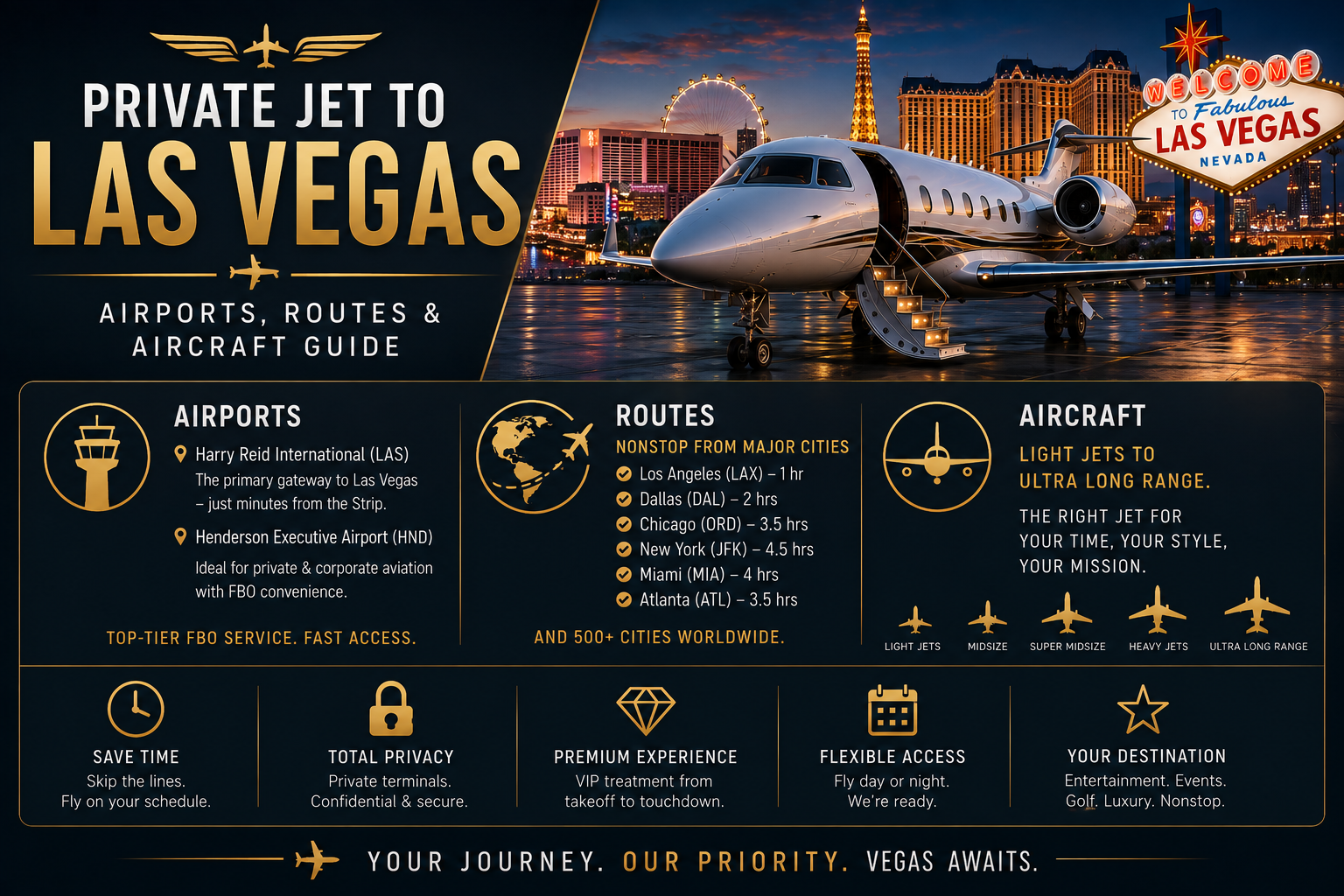
Private Jet to Las Vegas: Airports, Routes and Aircraft Guide
Flying by private jet to Las Vegas requires more than selecting an aircraft and arrival time. Instead, the strongest plan connects the departure market, passengers, baggage, airport choice, desert temperatures, event demand, aircraft parking, privacy, security, ground transportation, and the traveler’s exact destination across the Las Vegas Valley.
Las Vegas is one of the most active private aviation destinations in the United States. In particular, the market attracts executives, investors, entertainers, athletes, casino guests, sponsors, production teams, family offices, convention attendees, luxury travelers, sports organizations, wedding groups, and international visitors.
However, the city does not operate through one universal private aviation airport. Henderson Executive Airport may provide the strongest fit for travelers headed to the southern Strip, Henderson, corporate facilities, Allegiant Stadium, or communities south of central Las Vegas.
Meanwhile, North Las Vegas Airport may create practical access to downtown Las Vegas, Summerlin, northern communities, outdoor recreation, and destinations northwest of the Strip. Harry Reid International Airport may also support private aviation missions that require major-airport infrastructure, international connections, specialized handling, or direct access near the central Strip.
Therefore, airport selection should begin with the complete itinerary rather than the general destination name. Aircraft size, runway requirements, passenger schedule, final address, FBO preference, customs, security, event traffic, aircraft parking, and the departure plan can all change the best option.
Additionally, Las Vegas demand can become heavily compressed around conventions, major sporting events, championship fights, concerts, racing weekends, holidays, entertainment productions, festivals, corporate gatherings, and private celebrations.
Consequently, aircraft parking, FBO capacity, hotel rooms, catering, vehicles, security teams, restaurant reservations, event credentials, and preferred arrival windows may tighten simultaneously.
This guide connects Las Vegas destination demand with its private aviation airports, aircraft, routes, events, desert weather, business travel, entertainment logistics, privacy, baggage, ground transportation, and related buyer resources.
Is Las Vegas a Major Private Jet Destination?
Direct Answer: Yes. Las Vegas is a major private jet destination because it combines entertainment, gaming, conventions, professional sports, corporate gatherings, luxury resorts, private events, international tourism, and year-round leisure demand. Henderson Executive Airport often leads for private aviation, although North Las Vegas Airport and Harry Reid International may better support certain missions.
A private jet to Las Vegas may support an executive conference, casino stay, championship fight, major concert, sporting event, trade show, wedding, production schedule, private celebration, investor meeting, golf trip, or multi-city entertainment itinerary.
Moreover, private aviation can help passengers avoid commercial-terminal congestion while coordinating the flight around the real event schedule. Executives may arrive after a board meeting, performers may depart immediately after a show, and sports organizations may move players, ownership, sponsors, or support personnel within compressed windows.
However, Las Vegas demand often concentrates around the same arrival and departure periods. Therefore, the traveler must consider aircraft parking, FBO capacity, vehicle access, security procedures, hotel coordination, event traffic, crew duty, and the return schedule before confirming the mission.
Henderson Executive Airport commonly serves as a private aviation alternative to Harry Reid International Airport. Its official airport resource describes the facility as a corporate aviation gateway located south of the Strip with convenient access to major Las Vegas Valley roadways.
North Las Vegas Airport also supports general, corporate, and business aviation. Because it sits northwest of the Strip, it may fit travelers headed to downtown Las Vegas, Summerlin, northern communities, or destinations that would create an unnecessary cross-valley transfer from Henderson.
Meanwhile, Harry Reid International Airport may fit missions involving airline connections, international arrivals, unusually large aircraft, specialized handling, government movements, or direct access near the central Strip.
Therefore, travelers should compare the complete mission rather than assuming that the airport nearest the Strip always provides the best answer.
Las Vegas airport selection begins with the event, passenger profile, and final address—not the city name.
The strongest recommendation balances aircraft capability, airport access, parking, FBO services, event traffic, privacy, security, customs, ground transportation, and the departure plan.
Why Do Travelers Fly by Private Jet to Las Vegas?
Direct Answer: Travelers fly by private jet to Las Vegas to control arrival and departure times, avoid commercial-terminal friction, travel with executives or groups, protect privacy, carry event equipment, work during the flight, coordinate security, and leave immediately after concerts, games, fights, conventions, or private gatherings.
Las Vegas operates around event schedules rather than ordinary business hours. A fight may end late at night, a concert may run longer than expected, and a convention dinner may continue well beyond the original itinerary.
Therefore, private aviation can create valuable flexibility when commercial schedules do not support the passenger’s actual plans.
Arrive Around the Event
Travelers can coordinate the flight around a game, concert, conference, private dinner, production schedule, casino event, or business meeting.
Depart After the Final Whistle
Private aviation may allow passengers to leave after a sporting event, fight, performance, or private gathering instead of waiting for the next commercial departure.
Travel as One Group
Executives, athletes, sponsors, performers, production teams, families, and corporate guests can coordinate one aircraft and one ground plan.
Protect Privacy
Private terminals, limited passenger lists, discreet vehicles, controlled itinerary sharing, and coordinated security can reduce unnecessary public exposure.
Carry Specialized Equipment
Production cases, wardrobe, golf clubs, event materials, medical items, sports equipment, instruments, and oversized luggage may affect aircraft choice.
Connect Multiple Markets
Private aviation can connect Las Vegas with Los Angeles, Scottsdale, Dallas, Miami, New York, Chicago, San Francisco, Aspen, Vail, and other major markets.
Nevertheless, private aviation does not remove airport restrictions, crew duty, weather, aircraft parking, event congestion, or runway-performance requirements.
Consequently, the greatest value comes from planning the complete journey. The operator may adjust the arrival time, reserve aircraft parking, recommend another airport, stage vehicles early, reposition the aircraft, or build an overnight crew plan around the event.
What Creates Private Aviation Demand in Las Vegas?
Direct Answer: Las Vegas private aviation demand comes from conventions, gaming, resorts, professional sports, championship fights, concerts, entertainment productions, corporate meetings, weddings, private celebrations, racing events, golf, international tourism, luxury hospitality, and frequent short-haul movement from western markets.
Las Vegas combines several high-value travel categories within one destination. It functions as an entertainment center, business-convention market, sports destination, luxury resort hub, gaming market, wedding destination, production center, and international tourism gateway.
Therefore, demand can surge around completely different passenger profiles within the same week.
Executives, Exhibitors and Clients
Trade shows and conferences attract leadership teams, exhibitors, sponsors, investors, buyers, speakers, clients, media, and production personnel.
Teams, Ownership and Fans
Football, hockey, basketball, racing, golf, combat sports, and major tournaments can create concentrated private aviation demand.
Performers and Production Teams
Artists, executives, crews, managers, agents, media teams, sponsors, and equipment may require irregular schedules and discreet handling.
Casino and Resort Travel
Casino guests, private groups, hosts, executives, investors, entertainers, and luxury travelers may require coordinated resort and transportation access.
Corporate Meetings and Retreats
Companies use Las Vegas for sales meetings, product launches, conventions, client entertainment, leadership gatherings, and private events.
Weddings and Celebrations
Families, wedding parties, entertainers, planners, photographers, security, vendors, and guests may require several coordinated arrivals.
Resorts, Dining and Nightlife
Private aviation may support weekend travel, private dining, casino events, luxury hospitality, golf, shopping, and entertainment itineraries.
Connected Western Markets
Las Vegas connects frequently with Los Angeles, Scottsdale, San Diego, Orange County, San Francisco, Salt Lake City, and other western markets.
Additionally, demand can become heavily compressed immediately before and after a major event. As a result, aircraft parking, ramp space, FBO services, fuel, catering, hotel rooms, vehicles, security, and crew accommodations may tighten simultaneously.
Therefore, event travelers should begin planning earlier and should treat the return flight as a separate mission rather than an automatic reversal of the arrival.
Who Typically Flies Privately to Las Vegas?
Direct Answer: Travelers flying privately to Las Vegas include executives, family offices, investors, entertainers, athletes, team owners, sponsors, casino guests, convention groups, wedding parties, production crews, public figures, international visitors, and leisure travelers who value schedule control, privacy, group coordination, and direct event access.
The person arranging the private jet may not be the passenger. Executive assistants, tour managers, family office staff, travel managers, casino hosts, sports organizations, security professionals, production coordinators, event planners, and concierge teams often organize the mission.
Therefore, the aircraft and airport recommendation should answer both passenger-experience and operational questions.
Corporate Leaders and Clients
Executives may require same-day flexibility, confidential cabin space, connectivity, practical airport access, and coordinated convention transportation.
Artists and Production Teams
Performers, managers, agents, executives, technicians, wardrobe teams, media, and equipment may require irregular schedules and discreet logistics.
Players, Teams and Ownership
Athletes, coaches, representatives, owners, sponsors, medical staff, and support teams may travel for games, fights, races, events, or appearances.
Principals, Guests and Advisors
Family office missions may involve principals, relatives, security, household staff, advisors, guests, several vehicles, and connected destinations.
Private Resort Travel
Casino and resort travelers may prioritize discreet arrival, vehicle access, luggage handling, host coordination, privacy, and flexible departure timing.
Exhibitors and Corporate Groups
Companies may move executives, sales teams, speakers, clients, equipment, displays, event materials, and sponsors into Las Vegas.
Families and Private Groups
Wedding travel may include hosts, guests, planners, entertainers, photographers, security teams, luggage, and several coordinated itineraries.
Global Visitors
International travelers may arrive directly, connect through a U.S. gateway, or combine Las Vegas with Los Angeles, Miami, New York, or another destination.
Why Does the Passenger Profile Affect Aircraft Selection?
A small passenger group may still require a larger aircraft because production cases, sports equipment, wardrobe, golf clubs, security personnel, medical staff, or extended-stay luggage consume significant capacity.
Conversely, a larger group traveling lightly may fit another aircraft category. Therefore, maximum seat count does not identify the correct aircraft by itself.
Moreover, desert temperatures and departure fuel requirements may affect practical payload. Consequently, the operator needs accurate passenger, baggage, equipment, and return-flight information before confirming the mission.
What Should Travelers Know About Henderson Executive Airport?
Direct Answer: Henderson Executive Airport is a leading private aviation airport for Las Vegas. Located south of the Strip, it provides business-aviation-focused facilities, extensive ramp space, convenient freeway access, private-terminal services, and practical access to Henderson, the southern Strip, Allegiant Stadium, corporate facilities, and nearby communities.
Henderson Executive Airport, identified as HND and KHND, operates as part of the Clark County airport system. It was developed to support general, corporate, charter, and private aviation while reducing unnecessary pressure on the region’s primary commercial airport.
According to the airport’s official website, the facility covers approximately 760 acres and sits about 12 miles south of the Strip. Additionally, the airport provides access to Interstate 15 and the 215 Beltway, which can support travel toward the southern Strip, Henderson, Allegiant Stadium, resort properties, industrial developments, and nearby residential communities.
The airport also promotes approximately 84 acres of ramp space and runway capability intended to serve a broad range of general aviation aircraft. Nevertheless, the operator must still evaluate the exact aircraft, weight, temperature, wind, runway condition, fuel, passenger load, and departure requirements.
South Las Vegas Valley Access
HND may provide practical access to Henderson, the southern Strip, Allegiant Stadium, corporate facilities, resorts, private communities, and areas south of central Las Vegas.
Business-Aviation-Focused Environment
The airport centers on private, corporate, charter, owner-operated, training, and other general aviation activity rather than scheduled airline service.
Extensive Aircraft Space
Large ramp areas can support substantial private aviation activity. However, major events may still tighten preferred parking and handling capacity.
Planeside Vehicle Coordination
Private-terminal and vehicle services can support a controlled transition from aircraft to resort, residence, stadium, meeting, or event venue.
Summer Performance Planning
Extreme desert temperatures may affect takeoff performance, climb capability, fuel, payload, nonstop range, and the preferred departure time.
Peak Demand Requires Reservations
Major sports, entertainment, convention, and racing weekends may tighten aircraft parking, FBO services, vehicles, catering, and crew accommodations.
Why Do Many Private Travelers Choose Henderson?
Henderson provides a private-aviation-focused alternative to Harry Reid International Airport. Therefore, passengers may avoid some of the congestion and complexity associated with a major commercial airline gateway.
Additionally, the airport’s southern location may shorten the ground journey for Henderson, Enterprise, the southern Strip, Allegiant Stadium, the Raiders’ facilities, and surrounding communities.
However, travelers headed to downtown Las Vegas, Summerlin, northern communities, or destinations northwest of the Strip should also compare North Las Vegas Airport.
Can Every Private Jet Use Henderson Executive Airport?
No airport should be assumed suitable for every aircraft under every operating condition. The operator must evaluate runway performance, aircraft dimensions, weight, fuel, temperature, wind, passengers, baggage, departure requirements, crew procedures, parking, and current notices.
Furthermore, the arrival mission may differ from the departure mission. A jet may arrive with less fuel, yet the return trip may require a larger fuel load, different departure time, payload adjustment, or planned fuel stop.
Travelers and flight departments can review official airport information through the Henderson Executive Airport website and current aeronautical publications from the Federal Aviation Administration.
Henderson Executive Airport often provides the strongest private aviation fit for the southern Las Vegas Valley.
However, the final recommendation should still account for the passenger’s destination, aircraft, event, parking, heat, security, ground transportation, and return-flight requirements.
What Private Aviation Services Are Available at Henderson Executive Airport?
Direct Answer: Henderson Executive Airport services may include aircraft fueling, passenger handling, private-terminal facilities, aircraft parking, ground transportation, catering coordination, crew support, luggage assistance, flight planning, and planeside vehicle service. However, travelers should confirm availability and reservations for the actual date.
Henderson Executive Airport was designed around business and general aviation. Therefore, its terminal, ramp, fueling, passenger, and vehicle services can support charter companies, corporate flight departments, aircraft owners, management companies, crews, and private travelers.
However, Las Vegas event demand can concentrate hundreds of travel movements into limited periods. Consequently, aircraft parking, vehicle staging, catering, fuel, crew hotels, and preferred arrival windows should be coordinated before the trip.
Passenger Handling
Private-terminal services may support lounges, refreshments, baggage coordination, passenger communication, vehicle access, and a more controlled arrival experience.
Aircraft Fueling
The airport can support aircraft fueling, although the operator should confirm uplift requirements, timing, pricing, departure needs, and event-period demand.
Ground Transportation
Vehicles may be coordinated for Strip resorts, Henderson, Allegiant Stadium, private residences, convention venues, corporate facilities, and event locations.
Aircraft Parking
Ramp capacity supports significant activity. Nevertheless, major weekends may require reservations, repositioning, remote parking, or adjusted schedules.
Catering and Special Requests
Operators may coordinate catering, beverages, dietary requests, medical items, pet needs, child supplies, wardrobe, and other passenger preferences.
Crew Support
Crew services may include lounges, lodging coordination, transportation, rental vehicles, weather information, flight planning, and local support.
Why Should Parking and Ground Services Be Confirmed Early?
A major fight, race, convention, championship game, concert, or holiday weekend can bring numerous aircraft into Las Vegas within similar windows.
Therefore, the operator should confirm aircraft parking, handling, fuel, crew lodging, and departure timing as early as practical. Meanwhile, the passenger representative should reserve vehicles, security, resort access, event credentials, and luggage capacity.
Moreover, a late itinerary change can affect more than convenience. It may also affect parking, crew duty, airport access, event traffic, catering, and the ability to depart immediately after the event.
When Does North Las Vegas Airport Fit a Private Jet Mission?
Direct Answer: North Las Vegas Airport may fit private travelers headed to downtown Las Vegas, Summerlin, northern communities, northwest business districts, outdoor recreation, or destinations that would create an unnecessary cross-valley drive from Henderson. However, aircraft capability, runway requirements, parking, heat, FBO services, and the exact final address still determine suitability.
North Las Vegas Airport, commonly identified as VGT and KVGT, operates northwest of the Strip. Therefore, it may provide a practical alternative for travelers whose destination lies closer to downtown Las Vegas, Summerlin, Centennial Hills, northwest residential communities, or northern business districts.
Additionally, the airport supports general, corporate, charter, flight-training, and private aviation activity. Consequently, it may offer a more focused general aviation environment than the region’s primary commercial airport.
However, travelers should not choose VGT simply because it sits north of central Las Vegas. Instead, the operator should compare runway performance, aircraft weight, temperature, fuel, parking, FBO availability, passenger needs, ground transportation, and the return mission.
Reach Central and Northern Las Vegas
VGT may reduce the ground journey for passengers headed to downtown Las Vegas, nearby government facilities, cultural districts, and certain northern business areas.
Compare Northwest Residential Access
Travelers headed to Summerlin or northwest communities may benefit from comparing VGT with Henderson and Harry Reid International Airport.
Private and Corporate Operations
The airport supports private, charter, owner-operated, training, and business aviation activity without functioning as a major scheduled airline hub.
Mission-Specific Suitability
Runway length, heat, aircraft weight, fuel, climb performance, passenger load, and parking must support the exact flight.
Avoid Unnecessary Cross-Valley Travel
A northern arrival may reduce drive time when the final destination sits far from Henderson or the southern Strip.
Use Capacity Strategically
During major weekends, VGT may provide an additional option when preferred parking or handling becomes constrained elsewhere.
Who May Benefit Most From North Las Vegas Airport?
Travelers headed to downtown Las Vegas, Summerlin, northern residences, northwest business locations, government offices, or outdoor recreation may benefit from comparing VGT with other regional airports.
Likewise, aircraft operators may consider North Las Vegas when parking, ramp space, event demand, repositioning, or the return itinerary makes another airport less practical.
Nevertheless, passengers staying on the southern Strip, in Henderson, or near Allegiant Stadium may still receive a better total journey through Henderson Executive Airport.
North Las Vegas Airport can reduce ground time when the passenger’s destination lies north or northwest of the Strip.
However, the airport should be selected only after comparing aircraft suitability, parking, private-terminal services, heat, traffic, and the complete return itinerary.
When Should Private Travelers Use Harry Reid International Airport?
Direct Answer: Harry Reid International Airport may fit private aviation missions involving airline connections, international arrivals, large aircraft, specialized handling, government or diplomatic movements, central Strip access, medical requirements, or operational needs that exceed the practical capabilities of another regional airport.
Harry Reid International Airport, identified as LAS and KLAS, serves as the Las Vegas Valley’s primary commercial airport. However, the airport also supports private, charter, corporate, government, cargo, and specialized aviation activity.
Therefore, some missions may require or benefit from the airport’s broader infrastructure. For example, passengers connecting between a private aircraft and scheduled airline service may avoid an additional cross-city transfer by using LAS.
Additionally, certain international, large-aircraft, diplomatic, technical, or high-support missions may require facilities, runway capability, customs access, handling, or security coordination available at a major airport.
Airline Connections
Passengers connecting between private and commercial aviation may benefit from using the same airport, although transfer procedures and terminal access still require coordination.
International Arrivals
International missions may use LAS when customs, immigration, permits, handling, passenger processing, or onward connections support the choice.
Large Aircraft
Certain large-cabin, airliner-class, government, sports-team, entertainment, or production missions may require broader runway, ramp, and handling capability.
Central Strip Access
LAS sits near the southern and central Strip. Therefore, it may reduce ground time for some hotels, resorts, venues, convention facilities, and event locations.
Specialized Handling
Medical, diplomatic, sports, production, cargo, security, or technical missions may require support services not available at every regional airport.
Operational Flexibility
When weather, parking, runway, aircraft size, or event demand limits another airport, LAS may provide an additional regional option.
What Are the Tradeoffs of Using Harry Reid International Airport?
A major commercial airport may introduce more surface traffic, security coordination, airline congestion, vehicle restrictions, and operational complexity than a private-aviation-focused airport.
Therefore, travelers should compare the convenience of central Strip access against the private-terminal experience, parking, event demand, and ground logistics available elsewhere.
Moreover, the airport nearest the hotel may not create the fastest total journey if ramp access, vehicle staging, airport traffic, or private-terminal handling add unnecessary friction.
Harry Reid International Airport is not automatically better or worse for private aviation.
It becomes the right choice when airline connectivity, customs, large-aircraft capability, central Strip access, or specialized handling outweigh the benefits of a dedicated executive airport.
How Do Heat and Payload Affect a Private Jet to Las Vegas?
Direct Answer: Las Vegas heat can reduce aircraft takeoff, climb, payload, fuel, and nonstop-range performance. Therefore, the operator may recommend an earlier departure, different aircraft, lower payload, fuel stop, alternate airport, or revised schedule during the hottest periods.
Las Vegas regularly experiences extreme summer temperatures. Although clear skies may appear operationally favorable, heat can create meaningful performance limitations for private aircraft.
As air temperature rises, air density falls. Consequently, engines, wings, and aircraft systems may not produce the same takeoff and climb performance available during cooler conditions.
Therefore, a mission that operates comfortably in January may require different planning in July or August.
Hot Air Reduces Performance
Higher temperatures may increase takeoff distance, reduce climb capability, and lower the practical payload available for the route.
Passengers and Equipment Add Weight
Every passenger, production case, golf bag, instrument, wardrobe item, sports bag, pet carrier, and suitcase affects total aircraft weight.
Range Requires Tradeoffs
A longer route requires more fuel. However, added fuel increases weight and may reduce the available payload during hot-weather departures.
Morning May Create More Margin
Earlier departures may benefit from lower temperatures. Therefore, the operator may recommend moving the schedule away from peak afternoon heat.
Performance Varies by Model
Different aircraft respond differently to heat, runway length, payload, fuel, and climb requirements. Consequently, model selection matters.
One Stop May Protect the Mission
A planned fuel stop may allow the aircraft to depart with less fuel, maintain better performance, and continue the route safely after refueling.
Does Heat Mean Private Jets Cannot Fly From Las Vegas?
No. Private aircraft operate in Las Vegas throughout the year. However, professional operators calculate performance for the actual aircraft, airport, runway, temperature, passenger load, baggage, fuel, wind, and destination.
Therefore, travelers may receive different aircraft or timing recommendations during the summer than they would during winter.
Moreover, the operator should review the return mission separately. A late-night departure after an event may benefit from cooler conditions, yet crew duty, airport access, passenger delays, and parking may introduce other constraints.
Extreme heat changes the mission calculation, not necessarily the destination.
Accurate passenger, baggage, equipment, timing, and route information allows the operator to choose the aircraft and schedule before heat creates a last-minute surprise.
How Does Las Vegas Weather Affect Private Aviation?
Direct Answer: Las Vegas usually provides favorable flying conditions, although extreme heat, gusty winds, turbulence, thunderstorms, lightning, dust, reduced visibility, and seasonal weather systems may affect aircraft performance, routing, airport operations, arrival timing, and passenger comfort.
Las Vegas experiences many clear-weather days. Nevertheless, the desert environment can produce strong winds, rapid temperature changes, blowing dust, summer thunderstorms, turbulence, and reduced visibility.
Therefore, crews review more than a basic weather application. They evaluate airport observations, forecasts, winds aloft, radar, runway conditions, notices, alternates, route weather, and the aircraft’s operating limitations.
Extreme Heat
High temperatures primarily affect aircraft performance, fuel planning, passenger timing, ground handling, and the preferred departure window.
Gusty Winds
Strong winds and crosswinds may affect runway use, approach stability, turbulence, aircraft handling, and passenger comfort.
Thunderstorms
Summer storms may create reroutes, delays, lightning, gust fronts, turbulence, rain, and temporary airport restrictions.
Blowing Dust
Dust can reduce visibility and affect airport conditions. Therefore, crews monitor local observations and alternate-airport options.
Mountain Terrain
Terrain surrounding the valley may influence winds, turbulence, routing, arrivals, departures, and missed-approach planning.
Alternate Airports
Henderson, North Las Vegas, Harry Reid International, and other regional airports may provide flexibility when local conditions differ.
Should Travelers Expect Weather Delays?
Most Las Vegas missions operate close to the planned schedule. However, weather remains one of several factors that may require a delay, reroute, airport change, or revised departure time.
Additionally, an event may create limited flexibility because passengers want to arrive immediately before or leave immediately after a specific program.
Therefore, the travel team should build realistic buffers around major events rather than relying on an excessively narrow flight window.
Good weather planning protects the event schedule.
When the operator, driver, security team, hotel, and passenger representative understand the contingency plan, a weather adjustment becomes a managed change rather than a failed itinerary.
How Should Travelers Compare Las Vegas Private Aviation Airports?
Direct Answer: Travelers should compare Las Vegas airports by reviewing the final address, event location, aircraft capability, runway performance, parking, FBO services, heat, customs, airline connections, security, traffic, and departure timing. Henderson often fits southern destinations, North Las Vegas may fit northern areas, and Harry Reid may fit major-airport missions.
The correct airport depends on the complete journey. Therefore, travelers should compare more than driving mileage or the airport’s distance from the Strip.
For example, Henderson may provide a strong private-aviation environment and convenient access to the southern valley. However, North Las Vegas may reduce the ground journey for Summerlin or downtown destinations.
Likewise, Harry Reid International Airport may create the better mission when airline connections, customs, large-aircraft capability, or specialized handling matter more than avoiding a commercial airport.
| Airport | Potential Advantage | Primary Tradeoff | Best Planning Question |
|---|---|---|---|
| Henderson Executive Airport | Private-aviation-focused access south of the Strip | May create a longer drive to downtown or northwest Las Vegas | Is the passenger headed to Henderson, the southern Strip, Allegiant Stadium, or nearby communities? |
| North Las Vegas Airport | Practical access to downtown, Summerlin, and northern communities | May not fit every large-aircraft or long-range mission | Does a northern airport reduce the complete ground journey? |
| Harry Reid International Airport | Major-airport infrastructure, airline connections, customs, and specialized handling | Greater commercial-airport complexity and congestion | Does the mission require airline connectivity, large-aircraft capability, or central Strip access? |
| Other Regional Airports | Additional flexibility for parking, repositioning, weather, or specific destinations | Longer ground transfer or more limited services | Does another airport create a better operational or parking solution? |
What Should Be Compared Before the Airport Is Confirmed?
- The exact hotel, resort, residence, stadium, venue, or convention center
- The aircraft model, weight, wingspan, runway, and heat requirements
- Aircraft parking and repositioning needs
- FBO preference and passenger-service requirements
- Customs, immigration, permits, or airline connections
- Security, media, privacy, and planeside vehicle access
- Event traffic, road closures, checkpoints, and credentials
- Crew duty, overnight parking, and departure timing
- Baggage, production equipment, sports gear, and vehicle capacity
- A practical alternate-airport plan
Ultimately, the passenger should receive one clear airport recommendation with an explanation of the tradeoffs. A long list of airport codes does not replace a mission-specific decision.
How Should Ground Transportation Be Planned for Las Vegas?
Direct Answer: Las Vegas ground transportation should account for the selected airport, final venue, passenger count, luggage, security, equipment, event credentials, road closures, hotel access, traffic, vehicle staging, privacy, and possible airport changes. The ground plan should be confirmed before the aircraft departs.
Las Vegas traffic can change significantly around conventions, sporting events, concerts, races, holidays, nightlife periods, and major Strip closures.
Therefore, the nearest airport may not always provide the fastest transfer once checkpoints, road restrictions, venue access, crowds, and vehicle staging are included.
Strip Resorts
Drivers should confirm the correct entrance, loading area, security process, host contact, luggage plan, and passenger preference before landing.
Allegiant Stadium
Game and event traffic may require credentials, designated entrances, security coordination, road-closure planning, and early vehicle staging.
Convention Centers
Large events may create heavy traffic, restricted loading zones, exhibitor access, equipment deliveries, and multiple passenger arrival times.
Downtown Las Vegas
Passengers headed downtown should compare North Las Vegas Airport with other options against the exact hotel, venue, and event schedule.
Private Residences
Property access may require gate codes, security clearance, household-staff communication, luggage support, and limited itinerary distribution.
Production and Sports Equipment
Wardrobe cases, instruments, broadcast gear, sports equipment, medical supplies, and oversized luggage may require separate vehicles or cargo support.
What Should the Vehicle Plan Include?
- The exact airport and FBO
- The passenger pickup location
- The final resort, residence, venue, stadium, or convention center
- Passenger, staff, security, and assistant counts
- Luggage, production cases, sports equipment, or instruments
- Driver identification and secure communication
- Event credentials, loading zones, and access restrictions
- Traffic, road closures, construction, and checkpoints
- Alternate-airport repositioning instructions
- The departure pickup plan after the event
Additionally, departure transportation should be planned before the event begins. A late-running show, fight, game, dinner, or private gathering can create passenger delays that affect crew duty, airport access, aircraft parking, and the return flight.
Las Vegas ground transportation should be planned twice: once for arrival and once for departure.
The post-event transfer often creates more pressure because several passengers, aircraft, vehicles, and venues may release at the same time.
Which Aircraft Work Best for a Private Jet to Las Vegas?
Direct Answer: Las Vegas missions may use turboprops, light jets, midsize jets, super-midsize aircraft, large-cabin jets, or ultra-long-range aircraft. However, the correct choice depends on route distance, passengers, baggage, production equipment, sports gear, desert heat, runway performance, fuel, parking, and the return itinerary.
Las Vegas supports a broad range of private aviation missions. Nevertheless, aircraft selection should begin with the real passenger profile rather than a generic seating chart.
For example, a short flight from Scottsdale may fit a light jet. Meanwhile, an entertainment group traveling from New York with wardrobe cases, instruments, security personnel, and production equipment may require a larger cabin and more substantial baggage capacity.
Additionally, summer heat may affect practical payload and nonstop range. Therefore, the operator must evaluate the specific aircraft, airport, runway, temperature, passenger load, baggage, fuel, winds, and departure time before confirming the mission.
King Air 350
The King Air 350 may support efficient regional missions from Southern California, Arizona, Utah, and nearby western markets.
Pilatus PC-24
The Pilatus PC-24 may appeal to smaller groups that value flexible baggage access, cabin versatility, and efficient regional or domestic travel.
Phenom 300E
The Phenom 300E may support shorter domestic routes, executive trips, weekend travel, and smaller groups with moderate baggage.
Citation Latitude
The Citation Latitude may fit domestic business, entertainment, sports, and leisure missions where passengers value a stand-up cabin and practical baggage capacity.
Challenger 3500
The Challenger 3500 may support transcontinental travel, executive groups, entertainers, athletes, sponsors, family offices, and substantial baggage.
Praetor 600
The Praetor 600 may suit longer domestic and selected international missions where range, cabin comfort, equipment capacity, and efficiency matter.
Citation X
The Citation X may support longer domestic missions where speed matters. However, cabin fit, baggage, heat, fuel, parking, and runway performance still require review.
Gulfstream G550
The Gulfstream G550 may support large groups, international travel, working cabins, sleeping arrangements, extended baggage, and high-security missions.
Gulfstream G650
The Gulfstream G650 may support high-speed domestic and international travel, although the actual aircraft, heat, load, parking, and airport remain mission-specific.
What Aircraft Factors Matter Most?
- Departure city and route distance
- Passenger, assistant, crew, and security counts
- Production cases, instruments, sports equipment, or wardrobe
- Standard and oversized baggage
- Pets, medical needs, and accessibility requirements
- Desert temperature and runway performance
- Fuel, winds, reserves, and alternate-airport requirements
- Nonstop range and fuel-stop risk
- Working, sleeping, dining, and privacy needs
- Aircraft parking and departure timing
The return mission should receive a separate review. Passengers may add luggage, purchases, event materials, equipment, or additional travelers during the stay.
Moreover, a late-night departure after an event may introduce crew-duty, airport-access, passenger-delay, and parking considerations that did not affect the arrival.
Therefore, the inbound aircraft should not be assumed to fit the outbound mission automatically.
The best Las Vegas aircraft fits the passengers, equipment, airport, heat, event schedule, and departure plan together.
A larger cabin may offer more space, yet it may also create different parking, runway, handling, and cost considerations. Conversely, a smaller jet may appear efficient but lack the required baggage capacity or nonstop range.
What Are the Most Popular Routes for a Private Jet to Las Vegas?
Direct Answer: Popular Las Vegas private jet routes connect the city with Los Angeles, Scottsdale, Dallas, Miami, New York, Chicago, San Francisco, Aspen, and Vail. However, each route requires aircraft, passengers, baggage, equipment, heat, fuel, parking, event timing, and return-flight review.
Las Vegas route demand follows conventions, sports, entertainment, gaming, corporate travel, private events, production schedules, and short-duration leisure trips.
Therefore, the strongest corridors often combine large affluent markets with flexible event-based travel.
Los Angeles to Las Vegas
This short, high-demand corridor supports entertainment, executives, athletes, production teams, corporate groups, gaming, concerts, and same-day event travel.
Scottsdale to Las Vegas
This regional route may support executives, gaming, sports, conventions, entertainment, private gatherings, and weekend leisure travel.
Dallas to Las Vegas
Dallas travelers may include executives, investors, family offices, convention groups, sports organizations, corporate guests, and leisure passengers.
Miami to Las Vegas
This transcontinental corridor may serve entertainment, sports, gaming, family offices, corporate events, luxury hospitality, and private groups.
New York to Las Vegas
This longer route may involve executives, entertainers, investors, production groups, convention teams, sponsors, athletes, and extended baggage.
Chicago to Las Vegas
The corridor supports convention travel, executive groups, gaming, sports, entertainment, private events, and luxury leisure demand.
San Francisco to Las Vegas
This route may serve technology executives, investors, corporate events, entertainment, sports, conferences, and weekend travel.
Aspen to Las Vegas
This route may connect mountain residents, entertainers, executives, seasonal travelers, private groups, and event passengers with Las Vegas.
Vail to Las Vegas
This western route may support leisure travelers, corporate groups, entertainers, events, seasonal residents, and passengers connecting resort markets.
Why Should Each Direction Have Its Own Route Guide?
The arrival and departure missions may involve different winds, passenger schedules, airport choices, fuel, baggage, equipment, parking, crew duty, and event timing.
Therefore, Los Angeles-to-Las Vegas and Las Vegas-to-Los Angeles may answer different buyer questions even though the cities remain the same.
Moreover, the post-event departure often carries more timing pressure. Consequently, the outbound route should address venue release, traffic, passenger readiness, FBO access, aircraft staging, and the latest practical departure window.
How Do Major Events Affect Private Aviation in Las Vegas?
Direct Answer: Major Las Vegas events compress aircraft arrivals, parking, FBO services, catering, crew hotels, security, vehicles, resort access, event credentials, and departure windows. Therefore, event travelers should reserve the aircraft, airport, parking, ground transportation, and post-event departure plan earlier than they would for ordinary travel.
Las Vegas may host several high-demand events within the same period. A convention, championship fight, major concert, football game, racing weekend, and private gathering may all draw private aircraft into the region simultaneously.
Therefore, the airport system may experience pressure before passengers notice any visible congestion.
Reserve Ramp Space Early
Parking may become limited during major weekends. Consequently, the aircraft may require reservations, repositioning, remote parking, or a different airport.
Coordinate Handling and Fuel
Passenger lounges, fuel, baggage assistance, catering, vehicles, and crew services may experience heavier demand.
Stage Vehicles Before the Rush
Road closures, checkpoints, resort entrances, stadium traffic, and venue loading zones may require drivers to position earlier than normal.
Manage High-Profile Movement
Public figures, athletes, entertainers, executives, and sponsors may require airport coordination, controlled routes, security teams, and discreet arrivals.
Protect the Departure Window
A delayed event or passenger may cause the crew to approach applicable duty limits. Therefore, standby crews or overnight plans may become relevant.
Expect Post-Event Compression
Many passengers may attempt to depart immediately after the same event. Consequently, airports, roads, FBOs, and crews may experience simultaneous pressure.
What Should Event Travelers Confirm Before Departure?
- The selected Las Vegas airport and FBO
- Aircraft parking or repositioning arrangements
- The event venue and access credentials
- Vehicle staging and security procedures
- Passenger and baggage counts
- Production, sports, musical, or event equipment
- The preferred departure and latest acceptable departure
- Crew-duty and overnight options
- Alternate airports and alternate vehicles
- A communication plan for event delays
The arrival gets the passenger to Las Vegas, but the departure often determines whether the mission succeeds.
The strongest event plan anticipates the post-event surge, delayed passengers, traffic restrictions, crew limitations, and aircraft-parking requirements before the event begins.
How Does Private Aviation Support Sports Travel to Las Vegas?
Direct Answer: Private aviation supports Las Vegas sports travel by helping athletes, owners, executives, sponsors, agents, medical staff, media, corporate guests, and fans coordinate flights around games, fights, races, tournaments, practices, appearances, and post-event departures.
Las Vegas hosts professional football, hockey, basketball events, combat sports, racing, golf, tournaments, college sports, and major exhibitions.
Therefore, sports-related travel may involve much more than the athlete. Ownership groups, sponsors, broadcasters, medical personnel, agents, families, executives, hospitality teams, and high-value guests may each require separate logistics.
Athletes and Teams
Players, coaches, trainers, physicians, equipment staff, and executives may require group travel, privacy, medical support, and controlled timing.
Ownership and Executives
Owners, league personnel, investors, sponsors, agents, and business partners may travel on compressed schedules surrounding the event.
Combat Sports
Fighters, trainers, promoters, executives, broadcasters, sponsors, medical personnel, and guests may arrive through several coordinated missions.
Racing Events
Drivers, team principals, sponsors, engineers, hospitality personnel, media, and guests may require specialized equipment and venue access.
Corporate Hospitality
Companies may bring clients, executives, sales teams, sponsors, and VIP guests for games, races, tournaments, or championship events.
Post-Event Departures
Passengers may want to depart immediately after the event. Therefore, vehicle staging, security, crew duty, airport access, and aircraft readiness matter.
How Does Sports Equipment Affect the Flight?
Sports bags, medical equipment, uniforms, protective gear, broadcast equipment, sponsor materials, and event luggage may require additional baggage capacity.
Therefore, the operator should receive accurate quantities, dimensions, and approximate weights before selecting the aircraft.
Moreover, the ground fleet must support the same equipment after landing. Consequently, some missions require a separate cargo vehicle or coordinated equipment transfer.
How Does Private Aviation Support Entertainment Travel to Las Vegas?
Direct Answer: Private aviation supports Las Vegas entertainment travel by helping performers, managers, agents, executives, production teams, wardrobe staff, media, security, and equipment move around rehearsals, shows, appearances, residencies, concerts, filming, and immediate post-performance departures.
Entertainment schedules often change quickly. Rehearsals may run long, production requirements may shift, and appearances may be added with limited notice.
Therefore, private aviation can provide the schedule control and privacy required to move talent and support teams without relying on fixed airline schedules.
Performers and Public Figures
Artists, actors, hosts, executives, and public figures may require private terminals, limited itinerary sharing, security, and discreet transportation.
Crew and Technical Staff
Production managers, technicians, wardrobe teams, assistants, media, agents, and executives may require coordinated group travel.
Wardrobe and Production Cases
Wardrobe, instruments, technical cases, personal equipment, promotional materials, and specialty luggage may affect aircraft and vehicle choice.
Rehearsals and Show Times
Flights, vehicles, hotel access, rehearsals, sound checks, appearances, and show schedules should function as one coordinated itinerary.
Reduce Public Exposure
FBO selection, aircraft positioning, vehicle staging, resort access, alternate entrances, and limited communication may support discretion.
Leave After the Performance
A late-night departure requires advance planning for passenger readiness, equipment, traffic, crew duty, airport access, and aircraft preparation.
Can Equipment Travel on the Same Aircraft?
Some production, wardrobe, musical, and personal equipment may travel with the passenger when the aircraft provides sufficient baggage capacity and the items can be loaded safely.
However, larger production requirements may need a separate cargo aircraft, truck, or advance shipment. Therefore, equipment should be measured and reviewed before the mission is confirmed.
Entertainment travel succeeds when talent, crew, equipment, security, and the aircraft follow one shared schedule.
A beautiful cabin cannot solve missing production cases, late vehicles, inadequate baggage space, or an unrealistic post-show departure plan.
How Does Private Aviation Support Business Travel to Las Vegas?
Direct Answer: Private aviation supports Las Vegas business travel by helping executives, investors, boards, clients, sales teams, exhibitors, speakers, and corporate groups reach conventions, meetings, product launches, retreats, hospitality events, and private dinners with greater schedule control and confidentiality.
Las Vegas remains one of the largest convention and corporate-event destinations in the country. Therefore, business aviation demand extends well beyond casino and leisure travel.
Companies may use private aircraft to move leadership teams, high-value clients, investors, speakers, product specialists, sponsors, or sales personnel around a compressed event schedule.
Conventions and Trade Shows
Executives, exhibitors, speakers, clients, buyers, sponsors, and product teams may require coordinated arrivals, equipment, and hotel access.
Product Launches
Private aviation may support executives, media, investors, sales teams, technical personnel, customers, and demonstration equipment.
Leadership Meetings
Boards, founders, executives, advisors, and investors may use the aircraft as a confidential working environment before and after the meeting.
Client Entertainment
Companies may coordinate private dining, sporting events, concerts, resort stays, gaming, golf, and hospitality programs for clients and partners.
Sales Teams
High-value sales and account teams may travel together while carrying displays, documents, samples, event materials, and presentation equipment.
Multi-City Itineraries
Private aviation may connect Las Vegas with Los Angeles, Scottsdale, Dallas, San Francisco, Chicago, New York, Miami, or another business market.
How Should Businesses Evaluate the Value?
Businesses should compare more than the charter price. Several executives may travel together, work during the flight, avoid hotel nights, protect confidential discussions, and leave immediately after the event.
Consequently, the value may include recovered leadership time, reduced schedule risk, greater client access, faster decision-making, and fewer disruptions.
How Should Casino and Resort Travel Be Coordinated?
Direct Answer: Casino and resort travel should connect the aircraft, FBO, passenger profile, luggage, host, security, vehicle, hotel entrance, suite readiness, dining schedule, event access, and departure plan. Therefore, the travel team should coordinate directly with the resort or host before the aircraft departs.
Las Vegas resort travel may involve casino hosts, hotel executives, concierge teams, security personnel, drivers, assistants, chefs, event planners, and private dining staff.
Therefore, the final ground experience depends on accurate communication among several parties.
Connect the Passenger With the Resort
The host or concierge should receive the arrival window, passenger preferences, vehicle details, luggage plan, and any special access requirements.
Use the Correct Entrance
Large resorts may have several entrances, loading areas, private access points, valet zones, and security procedures.
Move Bags Without Delay
Extended-stay luggage, wardrobe, event materials, golf clubs, medical items, and gifts may require a separate vehicle or luggage team.
Limit Public Exposure
High-profile guests may require discreet FBO handling, private vehicles, alternate resort entrances, security, and limited itinerary distribution.
Coordinate Dining and Events
Flight timing should support hotel arrival, private dining, casino events, concerts, games, meetings, spa appointments, or other reservations.
Plan the Return Before Check-In
The resort, driver, passenger representative, FBO, and operator should understand the post-event pickup and latest practical departure time.
Why Should the Resort Know About the Alternate Airport?
Weather, parking, aircraft requirements, or event demand may cause the operator to use another Las Vegas-area airport.
Therefore, the vehicle and resort teams should know how they will respond if the arrival moves from Henderson to North Las Vegas, Harry Reid International, or another regional option.
Consequently, an airport change can remain a controlled adjustment rather than a passenger-facing failure.
What Should Families and Groups Know Before Flying Privately to Las Vegas?
Direct Answer: Families and groups should provide accurate information about adults, children, infants, pets, staff, security, luggage, medical needs, accessibility, event equipment, vehicles, hotel access, and the return schedule before selecting a private jet to Las Vegas.
Group travel may include families, wedding parties, corporate guests, bachelor or bachelorette groups, celebration attendees, assistants, security, children, grandparents, pets, and support personnel.
Therefore, the aircraft should be matched to the complete group rather than the maximum number of available seats.
Group Mission Questions
- How many adults, children, infants, and staff will travel?
- Will any passenger require accessibility or medical support?
- Will pets travel inside the cabin?
- How many standard and oversized bags are included?
- Are strollers, child seats, instruments, or event materials required?
- Will several passengers depart from different airports?
- Which resort, residence, venue, or stadium is the final destination?
- What airport and FBO should the vehicles use?
- Can the ground fleet carry the entire group and luggage?
- Will the group depart immediately after an event?
Why Accurate Information Matters
Every passenger, bag, pet carrier, stroller, piece of equipment, and supply contributes to aircraft weight and storage demand.
Therefore, incomplete information may produce an aircraft recommendation that fails once the complete group arrives.
Additionally, several vehicles may be required after landing. Consequently, transportation should be coordinated around the full group rather than the first passengers to leave the aircraft.
Should Large Groups Use One Aircraft?
One aircraft may simplify communication, baggage handling, ground transportation, and group timing. However, aircraft size, availability, cost, airport capability, passenger preferences, and baggage may favor two smaller aircraft.
Therefore, the operator should compare the total mission rather than assuming one aircraft automatically creates the best solution.
How Do Baggage and Equipment Affect a Private Jet to Las Vegas?
Direct Answer: Production cases, wardrobe, instruments, sports equipment, golf clubs, medical items, strollers, pet carriers, gifts, and extended-stay luggage can significantly affect aircraft and vehicle selection. Therefore, travelers should provide accurate quantities, photos, dimensions, and approximate weights before confirming the aircraft.
Las Vegas missions frequently include unusual baggage. Entertainment groups may carry wardrobe and instruments, while sports travelers may bring protective equipment, medical supplies, promotional materials, or broadcast cases.
Therefore, total baggage volume does not provide enough information. The operator should also review compartment dimensions, baggage-door size, loading angle, weight, fragility, and security requirements.
Compartment Dimensions
Large or rigid cases may not fit through every baggage door even when the aircraft appears to provide sufficient total storage volume.
Weight and Balance
Passengers, equipment, luggage, fuel, catering, and pets must remain within the aircraft’s weight and balance limitations.
Fragile Equipment
Instruments, cameras, technical equipment, wardrobe, medical supplies, and valuables may require special packing, handling, or cabin storage.
Security Requirements
High-value equipment, confidential materials, event credentials, and personal belongings may require controlled handling and limited access.
Vehicle Capacity
The ground fleet must carry the same passengers, cases, instruments, sports equipment, luggage, and staff after landing.
Return-Flight Changes
Merchandise, gifts, event materials, equipment, costumes, or additional passengers may change the outbound aircraft requirement.
What Equipment Information Should Travelers Provide?
- Number of standard bags
- Number and dimensions of production cases
- Wardrobe cases, instruments, or technical equipment
- Sports bags, protective gear, or medical supplies
- Golf clubs or oversized recreational equipment
- Strollers, child seats, pet carriers, or mobility devices
- Fragile, valuable, refrigerated, or controlled items
- Approximate weights and photographs
- Ground-vehicle and cargo requirements
- Expected additional return-flight baggage
Photos and measurements can prevent a late aircraft or vehicle change.
When baggage is unusual, the operator should verify the dimensions, weight, loading process, aircraft compartment, and ground-transfer plan before the mission begins.
How Can a Private Jet to Las Vegas Support Privacy?
Direct Answer: A private jet to Las Vegas can support privacy through controlled passenger lists, private-terminal handling, limited itinerary distribution, discreet vehicles, coordinated resort access, reduced public exposure, security teams, and direct communication among the operator, passenger representative, driver, and venue.
Las Vegas attracts entertainers, athletes, public figures, executives, investors, casino guests, family offices, government travelers, and passengers involved in sensitive personal or business matters.
Therefore, privacy may influence the airport, FBO, aircraft positioning, vehicle route, hotel entrance, venue access, security staffing, and communication process.
Limit Itinerary Distribution
Passenger names, aircraft information, flight times, resorts, venues, vehicles, events, and contact details should remain limited to necessary personnel.
Control the Arrival
Driver identification, baggage transfer, private-terminal pickup, resort access, event entrances, and passenger movement should be confirmed before landing.
Select the Best Privacy Environment
FBO access, ramp exposure, media interest, aircraft parking, vehicle staging, and event congestion may affect the preferred airport.
Use Controlled Access Points
High-profile travelers may require private entrances, alternate elevators, security coordination, limited staff awareness, and discreet luggage handling.
Reduce Predictable Exposure
Games, fights, concerts, racing weekends, conventions, and major events may increase crowds, media attention, traffic, and public visibility.
Plan for the Passenger Profile
Security teams may require airport access, vehicle credentials, route planning, venue coordination, local support, and alternate-airport procedures.
However, private aviation does not guarantee anonymity. Regulated flight operations, passenger identification, customs, airport access, and authorized records remain part of the mission.
Consequently, travelers with heightened security needs should coordinate with qualified aviation, security, legal, and risk-management professionals.
How Should Travelers Plan a Private Jet to Las Vegas?
Direct Answer: Travelers should plan a private jet to Las Vegas by defining the itinerary, passengers, equipment, baggage, preferred airport, event schedule, parking, heat, ground vehicles, security, resort access, crew-duty risks, and return-flight requirements before comparing aircraft.
1. Define the Complete Itinerary
Confirm the departure city, dates, preferred times, final resort or venue, return plan, event schedule, onward travel, and additional cities.
2. Confirm the Passenger Profile
List passengers, executives, assistants, staff, security, children, pets, accessibility needs, medical considerations, and special requests.
3. Measure Baggage and Equipment
Provide quantities, photos, dimensions, estimated weights, production cases, instruments, sports equipment, golf clubs, wardrobe, and oversized items.
4. Evaluate the Aircraft
Compare cabin layout, baggage capacity, route range, heat performance, fuel, privacy, passenger comfort, airport fit, and return-flight needs.
5. Select the Las Vegas Airport
Compare Henderson, North Las Vegas, Harry Reid International, and other options against the final address, aircraft, parking, customs, traffic, and event.
6. Reserve Parking and FBO Services
Confirm handling, ramp space, aircraft parking, fuel, catering, baggage assistance, crew support, and event-period availability.
7. Coordinate Ground Transportation
Arrange vehicles, luggage capacity, security, venue credentials, resort access, private entrances, drivers, and post-event pickup.
8. Prepare the Departure Plan
Review event delays, traffic, passenger readiness, crew duty, aircraft staging, airport access, heat, baggage changes, and overnight alternatives.
Why Should the Departure Be Planned Before Arrival?
The return mission may involve different passengers, equipment, baggage, heat, airport access, crew duty, parking, and event timing.
Additionally, passengers may want to depart immediately after a game, fight, concert, race, dinner, or private gathering. Therefore, the post-event vehicle, FBO, aircraft, crew, and communication plan should already exist.
Better early information creates a more reliable Las Vegas mission.
Accurate passengers, baggage, equipment, timing, airport preferences, parking, security, vehicles, and return details help the operator recommend the right aircraft and avoid preventable post-event problems.
Frequently Asked Questions About Booking a Private Jet to Las Vegas
Direct Answer: The best private jet to Las Vegas depends on the departure city, passengers, baggage, equipment, desert heat, aircraft performance, airport choice, parking, event timing, security, ground transportation, and return itinerary. Therefore, travelers should evaluate the complete mission rather than selecting an aircraft from seating or range alone.
What airport do private jets use for Las Vegas?
Many private travelers use Henderson Executive Airport because it provides a business-aviation-focused environment south of the Strip. However, North Las Vegas Airport may better serve downtown or northwest destinations, while Harry Reid International Airport may fit airline connections, international arrivals, large aircraft, or specialized missions.
Is Henderson Executive Airport close to the Las Vegas Strip?
Henderson Executive Airport sits south of the Strip and may provide practical access to Henderson, the southern resort corridor, Allegiant Stadium, corporate facilities, and nearby communities. However, the actual drive depends on traffic, road closures, event activity, and the traveler’s exact destination.
When should travelers use North Las Vegas Airport?
North Las Vegas Airport may fit travelers headed to downtown Las Vegas, Summerlin, northern residential communities, northwest business districts, or destinations that would create an unnecessary cross-valley drive from Henderson. Nevertheless, aircraft capability, parking, runway requirements, heat, and FBO services still require review.
Can private jets use Harry Reid International Airport?
Yes. Harry Reid International Airport supports private, charter, corporate, government, cargo, and specialized aviation activity. It may fit missions involving airline connections, international processing, large aircraft, central Strip access, or operational requirements that exceed the practical capabilities of another airport.
Which Las Vegas airport is closest to the Strip?
Harry Reid International Airport sits near the southern and central Strip. However, the closest airport does not always create the fastest private aviation journey because ramp access, traffic, FBO handling, parking, security, vehicle staging, and the exact resort entrance also affect total travel time.
Can all private jets use Henderson Executive Airport?
No airport should be assumed suitable for every aircraft under every condition. The operator must evaluate runway performance, aircraft dimensions, weight, temperature, fuel, passengers, baggage, wind, parking, crew procedures, and current airport conditions before confirming the mission.
How does Las Vegas heat affect private jet departures?
Extreme heat reduces air density and may affect takeoff distance, climb capability, fuel load, practical payload, and nonstop range. Therefore, the operator may recommend an earlier departure, different aircraft, lower payload, planned fuel stop, alternate airport, or revised schedule.
Can a light jet fly to Las Vegas?
Yes. Light jets commonly support shorter and regional missions to Las Vegas. However, route distance, passengers, baggage, summer heat, fuel requirements, runway performance, airport parking, and the specific aircraft determine whether the mission remains practical.
Can a Gulfstream G650 fly into Henderson Executive Airport?
A Gulfstream G650 may support certain Henderson missions. However, the exact aircraft, weight, temperature, fuel, passenger load, baggage, runway performance, parking, wingspan, crew procedures, and current operating conditions determine whether the flight remains suitable.
Can a private jet fly nonstop from New York to Las Vegas?
Many super-midsize and large-cabin aircraft may support a nonstop New York-to-Las Vegas mission under suitable conditions. Nevertheless, winds, passengers, baggage, equipment, fuel reserves, temperature, departure airport, and the specific aircraft affect nonstop feasibility.
Can a private jet fly nonstop from Miami to Las Vegas?
Many super-midsize and large-cabin aircraft may support the route. However, winds, passenger load, baggage, equipment, fuel, desert heat, runway performance, and aircraft availability influence the final recommendation.
How early should travelers book a private jet for a major Las Vegas event?
Travelers should begin planning as soon as the event dates become reasonably clear. Major fights, racing weekends, championship games, conventions, concerts, holidays, and large private events often justify earlier aircraft, parking, FBO, hotel, security, and vehicle coordination.
What happens if aircraft parking is unavailable?
The operator may arrange remote parking, reposition the aircraft to another airport, adjust the arrival window, use a different airport, or schedule the aircraft to return later. Therefore, the passenger should understand the parking and departure plan before the trip begins.
Can passengers depart immediately after a Las Vegas event?
Yes, although the mission requires advance planning. Traffic, event release, passenger readiness, airport access, crew duty, aircraft staging, parking, baggage, security, and FBO demand may affect the latest practical departure time.
Can production equipment travel on the same private jet?
Some wardrobe, instruments, technical cases, sports equipment, medical items, and production materials may travel with passengers when the aircraft provides sufficient capacity. However, larger loads may require another aircraft, truck, cargo service, or advance shipment.
Can pets travel in the cabin on a private jet to Las Vegas?
Many private aviation arrangements allow pets inside the cabin. However, operator policy, aircraft size, pet behavior, passenger needs, documentation, desert heat, health considerations, and ground transportation should be confirmed before travel.
Does flying privately always save time when traveling to Las Vegas?
Private aviation can reduce airline connections, terminal delays, baggage waits, and schedule restrictions. However, event traffic, aircraft parking, airport congestion, heat, crew limitations, passenger delays, or poor ground planning may reduce part of that advantage.
Turn Las Vegas Destination Demand Into a Compounding Digital Asset
Direct Answer: IMR builds private aviation authority systems that connect destinations, airports, routes, aircraft, buyer questions, SEO, GEO, AI search, paid media, conversion paths, and CRM tracking into one owned Digital Real Estate platform designed to attract and qualify demand over time.
This Las Vegas destination guide demonstrates how one high-value market can support an interconnected cluster of airport pages, aircraft resources, directional routes, event travel guides, sports content, entertainment logistics, convention pages, privacy resources, and buyer questions.
Therefore, the opportunity extends beyond ranking one page for “private jet to Las Vegas.” Instead, a complete authority system can meet travelers while they compare Henderson, North Las Vegas, and Harry Reid International, evaluate aircraft, plan event logistics, review desert heat, reserve vehicles, and prepare the return mission.
Moreover, every connected page strengthens the broader private aviation ecosystem. As the network expands, search engines and AI systems receive clearer relationships between Las Vegas, its airports, aircraft categories, routes, major events, passenger profiles, ground transportation, and buyer intent.
IMR can build the system from the first destination cluster through a complete 100-, 500-, or 1,000-page Digital Real Estate platform designed around the destinations, airports, routes, aircraft, services, and clients a private aviation company wants to attract.