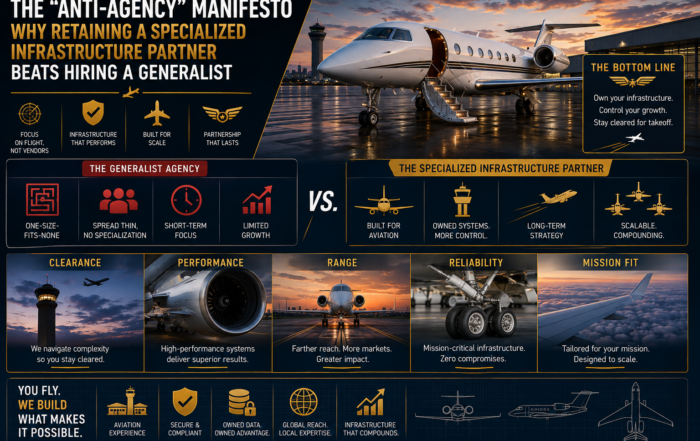
Private Aviation Marketing Strategy
Private Aviation Digital Marketing Strategy Guide
A private aviation digital marketing strategy should combine SEO, GEO, AI search optimization, Google Ads, Meta Ads, route pages, aircraft content, privacy messaging, conversion psychology, CRM tracking, and speed-to-lead systems so aviation companies can attract better qualified UHNW buyers.
Private aviation buyers do not search like low-ticket consumers. Instead, they research routes, aircraft fit, privacy, convenience, airport access, luggage, family needs, and time savings before they inquire. Therefore, aviation companies need a full authority system, not only a beautiful website.
Additionally, AI search now changes how buyers discover aviation providers. Consequently, private aviation brands must build content that human buyers, Google, and AI answer engines can understand.
At Infinite Media Resources, we build private aviation growth systems that connect visibility, conversion, paid acquisition, and CRM follow-up into one owned digital asset.
Private Aviation Digital Marketing Requires More Than a Luxury Website
Direct Answer: Private aviation digital marketing works best when SEO, GEO, AI search, route content, aircraft pages, paid ads, landing pages, CRM tracking, and conversion psychology operate as one system. Therefore, aviation companies should build authority around how UHNW buyers actually search, compare, and inquire.
Many aviation websites look premium. However, they fail to answer the questions that serious buyers ask before they contact a provider. As a result, those websites may attract traffic but produce weak lead quality.
Instead, a strong strategy connects buyer psychology with digital infrastructure. It helps the right people find the company, trust the company, and take the next step with less uncertainty.
Why Private Aviation Needs a Full Digital Marketing System
Direct Answer: Private aviation needs a full digital marketing system because high-value buyers move through research, comparison, trust evaluation, route planning, and inquiry before they become sales opportunities.
A single service page cannot support the full buyer journey. Additionally, a generic contact page usually asks for trust before it creates value. Therefore, aviation companies need a connected system that includes search visibility, answer-engine visibility, paid traffic, landing pages, and follow-up workflows.
The strongest systems include:
- SEO authority pages
- GEO and AI-search pages
- route demand content
- aircraft-specific pages
- airport authority pages
- privacy and buyer psychology content
- Google Ads landing pages
- Meta retargeting campaigns
- CRM tracking
- speed-to-lead workflows
Consequently, the company builds an owned acquisition engine instead of depending only on referrals, brokers, or rented traffic.
The Private Aviation Buyer Journey
Direct Answer: Private aviation buyers often start with quiet research, then compare routes, aircraft, providers, privacy, timing, and trust signals before they inquire.
UHNW buyers, executive assistants, family offices, and travel coordinators often perform research before a principal speaks with anyone. Therefore, the website must answer questions clearly before the lead form.
Buyer questions often include:
- Which aircraft fits this route?
- How much time does private aviation save?
- Which airport is most convenient?
- Can pets travel privately?
- How much luggage fits?
- Can this aircraft handle mountain airports?
- How private is the process?
- What happens after I inquire?
Additionally, these buyers expect fast, professional response. Consequently, marketing and sales must work together.
Private Aviation SEO
Direct Answer: Private aviation SEO helps charter companies, brokers, aircraft management firms, and aviation brands rank for routes, aircraft, airports, buyer questions, and high-intent service searches.
SEO should not rely only on broad keywords like “private jet charter.” Although those searches matter, private aviation buyers often search with deeper intent. Therefore, a strong SEO strategy must build topical authority across the full decision process.
Core SEO assets include:
- private jet charter SEO pages
- local airport authority pages
- route demand pages
- aircraft comparison pages
- buyer-question pages
- privacy content
- conversion psychology pages
- lead generation pages
As a result, the website can rank for more than one broad service term. It can also capture long-tail searches that often convert better.
GEO and AI Search Optimization
Direct Answer: GEO helps private aviation companies appear in AI-generated answers when buyers ask questions about routes, aircraft, airports, privacy, time savings, and provider selection.
AI search rewards clear structure. Therefore, aviation pages should use direct answers, schema, FAQs, internal links, entity clarity, and specific buyer context.
GEO-ready content should answer questions such as:
- What is the best jet for London to Dubai?
- Can a Global 8000 fly London to the Maldives?
- Which aircraft works best for Aspen?
- How do private jet buyers search online?
- How does private aviation save time?
- Why do UHNW buyers care about privacy?
Additionally, AI search can summarize answers before the buyer clicks. Consequently, every page must provide clear, quotable answers while still guiding visitors toward a useful next step.
Route Demand Pages
Direct Answer: Route demand pages attract high-intent buyers because they match the specific private flight missions people actually research.
A route page should explain more than city names. Instead, it should answer why the route matters, which buyers search it, which aircraft fit, what time friction exists, and what next step makes sense.
Strong route pages include:
- buyer intent
- airport context
- aircraft-fit guidance
- time savings
- privacy considerations
- luggage and passenger needs
- seasonal demand
- route review CTA
Consequently, route pages can support SEO, GEO, paid ads, retargeting, and conversion.
Aircraft Marketing Pages
Direct Answer: Aircraft marketing pages help aviation companies capture buyers who compare jets before they inquire.
Many buyers research aircraft because they want confidence before they contact a provider. Therefore, aircraft pages should explain use cases, passenger needs, luggage, range, comfort, speed, and route fit.
Aircraft pages should not read like spec sheets. Instead, they should explain what the aircraft helps the buyer accomplish.
- Gulfstream G650 for long-range executive travel
- Challenger 350 for super-midsize flexibility
- Phenom 300 for efficient regional travel
- Citation X for speed-sensitive missions
- Legacy 500 for comfort and modern midsize travel
Additionally, aircraft pages can support route pages, GEO pages, paid ads, and retargeting audiences.
Google Ads and Meta Ads
Direct Answer: Paid ads work best for private aviation when campaigns match buyer intent and send traffic to dedicated conversion pages.
Google Ads can capture active demand. Meanwhile, Meta Ads can nurture warm buyers who research quietly before they inquire. Therefore, paid strategy should connect to SEO and landing pages instead of operating alone.
Campaigns should separate:
- route searches
- airport searches
- urgent charter searches
- aircraft-fit searches
- executive travel searches
- privacy-focused searches
- retargeting audiences
However, paid ads should not send traffic to a generic homepage. Instead, each campaign should match a page built for that intent.
Conversion Psychology
Direct Answer: Private aviation conversion improves when pages reduce uncertainty, build trust, explain the next step, and match the buyer’s real motivation.
Many aviation websites ask visitors to “contact us” before creating enough value. However, high-ticket buyers need clarity first. Therefore, conversion pages should explain what the buyer receives after inquiry.
Strong conversion elements include:
- direct-answer summary
- route or service context
- trust-building proof
- privacy and discretion language
- aircraft-fit guidance
- fast-response expectation
- value-based CTA
- CRM-backed follow-up
Consequently, the form feels like a useful next step instead of a risky contact request.
Privacy and Trust Messaging
Direct Answer: Privacy messaging attracts higher-quality private aviation buyers because many UHNW clients value discretion, confidentiality, and reduced exposure more than visible luxury.
Private aviation buyers may include executives, celebrities, athletes, family offices, investors, founders, and public figures. Therefore, privacy content should address confidential scheduling, private terminals, family protection, and professional inquiry handling.
Additionally, privacy messaging differentiates the company from brands that rely only on aircraft photography.
Time, Convenience, and Control
Direct Answer: Time, convenience, and control often drive private aviation buying decisions more than generic luxury messaging.
Private aviation buyers purchase fewer wasted hours, faster movement, more flexible schedules, and better control over their day. Therefore, marketing should explain the value of time returned.
Strong time-based messaging includes:
- reduced airport friction
- schedule control
- productive travel time
- family convenience
- direct routing
- less uncertainty
- faster response
As a result, the marketing speaks to the real value behind private aviation.
CRM and Speed-to-Lead
Direct Answer: CRM and speed-to-lead matter because high-value aviation buyers judge service quality from the first response.
If an aviation company responds slowly, the buyer may assume the service experience will also feel slow. Therefore, every marketing system should include lead alerts, call tracking, source tracking, and follow-up workflows.
Strong CRM systems include:
- instant lead alerts
- route-specific lead source tagging
- call tracking
- missed-call recovery
- CRM assignment rules
- follow-up reminders
- qualified opportunity reporting
Consequently, marketing creates measurable sales opportunities instead of anonymous traffic.
Private Aviation Digital Marketing Strategy Framework
Direct Answer: A complete private aviation strategy connects visibility, authority, conversion, paid acquisition, and lead handling.
| Strategy Area | Purpose | Buyer Impact |
|---|---|---|
| SEO | Rank for routes, aircraft, airports, and services | Better discovery |
| GEO | Appear in AI-generated answers | Stronger answer visibility |
| Route Pages | Capture mission-specific demand | More relevant inquiries |
| Aircraft Pages | Support aircraft-fit research | Higher buyer confidence |
| Paid Ads | Capture active demand quickly | Faster pipeline creation |
| Conversion Pages | Turn traffic into qualified inquiries | Less uncertainty |
| CRM Workflows | Track and respond to leads | Better experience |
Recommended Private Aviation Marketing Build Order
Direct Answer: The best build order starts with core service pages, then expands into SEO, GEO, route content, aircraft pages, paid landing pages, and CRM workflows.
Strong build order:
- Private aviation service pages
- Core SEO and GEO pages
- Buyer psychology pages
- Route demand pages
- Aircraft marketing pages
- Airport authority pages
- Paid ad landing pages
- Retargeting funnels
- CRM workflows
- Reporting and optimization
Additionally, every new page should support the broader authority cluster. Consequently, the website grows stronger over time.
How IMR Builds Private Aviation Digital Marketing Systems
Direct Answer: IMR builds private aviation digital marketing systems by connecting SEO, GEO, AI search, paid ads, route content, aircraft pages, conversion psychology, CRM tracking, and lead generation.
First, we map buyer intent. Next, we build authority pages around services, routes, aircraft, privacy, time, and buyer questions. Then, we connect those pages to paid ads, retargeting, landing pages, and CRM workflows.
Additionally, we structure pages for AI search through direct answers, schema, FAQs, and internal links. Therefore, your aviation company can build visibility across search engines and answer engines.
Finally, we optimize around qualified opportunities, not vanity metrics. As a result, the system supports growth your team can actually measure.
Proof and Validation
Direct Answer: Digital marketing works best when visibility, conversion, and follow-up operate as one system.
One IMR lead generation campaign produced 415 leads in 30 days. Additionally, a seven-day optimization phase generated 123 leads at approximately $57.86 per lead. While private aviation follows a different sales cycle, the same principle applies. Better structure creates stronger lead quality, clearer tracking, and better conversion performance.
Frequently Asked Questions
What is private aviation digital marketing?
Private aviation digital marketing is the strategy of attracting aviation buyers through SEO, GEO, AI search, paid ads, route pages, aircraft pages, landing pages, CRM tracking, and conversion systems.
Why does private aviation need SEO?
SEO helps aviation companies rank for high-intent searches around routes, aircraft, airports, services, and buyer questions.
What is GEO for private aviation?
GEO helps aviation companies appear in AI-generated answers by structuring content around direct buyer questions, schema, FAQs, and clear authority signals.
Do Google Ads work for private aviation?
Yes. Google Ads can work when campaigns target high-intent searches and send traffic to dedicated landing pages.
Do Meta Ads work for private aviation?
Yes. Meta Ads can support retargeting and buyer education when messaging focuses on privacy, time savings, convenience, and route value.
What pages should private aviation companies build first?
They should start with service pages, SEO and GEO pages, buyer psychology pages, route pages, aircraft pages, and paid ad landing pages.
Why does speed-to-lead matter?
Speed matters because high-value buyers often compare providers quickly and judge service quality from the first response.
What is the best next step?
The best next step is a Private Aviation Growth Review so IMR can evaluate SEO, GEO, paid ads, content, conversion paths, CRM tracking, and lead quality.
Build Your Private Aviation Digital Marketing System
Direct Answer: The next step is to evaluate your SEO, GEO, AI search visibility, paid ads, route content, aircraft pages, conversion paths, CRM workflows, and lead quality.
If your aviation company wants stronger authority, better qualified inquiries, and a scalable acquisition system your team can own, IMR can help build the full private aviation digital marketing system.