Private Aviation Website Conversion Guide
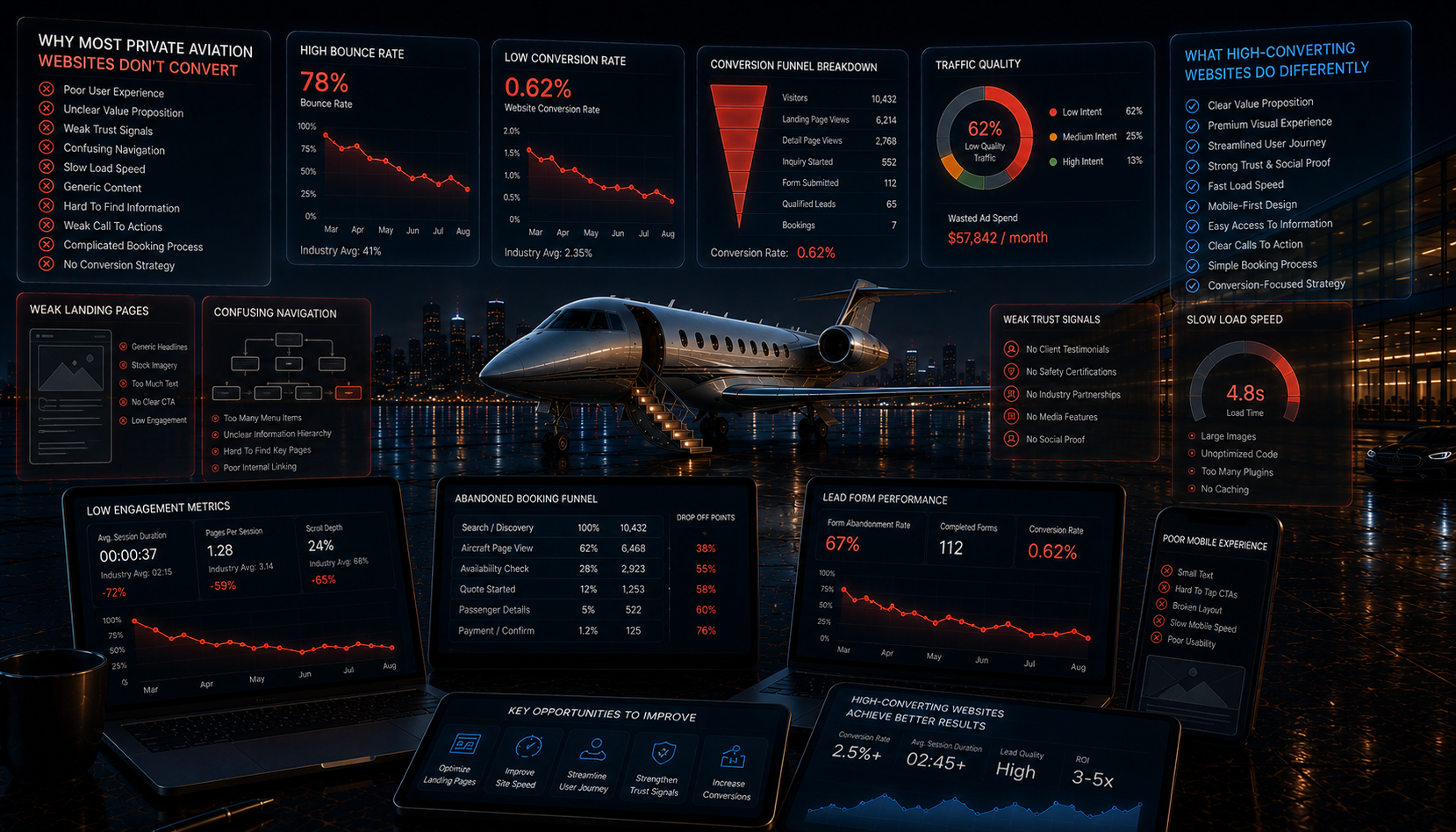
Why Most Private Aviation Websites Don’t Convert
Most private aviation websites do not convert because they focus too heavily on generic luxury branding instead of buyer psychology, route intent, trust, urgency, operational clarity, and conversion structure. Therefore, the website may look expensive while still failing to generate qualified charter inquiries.
Many private aviation websites rely on large jet images, vague luxury messaging, and generic “Contact Us” buttons. However, high-net-worth buyers rarely convert because a website simply looks luxurious. Instead, they convert when the site reduces uncertainty, answers operational questions, creates trust, and explains the next step clearly.
Additionally, many aviation websites fail because they ignore search intent entirely. Buyers often search for routes, airport options, aircraft fit, luggage concerns, travel timing, pet policies, and operational limitations. Consequently, a generic homepage cannot answer the questions that drive serious charter decisions.
At Infinite Media Resources, we help private aviation companies build websites designed around buyer behavior, SEO, GEO, AI search visibility, conversion strategy, lead quality, CRM integration, and long-term authority building.
Why Most Private Aviation Websites Don’t Convert
Direct Answer: Most private aviation websites fail to convert because they prioritize appearance over buyer psychology, operational clarity, route intent, trust signals, lead qualification, and conversion structure. Therefore, the website attracts attention without producing serious charter conversations.
Private aviation buyers want clarity. They want to understand whether the operator can solve their travel problem efficiently. However, many websites force buyers through vague navigation and generic branding instead of answering practical concerns.
Additionally, buyers often compare multiple providers before they inquire. Consequently, the website must build trust quickly while reducing uncertainty throughout the experience.
Why Most Private Aviation Websites Fail
Direct Answer: Private aviation websites usually fail because they look visually impressive while lacking strong conversion infrastructure. Therefore, they fail to guide buyers toward action.
Many aviation sites behave more like digital brochures than acquisition systems. However, a high-performing website should actively support:
- Lead generation
- Buyer education
- Trust building
- Route discovery
- Airport research
- Aircraft comparisons
- CRM qualification
- SEO and GEO visibility
Consequently, websites without conversion structure often waste paid traffic, SEO traffic, and referral traffic.
The Problem With Generic Luxury Branding
Direct Answer: Generic luxury branding hurts conversion because buyers care more about convenience, flexibility, and operational trust than vague status imagery. Therefore, the website should communicate outcomes instead of only lifestyle aesthetics.
Many aviation websites use the same visual approach:
- Private jet on runway
- Luxury lifestyle photos
- Vague “elite experience” messaging
- Minimal operational detail
However, buyers often care more about:
- Airport access
- Flight timing
- Aircraft fit
- Passenger comfort
- Pet travel
- Luggage capacity
- Travel flexibility
- Privacy
Consequently, websites convert better when they focus on solving travel friction instead of displaying generic luxury symbolism.
No Buyer Intent Match
Direct Answer: Most aviation websites fail because the content does not match the buyer’s search intent. Therefore, visitors leave before they inquire.
Buyers rarely search only for “private jet charter.” Instead, they search for specific travel problems and operational questions.
Examples include:
- Private jet from Teterboro to Aspen
- Pet-friendly private jet charter
- Best jet for ski equipment
- Private jet for business travel
- Can a jet land near my estate?
- Flight time comparisons
- Cabin noise comparisons
Consequently, websites need question-led pages, route pages, airport pages, and aircraft comparison pages to support real buyer intent.
Weak Calls-to-Action
Direct Answer: Weak CTAs reduce private aviation conversions because buyers need a clear next step and low-friction engagement path. Therefore, generic “Contact Us” buttons often underperform.
Buyers may not feel ready to request a quote immediately. However, they may respond well to:
- Private route reviews
- Aircraft-fit guidance
- Airport access consultations
- Travel timing reviews
- Mission-specific recommendations
Additionally, the CTA should explain what happens after submission. Consequently, the buyer feels less uncertainty.
Trust and Authority Problems
Direct Answer: Private aviation websites fail when they ask for trust before proving expertise. Therefore, websites need authority-building content and operational clarity.
Trust can come from:
- Educational content
- Route expertise
- Operational detail
- Aircraft comparisons
- FAQ content
- Direct-answer pages
- SEO authority
- AI-search visibility
Additionally, buyers often trust companies that explain complex travel details clearly. Consequently, educational content becomes a major conversion asset.
No Route or Mission Content
Direct Answer: Most aviation websites lack route-specific and mission-specific content. Therefore, they miss high-intent search traffic and qualified buyers.
Route pages and buyer-question pages help websites rank for specific searches while answering operational concerns directly.
Examples include:
- Teterboro to Van Nuys
- Aspen winter charter access
- Pet-friendly international flights
- Golf and ski luggage capacity
- Transatlantic flight timing
Consequently, aviation websites become more useful, more searchable, and more conversion-focused.
Mobile Conversion Failures
Direct Answer: Mobile conversion failures happen because many aviation websites prioritize desktop aesthetics over mobile usability. Therefore, buyers struggle to navigate, inquire, or call efficiently.
Private aviation buyers often research while traveling. Consequently, mobile performance matters heavily.
Common mobile problems include:
- Slow load speed
- Overly large images
- Hard-to-use menus
- Poor CTA placement
- Weak mobile forms
- Difficult call access
As a result, mobile optimization directly impacts lead generation performance.
Slow Follow-Up and CRM Problems
Direct Answer: Many aviation websites fail because leads enter weak CRM systems with slow follow-up. Therefore, good traffic still produces poor outcomes.
Private aviation buyers often choose providers who respond quickly and professionally. However, many websites generate inquiries without structured response systems.
Strong systems should track:
- Lead source
- Route intent
- Audience type
- Inquiry quality
- Response speed
- Sales outcomes
Consequently, CRM structure becomes part of website conversion strategy.
SEO, GEO, and AI Search Problems
Direct Answer: Most aviation websites fail because they lack SEO authority, GEO structure, and AI-search visibility. Therefore, they miss buyers during research stages.
Many websites only focus on branding. However, modern aviation buyers search for answers long before they contact a provider.
Consequently, websites need:
- Question-led content
- Route pages
- Airport content
- Direct answers
- Structured schema
- Internal linking
- AI-search optimization
Additionally, GEO and AI-search visibility help brands appear in AI-generated answers and buyer research workflows.
Private Aviation Website Conversion Table
Direct Answer: Strong private aviation websites combine buyer psychology, operational clarity, SEO visibility, and conversion structure.
Website Area |
What Converts Better |
Why It Matters |
|---|---|---|
| Messaging | Operational value and convenience | Matches buyer priorities |
| Content Structure | Question-led and route-specific pages | Supports search intent |
| CTAs | Low-friction consultation offers | Improves inquiry quality |
| SEO and GEO | Authority-focused educational content | Increases visibility and trust |
| Mobile Experience | Fast and simplified navigation | Improves mobile conversion |
| CRM Integration | Fast lead routing and tracking | Improves follow-up performance |
How to Fix a Private Aviation Website
Direct Answer: Fix a private aviation website by aligning buyer intent, SEO, GEO, conversion structure, route content, authority content, CRM tracking, and follow-up systems into one acquisition strategy.
Additionally, aviation websites should:
- Build route-specific pages
- Create aircraft comparison pages
- Answer buyer questions directly
- Improve CTA structure
- Use mobile-first optimization
- Integrate CRM tracking
- Improve AI-search visibility
- Retarget visitors effectively
Consequently, the website becomes an active lead-generation asset instead of a passive digital brochure.
How IMR Builds Private Aviation Websites
Direct Answer: IMR builds private aviation websites around buyer psychology, route intent, SEO, GEO, AI search visibility, CRM integration, conversion strategy, and long-term authority building.
First, we map how buyers search and evaluate charter options. Next, we build structured website architecture around routes, airports, aircraft, and buyer questions. Then, we integrate conversion-focused landing pages, tracking systems, and SEO/GEO authority.
Additionally, we connect the website into Meta advertising, Google Ads, retargeting, and CRM workflows. Consequently, the website becomes part of a scalable acquisition system.
Proof and Validation
Direct Answer: Websites convert better when traffic, landing pages, offers, CRM systems, and follow-up processes operate together. Therefore, strong acquisition systems outperform visually attractive but disconnected websites.
Our broader lead generation systems demonstrate how structured acquisition architecture improves conversion performance. For example, one of our Meta advertising systems generated 415 leads in 30 days for a home exterior company. Additionally, a seven-day optimization phase generated 123 leads with an estimated $57.86 average cost per lead.
Although private aviation requires different buyer psychology and higher qualification standards, the same principle applies. Better systems create better opportunities.
Frequently Asked Questions About Private Aviation Website Conversion
Direct Answer: These answers explain why private aviation websites fail to convert and how aviation companies can improve website performance.
Why do most private aviation websites not convert?
Most aviation websites fail because they focus on luxury aesthetics instead of buyer intent, operational clarity, SEO, trust, and conversion strategy.
What should a private aviation website focus on?
It should focus on route intent, operational value, trust, authority, buyer education, lead quality, and clear next steps.
Do route pages help private aviation conversions?
Yes. Route-specific pages improve search relevance, buyer trust, and conversion quality.
Does SEO help private aviation websites convert?
Yes. SEO and GEO help aviation websites attract buyers earlier in the research process.
Why are generic luxury websites weak performers?
They fail because buyers want convenience, flexibility, and operational confidence more than vague luxury messaging.
What is the best next step?
The best next step is a Private Aviation Website Conversion Review so IMR can evaluate your website structure, SEO, GEO, landing pages, and lead-generation systems.
Review Your Private Aviation Website Conversion Strategy
Direct Answer: The next step is to review your current website structure, buyer journey, route content, SEO authority, GEO structure, mobile experience, CRM tracking, and lead qualification process. Therefore, IMR can identify where your website loses high-value charter opportunities.
If your aviation company wants stronger website conversion performance, better qualified leads, and a long-term authority system your team can own, a structured private aviation website strategy can become a major acquisition advantage.