Why Speed Matters in Private Aviation Sales
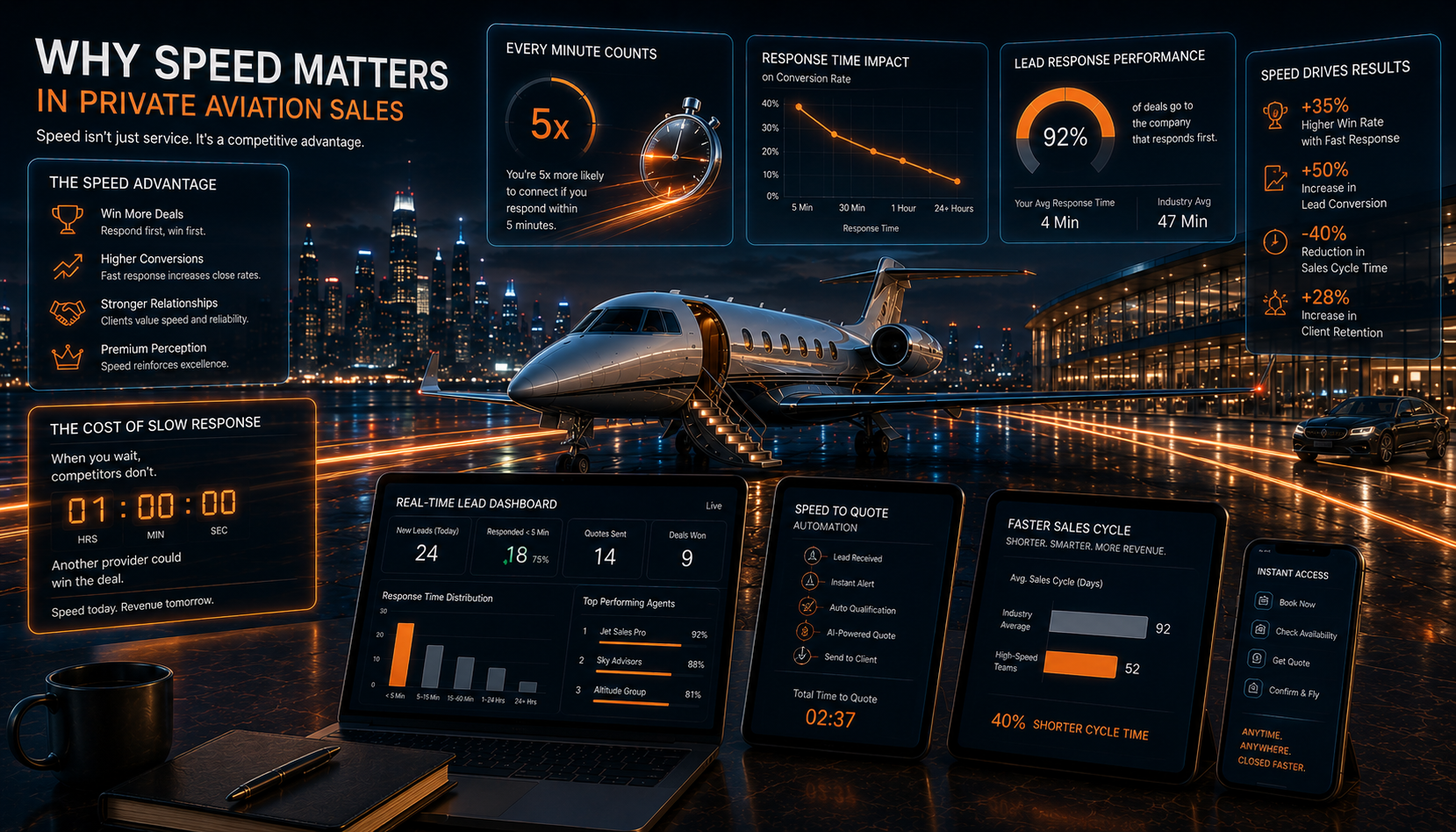
Speed matters in private aviation sales because buyers often inquire when timing, route access, aircraft fit, and urgency already matter. Therefore, the company that responds fastest with useful guidance often earns the first real sales conversation.
Private aviation buyers do not submit forms casually when they have a serious route, event, business trip, family need, or last-minute travel issue. Instead, they want clarity quickly. Consequently, slow follow-up creates doubt, lowers trust, and gives competitors time to win the conversation.
Additionally, private aviation sales involve high-value decisions and high expectations. Buyers expect premium service before they ever step onto an aircraft. Therefore, response speed becomes part of the brand experience.
At Infinite Media Resources, we help private aviation companies build lead generation, CRM, SEO, GEO, AI search, Google Ads, Meta ads, and follow-up systems that turn traffic into faster, better-qualified sales conversations.
Why Speed Matters in Private Aviation Sales
Direct Answer: Speed matters in private aviation sales because serious buyers often compare multiple providers quickly. Therefore, fast, helpful follow-up can increase trust, reduce buyer uncertainty, protect lead quality, and improve the chance of winning the charter conversation.
Private aviation buyers expect fast service. If a company responds slowly before the sale, the buyer may question how responsive the company will be during travel.
Additionally, many buyers submit inquiries while actively planning a trip. Consequently, delays can turn a strong lead into a missed opportunity.
Why Speed Matters So Much
Direct Answer: Speed matters because private aviation buyers often need answers before they can make decisions. Therefore, fast response times help your team control the conversation before competitors do.
A buyer may need aircraft guidance, route feasibility, availability, passenger capacity, pet support, luggage clarity, or airport advice. However, if your team waits too long, the buyer may already speak with another company.
Consequently, speed-to-lead should not be treated as an operations detail. Instead, it should become a core sales advantage.
Private Aviation Buyer Psychology
Direct Answer: Private aviation buyers associate speed with competence. Therefore, fast follow-up signals professionalism, confidence, organization, and premium service.
High-value buyers want to feel handled. They do not want confusion, delay, or vague responses. Additionally, many buyers delegate research to assistants, travel managers, or family office staff. Those researchers need answers quickly so they can report options back to the decision-maker.
Therefore, fast response helps your company become the easy choice.
Urgency and Route Timing
Direct Answer: Many private aviation inquiries include built-in urgency because buyers search around routes, dates, aircraft needs, and availability. Therefore, delayed responses reduce conversion potential.
A buyer may need a same-week departure, a peak holiday route, an event flight, or an urgent business trip. Additionally, aircraft availability can change quickly.
Consequently, your sales process should prioritize fast route review and next-step clarity.
Speed Builds Trust Before the Sale
Direct Answer: Fast response builds trust because private aviation buyers judge the future service experience from the first interaction. Therefore, the sales process becomes part of the brand promise.
If a buyer receives a fast, thoughtful response, they feel more confident. However, if the response feels slow or generic, they may assume the provider lacks urgency.
Additionally, speed should not mean rushed. The response must be fast and useful. Therefore, the strongest teams combine speed with context.
Speed Protects Lead Quality
Direct Answer: Speed protects lead quality because buyer interest fades quickly after inquiry. Therefore, fast follow-up helps preserve intent while the buyer still remembers the reason they reached out.
Leads lose value when they sit too long. The buyer may forget the page they viewed, speak with another provider, or move on to a different travel solution.
Consequently, fast response helps maintain context and momentum.
CRM and Follow-Up Systems
Direct Answer: CRM systems help private aviation teams respond faster by routing leads, showing source data, tracking buyer intent, and organizing follow-up. Therefore, CRM structure directly affects sales speed.
A strong CRM should show:
- Lead source
- Route request
- Travel timeline
- Passenger count
- Service interest
- Ad or SEO source
- Follow-up status
- Sales outcome
Additionally, automated alerts can help sales teams respond before leads go cold.
Paid Traffic Needs Fast Response
Direct Answer: Paid traffic needs fast response because every delayed inquiry wastes ad spend. Therefore, Google Ads and Meta campaigns must connect directly to fast follow-up workflows.
Google Ads often captures active demand. Meanwhile, Meta ads can create awareness and retargeting demand. However, both channels lose value when leads enter slow sales processes.
Consequently, paid traffic should always connect to call tracking, CRM routing, and qualified response workflows.
SEO, GEO, and AI Search Leads Still Need Speed
Direct Answer: SEO, GEO, and AI search leads still need fast response because organic buyers often arrive with high trust and strong intent. Therefore, slow follow-up wastes authority-driven demand.
A buyer who finds your company through a detailed route page or AI-search answer may already trust your expertise. However, that trust can fade if your sales response does not match the quality of the content.
Therefore, authority systems and sales systems must work together.
Private Aviation Speed-to-Lead Table
Direct Answer: Faster response improves the buyer experience because it reduces uncertainty and keeps the conversation active.
Response Area |
What Fast Teams Do |
Why It Matters |
|---|---|---|
| New Inquiry | Respond quickly with context | Protects buyer momentum |
| Route Request | Ask only necessary mission questions | Reduces friction |
| Aircraft Fit | Provide useful guidance early | Builds authority |
| CRM Routing | Send leads to the right person fast | Prevents missed opportunities |
| Follow-Up | Use structured reminders | Keeps deals moving |
| Tracking | Measure lead source and outcome | Improves marketing decisions |
Common Follow-Up Mistakes
Direct Answer: Common follow-up mistakes include slow replies, generic responses, poor CRM routing, weak qualification, and no source tracking. Therefore, many aviation companies lose leads they already paid to generate.
- Waiting too long to respond
- Sending generic replies
- Failing to mention the buyer’s route
- Not tracking lead source
- Not assigning ownership quickly
- Asking questions the form already answered
- No follow-up reminders
- No CRM outcome tracking
Consequently, sales speed depends on process design, not only effort.
How to Improve Sales Speed
Direct Answer: Improve private aviation sales speed by connecting lead forms, call tracking, CRM routing, automated alerts, lead qualification, and follow-up workflows into one system.
Additionally, your team should create response templates that still feel personal. For example, the first reply should reference the buyer’s route, timeline, or aircraft need.
Strong speed improvements include:
- Instant CRM alerts
- Call tracking
- Lead source tagging
- Route-specific forms
- Fast qualification workflows
- Sales task reminders
- Missed-call recovery
- Follow-up automation
How IMR Builds Faster Private Aviation Sales Systems
Direct Answer: IMR builds faster private aviation sales systems by connecting lead generation, CRM routing, paid ads, SEO, GEO, AI search visibility, landing pages, and follow-up workflows.
First, we map where leads come from. Next, we identify where response speed breaks down. Then, we build better forms, tracking, CRM routing, and conversion paths.
Additionally, we align marketing and sales so each lead arrives with better context. Consequently, your team can respond faster and smarter.
Proof and Validation
Direct Answer: Lead generation systems perform better when marketing, conversion paths, CRM routing, and sales response work together. Therefore, speed-to-lead should be treated as part of the acquisition system.
Our broader lead generation systems demonstrate how structure improves performance. For example, one home exterior campaign generated 415 leads in 30 days. Additionally, a seven-day optimization phase generated 123 leads with an estimated $57.86 average cost per lead.
Although private aviation uses a different buyer journey, the same principle applies. Better systems create better conversations, and faster response protects those opportunities.
Frequently Asked Questions About Speed in Private Aviation Sales
Direct Answer: These answers explain why fast follow-up improves private aviation lead conversion and buyer trust.
Why does speed matter in private aviation sales?
Speed matters because buyers often compare providers quickly and expect premium response quality before they trust a company.
Does slow follow-up hurt charter lead conversion?
Yes. Slow follow-up can reduce trust, lose buyer momentum, and give competitors time to win the conversation.
Should private aviation companies use CRM automation?
Yes. CRM automation can improve routing, alerts, follow-up reminders, and lead source tracking.
Do paid ad leads need faster response?
Yes. Paid ad leads cost money, so slow response can waste ad spend and reduce campaign ROI.
Does SEO lead generation still need fast follow-up?
Yes. SEO and GEO leads often arrive with strong trust, so fast follow-up helps preserve that momentum.
What is the best next step?
The best next step is a Private Aviation Sales Speed Review so IMR can evaluate your lead routing, CRM, follow-up, and conversion system.
Review Your Private Aviation Sales Speed
Direct Answer: The next step is to review your lead sources, form flow, CRM routing, response speed, follow-up process, paid ad traffic, SEO/GEO leads, and sales outcomes. Therefore, IMR can identify where your sales process loses high-value charter opportunities.
If your aviation company wants better lead conversion, faster response systems, and stronger buyer trust, a private aviation sales speed strategy can become a major competitive advantage.