Private Aviation Route Marketing
Scottsdale To Aspen Private Aviation
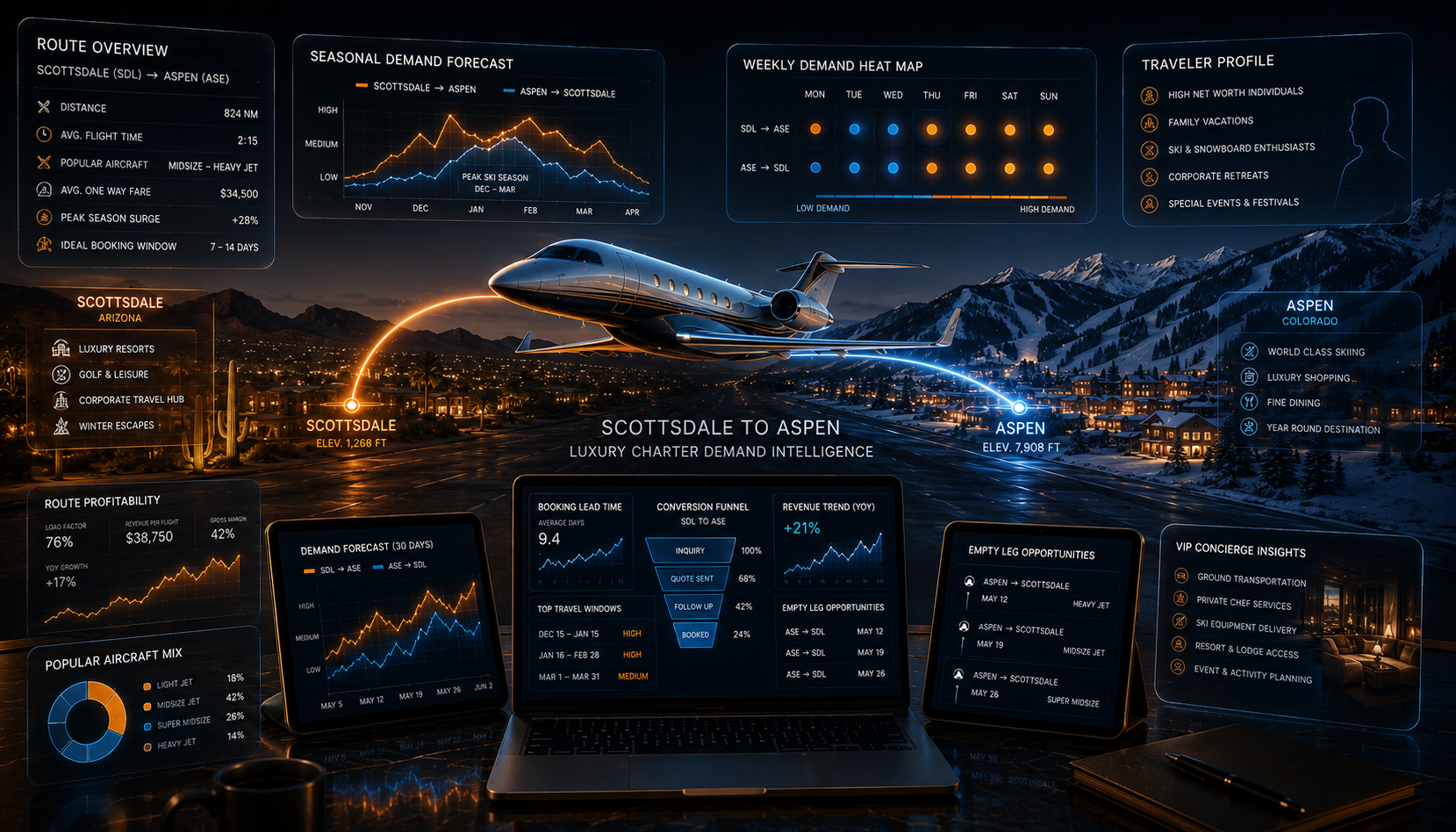
Scottsdale to Aspen private aviation creates strong search and lead generation opportunities because the route connects luxury desert travel, seasonal mountain demand, executive movement, ski travel, golf travel, and high-net-worth private aviation buyers.
The Scottsdale to Aspen corridor represents one of the strongest luxury seasonal private aviation routes in the western United States. Buyers often search around ski access, mountain airport performance, winter schedules, luxury resort travel, family trips, golf escapes, and executive flexibility. Therefore, aviation companies should not treat this route like a generic charter page.
Instead, they should build a structured route authority asset. This asset should answer buyer questions, support SEO and GEO visibility, create AI-search clarity, connect to paid ads, and guide visitors toward qualified charter conversations.
At Infinite Media Resources, we build private aviation growth systems that connect route content, aircraft pages, Google Ads, Meta retargeting, SEO, GEO, CRM tracking, and high-ticket lead generation into one owned acquisition engine.
Scottsdale to Aspen Private Aviation Creates High-Intent Route Opportunity
Direct Answer: Scottsdale to Aspen private aviation creates valuable marketing opportunity because buyers searching this route often have clear luxury travel intent, strong purchasing power, seasonal timing needs, and repeat private aviation behavior. Therefore, private aviation companies should build route-specific SEO, GEO, paid ads, retargeting, aircraft-fit content, and landing pages around this corridor.
This route connects Scottsdale luxury travel demand with Aspen mountain access, ski travel, executive movement, luxury hospitality, and seasonal second-home ownership. Additionally, it attracts executives, family offices, athletes, luxury vacation travelers, and high-frequency private aviation users.
Consequently, the route deserves more than a short service mention. It should become a structured content asset that answers practical questions, explains aircraft fit, supports AI-search visibility, and moves qualified buyers toward a route review.
Why This Route Matters
Direct Answer: The Scottsdale to Aspen route matters because it connects two major luxury lifestyle markets with consistent seasonal private aviation demand.
Scottsdale attracts high-net-worth travelers who prioritize golf, luxury resorts, business flexibility, winter warmth, and executive convenience. Meanwhile, Aspen attracts ski travelers, second-home owners, luxury leisure buyers, corporate travelers, and high-end hospitality demand.
Therefore, this route naturally creates strong search demand and premium charter opportunities. A prospect may search for mountain-airport capable aircraft, ski luggage concerns, winter weather flexibility, or nonstop luxury travel options.
However, many aviation websites fail to capture this demand because they publish broad “private jet charter” pages. Instead, a strong route page should answer the exact mission the buyer wants to understand.
Buyer Intent Behind the Route
Direct Answer: Buyer intent behind this route often centers on luxury seasonal travel, ski access, family convenience, mountain airport capability, luggage flexibility, and premium scheduling control.
Strong search intent may appear in searches such as:
- Scottsdale to Aspen private jet
- private jet from Scottsdale to Aspen
- best jet for Aspen ski trips
- private charter Scottsdale to Aspen
- mountain airport private jet
- private jet for ski travel
- Aspen capable private jet
- Scottsdale luxury ski travel
- private flight for golf and ski travel
- private aviation to Aspen from Arizona
Additionally, some buyers search indirectly. They may ask which aircraft can safely access Aspen, how much ski equipment fits onboard, or how weather impacts scheduling. Consequently, a route-demand page should answer all of those concerns before the form.
Seasonal Luxury Travel Demand
Direct Answer: Seasonal luxury demand increases route searches because Scottsdale and Aspen attract opposite-season lifestyle traffic throughout the year.
Buyers often move between Scottsdale and Aspen for winter ski seasons, summer mountain escapes, golf travel, luxury resort stays, executive retreats, and second-home access. Therefore, aviation companies should build route content around those seasonal patterns.
Additionally, many buyers value convenience more than luxury branding alone. They want fast airport access, reduced friction, ski-equipment flexibility, weather planning support, and direct scheduling control. As a result, route messaging should focus heavily on convenience and operational confidence.
Consequently, route pages can support SEO, Google Ads, Meta retargeting, and CRM workflows simultaneously.
Aspen Airport and Mountain Flight Considerations
Direct Answer: Aspen flight planning requires additional operational consideration because mountain airports create performance, weather, runway, and altitude challenges that affect aircraft selection and scheduling.
Buyers researching Aspen flights often care about aircraft capability and reliability. Therefore, route pages should explain why some aircraft perform better in mountain conditions than others.
Important route considerations include:
- high-altitude airport performance
- winter weather conditions
- shorter runway limitations
- ski equipment storage
- passenger payload flexibility
- mountain-approach experience
- backup airport planning
Additionally, buyers appreciate operational transparency. Instead of hiding route realities, strong aviation companies explain how they manage mountain logistics professionally. Consequently, trust increases before the first conversation.
Route SEO Strategy
Direct Answer: Route SEO helps private aviation companies rank for high-intent city-pair and mountain-travel searches. Therefore, the page should target the route, the buyer problem, and related travel questions.
Strong route SEO should include:
- direct-answer sections
- airport and mountain context
- route intent phrases
- aircraft-fit guidance
- ski travel considerations
- seasonal luxury travel concerns
- family and luggage flexibility
- internal links to aviation authority pages
However, keyword repetition should stay natural. Instead of repeating the exact phrase too often, the page should use related language such as Arizona-to-Aspen private flight, Scottsdale ski charter demand, mountain luxury aviation, and Aspen-capable aircraft.
As a result, the page can rank without feeling stuffed or unnatural.
GEO and AI Search Visibility
Direct Answer: GEO and AI Search Optimization help route pages appear in AI-generated answers when buyers ask about ski travel, mountain airport access, luxury private flights, and Aspen-capable aircraft.
AI systems need clear structure. Therefore, route pages should include direct answers, FAQs, schema, internal links, and precise explanations. Additionally, the page should identify airports, destinations, mountain-flight concerns, and buyer intent clearly.
For example, AI systems can better understand a page that explains route timing, ski-equipment flexibility, and aircraft categories than a generic page that only says “book now.”
Consequently, route authority supports both search visibility and AI citation opportunities.
Aircraft-Fit Content
Direct Answer: Aircraft-fit content helps route pages convert because buyers want confidence that the selected jet matches mountain-airport performance, passengers, luggage, comfort expectations, and scheduling flexibility.
For this route, buyers may compare super-midsize jets, large-cabin aircraft, and mountain-capable aircraft depending on passenger count, ski equipment, weather flexibility, and Aspen operational requirements.
Additionally, the page can support aircraft-specific internal links. For example, Challenger 350 pages may support ski-travel discussions, while Gulfstream G650 pages may support luxury long-range family travel and executive comfort discussions.
Therefore, aircraft pages should explain use cases instead of only listing specs. As a result, the buyer can make a better inquiry.
Google Ads Strategy
Direct Answer: Google Ads can capture active route demand when buyers search for Scottsdale, Aspen, ski-travel aviation, private jet charter, and mountain-airport aircraft terms.
Paid search works well for route demand because the buyer often has a clear mission. However, campaigns can waste budget when they use broad match without strong structure.
Therefore, campaigns should separate:
- city-pair searches
- mountain-airport searches
- ski-travel searches
- luxury resort travel searches
- same-week charter searches
- family luxury travel searches
- aircraft-capability searches
Additionally, ads should send traffic to dedicated route landing pages instead of generic homepages. Consequently, message match improves lead quality and conversion clarity.
Meta Retargeting Strategy
Direct Answer: Meta retargeting helps route pages convert because buyers often research luxury travel and private aviation options before they inquire.
A buyer may visit a Scottsdale to Aspen route page, compare aircraft, leave, and return later. Additionally, assistants, spouses, or family office staff may share information internally before the decision-maker acts.
Consequently, retargeting should reinforce useful angles such as:
- mountain travel convenience
- ski-trip flexibility
- family comfort
- weather planning support
- private airport convenience
- luxury resort access
- golf and ski lifestyle travel
- route review guidance
However, Meta ads should not rely only on luxury imagery. Instead, they should explain why the route reduces friction and improves scheduling flexibility. As a result, the ad feels more useful and relevant.
Landing Page Conversion Strategy
Direct Answer: A route landing page converts better when it continues the search promise, explains mountain-travel concerns clearly, qualifies the buyer, and offers a useful next step.
Instead of using a generic “Contact Us” CTA, a route page should offer a route review. This gives the visitor a clear reason to submit details. Additionally, the form should ask useful questions without creating unnecessary friction.
Helpful form fields may include:
- departure airport
- destination airport
- preferred travel date
- passenger count
- ski-equipment needs
- same-day return preferences
- best contact method
Consequently, the sales team receives better context and can respond faster with useful guidance.
Speed-to-Lead Strategy
Direct Answer: Speed-to-lead matters on this route because buyers often compare multiple providers quickly and expect premium response before they book.
Private aviation buyers judge the sales experience before they judge the flight experience. Therefore, fast follow-up creates trust. Additionally, route-specific context makes the response feel more professional.
Strong speed-to-lead systems include:
- instant CRM alerts
- route-specific lead source tagging
- call tracking
- missed-call recovery
- fast quote review workflows
- sales task reminders
- follow-up sequences
As a result, the company protects expensive paid traffic and high-value organic demand.
Scottsdale to Aspen Route Demand Content Table
Direct Answer: The strongest route strategy connects SEO, GEO, aircraft guidance, landing pages, paid ads, retargeting, and CRM tracking.
Content Asset |
Purpose |
Buyer Intent |
|---|---|---|
| Route Authority Page | Explain the Scottsdale-to-Aspen opportunity | Research and commercial |
| Aircraft Fit Pages | Help buyers compare options | Decision support |
| Mountain Travel Pages | Capture ski and luxury travel traffic | High intent |
| Google Ads Landing Pages | Convert active route searches | Immediate inquiry |
| FAQ and AI Pages | Support AI search and buyer education | Research and discovery |
| Retargeting Pages | Nurture warm route researchers | Consideration |
Lead Generation System
Direct Answer: A route-based lead generation system should combine SEO, paid ads, retargeting, landing pages, CRM tracking, and fast follow-up.
Traffic alone does not create revenue. Instead, the system must convert route interest into qualified conversations. Therefore, the page should connect every visitor action to a clear next step.
Strong systems include:
- route review funnels
- consultative landing pages
- CRM integration
- lead source tracking
- call tracking
- retargeting sequences
- qualified opportunity reporting
Furthermore, private aviation companies should judge lead generation by qualified opportunities, not raw form fills. As a result, the strategy protects sales time and improves ROI clarity.
How IMR Builds the Scottsdale to Aspen Route Demand System
Direct Answer: IMR builds route-demand systems by connecting SEO, GEO, paid ads, AI-search visibility, landing pages, CRM tracking, and lead qualification into one acquisition engine.
First, we map buyer intent around the route, airports, ski travel, mountain performance concerns, luxury hospitality demand, and seasonal movement. Next, we build content assets that match those searches. Then, we connect the traffic to conversion pages, retargeting, and follow-up workflows.
Additionally, we structure pages for AI search. We use direct answers, internal links, schema, FAQs, and clear entities. Consequently, the website becomes easier for both buyers and search systems to understand.
Finally, we focus on ownership. The goal is to build systems your aviation company can keep, use, and scale instead of depending only on referrals or rented traffic.
Proof and Validation
Direct Answer: Private aviation marketing works best when SEO, GEO, paid ads, landing pages, CRM tracking, and follow-up operate as one system.
Our broader acquisition systems demonstrate how structured strategy improves lead generation performance. For example, one Meta lead generation system generated 415 leads in 30 days for a home exterior campaign. Additionally, a seven-day optimization phase produced 123 leads with an estimated $57.86 average cost per lead.
Although aviation has a different buyer journey, the same principle applies. Better structure creates better lead quality, stronger authority, and more useful sales conversations.
Frequently Asked Questions
Why does the Scottsdale to Aspen route matter for private aviation marketing?
The route matters because it connects Scottsdale luxury travel demand with Aspen ski travel, executive movement, second-home access, and seasonal mountain hospitality.
What kind of buyers search this route?
Buyers may include executives, luxury travelers, family offices, athletes, second-home owners, ski travelers, and high-frequency private aviation users.
Why should aviation companies build route pages?
Route pages match real buyer intent better than generic service pages. Therefore, they can improve SEO visibility, paid ad relevance, and lead quality.
Can AI search impact route demand visibility?
Yes. AI systems increasingly summarize route questions, mountain-airport concerns, aircraft comparisons, and ski-travel recommendations.
Should paid ads support this route page?
Yes. Google Ads can capture immediate route demand, while Meta retargeting can nurture visitors who research before they inquire.
What is the best next step?
The best next step is a Private Aviation Route Demand Review so IMR can evaluate your SEO, GEO, ads, landing pages, and lead system.
Build Your Scottsdale to Aspen Route Authority System
Direct Answer: The next step is to review your route SEO, AI-search visibility, aircraft pages, route content, landing pages, paid ads, CRM tracking, and conversion paths.
If your aviation company wants stronger route visibility, better qualified inquiries, and a scalable acquisition system your team can own, this route-demand strategy can become a major long-term authority asset.