Luxury Aviation Conversion Psychology
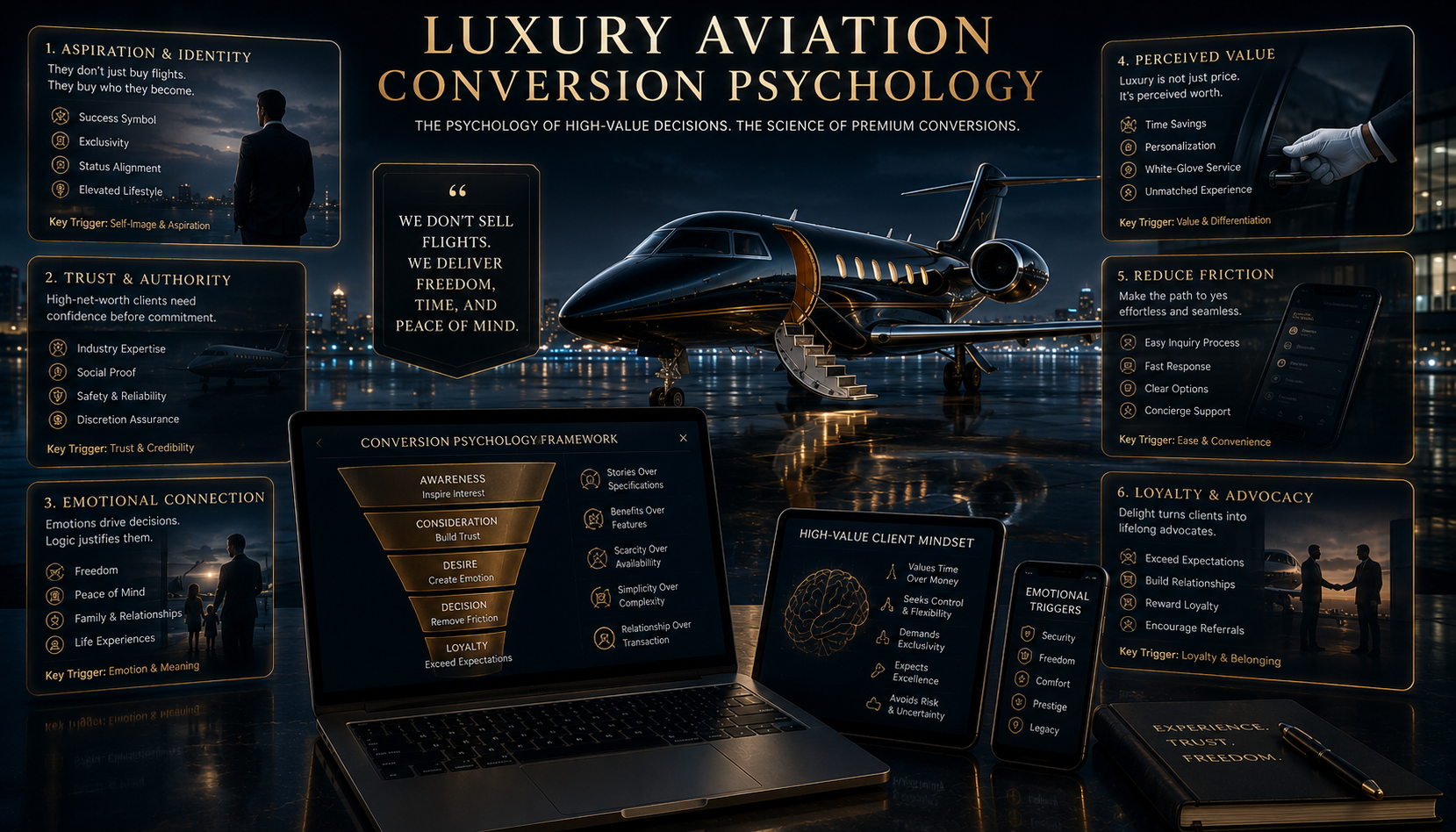
Luxury aviation conversion psychology helps private aviation companies turn high-value visitors into qualified inquiries by reducing uncertainty, increasing trust, matching buyer intent, and making the next step feel useful instead of risky.
Private aviation buyers do not convert only because a website looks premium. Instead, they convert when the page answers their quiet questions, proves competence, explains the next step, and shows how the company can reduce friction. Therefore, luxury aviation websites need more than beautiful aircraft photos.
Additionally, high-net-worth buyers often evaluate private aviation through time, privacy, convenience, aircraft fit, route confidence, family comfort, and operational certainty. Consequently, conversion strategy must speak to those motivations before asking for contact information.
At Infinite Media Resources, we build private aviation growth systems that connect SEO, GEO, AI search visibility, paid ads, landing pages, CRM tracking, and conversion psychology into one owned acquisition engine.
Luxury Aviation Conversion Psychology Turns Attention Into Qualified Inquiries
Direct Answer: Luxury aviation conversion psychology helps private aviation companies convert better by aligning the page with buyer intent, trust signals, urgency, privacy, convenience, aircraft fit, and clear next steps. Therefore, the strongest pages do not simply say “contact us.” Instead, they create confidence before the form.
High-value buyers often hesitate when a page feels vague. They want to know what happens next, whether the company understands their route, whether the inquiry will waste time, and whether the provider can handle the mission professionally.
Consequently, the page must remove doubt in the correct order. It should lead with outcome, explain the buyer problem, show credibility, clarify the process, and make the CTA feel valuable.
Why Conversion Psychology Matters in Private Aviation
Direct Answer: Conversion psychology matters because private aviation buyers make high-value decisions where trust, timing, privacy, and certainty shape action.
Many aviation websites focus on visual prestige. However, buyers already expect luxury. Therefore, the website must do more than look expensive. It must help the buyer feel understood.
Additionally, private aviation decisions often involve assistants, spouses, executives, family offices, and multiple stakeholders. As a result, the page must give every evaluator enough clarity to move forward.
Strong conversion psychology answers silent questions such as:
- Can this company handle my route?
- Will this inquiry waste my time?
- Will someone pressure me?
- Do they understand private aviation buyers?
- What happens after I submit?
- Will I receive useful guidance?
Luxury Aviation Buyer Mindset
Direct Answer: Luxury aviation buyers often care more about control, speed, privacy, and convenience than status alone. Therefore, conversion copy should focus on practical outcomes.
A buyer may want to save time, avoid commercial airport friction, travel privately with family, bring pets, reach a remote airport, protect sensitive conversations, or control the schedule. Additionally, many buyers already have access to luxury in other areas of life.
Consequently, generic “luxury experience” messaging often feels weak. Instead, the strongest messaging explains how private aviation improves life directly.
Trust Must Come Before the Contact Request
Direct Answer: Private aviation pages convert better when they build trust before asking visitors to submit a form.
A form without context creates friction. However, a form after useful guidance feels like a logical next step. Therefore, the page should show competence before the CTA.
Trust can come from:
- route-specific guidance
- aircraft-fit explanations
- clear process details
- privacy expectations
- fast-response expectations
- case study proof where available
- strong direct answers
- helpful FAQs
As a result, the buyer feels less risk when they take the next step.
Convenience Beats Generic Luxury Messaging
Direct Answer: Convenience often converts better than generic luxury because it gives the buyer a practical reason to act.
Luxury branding supports positioning. However, convenience creates urgency and relevance. Buyers respond to fewer delays, easier airport access, flexible scheduling, private terminals, better family travel, and reduced travel stress.
Additionally, convenience helps justify the decision. A buyer can explain time savings, productivity, privacy, and scheduling control more easily than abstract status.
Therefore, conversion pages should use luxury as atmosphere and convenience as the sales argument.
Risk Reduction and Certainty
Direct Answer: Risk reduction improves conversion because buyers avoid vague next steps when the decision involves money, timing, privacy, and trust.
Private aviation buyers may worry about hidden costs, poor aircraft fit, slow response, limited availability, unreliable operators, or aggressive sales pressure. Therefore, the page should reduce uncertainty before asking for action.
Strong certainty copy explains:
- what the team reviews
- what the buyer receives
- how fast the team follows up
- how the inquiry stays private
- why the questions matter
- what happens after submission
Consequently, the buyer feels guided instead of sold.
Message Match Improves Trust
Direct Answer: Message match improves conversion because the landing page continues the same promise from the ad, search result, email, or CTA.
If a buyer clicks a route review offer, the page should mention the route review immediately. If the buyer clicks an aircraft comparison ad, the page should discuss aircraft fit immediately. Therefore, each traffic source needs a matching page.
However, many aviation companies send all traffic to one generic contact page. Consequently, visitors feel disconnected from the promise that earned the click.
Instead, private aviation companies should build conversion paths around intent:
- route review pages
- aircraft-fit pages
- airport authority pages
- executive travel pages
- family travel pages
- event travel pages
High-Converting Page Structure
Direct Answer: A high-converting aviation page leads with buyer outcome, explains the route or service, proves competence, reduces risk, and offers a clear next step.
Strong page structure should follow a buyer’s thought process. First, the page confirms they are in the right place. Next, it explains the value. Then, it answers objections. Finally, it offers a useful next step.
Effective sections include:
- direct-answer summary
- buyer problem
- route or service context
- aircraft-fit guidance
- trust-building proof
- process expectations
- FAQ section
- conversion-focused CTA
As a result, the page creates momentum instead of forcing the visitor to decide too soon.
CTA Strategy for Luxury Aviation
Direct Answer: Luxury aviation CTAs should name a valuable next step instead of using vague language like “submit” or “contact us.”
A strong CTA reduces uncertainty. Therefore, it should tell the buyer what they receive. For example, a route page should offer a route review. An aircraft page should offer an aircraft-fit review. A marketing page should offer a strategy review.
Better CTA angles include:
- route review
- aircraft-fit review
- private aviation strategy review
- lead generation review
- SEO and GEO visibility review
- conversion system review
Consequently, the CTA becomes a value exchange, not a request for attention.
Form Strategy and Buyer Qualification
Direct Answer: Private aviation forms should ask enough questions to qualify the inquiry without creating unnecessary friction.
Short forms create less friction. However, high-ticket buyers often accept more questions when the page explains why those questions matter. Therefore, form length should match the value of the offer.
Useful fields can include:
- name
- phone
- service interest
- departure city or airport
- destination city or airport
- timeline
- biggest challenge
- best contact method
Additionally, every field should help the team respond better. If a field does not improve follow-up, remove it.
Speed-to-Lead Psychology
Direct Answer: Speed-to-lead matters because buyers judge the future service experience from the first response.
Private aviation buyers expect premium attention. Therefore, slow follow-up can damage trust before the sales conversation begins. Additionally, many buyers compare several providers quickly.
Consequently, the company that responds first with useful guidance often controls the conversation. Strong systems should include CRM alerts, call tracking, lead routing, missed-call recovery, and follow-up reminders.
Luxury Aviation Conversion Psychology Table
Direct Answer: The strongest conversion strategy connects buyer psychology, page structure, CTA clarity, trust signals, and fast follow-up.
Conversion Element |
What It Does |
Why It Matters |
|---|---|---|
| Direct Answer | Confirms relevance fast | Reduces confusion |
| Message Match | Continues the click promise | Builds trust |
| Route Context | Matches real travel intent | Improves lead quality |
| Aircraft Fit | Answers practical questions | Supports buyer confidence |
| Risk Reversal | Explains what happens next | Lowers hesitation |
| Fast Follow-Up | Protects buyer momentum | Improves conversion rate |
SEO, GEO, and AI Search Conversion
Direct Answer: SEO, GEO, and AI search visibility only create business value when the page also converts the visitor into a qualified next step.
Ranking alone does not close deals. Therefore, each aviation page should connect search intent to conversion intent. A route page should drive a route review. An aircraft page should drive an aircraft-fit review. A service page should drive a strategy review.
Additionally, AI-search pages need clear structure. Direct answers, schema, FAQ sections, internal links, and entity clarity help search systems understand the content. Meanwhile, strong CTAs and trust-building sections help humans act.
How IMR Builds Luxury Aviation Conversion Systems
Direct Answer: IMR builds luxury aviation conversion systems by connecting buyer psychology, SEO, GEO, paid ads, route content, aircraft pages, landing pages, CRM tracking, and fast follow-up into one acquisition engine.
First, we map buyer intent across search, AI platforms, paid traffic, and website behavior. Next, we build pages that match each intent. Then, we connect those pages to conversion-focused CTAs, retargeting, and CRM workflows.
Additionally, we structure content for both humans and AI systems. Therefore, the website can support rankings, citations, trust, and lead generation at the same time.
Finally, we focus on owned authority. As a result, your aviation company can build a system that compounds over time instead of depending only on referrals or rented traffic.
Proof and Validation
Direct Answer: Private aviation conversion improves when SEO, GEO, paid ads, landing pages, CRM tracking, and follow-up operate as one system.
Our broader acquisition systems demonstrate how structured strategy improves lead generation performance. For example, one Meta lead generation system generated 415 leads in 30 days for a home exterior campaign. Additionally, a seven-day optimization phase produced 123 leads with an estimated $57.86 average cost per lead.
Although aviation has a different buyer journey, the same principle applies. Better structure creates better lead quality, stronger authority, and more useful sales conversations.
Frequently Asked Questions
What is luxury aviation conversion psychology?
Luxury aviation conversion psychology is the strategy of aligning private aviation pages with buyer trust, convenience, privacy, route intent, aircraft fit, and clear next steps.
Why do private aviation websites fail to convert?
Many fail because they rely on luxury visuals while ignoring buyer questions, trust signals, route clarity, CTA value, and fast follow-up systems.
What should private aviation CTAs say?
They should offer a useful next step, such as a route review, aircraft-fit review, or aviation strategy review.
Does conversion psychology help SEO and GEO?
Yes. Strong page structure helps search systems understand the content while also helping buyers take action.
Why does speed-to-lead matter?
Speed matters because private aviation buyers often compare providers quickly and judge service quality from the first response.
What is the best next step?
The best next step is a Luxury Aviation Conversion Review so IMR can evaluate your pages, CTAs, forms, CRM flow, and lead system.
Build Your Luxury Aviation Conversion System
Direct Answer: The next step is to review your private aviation website, buyer journey, page structure, CTAs, forms, SEO, GEO, paid ads, CRM tracking, and follow-up process.
If your aviation company wants stronger conversion, better qualified inquiries, and a scalable acquisition system your team can own, luxury aviation conversion psychology can become a major growth advantage.