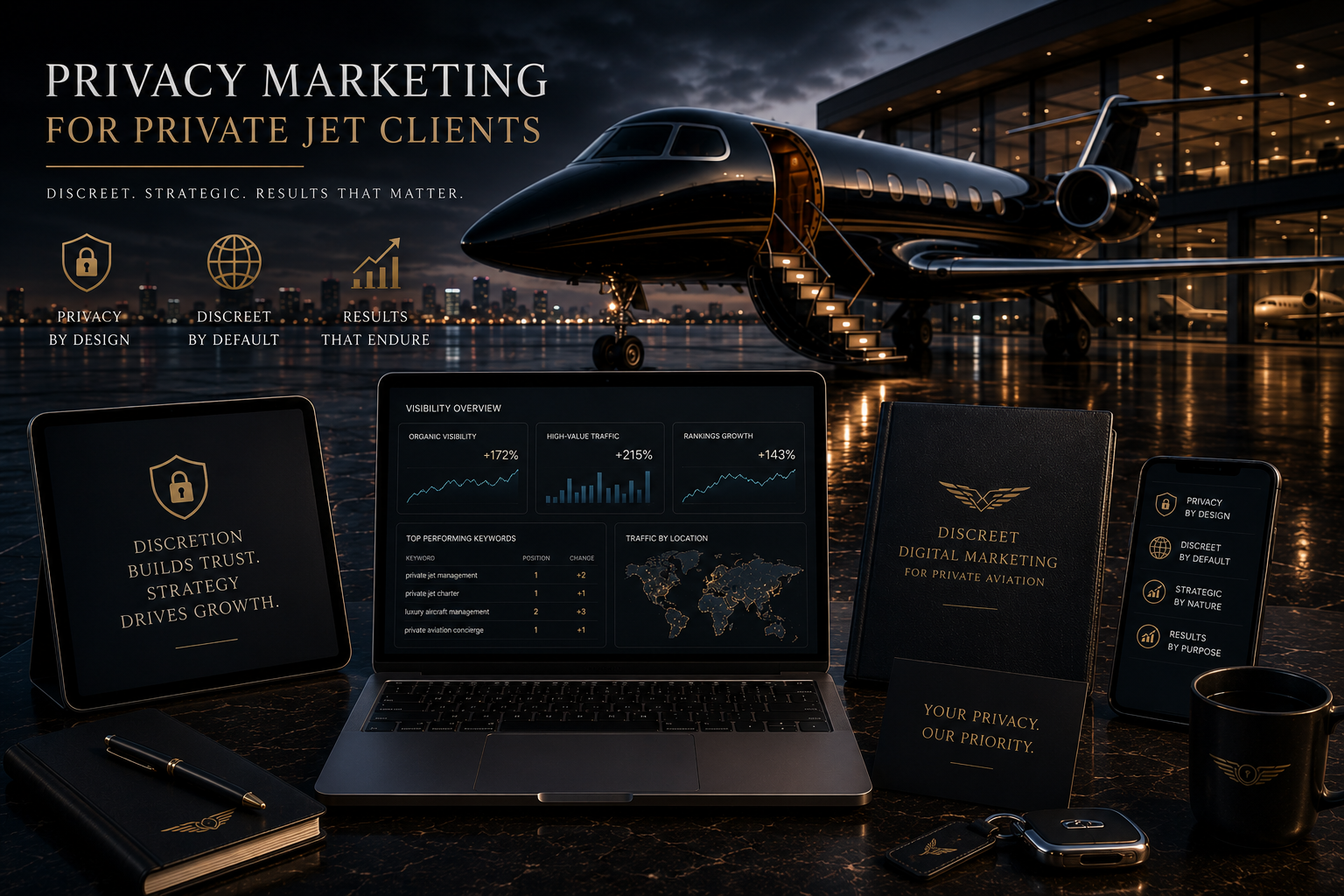
Privacy Marketing For Private Jet Clients
Privacy marketing for private jet clients helps aviation companies attract executives, family offices, celebrities, athletes, entrepreneurs, and high-net-worth travelers by emphasizing confidentiality, discretion, security, schedule control, and reduced public exposure.
Many private aviation companies market luxury first. However, many buyers choose private aviation for privacy first. They want fewer public touchpoints, private terminals, confidential scheduling, family protection, and professional handling. Therefore, aviation brands need messaging that speaks to discretion, not only status.
Additionally, privacy-focused buyers often value certainty before contact. They want to know what happens after they inquire, how the company handles sensitive details, and whether the team understands high-value travel. Consequently, strong privacy marketing connects content, conversion psychology, SEO, GEO, AI search, paid ads, and CRM follow-up into one system.
At Infinite Media Resources, we build private aviation growth systems that help aviation companies attract better qualified buyers, improve lead quality, and create owned authority across search, AI platforms, paid media, and conversion pages.
Privacy Marketing For Private Jet Clients Creates Stronger Buyer Trust
Direct Answer: Privacy marketing for private jet clients improves lead quality because it focuses on one of the strongest private aviation buying motivations: discretion. Therefore, aviation companies that emphasize confidentiality, privacy, security, convenience, and professional handling often attract more qualified inquiries than brands that rely only on luxury messaging.
Luxury is expected in private aviation. However, privacy creates differentiation. Buyers frequently assume a jet will feel premium. What they need to understand is how private aviation protects their time, schedule, family, reputation, and business interests.
Consequently, privacy marketing often creates stronger engagement, better conversion intent, and more meaningful sales conversations.
Why Privacy Matters More Than Generic Luxury
Direct Answer: Privacy matters because many private aviation buyers want to avoid attention, reduce friction, protect sensitive information, and maintain schedule control.
Many travelers do not charter aircraft because they want more visibility. Instead, they charter because they want less visibility. Therefore, aviation marketing should speak directly to privacy, control, and discretion.
Additionally, privacy supports more than personal comfort. It protects business conversations, family movement, medical travel, sensitive negotiations, executive schedules, and public reputation. As a result, privacy becomes a practical value proposition.
- Private terminals reduce public exposure.
- Flexible schedules protect sensitive travel timing.
- Confidential planning supports executives and advisors.
- Controlled environments improve family comfort.
- Professional lead handling builds trust before the first call.
However, most aviation websites still lead with aircraft photos and broad luxury claims. Consequently, they miss the buyer’s deeper reason for choosing private travel.
The Psychology of Privacy Buyers
Direct Answer: Privacy buyers want control, predictability, discretion, and reduced risk. Therefore, marketing should reduce uncertainty before asking for contact information.
These buyers often think differently than broad luxury consumers. They already have access to premium services. Therefore, status language rarely creates enough motivation by itself.
Instead, they evaluate trust, response quality, professionalism, confidentiality, and operational reliability. Additionally, many privacy buyers involve assistants, family offices, security teams, or advisors before they make contact.
- They want a clear process.
- They want fast but professional follow-up.
- They want confidence before sharing details.
- They want private handling of route and passenger information.
- They want less friction, not more sales pressure.
Consequently, the strongest privacy pages educate first and convert second.
Executive Travel and Confidentiality
Direct Answer: Executives often use private aviation because it protects schedule control, business confidentiality, and productivity.
Business leaders may travel for acquisitions, negotiations, investor meetings, board sessions, legal matters, or strategic planning. Therefore, public travel patterns can create unnecessary exposure.
Additionally, commercial travel introduces delays, crowds, public schedules, and limited privacy. Private aviation gives executives more control over timing, conversations, and access.
Strong executive-focused content should emphasize:
- confidential business travel
- productive cabin time
- private terminal access
- schedule flexibility
- reduced public exposure
- faster route planning
- professional inquiry handling
As a result, the page speaks to executive needs directly instead of relying on generic prestige.
Family Office Aviation Buyers
Direct Answer: Family offices often value privacy because aviation decisions affect principals, family members, advisors, assets, and long-term relationships.
Family office teams frequently research providers before they ever contact them. Therefore, the website must prove competence before the inquiry. Additionally, family office travel often involves multi-passenger coordination, privacy expectations, pets, children, security, and complex schedules.
Strong family office content should cover:
- confidential transportation planning
- multi-generational travel needs
- trusted route guidance
- family privacy expectations
- reliable follow-up workflows
- long-term aviation support
- secure communication processes
Consequently, aviation companies can attract better inquiries by showing they understand the buyer behind the request.
Celebrity and Public Figure Travel
Direct Answer: Public figures often prioritize private aviation because public exposure creates security, scheduling, and reputation concerns.
Celebrities, athletes, entertainers, executives, and influencers may want to avoid crowded terminals, unwanted attention, public flight patterns, and unpredictable travel environments. Therefore, privacy-focused messaging can resonate strongly with this audience.
However, aviation companies should avoid shallow celebrity language. Instead, they should emphasize professional handling, discretion, private terminals, schedule control, and confidential communication.
As a result, the brand appears more serious, more trusted, and more suitable for sensitive travel needs.
How Privacy Buyers Search Online
Direct Answer: Privacy-focused buyers often search with language related to confidentiality, executive travel, secure travel, family offices, private terminals, and discretion.
Search behavior often reveals the true buying motivation. Therefore, aviation companies should build content around privacy-driven search patterns, not only broad charter keywords.
- private aviation for executives
- confidential private jet travel
- family office aviation services
- secure business travel options
- private terminal advantages
- private jet privacy benefits
- executive charter flights
- discreet private aviation provider
- private aviation security considerations
- confidential travel solutions
Additionally, buyers may search route-specific privacy concerns. For example, they may look for private flights to events, private airport access near major cities, or confidential executive travel between financial hubs. Consequently, privacy content can support both broad authority and route-specific lead generation.
SEO Strategy for Privacy Marketing
Direct Answer: Privacy-focused SEO helps aviation companies rank for buyer motivations that generic charter pages often miss.
Strong privacy SEO uses topical depth. Instead of repeating “private jet charter” across every page, the content should explain confidentiality, executive travel, family office needs, private terminal advantages, secure routing, and discreet inquiry handling.
Privacy content clusters may include:
- executive travel authority pages
- family office aviation pages
- private terminal guides
- celebrity and public figure travel pages
- secure business travel pages
- privacy-focused route pages
- AI-search optimized FAQs
- conversion psychology pages
Furthermore, these topics support the broader private aviation authority cluster. As a result, search engines can better understand expertise across buyer intent, not only service terms.
GEO and AI Search Strategy
Direct Answer: GEO and AI search strategy help privacy-focused aviation content appear when buyers ask direct questions about confidentiality, executive travel, secure transportation, and private jet privacy.
AI systems reward clear answers. Therefore, privacy pages should use direct-answer sections, structured headings, FAQ schema, HowTo schema, internal links, and entity clarity.
Additionally, AI search often summarizes practical concerns. A page that explains how private aviation reduces public exposure, protects executive schedules, and supports family office travel can become more useful than a generic charter page.
Consequently, privacy content can support both human buyers and AI systems.
Paid Ads Strategy for Privacy-Driven Buyers
Direct Answer: Privacy-focused paid ads can attract higher-intent prospects when campaigns target executive travel, family office needs, private terminals, secure transportation, and discreet travel planning.
Google Ads can capture active search intent. Meanwhile, Meta retargeting can nurture buyers who research before they inquire. Therefore, both channels should connect to privacy-focused landing pages.
Campaign segments may include:
- executive travel campaigns
- family office campaigns
- private terminal campaigns
- secure business travel campaigns
- route-specific privacy campaigns
- high-value retargeting audiences
However, the landing page must continue the privacy promise. If the ad mentions confidential executive travel, the page should explain confidential executive travel immediately. As a result, message match improves trust.
Conversion Psychology for Privacy Buyers
Direct Answer: Privacy buyers convert when the page reduces perceived risk, explains the next step, and makes the inquiry feel confidential and useful.
A vague “Contact Us” page creates friction. However, a page that explains the process creates confidence. Therefore, privacy pages should explain what happens after the buyer submits a form.
Strong conversion elements include:
- direct-answer summaries
- privacy-focused positioning
- clear next-step expectations
- confidentiality language
- route or mission guidance
- trust-building FAQs
- value-based CTAs
- fast-response expectations
Additionally, trust-building content should appear before the form. Consequently, buyers feel less exposed when they inquire.
Landing Page Strategy
Direct Answer: Privacy-focused landing pages should lead with outcome, explain confidentiality, reduce uncertainty, and offer a useful private review instead of a generic contact request.
The strongest privacy landing pages confirm that the buyer is in the right place. Then, they explain the privacy value, show operational understanding, and guide the visitor toward a low-pressure review.
Strong landing page sections include:
- direct-answer summary
- privacy-driven buyer problem
- confidentiality and discretion explanation
- route or mission context
- aircraft-fit guidance
- process explanation
- FAQ section
- conversion-focused CTA
As a result, the page supports both trust and action.
CRM and Lead Handling
Direct Answer: Privacy-focused leads require fast, professional, and organized handling because the buyer expects discretion before the first conversation.
CRM systems should protect buyer momentum. Therefore, private aviation companies should connect forms, calls, lead source tracking, alerts, and follow-up workflows.
Strong CRM workflows include:
- rapid lead assignment
- confidential inquiry tagging
- lead source tracking
- route or mission notes
- call tracking
- follow-up reminders
- missed-call recovery
- qualified opportunity reporting
Additionally, fast response creates trust. Consequently, speed-to-lead becomes part of the privacy experience.
Privacy Marketing Framework
Direct Answer: Privacy marketing works best when SEO, GEO, paid ads, landing pages, CRM tracking, and conversion psychology work together.
| Marketing Element | Purpose | Buyer Benefit |
|---|---|---|
| Privacy SEO | Ranks for discretion-driven searches | Better research experience |
| AI Search Content | Answers privacy questions clearly | Faster trust building |
| Executive Travel Pages | Targets business confidentiality | More relevant guidance |
| Family Office Content | Supports complex buyer needs | Higher confidence |
| Privacy Landing Pages | Reduces inquiry risk | More comfortable next step |
| CRM Workflows | Improves response and tracking | Professional follow-up |
How IMR Builds Privacy Marketing Systems For Private Aviation
Direct Answer: IMR builds privacy marketing systems by combining SEO, GEO, AI search visibility, paid ads, landing pages, CRM automation, conversion psychology, and lead tracking into one acquisition engine.
First, we identify privacy-driven buyer intent. Next, we create content assets that address those concerns directly. Then, we connect those assets to conversion-focused landing pages and CRM workflows.
Additionally, we optimize for AI search and traditional search simultaneously. Therefore, aviation companies can create long-term authority while generating better qualified inquiries.
Finally, we focus on owned systems. As a result, the company builds digital assets that continue supporting growth instead of depending only on rented traffic.
Proof and Validation
Direct Answer: Marketing systems perform best when traffic generation, conversion optimization, CRM tracking, and lead management work together.
One IMR lead generation campaign produced 415 leads in 30 days. Additionally, a seven-day optimization phase generated 123 leads at approximately $57.86 per lead. While private aviation follows a different sales cycle, the same principles apply. Better structure creates stronger lead quality, clearer tracking, and better conversion performance.
Frequently Asked Questions
What is privacy marketing in private aviation?
Privacy marketing in private aviation focuses on confidentiality, discretion, security, convenience, and private travel control rather than generic luxury messaging.
Why do private jet clients value privacy?
Private jet clients often value privacy because it protects schedules, family movement, business activities, personal security, and public reputation.
Does privacy messaging outperform luxury messaging?
Privacy messaging can outperform luxury messaging when buyers care more about discretion, control, and reduced public exposure than status alone.
Can privacy content improve SEO?
Yes. Privacy content can improve SEO by targeting buyer-intent searches around executive travel, family offices, secure travel, and confidential aviation needs.
Can privacy content help AI search visibility?
Yes. AI systems often favor direct-answer content that clearly explains specific buyer concerns such as confidentiality, security, and private travel planning.
How do aviation companies attract executive travelers?
Aviation companies attract executive travelers with content about schedule control, confidential business travel, private terminals, productivity, and fast response.
How do family offices search for aviation providers?
Family offices often search for discretion, reliability, operational expertise, private travel planning, and long-term aviation support.
What is the best next step?
The best next step is a Private Aviation Growth Review so IMR can evaluate visibility, lead generation, conversion, CRM handling, and buyer experience.
Build Your Privacy Marketing System
Direct Answer: The next step is to evaluate your privacy messaging, content strategy, SEO visibility, AI search presence, paid advertising, landing pages, CRM process, and lead management system.
If your aviation company wants stronger authority, better qualified inquiries, and a scalable acquisition engine, privacy marketing can become a significant competitive advantage.