
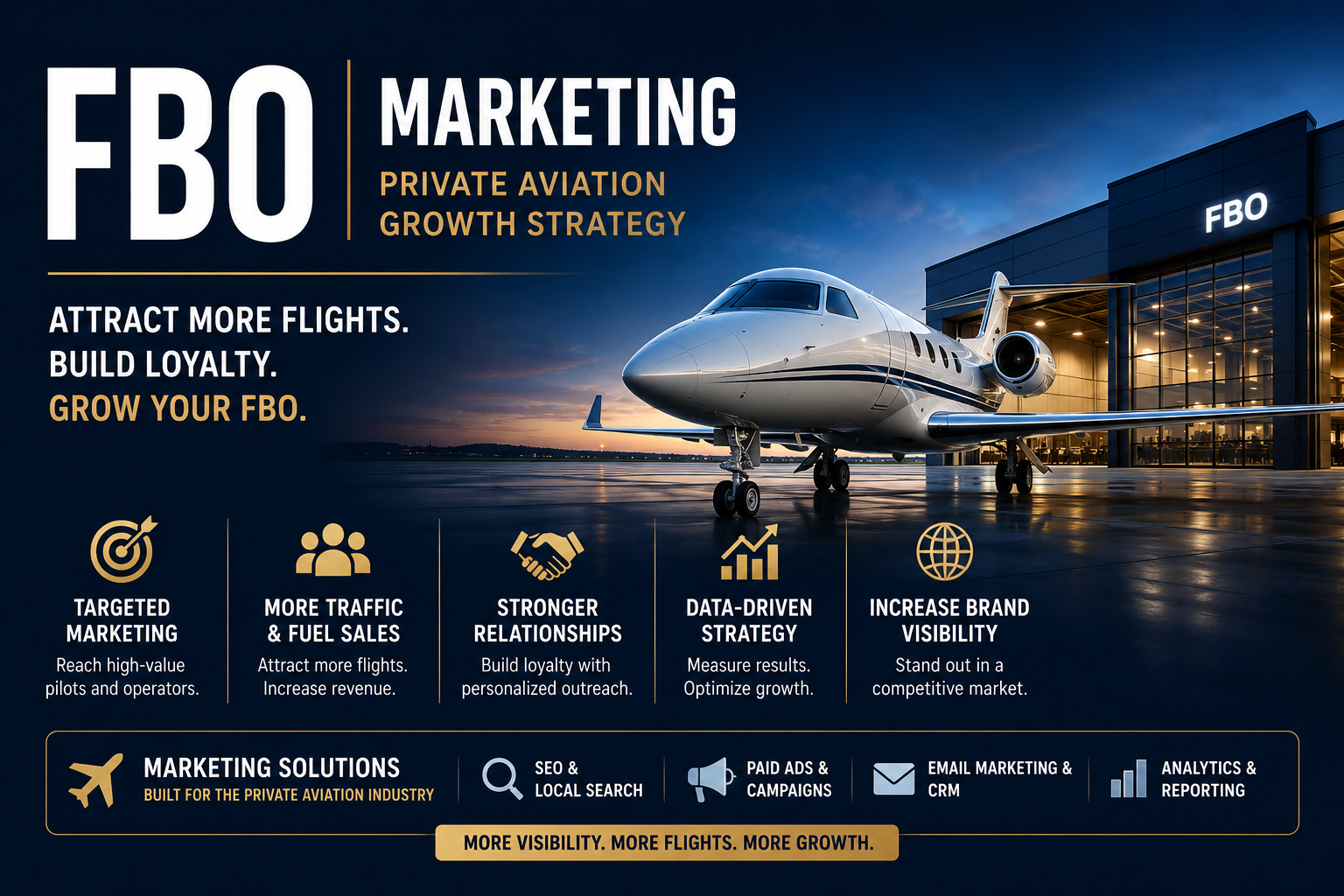
FBO Marketing
FBO marketing helps fixed-base operators attract transient aircraft, based tenants, fuel customers, charter partners, aircraft owners, flight departments, and private aviation clients through SEO, GEO, AI search, paid ads, local authority, landing pages, CRM tracking, and conversion systems.
FBO buyers and decision-makers search differently than generic private jet charter customers. They may look for fuel availability, hangar space, aircraft services, executive terminals, ground handling, crew amenities, airport access, charter support, or private aviation convenience. Therefore, FBO marketing needs a strong local and service authority system.
Additionally, FBOs compete on trust, speed, convenience, service quality, location, and operational confidence. Consequently, the website must explain why pilots, flight departments, owners, operators, brokers, and private travelers should choose that facility before they arrive.
At Infinite Media Resources, we build private aviation growth systems that connect FBO SEO, GEO, AI search visibility, Google Ads, Meta retargeting, landing pages, CRM tracking, and lead generation into one owned acquisition engine.
FBO Marketing Builds Demand Around Location, Service, and Operational Confidence
Direct Answer: FBO marketing works best when it builds authority around airport location, fuel services, hangar availability, aircraft support, passenger experience, crew amenities, charter operations, based aircraft demand, and private aviation convenience. Therefore, fixed-base operators need SEO, GEO, paid ads, landing pages, and CRM systems that match how aviation decision-makers search.
An FBO website should not function like a basic brochure. Instead, it should answer real operational questions, support local search, appear in AI search, and convert high-value inquiries from aircraft owners, operators, pilots, brokers, and flight departments.
Consequently, the strongest FBO marketing systems connect visibility, trust, local authority, service clarity, and fast response.
Why FBO Marketing Matters
Direct Answer: FBO marketing matters because aircraft operators, owners, pilots, flight departments, and charter teams often research facilities before choosing where to land, fuel, park, or base an aircraft.
Many FBOs rely heavily on airport location, repeat relationships, fuel programs, and word of mouth. However, digital visibility now influences more decisions. Therefore, an FBO should own its local market online.
Strong FBO marketing helps attract:
- transient aircraft traffic
- fuel customers
- hangar tenants
- based aircraft owners
- charter operators
- aircraft management companies
- corporate flight departments
- crew and passenger service inquiries
- event-related private aviation demand
Additionally, a strong digital system can help an FBO compete beyond the ramp. As a result, the company becomes easier to find, easier to trust, and easier to contact.
FBO Buyer Intent
Direct Answer: FBO buyer intent often appears through airport searches, fuel searches, hangar searches, ground handling searches, and private terminal convenience searches.
Unlike broad charter buyers, FBO prospects often need a specific operational answer. Therefore, search intent can be highly practical and location-driven.
High-value searches may include:
- FBO near [airport]
- private jet FBO [city]
- jet fuel [airport]
- hangar space [airport]
- aircraft parking [airport]
- private terminal [city]
- ground handling [airport]
- crew amenities [airport]
- aircraft services [airport]
- corporate aviation terminal [city]
Additionally, some buyers search indirectly. For example, they may search for airport convenience, event access, charter support, or aircraft management services near a private aviation market. Consequently, FBO content should cover both direct and adjacent buyer intent.
FBO SEO Strategy
Direct Answer: FBO SEO helps fixed-base operators rank for airport, city, service, fuel, hangar, ground handling, and private aviation searches.
An FBO SEO strategy should start with local service authority. However, it should not stop there. Instead, the site should build pages around every important commercial intent that supports the facility.
Strong FBO SEO assets include:
- main FBO service page
- airport-specific FBO page
- fuel services page
- hangar space page
- ground handling page
- aircraft parking page
- crew amenities page
- passenger terminal page
- charter support page
- event travel support page
Furthermore, each page should include direct answers, local context, internal links, and conversion-focused CTAs. As a result, the website becomes a stronger private aviation authority asset.
FBO Local SEO
Direct Answer: FBO local SEO helps fixed-base operators become more visible for airport-specific and city-specific private aviation searches.
Location matters heavily for FBO decisions. Therefore, local SEO should clearly connect the FBO to its airport, city, region, nearby business centers, event venues, resorts, and aviation corridors.
Important local SEO elements include:
- optimized airport landing page
- Google Business Profile optimization
- consistent name, address, and phone data
- local service pages
- airport and city references
- nearby route demand content
- review strategy
- local backlinks and citations
- schema markup
- mobile-friendly contact paths
Additionally, local SEO should support both pilots and passengers. Consequently, the FBO can rank for operational searches and private aviation convenience searches.
GEO and AI Search for FBOs
Direct Answer: GEO helps FBOs appear in AI-generated answers when pilots, operators, owners, and travelers ask about airport services, FBO options, hangar availability, fuel, private terminals, or ground support.
AI search favors clear answers. Therefore, FBO pages should explain services in direct, structured language. Additionally, pages should use schema, FAQs, internal links, and airport-specific context.
AI-ready questions may include:
- What services does an FBO provide?
- How do I choose an FBO at an airport?
- Which FBO has hangar space near this airport?
- Where can private jets fuel at this airport?
- What should pilots look for in an FBO?
- How do FBOs support charter operators?
- What does ground handling include?
Consequently, FBO content should answer operational questions before the visitor has to call.
Fuel and Transient Traffic Marketing
Direct Answer: Fuel and transient traffic marketing helps FBOs attract operators and pilots who need reliable fueling, quick turns, ramp support, and efficient service.
Transient aircraft traffic often depends on convenience, reliability, fuel programs, service speed, and airport location. Therefore, FBO marketing should explain why the facility supports a smoother stop.
Fuel-focused content should cover:
- jet fuel availability
- quick-turn support
- ramp coordination
- fuel program participation
- line service standards
- crew support
- passenger handling
- after-hours support when available
Additionally, fuel pages should create fast contact paths for operators. As a result, the FBO can turn search traffic into operational inquiries.
Hangar and Based Tenant Marketing
Direct Answer: Hangar and based tenant marketing helps FBOs attract aircraft owners, operators, and businesses looking for aircraft storage, long-term support, and airport access.
Hangar demand can be highly competitive. Therefore, an FBO should build dedicated content around hangar availability, aircraft storage benefits, location advantages, maintenance access, and owner convenience.
Hangar-focused content should explain:
- hangar availability
- aircraft size considerations
- based tenant benefits
- access and security
- ramp support
- maintenance coordination
- owner convenience
- long-term relationship value
Furthermore, hangar leads should move into CRM immediately. Consequently, the team can track interest, availability, follow-up, and waitlist demand.
Charter and Operator Support Marketing
Direct Answer: FBOs can attract charter operators and flight departments by marketing reliable ground support, passenger handling, crew services, and operational efficiency.
Charter operators need predictable service. Therefore, the FBO website should show that the facility understands dispatch pressure, passenger expectations, quick turns, and crew needs.
Charter support content should cover:
- ground handling
- passenger arrival experience
- crew amenities
- transportation coordination
- ramp service
- fueling support
- concierge support
- operator communication
Additionally, this content can support private jet charter SEO and aircraft management marketing. As a result, the FBO becomes more visible within the broader aviation ecosystem.
Crew and Passenger Experience Messaging
Direct Answer: Crew and passenger experience messaging helps FBOs differentiate through comfort, speed, professionalism, amenities, and service consistency.
FBO decisions often involve both operational needs and passenger experience. Therefore, marketing should speak to pilots, dispatch teams, owners, assistants, and travelers.
Experience-focused messaging may include:
- comfortable passenger lounge
- crew lounge
- conference space
- ground transportation support
- concierge coordination
- refreshments
- private terminal experience
- fast arrival and departure flow
However, the messaging should stay practical. Instead of vague luxury claims, the page should explain how the FBO reduces friction and improves the travel day.
Paid Ads Strategy for FBOs
Direct Answer: Paid ads for FBOs should target high-intent airport, fuel, hangar, charter support, and local private aviation searches.
Google Ads can capture active operational demand. Meanwhile, Meta retargeting can reinforce facility awareness after someone visits airport, route, or service pages. Therefore, paid campaigns should match the service being promoted.
Strong paid ad campaign segments include:
- FBO near airport searches
- jet fuel searches
- hangar space searches
- aircraft parking searches
- ground handling searches
- private terminal searches
- event travel support searches
- retargeting audiences
Additionally, each campaign should send visitors to a focused landing page. Consequently, message match improves conversion.
Conversion Psychology for FBO Websites
Direct Answer: FBO websites convert better when they make service availability, airport location, contact options, response expectations, and operational support clear.
FBO visitors often need quick answers. Therefore, the page should reduce friction. A pilot, operator, aircraft owner, or assistant should quickly understand what the facility offers and how to contact the team.
Strong conversion elements include:
- direct-answer opening
- airport-specific service clarity
- fuel and hangar CTAs
- click-to-call buttons
- quick inquiry forms
- service-specific landing pages
- crew and passenger experience details
- trust-building FAQs
- CRM-backed follow-up
As a result, the website becomes useful during real aviation decision-making, not just brand browsing.
CRM and Lead Handling for FBOs
Direct Answer: CRM tracking helps FBOs measure and respond to fuel inquiries, hangar leads, service requests, charter support opportunities, and based tenant interest.
FBO inquiries should not disappear into a general inbox. Instead, each inquiry should route based on service type, urgency, and commercial value.
Strong CRM workflows include:
- fuel inquiry tracking
- hangar lead tracking
- based tenant interest tagging
- charter operator inquiry tracking
- call tracking
- form tracking
- instant lead alerts
- follow-up reminders
- qualified opportunity reporting
Additionally, speed matters because many FBO inquiries are time-sensitive. Consequently, fast response can directly influence revenue.
FBO Marketing Framework
Direct Answer: A complete FBO marketing framework connects airport authority, local SEO, fuel demand, hangar demand, paid ads, landing pages, and CRM tracking.
| Marketing Asset | Purpose | Buyer Value |
|---|---|---|
| FBO Service Page | Explain core services | Clear facility understanding |
| Local SEO Pages | Rank for airport demand | Easier discovery |
| Fuel Pages | Capture transient traffic | Fast operational clarity |
| Hangar Pages | Attract based tenants | Clear storage options |
| GEO Content | Support AI answers | Better research experience |
| Paid Landing Pages | Convert active demand | Specific next step |
| CRM Workflows | Track and respond | Faster follow-up |
Recommended FBO Marketing Build Order
Direct Answer: The best FBO marketing build order starts with the core FBO page, then expands into local SEO, fuel, hangar, ground handling, paid landing pages, and CRM workflows.
- Build the core FBO marketing service page.
- Build airport and local SEO pages.
- Build fuel service pages.
- Build hangar and based tenant pages.
- Build ground handling and charter support pages.
- Build crew and passenger experience pages.
- Build GEO and AI-search FAQ pages.
- Build paid ad landing pages.
- Set up retargeting audiences.
- Connect CRM tracking and reporting.
Additionally, each page should support one clear buyer intent. Consequently, the FBO builds stronger visibility and better lead quality over time.
How IMR Builds FBO Marketing Systems
Direct Answer: IMR builds FBO marketing systems by connecting airport SEO, local SEO, GEO, AI search, paid ads, service pages, landing pages, conversion psychology, CRM tracking, and lead generation.
First, we map FBO buyer intent across fuel, hangar, aircraft services, ground handling, charter support, private terminal access, and local airport demand. Next, we build content that matches those searches. Then, we connect those pages to paid ads, CTAs, retargeting, and CRM workflows.
Additionally, we structure major pages for AI search with direct answers, schema, FAQs, and internal links. Therefore, the system supports both traditional search and answer-engine visibility.
Finally, we optimize around qualified operational inquiries. As a result, marketing supports real FBO revenue opportunities, not just website traffic.
Proof and Validation
Direct Answer: FBO marketing works best when visibility, conversion, and lead handling operate together.
One IMR lead generation campaign produced 415 leads in 30 days. Additionally, a seven-day optimization phase generated 123 leads at approximately $57.86 per lead. While FBO demand follows a different aviation-specific sales cycle, the same principle applies. Better structure creates stronger lead quality, clearer tracking, and better conversion performance.
Frequently Asked Questions
What is FBO marketing?
FBO marketing is the strategy of attracting aircraft operators, pilots, owners, charter companies, based tenants, and private aviation clients through SEO, GEO, paid ads, landing pages, CRM tracking, and conversion systems.
Why do FBOs need SEO?
FBOs need SEO because buyers often search by airport, city, fuel, hangar space, ground handling, private terminals, and aviation services before choosing a facility.
Can GEO help an FBO appear in AI search?
Yes. GEO can help FBOs appear in AI-generated answers when users ask about airport services, FBO selection, fuel, hangars, or ground handling.
What pages should an FBO website include?
An FBO website should include core FBO services, fuel, hangar space, ground handling, crew amenities, passenger experience, airport pages, local SEO pages, and FAQs.
Do paid ads work for FBOs?
Yes. Paid ads can work when campaigns target high-intent searches for fuel, hangar space, ground handling, airport services, and local private aviation demand.
Why does CRM tracking matter for FBO marketing?
CRM tracking matters because FBO inquiries often involve fuel, hangar, based tenant, or charter support opportunities that need fast response and organized follow-up.
How should FBO leads be tracked?
FBO leads should be tracked by source, service type, airport interest, urgency, call activity, form activity, and qualified opportunity value.
What is the best next step?
The best next step is an FBO Marketing Review so IMR can evaluate visibility, content gaps, paid ads, landing pages, CRM tracking, and lead quality.
Build Your FBO Marketing System
Direct Answer: The next step is to evaluate your FBO SEO, local visibility, GEO and AI search presence, fuel and hangar pages, paid ads, landing pages, CRM workflows, and lead quality.
If your FBO wants more transient traffic, stronger hangar inquiries, better local visibility, and a scalable private aviation marketing system, IMR can help build the full FBO growth engine.